A tenant has paid rent late four times this year. Another keeps letting a friend stay who disturbs the building. A third sublet the unit without asking. In each case, you may be thinking about ending the tenancy, and in British Columbia the tool for that is the One Month Notice to End Tenancy for Cause, form RTB-33.
It is also one of the easiest notices to get wrong. A missing page, a blank "details" box or a ground you can't prove can mean the notice is cancelled at a hearing and you start again, months later.
This guide covers every ground in section 47 of the Residential Tenancy Act, how to set the effective date, what the form needs, how service and deemed receipt work, the tenant's 10-day dispute window, and what happens after.
BC One Month Notice for Cause Checklist
A landlord checklist for the BC One Month Notice to End Tenancy for Cause (RTB-33): the grounds, details, effective date, service and what happens after.
Get Free PDF →The rule: section 47 and the grounds for cause
Section 47(1) of the Residential Tenancy Act (RTA) lets a landlord end a tenancy by notice if one or more of these grounds applies:
| Ground | What the Act says |
|---|---|
| (a) Unpaid deposit | The tenant doesn't pay the security or pet damage deposit within 30 days of the date it is required under the tenancy agreement |
| (b) Late rent | The tenant is repeatedly late paying rent |
| (c) Too many occupants | There is an unreasonable number of occupants in the unit |
| (d) Disturbance or risk | The tenant, or a person the tenant or an occupant let onto the property, significantly interfered with or unreasonably disturbed an authorized person, seriously jeopardized someone's health, safety or lawful right, or put the landlord's property at significant risk |
| (e) Illegal activity | Illegal activity that has caused or is likely to cause damage, or has affected or is likely to affect quiet enjoyment, safety or a lawful right |
| (f) Extraordinary damage | Extraordinary damage to the unit or the residential property |
| (g) Repairs not done | The tenant doesn't repair damage they are responsible for under s.32(3) within a reasonable time |
| (h) Material term | The tenant breached a material term and didn't correct it within a reasonable time after written notice |
| (i) Assignment or sublet | The tenant assigned or sublet without the landlord's written consent required by s.34 |
| (j) False information | The tenant knowingly gave false information about the property to a prospective tenant or purchaser viewing it |
| (k) Government order | The unit must be vacated to comply with an order of a federal, provincial, regional or municipal authority |
| (l) Director's order | The tenant hasn't complied with an RTB order within 30 days of the later of receiving it and the compliance date in it |
An "authorized person" includes the landlord, other tenants and occupants, and others lawfully on the property, such as guests, contractors and officials. The RTB-33 explains this on page 4.
Two grounds with extra rules
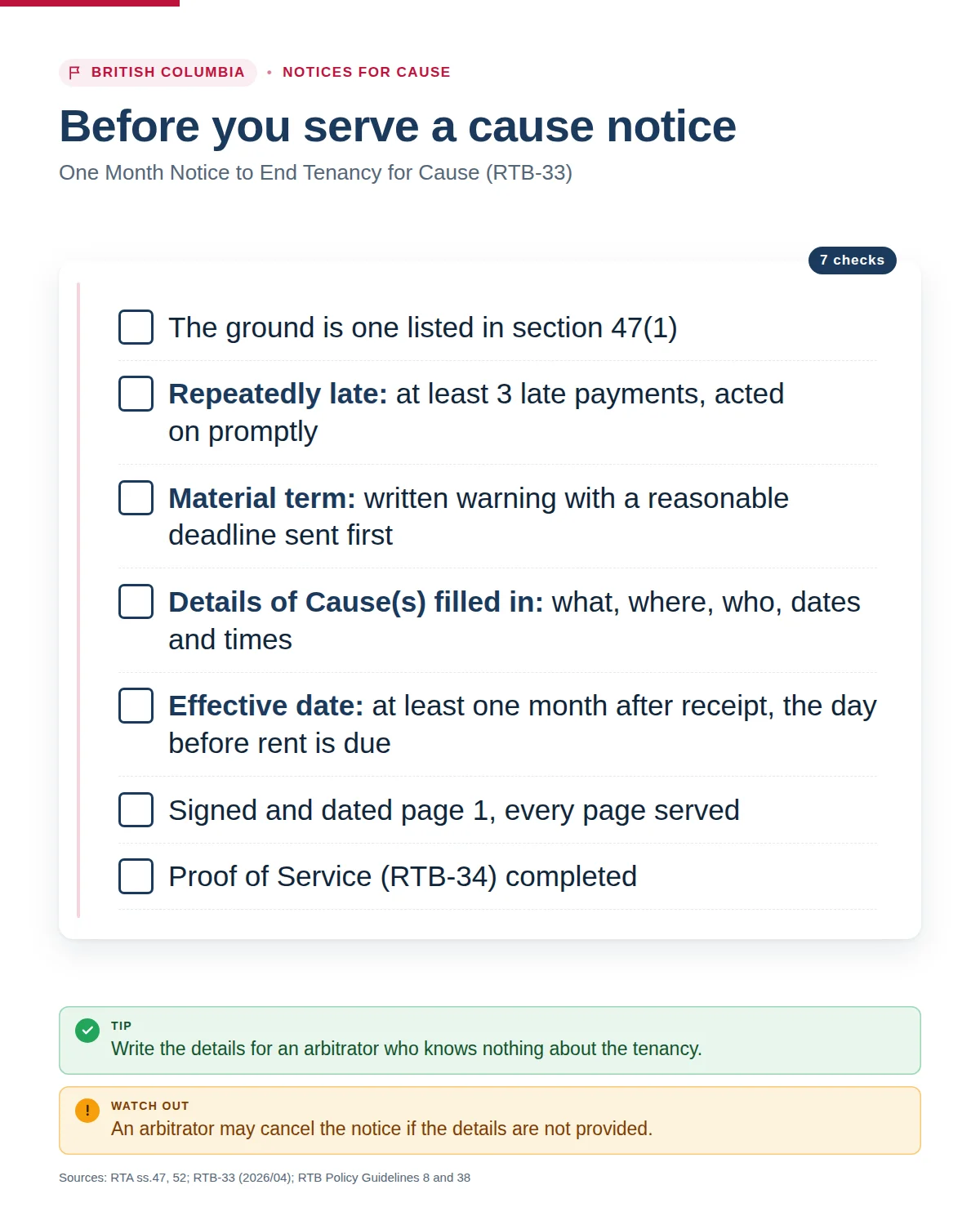
Repeatedly late rent. RTB Policy Guideline 38 says three late payments are the minimum. They don't need to be consecutive, but if they are far apart an arbitrator may decide the tenant isn't "repeatedly" late. A landlord who waits too long after the most recent late payment may be found to have waived reliance on this ground.
Material term. Policy Guideline 8 says that before serving the notice, you must tell the tenant in writing that there is a problem, that you believe it breaches a material term, that it must be fixed by a reasonable deadline, and that you will serve a notice to end the tenancy if it isn't. Calling a term "material" in the lease is not decisive; the arbitrator looks at the true intention of the parties.
The effective date: at least one month, ending the day before rent is due
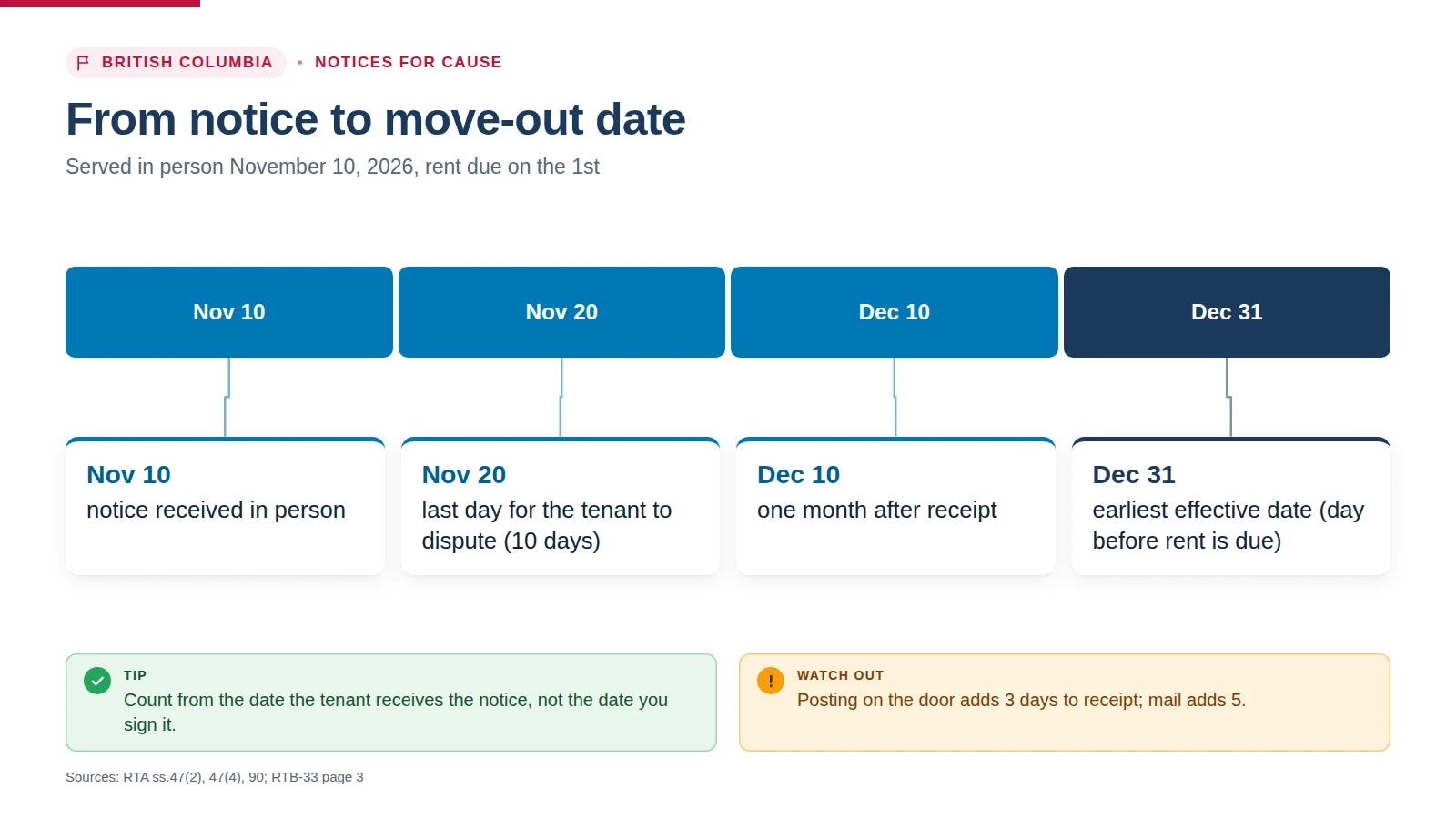
Section 47(2) says the effective date must be:
- not earlier than one month after the date the tenant receives the notice, and
- the day before the day rent is payable under the tenancy agreement.
For rent due on the 1st, that means the last day of a month, at least one full month after receipt.
| Notice received (rent due on the 1st) | One month later | Earliest effective date |
|---|---|---|
| November 10, 2026 | December 10, 2026 | December 31, 2026 |
| December 1, 2026 | January 1, 2027 | January 31, 2027 |
If you get the date wrong, section 53 changes it automatically to the earliest date that complies. The RTB-33 itself says an incorrect move-out date does not make the notice invalid. But a corrected date can be weeks later than you planned, so count carefully.
Filling in the RTB-33
Section 52 says a landlord's notice to end tenancy is effective only if it is in writing, signed and dated, gives the unit address, states the effective date and the grounds, and is on the approved form. For cause, that form is the RTB-33 (current version 2026/04).
- Page 1: tenant and landlord names and addresses (use the Schedule of Parties, RTB-26, for more), the unit address, the move-out date, and your name, signature and date.
- Page 2: tick every reason that applies, then complete "Details of Cause(s)". The form says this information is required and that an arbitrator may cancel the notice if details are not provided. Describe what happened, where, who caused it, with dates and times.
- Page 3: record how you served it. This isn't required on your copy, and leaving it blank doesn't invalidate the notice, but the form says landlords should also complete the Proof of Service Notice to End Tenancy (RTB-34).
- Pages 3 and 4: the information for tenants and landlords. Page 4 says you must give the tenant every page.
Serving the notice and when it counts as received
Page 3 of the RTB-33 lists the service methods and the receipt dates:
| How it was served | Deemed received |
|---|---|
| In person to the tenant, or to an adult (19+) who appears to live with them | That day |
| Mailbox or mail slot, attached to the door, or emailed or faxed to an address for service the tenant provided | 3 days later |
| Registered or regular mail | 5 days later |
The form adds that a tenant who actually received it earlier doesn't get extra time: the deeming provisions don't extend the time to respond. Keep a copy of every notice and record each date and how it was given.
The tenant's 10 days, and what happens next
Under section 47(4), the tenant may dispute the notice by applying for dispute resolution within 10 days after receiving it. The RTB-33 calls this 10 calendar days. For a notice received in person on November 10, 2026, the last day to apply is November 20, 2026.
| If the tenant… | Then… |
|---|---|
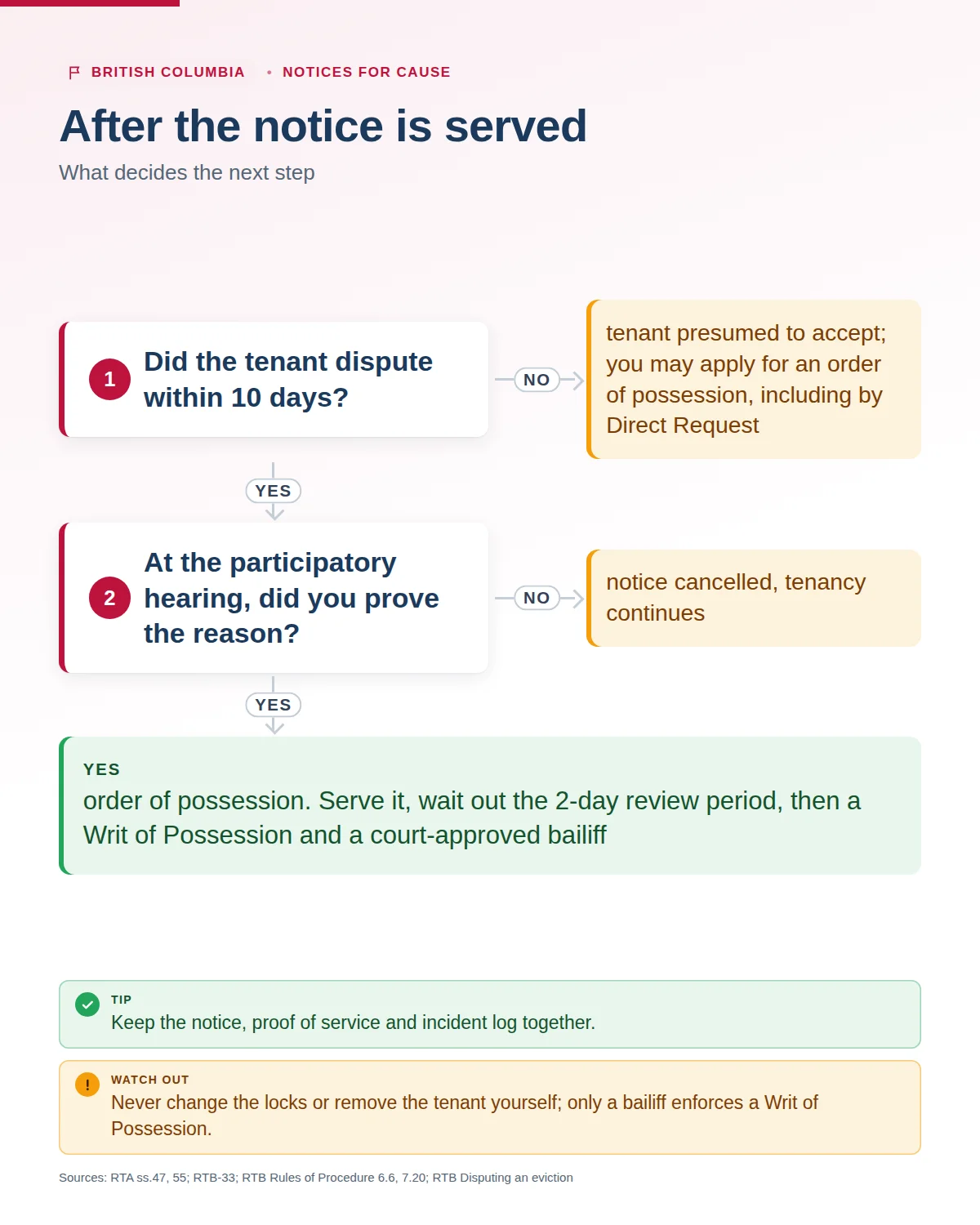
| Does not apply within 10 days | Under s.47(5), the tenant is conclusively presumed to accept the notice and must move out by the effective date. If they stay, you may apply for an order of possession (s.55(2)(b)), including by Direct Request. |
| Applies in time | The tenant must serve you the Notice of Dispute Resolution Proceeding package within 3 days of applying. A hearing is held. |
| Applies late | An arbitrator may extend the time only in exceptional circumstances (s.66(1)), and never beyond the notice's effective date (s.66(3)). |
The RTB-33 says Direct Requests can only be submitted when the tenant does not dispute the notice. If the tenant has disputed, the question is decided at a participatory hearing.
At the hearing, you go first
Under the RTB Rules of Procedure (6.6 and 7.20), when a tenant applies to cancel a notice to end tenancy, the landlord must prove the reason, and the hearing begins with the landlord presenting first unless the arbitrator decides otherwise. The standard is a balance of probabilities.
If the arbitrator dismisses the tenant's application or upholds the notice, and the notice complies with section 52, section 55(1) says the arbitrator must grant you an order of possession. If the notice is found not valid, it is cancelled and the tenancy continues.
Enforcing an order of possession
The RTB's disputing an eviction page lists four steps:
- Serve the tenant with a copy of the order of possession.
- Wait for the 2-day review period to expire. If the tenant applies for review in that time, the order is put on hold until the review is decided.
- Take the order to the BC Supreme Court and get a Writ of Possession.
- Hire a court-approved bailiff to remove the tenant and their belongings.
The RTB-33 is blunt: you must not physically evict a tenant without a Writ of Possession, change the locks without an arbitrator's order, or seize a tenant's property without a court order.
When one month is too long: ending a tenancy early
Section 56 lets a landlord apply directly to end a tenancy early, without a cause notice, for the most serious conduct. The RTB's information sheet says this is only for urgent situations where there is an imminent danger to the health or safety of the landlord or another person on the property. If there is no imminent danger, the application is dismissed and you will need to serve a One Month Notice anyway, having lost time.
Common mistakes with cause notices
- Serving pages 1 and 2 only. The tenant must get every page.
- Generic details. Name dates, times, places and people.
- Skipping the warning letter for a material term. Guideline 8 lists written notice and a reasonable deadline among the conditions the arbitrator must find.
- Two late payments. Guideline 38 sets three as the minimum.
- Waiting months after the last late payment. That delay can be treated as a waiver.
- Taking matters into your own hands. Lockouts and removing belongings without a writ are prohibited.
- No proof of service. Complete the RTB-34 when you serve.
Running cause notices across a portfolio
- Log incidents as they happen, with dates and witnesses, so the details box writes itself.
- Track late payments per tenancy and review them monthly, so a pattern isn't noticed only after waiver becomes an argument.
- Use one template for material-term warning letters with Guideline 8's four elements.
- Calendar the tenant's 10-day window and the effective date the day you serve, using the deemed-receipt date.
- Keep the notice, proof of service and incident log together. If the tenant disputes, you present first and need it all.
How Tenon10 helps
Tenon10 generates the One Month Notice to End Tenancy for Cause (RTB-33), along with the 10 Day Notice (RTB-30) and the other BC notices you're likely to need.
The lease, notices and payment history for each tenancy are kept together, so the late-payment record behind a "repeatedly late" notice and the notice itself are in one place when you prepare for a hearing. Tenon10 doesn't file dispute applications; it links you to the RTB.
Frequently asked questions
How much notice does a cause notice give?
At least one month after the tenant receives it, ending the day before rent is due (s.47(2)).
How long does the tenant have to dispute?
10 days after receiving the notice (s.47(4)). If they don't apply, they are presumed to accept it.
Can I use a cause notice for unpaid rent?
Unpaid rent has its own notice, the 10 Day Notice (RTB-30) under section 46. Repeated late payment is a cause ground under section 47(1)(b).
What if I wrote the wrong move-out date?
Section 53 changes it to the earliest date that complies, and the RTB-33 says an incorrect date doesn't invalidate the notice.
Can I change the locks once the date has passed?
No. You need an order of possession and then a Writ of Possession from the BC Supreme Court, enforced by a court-approved bailiff.
BC One Month Notice for Cause Checklist
A landlord checklist for the BC One Month Notice to End Tenancy for Cause (RTB-33): the grounds, details, effective date, service and what happens after.
Get Free PDF →Generate a complete RTB-33
Tenon10 generates the One Month Notice for Cause and keeps it with the lease, payment history and notices for the tenancy.
Built for Canadian landlords and property managers.
Related BC guides
- Serving Documents in BC: Every Method the RTA Allows
- How to Give a 10 Day Notice to End Tenancy for Unpaid Rent in BC (RTB-30)
- Direct Request for an Order of Possession in BC
- What You Can and Can't Add to a BC Tenancy Agreement
Sources: Residential Tenancy Act; One Month Notice to End Tenancy for Cause (RTB-33); RTB Policy Guideline 38; RTB Policy Guideline 8; RTB Rules of Procedure; RTB: Disputing an eviction; RTB information sheet: Ending a Tenancy for Cause. This article is a summary of British Columbia rules as of October 2026, not legal advice. Check the Residential Tenancy Branch for your situation.