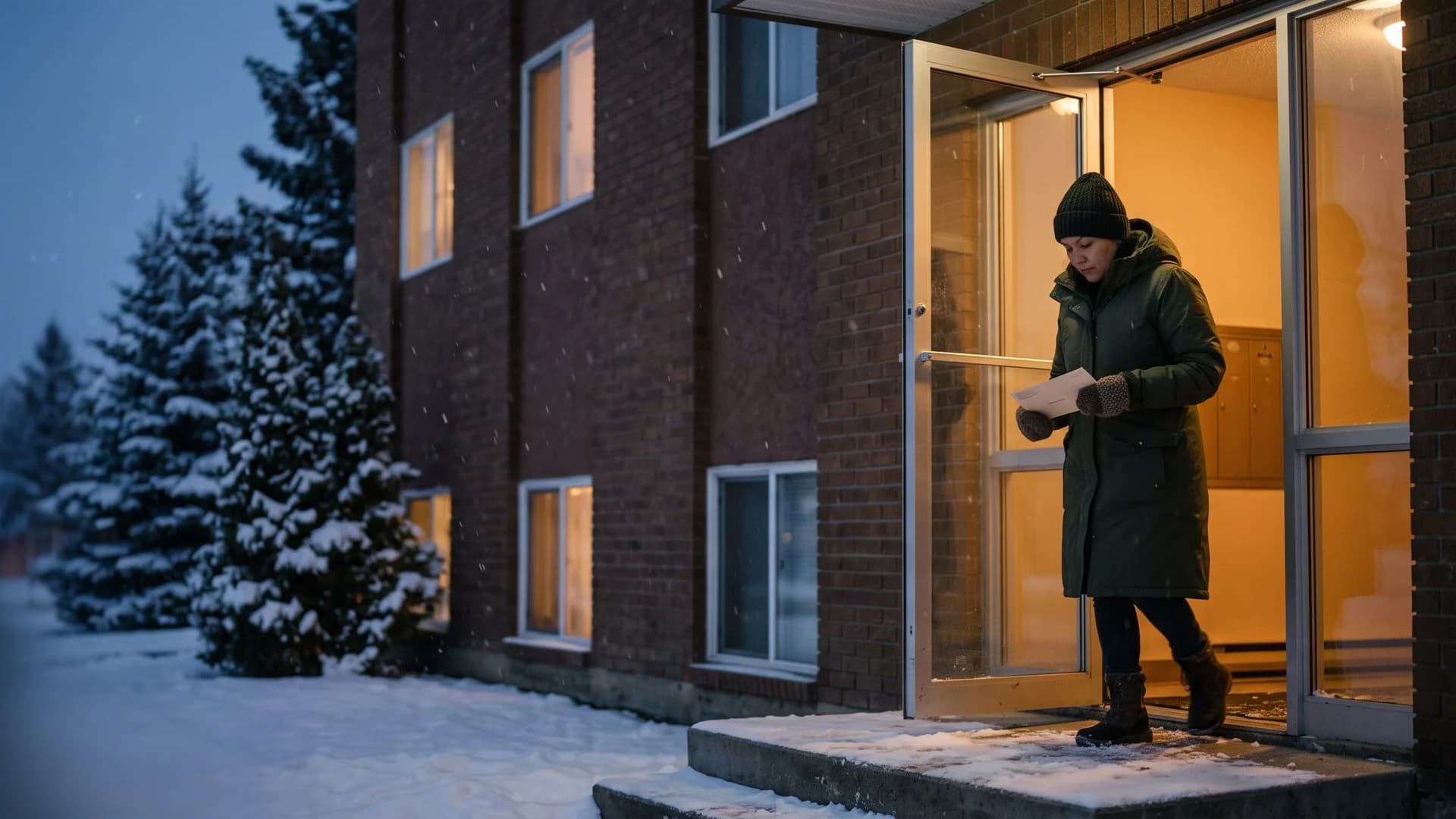
You own an older building. The wiring is past its life, a seismic upgrade is overdue, or the sprinkler system needs replacing. The work is real, and you may believe the only safe way to do it is with the unit empty. In British Columbia you cannot get there by handing your tenant a notice.
Since July 1, 2021, a landlord who wants to end a tenancy for renovations or repairs must apply to the Residential Tenancy Branch (RTB) and win an order from an arbitrator first. The tenant does not receive an eviction notice from you at all. They receive your application and a hearing date.
This guide covers what section 49.2 of the Residential Tenancy Act requires, how the RTB reads "requires vacancy", how renovation differs from demolition and conversion, what you owe the tenant, and how to plan the work across a building without losing the case.
BC Renovation Order Checklist
A landlord checklist for a BC renovation order under RTA s.49.2: the four-part test, permits, the 45-day point, the effective date and what you owe the tenant.
Get Free PDF →The rule: you need an RTB order before you renovate
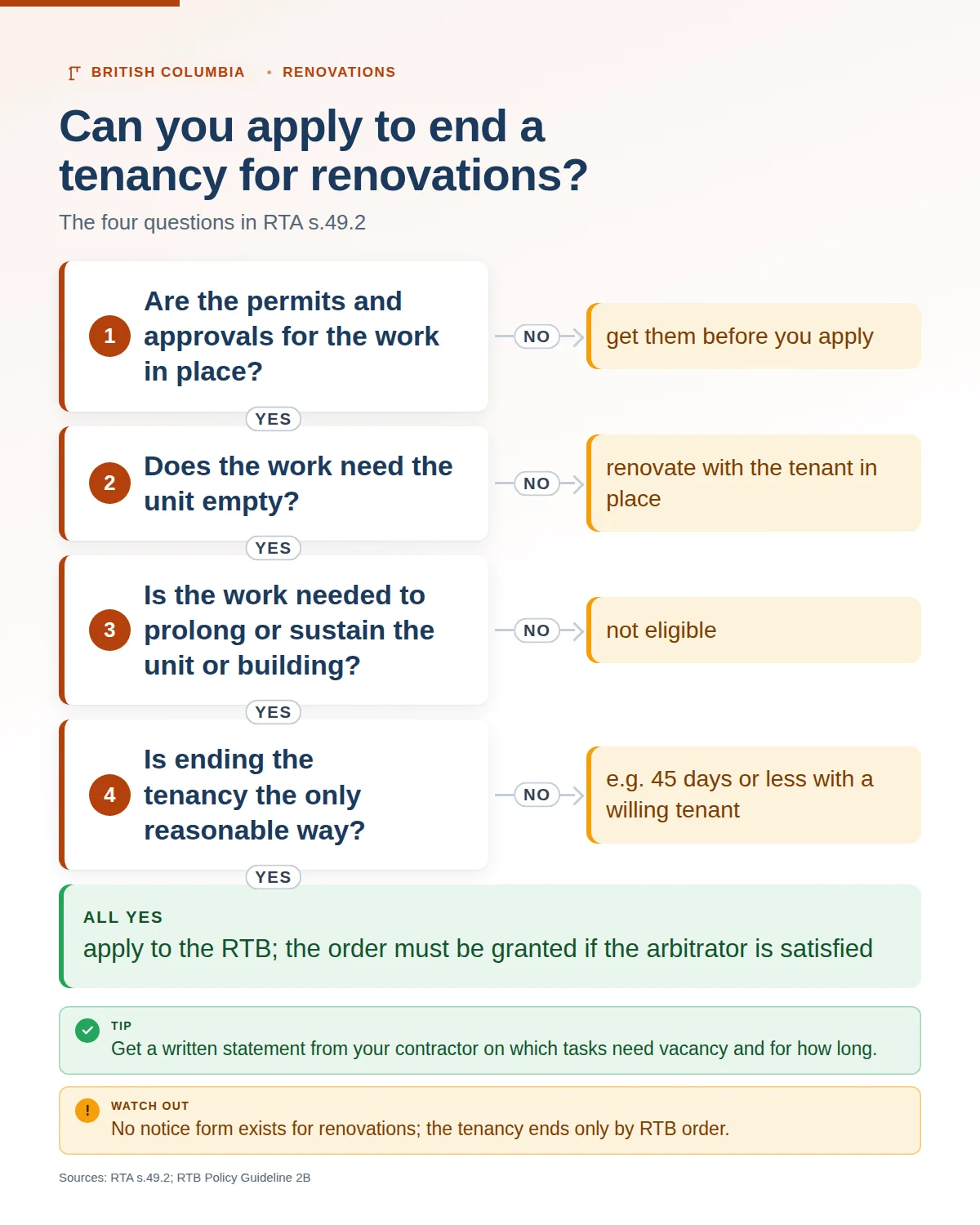
Section 49.2 of the Residential Tenancy Act lets a landlord apply for an order ending a tenancy, and an order of possession, only if all four of these are true:
- You intend in good faith to renovate or repair the unit and already have all the permits and approvals the law requires for the work.
- The renovations or repairs require the unit to be vacant.
- The work is necessary to prolong or sustain the use of the unit or the building.
- The only reasonable way to get the vacancy is to end the tenancy.
If the arbitrator is satisfied all four apply, the Act says the order must be granted. If even one is missing, it will not be.
When the order takes effect
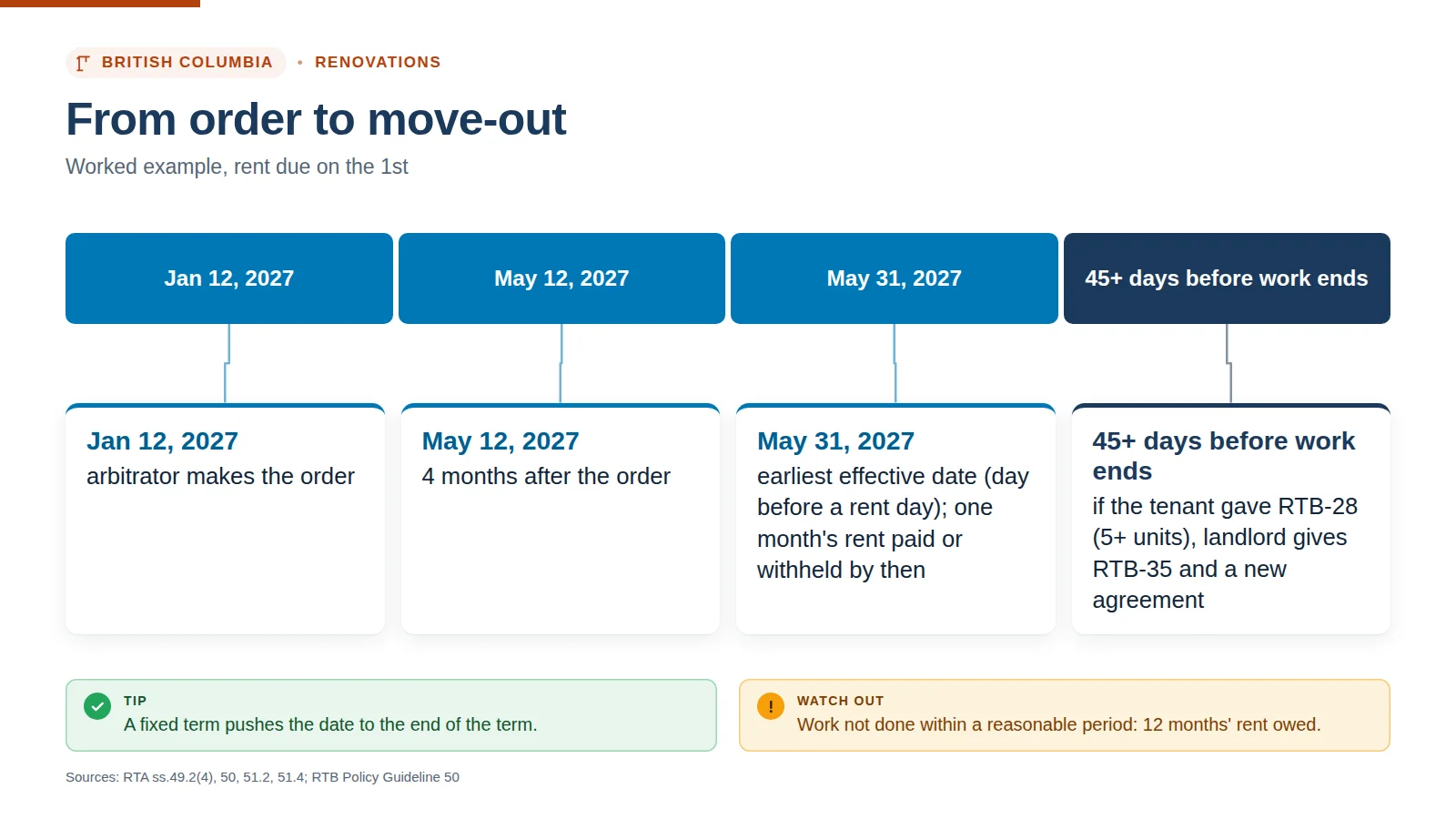
The order's effective date must be at least 4 months after the date the order is made. It must also fall on the day before rent is due, and for a fixed-term tenancy it cannot be earlier than the end of the term.
| Step | Example date |
|---|---|
| Arbitrator makes the order | Tuesday, January 12, 2027 |
| 4 months after the order | Wednesday, May 12, 2027 |
| Rent is due on the 1st, so the date moves to the day before a rent day | Monday, May 31, 2027 |
| If a fixed term runs to August 31, 2027 | No earlier than Tuesday, August 31, 2027 |
Count from the date of the order, not the date you applied. Hearing wait times vary, so build that uncertainty into your construction schedule.
"Requires vacancy" is a high bar
RTB Policy Guideline 2B relies on BC court decisions to set the test. "Vacant" means empty. You cannot end a tenancy because the work would be faster, cheaper or easier with the unit empty. The question is whether the nature and extent of the work objectively requires it.
Work that may require vacancy includes major asbestos remediation, full interior wall and ceiling demolition, a full rewire of the unit, seismic upgrades and fire sprinkler installation. Work that usually does not includes re-piping, roof replacement, window replacement, new flooring, cabinets, appliances, painting and replacing bathtubs or toilets. The guideline says cosmetic updates aimed at décor or prestige are rarely enough.
The 45-day point
Guideline 2B adds a practical test. If the work that needs vacancy can be done in 45 days or less, and the tenant is willing to live elsewhere for that time and give you access, the tenancy generally should not need to end. Longer periods may make continuing the tenancy unreasonable, but the tenant's willingness to move out temporarily is not decisive when the vacancy is long.
Permits come first
You must have the permits and approvals required by law in place before you apply. They must cover the work that requires vacancy, though not every permit for the full project. If no permit is needed, the guideline expects proof, such as written confirmation from the municipality or a report from a qualified engineer or certified tradesperson. If a strata bylaw requires approval before renovating, you need that approval before applying too.
Good faith
Good faith means an honest intention with no ulterior motive. Guideline 2B says a landlord who plans to re-rent at a higher rent without doing work that requires vacancy is not acting in good faith, and a history of past renovation evictions without real work can count against you.
Renovation, demolition and conversion are different routes
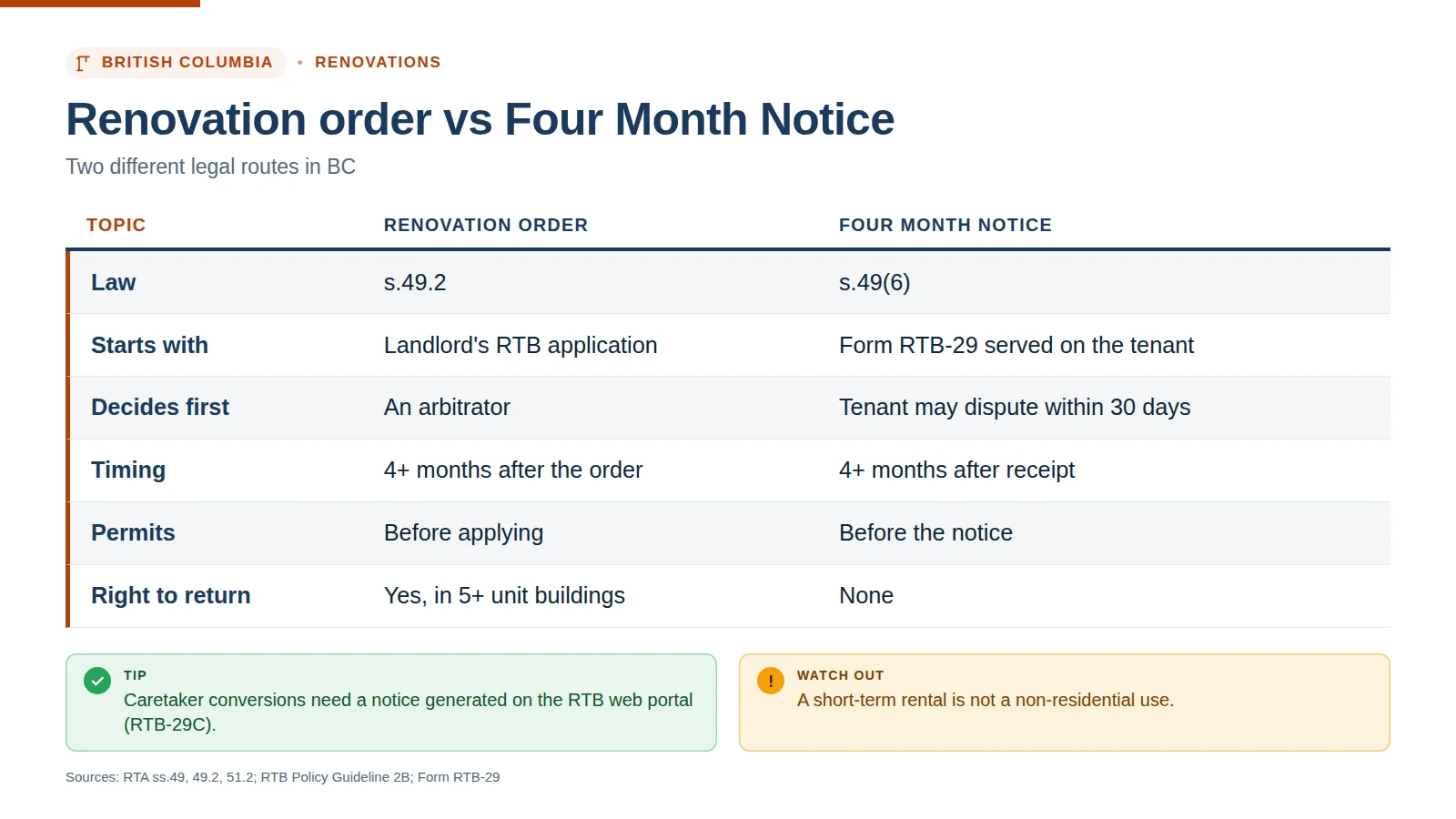
Many landlords mix these up. The route depends on what happens to the unit.
| Renovation or repair | Demolition or conversion | |
|---|---|---|
| Law | RTA s.49.2 | RTA s.49(6) |
| How it starts | Your application to the RTB | Four Month Notice (Form RTB-29) served on the tenant |
| Who decides first | An arbitrator, before the tenancy ends | The tenant, who may dispute within 30 days of receiving it |
| Timing | At least 4 months after the order | At least 4 months after the tenant receives the notice |
| Permits | In place before applying | In place before giving notice |
| Right to return | Yes, in buildings with 5 or more units | No right of first refusal under the Act |
Demolition, under Guideline 2B, means the complete and irreversible destruction of the unit. The RTB-29 covers demolition, conversion to strata lots, conversion to a non-profit housing co-operative, and conversion to a non-residential use. Converting a unit for a caretaker, manager or superintendent is separate: since July 18, 2024 that notice (RTB-29C) must be generated through the RTB's web portal, and the Act does not allow a notice for that purpose to be given any other way. A short-term or vacation rental is not a "non-residential use".
If the tenant does not dispute an RTB-29 within the 30 days, the Act treats them as accepting that the tenancy ends on the effective date.
What you owe the tenant
One month's rent, automatically
Under section 51.4, a tenant who receives a renovation order is entitled to the equivalent of one month's rent, on or before the order's effective date. The tenant may instead withhold that amount from the rent for the final month. The same one-month amount applies to an RTB-29 under section 51.
The tenant may leave early
For a periodic tenancy, section 50 lets the tenant end it earlier by giving you at least 10 days' written notice. Their one-month compensation is not affected. Section 50 says that on receiving the tenant's notice you must refund any rent already paid for the period after the tenant's earlier date, and Policy Guideline 50 expects it no later than the effective date.
Twelve months' rent if the work is not done
If you do not accomplish the renovations or repairs within a reasonable period after the effective date, section 51.4 requires you to pay the tenant an additional 12 times the monthly rent. The onus is on you to prove the work was done. An arbitrator can excuse the payment only for extenuating circumstances.
Right of first refusal in buildings with 5 or more units
In a residential property with 5 or more rental units, a tenant who receives a section 49.2 order can tell you, before moving out, that they want to return. They do this on Form RTB-28. You must then give them a Form RTB-35 45 Day Notice of Availability and a tenancy agreement starting on the availability date, at least 45 days before the work is finished. If you do not, section 51.3 requires 12 months' rent under the previous agreement unless extenuating circumstances apply.
Common mistakes
- Serving a notice for a renovation. No notice form exists for renovations. An RTB-29 used for renovation work is the wrong route.
- Applying before permits are issued. The permits must be in place when you apply. An expired permit at the hearing is not always fatal if you can show an extension is being pursued, but a missing one is.
- Calling an upgrade a necessity. New kitchens, flooring and paint rarely meet the "prolong or sustain" and vacancy tests.
- Ignoring a willing tenant. If the vacancy is short and the tenant offers to move out temporarily, expect the arbitrator to ask why the tenancy must end.
- Filing unit by unit. For several units in one building, section 49.2 requires a single application with the same effective date.
- Re-renting before the work is done. That is the fact pattern behind both bad-faith findings and the 12-month award.
Planning the work across a building
Multi-unit projects fail on sequencing more often than on law. Work through this order:
- Scope the work by unit. Separate tasks that need vacancy from those that can be done with tenants in place, one unit at a time.
- Pull permits that match that scope. The permits must cover the work that requires vacancy in each unit you name.
- Check strata approvals and local bylaws. Some municipalities have tenant relocation policies. Guideline 2B says the RTB does not enforce them, but you may still face consequences under them.
- File one application for all affected units. Gather each tenancy agreement, the permits, the contractor's vacancy statement and photos of current conditions.
- Prepare for each hearing. Renovation applications go straight to a hearing rather than facilitated settlement. Evidence you did not upload with the application must reach the tenant and the RTB at least 14 days before the hearing.
- Track compensation and return rights. Record each tenant's one-month payment or withholding, any early move-out, and any RTB-28 received.
How Tenon10 helps
Tenon10 generates the BC Four Month Notice (RTB-29) for demolition and conversion, and keeps each tenancy's lease, notices and payment records together. For a renovation application, that record is the evidence you upload: the tenancy agreement, rent history and every notice served.
Dispute applications are made through the RTB's own online service. Tenon10 does not file them, but it keeps what you need to file in one place.
FAQ
Can I give a Four Month Notice for a big renovation?
No. Renovation was removed as a notice ground in 2021. You must apply to the RTB under section 49.2 and get an order.
How much notice does the tenant get after the order?
The effective date must be at least 4 months after the order is made, on the day before rent is due, and not before a fixed term ends.
Do I pay compensation if the tenant leaves early?
Yes. The one month's rent is still owed, and you must refund rent paid for any period after the tenant's earlier move-out date.
Does the tenant get to come back?
In buildings with 5 or more rental units, yes, if they give you Form RTB-28 before moving out. In smaller buildings the Act gives no right of first refusal.
What if the work takes longer than planned?
The test is a reasonable period after the effective date. Guideline 50 accepts that unexpected additional repairs can justify a longer period, but the onus is on you to prove the work was accomplished.
BC Renovation Order Checklist
A landlord checklist for a BC renovation order under RTA s.49.2: the four-part test, permits, the 45-day point, the effective date and what you owe the tenant.
Get Free PDF →Keep your evidence ready before you apply
Tenon10 generates the BC RTB-29 and keeps every lease, notice and payment record together, so your hearing file is built as you go.
Built for Canadian landlords and property managers.
Related BC guides
- Serving Documents in BC: Every Method the RTA Allows
- Fixed-Term vs Month-to-Month in BC: What Happens When the Term Ends
- The BC Residential Tenancy Agreement (RTB-1): The Complete Landlord Guide
Sources: Residential Tenancy Act; RTB Policy Guideline 2B; RTB Policy Guideline 50; RTB: Types of evictions; Form RTB-29; RTB Rules of Procedure; RTB: Prepare and serve evidence. This article is a summary of British Columbia rules as of October 2026, not legal advice. Check the Residential Tenancy Branch for your situation.