In British Columbia, the first thing an arbitrator checks on a renovation application is not the tenant, the rent or the construction schedule. It is the permits. Section 49.2 of the Residential Tenancy Act only lets you apply once every permit and approval the law requires for the work is already in place, so BC renovation eviction permits decide when your application can start.
Applications usually fail on evidence, not on bad intentions. A landlord arrives with a permit number and a story, but nothing showing which work needs the unit empty or why the tenancy must end. The arbitrator decides on what is in front of them, and the burden is yours.
This article covers the permits and approvals to have in hand, the evidence for the rest of the section 49.2 test, and the deadlines from filing to the hearing. For the whole process, including what you owe the tenant after an order, see Renovictions in BC: Applying to the RTB Before You Renovate.
BC Renovation Hearing Evidence Checklist
A landlord checklist for an RTB renovation hearing: evidence for each part of the s.49.2 test, the filing steps, the 14-day evidence deadline and file rules.
Get Free PDF →Permits first, then the rest of the test
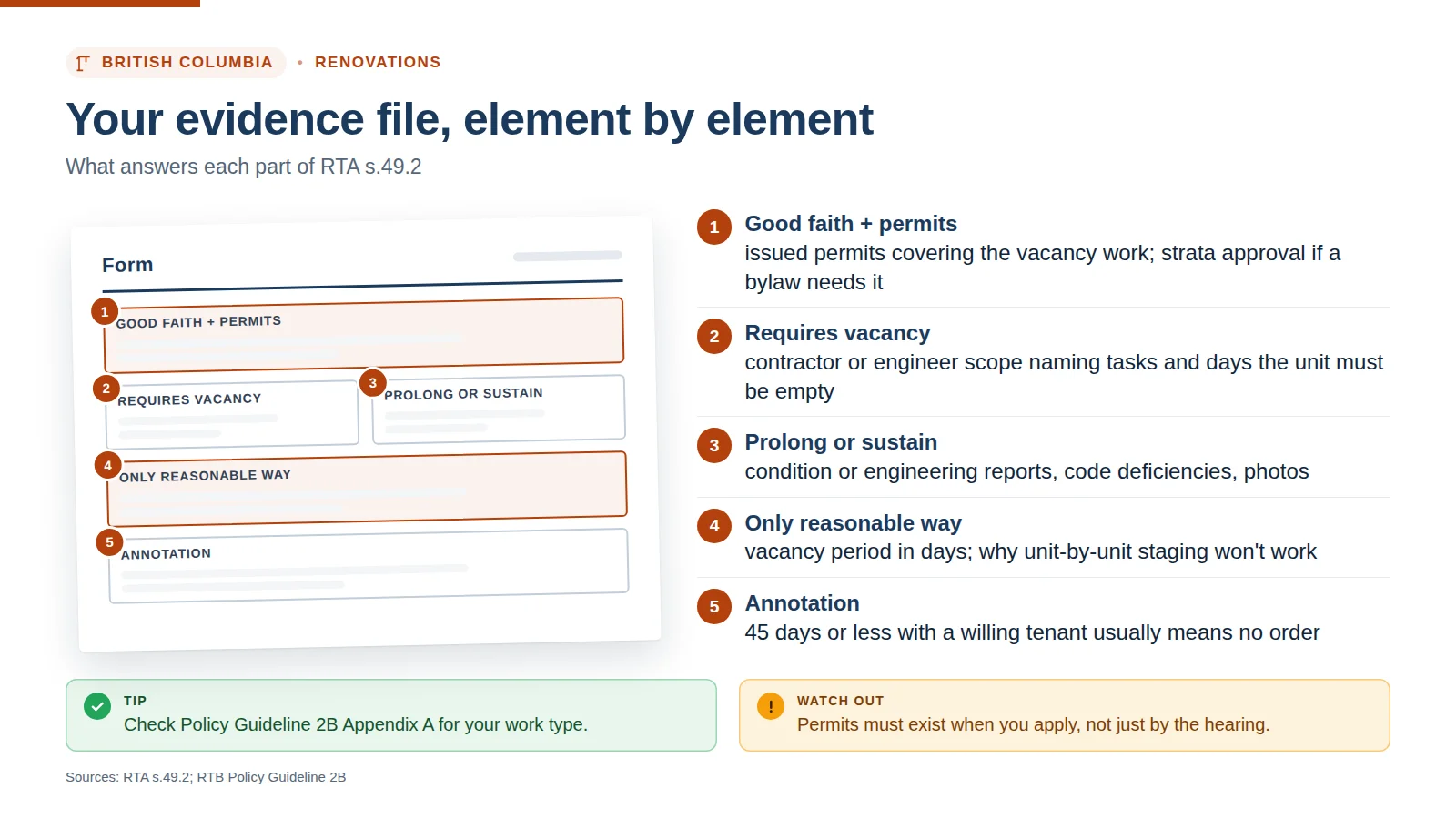
Section 49.2 of the Residential Tenancy Act lets you apply for an order ending the tenancy and an order of possession. The first condition is a good-faith intention to do the work with all permits and approvals required by law already obtained. RTB Policy Guideline 2B explains what that means in practice:
- In place before you file. The permits must be valid when you apply. If a permit cannot be issued until other conditions are met, bring a copy of the policy that sets those conditions and show you have completed every step you can.
- Matched to the vacancy work. They must cover the work that needs the unit empty. You do not need every permit for the whole project, but the ones for that work must be there.
- Proof when no permit is needed. Bring written confirmation from the municipal or provincial authority, or a report from a qualified engineer or certified tradesperson, saying none is required.
- Strata approval. If a strata bylaw requires approval before renovating, get it before you apply.
- An expired permit is not always fatal. If a permit valid when you applied lapses before the hearing, bring evidence of your efforts to renew it. The arbitrator may consider the likelihood of renewal or adjourn.
- Local policies and bylaws. Some local governments have extra rules for renovations. The municipality, not the RTB, enforces them, and the RTB considers them only where they add permits or approvals the work needs. Check with your local government, because you may face other consequences even if you win the order.
Evidence for the other three elements
The arbitrator must grant the order if satisfied that all four conditions apply, and Guideline 2B says the onus is on you to show the planned work reasonably requires the tenancy to end.
| What the Act requires | Evidence that speaks to it |
|---|---|
| Good faith, with permits and approvals in place | The issued permits and their drawings or work description; strata approval if a bylaw requires it; contracts, quotes or a construction schedule |
| The work requires the unit to be vacant | A contractor's or engineer's written scope naming the tasks that need the unit empty, and for how long; hazard reports such as an asbestos survey |
| The work is necessary to prolong or sustain the use of the unit or building | Inspection or condition reports, engineering assessments, code deficiencies, photos of current conditions |
| Ending the tenancy is the only reasonable way to get the vacancy | The vacancy period in days, why staging unit by unit will not work, and any discussion with the tenant about a temporary move |
- Vacant means empty. A BC Supreme Court decision quoted in Guideline 2B reads "vacant" as "empty". Faster, cheaper or easier is not enough.
- The 45-day point. If the work that needs vacancy can be finished in 45 days or less, and the tenant is willing to live elsewhere for that time and give access, the tenancy generally should not need to end.
- A clean history. Past renovation evictions where the work never happened can suggest bad faith in the current case.
From application to hearing
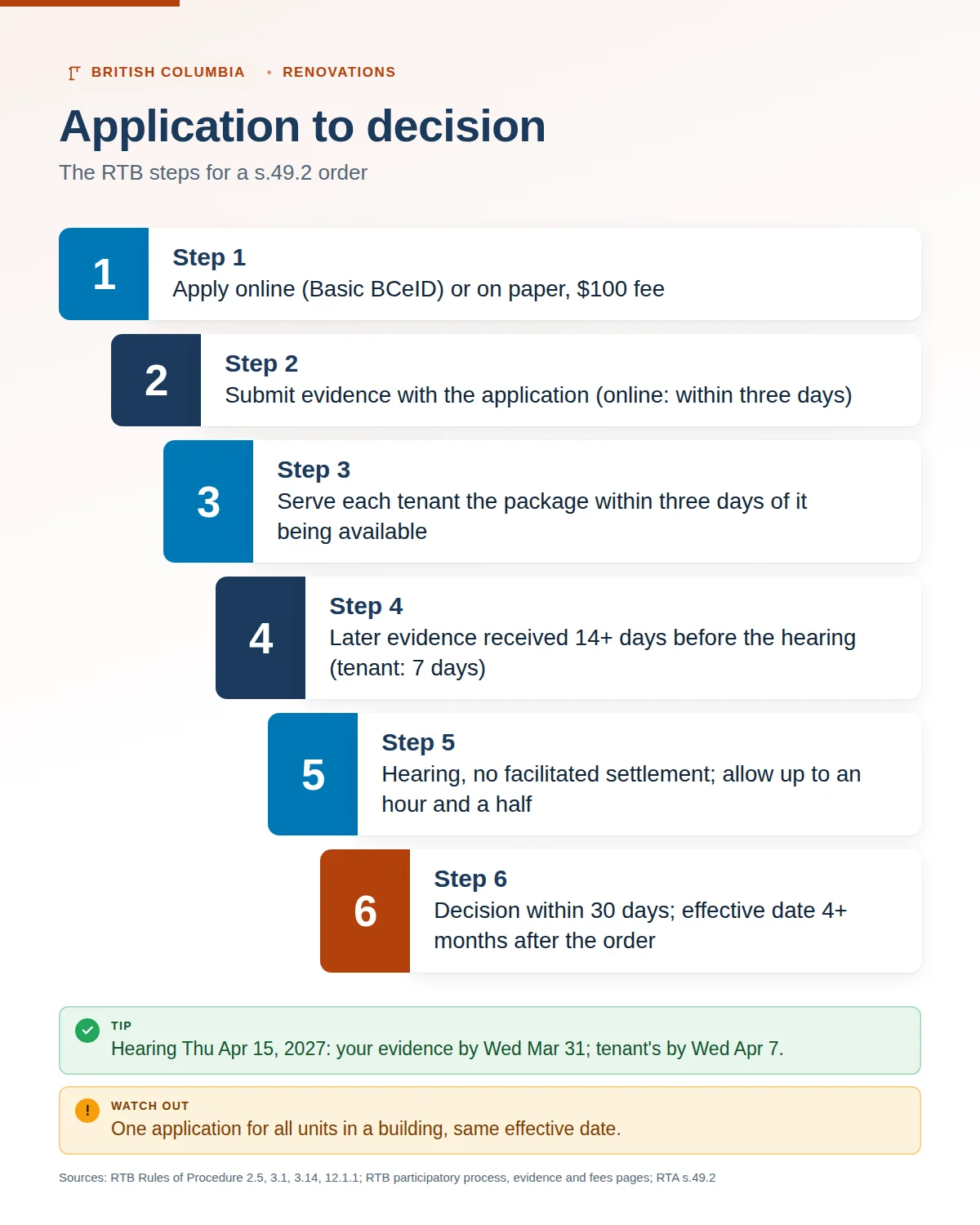
The RTB Rules of Procedure and the RTB's process pages set the steps.
- Apply. Landlords apply through the RTB's online service, which needs a Basic BCeID, or on paper. The filing fee is $100. You can ask in the application to have the fee repaid if you win.
- Upload evidence with the application. Rule 2.5 says, to the extent possible, the applicant submits all documentary and digital evidence at the same time as the application. Online applicants who send documents separately have three days to do so.
- Serve the tenant. Rule 3.1 requires you to serve each respondent with the Notice of Dispute Resolution Proceeding package, the respondent instructions, any fact sheets and your evidence, within three days of the package being made available.
- Serve any later evidence on time. Under Rule 3.14, evidence not submitted with the application must be received by the tenant and the RTB not less than 14 days before the hearing.
- Go to the hearing. Rule 12.1.1 sends section 49.2 applications straight to a hearing rather than the facilitated settlement process. The RTB says to expect to be available for up to an hour and a half.
- Get the decision. The RTB says the arbitrator decides within 30 days. If granted, the order's effective date must be at least 4 months after the order is made, on the day before rent is due, and not before a fixed term ends.
Counting the evidence deadline
The RTB's evidence page explains the count: your evidence must arrive at least 14 days before the hearing, and the tenant's at least 7 days before. Do not count the day the documents are received or the hearing date. Using the RTB's own pattern:
| Hearing date | Your evidence must be received by | Tenant's evidence must be received by |
|---|---|---|
| Thursday, April 15, 2027 | Wednesday, March 31, 2027 | Wednesday, April 7, 2027 |
"Received" depends on how you serve. Documents left in a mailbox or sent by mail are deemed received days later, so serve early.
Evidence the RTB can actually use
The RTB accepts common document, photo, video and audio formats. Non-video uploads are capped at 10MB per file and video at 200MB. Each upload needs a description of what it shows and the date it was captured. Website links are not accepted as evidence; include the content itself.
Common mistakes
- Applying while permits are pending. The permits must be in place when you file, not by the hearing.
- No time estimate. Without a number of days, the arbitrator cannot apply the 45-day point, and the gap counts against the applicant.
- Treating a willing tenant as irrelevant. If the tenant offers to move out temporarily for short work, address that directly in your evidence.
- Separate applications for one building. Section 49.2(2) requires a single application, with the same effective date, for renovations to more than one unit in a building.
- Late evidence. Material that arrives inside the 14-day window may not be considered.
- Forgetting what comes after. An order brings duties: one month's rent compensation, a possible right of first refusal in buildings with 5 or more units, and 12 months' rent if the work is not done within a reasonable period.
Preparing applications across several units
- Build one evidence package for the building: permits, engineering reports and the construction schedule.
- Add a short sheet per unit: tenancy agreement, current rent, rent due day, any fixed-term end date, and the specific work and vacancy days for that unit.
- List every tenant as a respondent in the single application and serve each one the full package.
- Keep proof of service for each tenant, with the method and date.
- Diarise the 14-day evidence cut-off and the hearing date, then the earliest effective date once the order is made.
How Tenon10 helps
Tenon10 keeps each tenancy's lease, notices and payment records together. For a renovation application, those are the per-unit facts the arbitrator needs: the agreement, the rent and due day, and the term.
The application itself is filed on the RTB's own service; Tenon10 does not file dispute applications. For demolition or conversion rather than renovation, Tenon10 generates the RTB-29 Four Month Notice.
FAQ
Can I serve a notice first and apply later?
No. For renovations there is no notice step. The tenancy ends only if the arbitrator makes an order under section 49.2.
Will the RTB try to settle it first?
No. Under Rule 12.1.1, section 49.2 applications go directly to a hearing. You and the tenant can still reach your own agreement.
What if my permit expires before the hearing?
Guideline 2B says this is not always a failure. Bring evidence of your efforts to renew; the arbitrator may consider the likelihood of renewal or adjourn.
How long until the tenant must leave?
At least 4 months after the order is made, on the day before rent is due, and not before a fixed term ends.
BC Renovation Hearing Evidence Checklist
A landlord checklist for an RTB renovation hearing: evidence for each part of the s.49.2 test, the filing steps, the 14-day evidence deadline and file rules.
Get Free PDF →Walk into the hearing with the records in order
Tenon10 keeps every lease, notice and payment record together and generates the RTB-29 for demolition and conversion.
Built for Canadian landlords and property managers.
Related BC guides
- Renovictions in BC: Applying to the RTB Before You Renovate
- Serving Documents in BC: Every Method the RTA Allows
- Direct Request for an Order of Possession in BC
- Fixed-Term vs Month-to-Month in BC: What Happens When the Term Ends
Sources: Residential Tenancy Act; RTB Policy Guideline 2B; RTB Rules of Procedure; RTB: Participatory process; RTB: Prepare and serve evidence; RTB: Fees and fee waivers; RTB: Types of evictions. This article is a summary of British Columbia rules as of October 2026, not legal advice. Check the Residential Tenancy Branch for your situation.