The Notice of Dispute Resolution Proceeding gives you a date, a time and a phone number. Whether you are the landlord or the tenant, that's usually all you know about the hearing itself: no courtroom, no judge you've met, and an hour to make your case.
Knowing the order of events takes much of the stress out of it. Residential Tenancy Branch (RTB) hearings in British Columbia follow a predictable pattern, and most of what decides the outcome happens before you dial in.
This walkthrough covers what to have ready, what happens step by step on the call, how to behave, and what comes after the decision.
RTB Hearing-Day Checklist
A checklist for landlords and tenants attending a BC RTB hearing: what to have ready, what happens on the call, conduct rules and the deadlines after the decision.
Get Free PDF →The rules that shape every hearing
An RTB participatory hearing is run by an arbitrator under the Residential Tenancy Act (RTA) and the RTB Rules of Procedure. A few rules matter more than the rest:
| Rule | What it means for you |
|---|---|
| Rules of evidence don't apply (RTA s.75) | The arbitrator can accept evidence a court might not, and decides what weight to give it. |
| Balance of probabilities (Rule 6.6) | The question is whether your version is more likely than not. |
| The person claiming usually proves it (Rule 6.6) | Except that when a tenant disputes a notice to end tenancy, the landlord must prove the reason. |
| Order of presentation (Rule 7.20) | The applicant usually goes first. When a tenant applies to cancel a notice, the landlord usually presents first. |
| Evidence must be presented (Rule 7.4) | Uploading it isn't enough. Only evidence presented at the hearing is used. |
| No recording by parties (Rule 6.11) | The RTB's system records every hearing automatically. You may not record it yourself. |
The RTB's hearing page says hearings are usually by phone and last about an hour, up to 90 minutes. If there are several issues, the arbitrator decides the order, with notices to end tenancy and urgent health-and-safety repairs first. Some issues may need a separate application.
Before the day: what to have ready
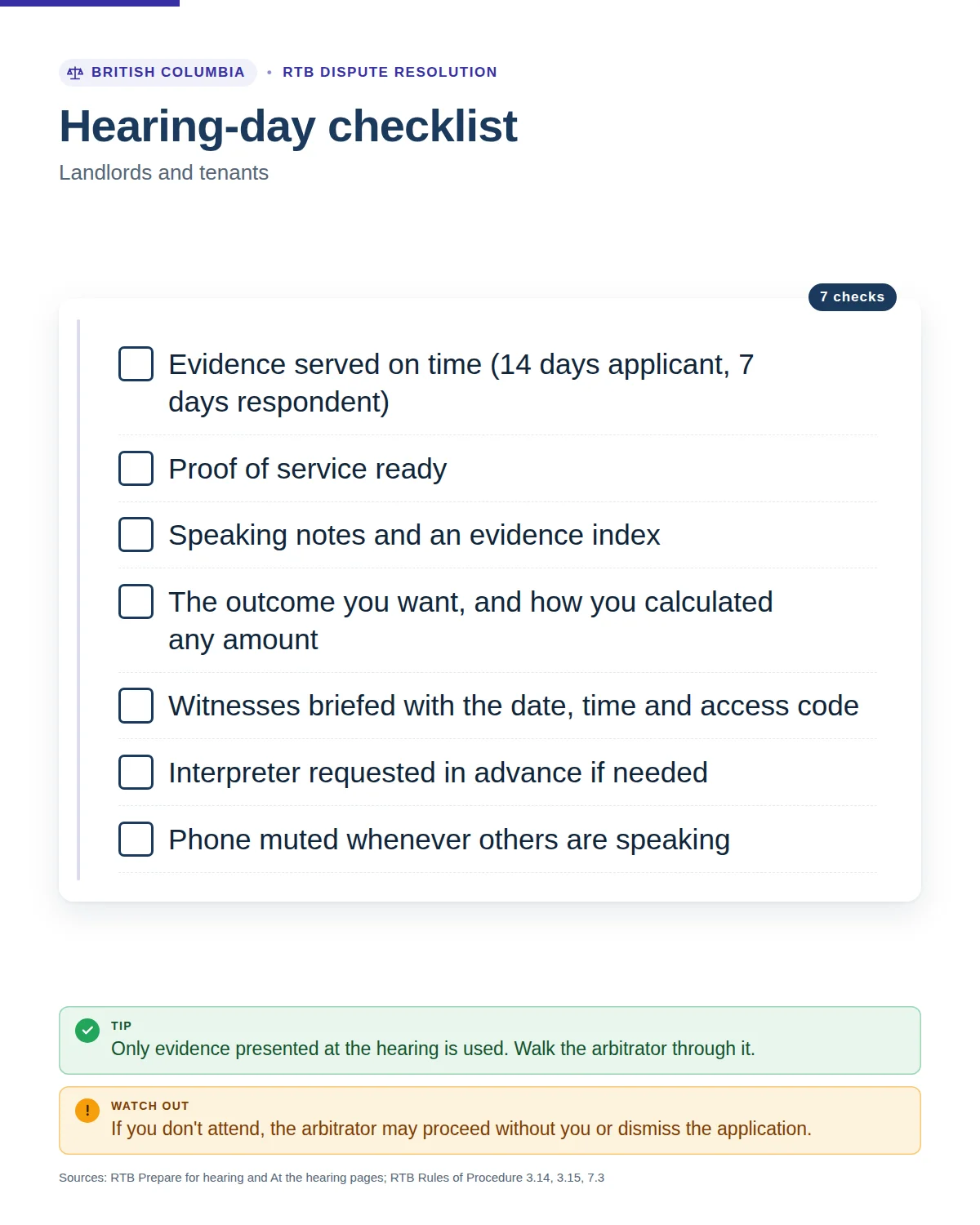
- Your evidence, already served. You can only present evidence properly served before the hearing. For applicants that means received at least 14 days before; for respondents, 7 days (Rules 3.14 and 3.15).
- Proof of service. The arbitrator may ask the applicant to show the respondent was served with the hearing package.
- Speaking notes. The RTB suggests assuming the arbitrator knows nothing about your situation: key facts, a timeline, the main issues and the outcome you want.
- What you want. If you're asking for money, be ready to explain how you calculated it.
- Witnesses briefed. Give them the date, time, phone number and access code. The RTB says witnesses must have been part of the dispute, such as another tenant who can speak to the dates and times of loud parties. A witness can instead provide a written statement sworn before a notary, lawyer or commissioner of oaths.
- Help, if you need it. Free telephone interpretation is available in over 200 languages by emailing [email protected] with your dispute number, in advance. You may bring an agent, assistant, advocate, interpreter or lawyer (Rule 6.7), but legal fees can't be claimed in the application.
- An alternate format, if needed. In-person hearings are possible for people with hearing loss or a disability that prevents phone participation, by applying on form RTB-36 (paper only).
On the call, step by step

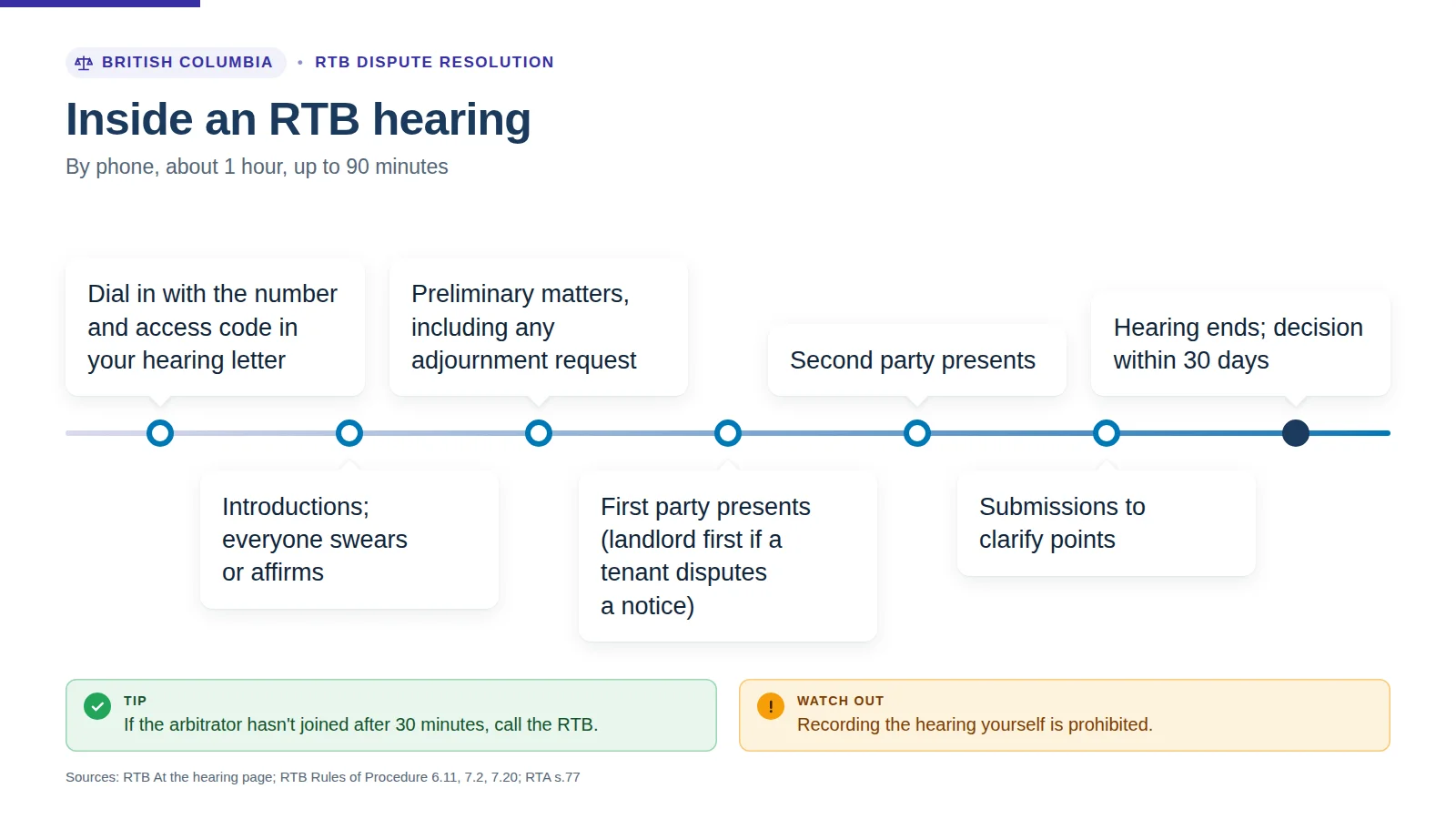
- Dial in. Use the number and access code in your Notice of Dispute Resolution Proceeding letter, and wait for the arbitrator. If they haven't joined, check the date and time, then call again. Rule 7.2 requires parties to stay available for 30 minutes after the start time. If the arbitrator still isn't on the line after 30 minutes, call the RTB at 604-660-1020 (Lower Mainland), 250-387-1602 (Victoria) or 1-800-665-8779 (elsewhere).
- Introductions. The arbitrator explains the process and the conduct rules, and everyone swears or affirms they'll tell the truth.
- Preliminary matters. This is the time for any request to adjourn: the RTB says an applicant must ask at the start of the hearing, and it's up to the arbitrator.
- First party presents. Usually the applicant, or the landlord where a tenant is disputing a notice. Testimony, evidence and witnesses.
- Second party presents. The other side responds with their own evidence and witnesses. Under Rules 7.23 to 7.25, the arbitrator decides whether you may question the other side directly or through the arbitrator, and may ask questions of anyone.
- Submissions. The arbitrator may ask whether you want to clarify relevant points. It isn't a chance to repeat your evidence.
- Settlement, possibly. The arbitrator may explore whether you can agree. If you agree, section 64.2 lets the agreement be recorded as a decision or order.
- The hearing ends. Complex cases may be adjourned to a later date with the same arbitrator.
Conduct on the call
- Mute your phone while others are speaking.
- Don't interrupt the arbitrator. The RTB says yelling, threats and interruptions may get the speaker excluded from the rest of the hearing (see also Rule 6.10).
- Stay on the line to the end. If you hang up, you can't respond to anything said after.
- Answer what you're asked, briefly, with relevant facts.
Common mistakes at the hearing
- Assuming the arbitrator read everything. Walk them through the key items.
- Telling the whole history. Stick to the issues on the application.
- Arguing with the other party. Speak to the arbitrator.
- Raising new documents. Evidence not served in time is considered only in limited cases (Rule 3.17).
- Calling the wrong witnesses. They must have been part of the dispute.
After the hearing: what to do next
Section 77 of the Act requires the decision within 30 days after the proceedings conclude, and makes it final and binding. Copies are mailed to the first applicant and first respondent; tell the arbitrator at the end of the hearing if you need it sent to a different address. In urgent possession matters, the arbitrator may fax decisions or tell the parties when to pick them up.
- If you won an order, serve it on the other party. The RTB doesn't enforce orders: an order of possession is enforced through the BC Supreme Court, and a monetary order through the Provincial Court (small claims).
- If a tenant lost an eviction dispute, the RTB's preparation page warns the tenant might be required to leave the rental with only 2 days notice. It suggests tenants look for a new place while waiting for the hearing.
- If something is wrong in the decision, ask for clarification or correction of an obvious error within 15 days (s.78).
- If you want a review, section 80 sets 2 days for an order of possession or a 10 Day Notice decision, 5 days for repairs, services or other notices to end tenancy, and 15 days for other matters, on the limited grounds in section 79. Beyond that, a decision can be challenged by judicial review in the BC Supreme Court.
For landlords and managers attending regularly
Send the person who knows the facts, or an agent with authority to settle. Keep one file per tenancy with the lease, notices, payment history, inspection reports and proof of service, so preparing for a hearing means printing an index rather than rebuilding the story.
How Tenon10 helps
Tenon10 keeps the lease, notices and payment records for each tenancy together. On hearing day, that record is your evidence of what was agreed, what was served and when, and what was paid.
Tenon10 doesn't file applications or attend hearings. You apply through the RTB, and Tenon10 links you there.
Frequently asked questions
How long is an RTB hearing?
Usually about an hour, and up to 90 minutes, by phone.
Who speaks first?
Usually the applicant. When a tenant disputes a notice to end tenancy, the landlord usually presents first and must prove the reason.
Can I record the hearing?
No. The RTB records hearings automatically, and parties are prohibited from recording them (Rule 6.11).
Can I get my lawyer's fees back?
No. The RTB says legal fees can't be claimed as part of an application. The filing fee can be ordered repaid under section 72.
RTB Hearing-Day Checklist
A checklist for landlords and tenants attending a BC RTB hearing: what to have ready, what happens on the call, conduct rules and the deadlines after the decision.
Get Free PDF →Walk into your hearing with the record in hand
Tenon10 keeps the lease, notices and payment history for each tenancy together, so your evidence is ready before the call.
Built for Canadian landlords and property managers.
Related BC guides
- Direct Request for an Order of Possession in BC
- Five Days to Pay or Dispute: What Happens After a BC 10 Day Notice
- Serving Documents in BC: Every Method the RTA Allows
Sources: Residential Tenancy Act; RTB Rules of Procedure; RTB: Prepare for a hearing; RTB: At the hearing; RTB: After the hearing. This article is a summary of British Columbia rules as of October 2026, not legal advice. Check the Residential Tenancy Branch for your situation.