Your tenant moves out after three years. The carpet in the second bedroom is stained, two blinds are broken and there are holes in the living room wall. You want to keep part of the deposit. The tenant says the stain and the holes were there when they moved in. Who is right?
In British Columbia, that argument is usually settled by one document: the condition inspection report. The Residential Tenancy Act (RTA) makes the move-in and move-out inspections mandatory, sets out how they must be scheduled, and takes away deposit rights from whichever side does not follow the process.
This guide covers when inspections must happen, how to schedule them properly, what the report must contain, the deadlines for giving the tenant a copy, and what you lose if you skip a step. It ends with a workflow for running inspections across many units.
BC Condition Inspection Checklist
A landlord checklist for BC move-in and move-out inspections: timing, the two opportunities and RTB-22, what the report must contain, and the 7-day and 15-day copy deadlines.
Get Free PDF →The rule: what the RTA and Regulation require
The core rules are in sections 23 to 24 and 35 to 36 of the Residential Tenancy Act and Part 3 (sections 14 to 21) of the Residential Tenancy Regulation. The Residential Tenancy Branch (RTB) explains them on its move-in inspection page.
When inspections must happen
| Inspection | When | Source |
|---|---|---|
| Move-in | On the day the tenant is entitled to possession, or another day you both agree on | RTA s.23(1) |
| New pet | On or before the day the tenant starts keeping a pet you permitted after the tenancy began, if no move-in inspection was done | RTA s.23(2) |
| Move-out | Before a new tenant begins to occupy the unit, on or after the day the tenant stops occupying it, or another agreed day | RTA s.35(1) |
The unit should be empty of the tenant's possessions unless you both agree otherwise (Regulation s.14). The inspection must be scheduled and done between 8 a.m. and 9 p.m. unless you agree on a different time (s.16(2)).
Two opportunities, and how to offer them
For both inspections, you must offer the tenant at least two opportunities (RTA ss.23(3) and 35(2)). Section 17 of the Regulation sets the order:
- You offer a first opportunity by proposing one or more dates and times.
- If the tenant can't make it, they may propose another time, and you must consider it.
- If that still doesn't produce an inspection, you must propose a second, different opportunity using the approved form: the Notice of Final Opportunity to Schedule a Condition Inspection (RTB-22).
Both of you must try in good faith to agree on a time (s.16(1)), and consider the other's known, reasonable time limits (s.17(3)).
Who can attend
A tenant may send an agent to attend and sign, but must tell you in advance (Regulation s.15). You can't act as the tenant's agent. The RTB says a landlord who sends someone else must tell the tenant in writing.
If you offered both opportunities and the tenant didn't take part on either, you must do the move-in inspection and sign the report without them (RTA s.23(6)). At move-out you may do the same, or proceed alone if the tenant has abandoned the unit (s.35(5)).
What the report must contain
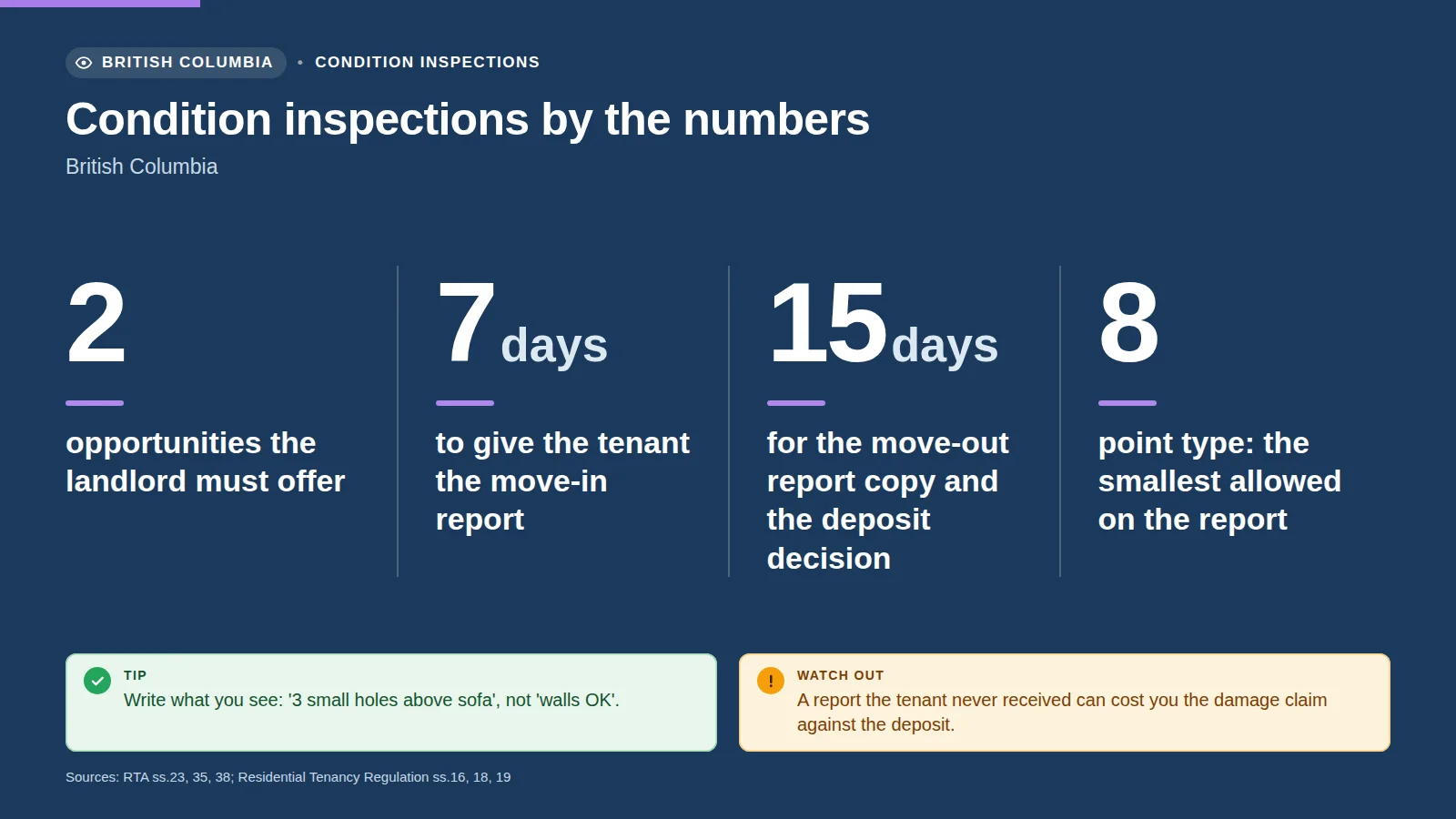
The report must be in writing, in type no smaller than 8 point, and easy for a reasonable person to understand (Regulation s.19). Section 20 lists the contents, including:
- the legal names of the landlord, the tenant and any tenant's agent;
- the unit address, the possession date, your address for service and the inspection date;
- the state of repair and general condition of each room, from entry and kitchen to bathrooms, bedrooms, storage, exterior, balcony, garage or parking;
- the condition of floor and window coverings, appliances, furniture, fixtures, outlets and connections provided for the tenant's exclusive use;
- any damage or items needing repair;
- space for the tenant to agree or disagree, with reasons; and
- space for both signatures.
At move-out, the report must also clearly itemize damage the tenant is responsible for and, if agreed, the amount to be deducted from a deposit with the tenant's signature and date (s.20(2)). The RTB's Condition Inspection Report (RTB-27) covers all of this. The RTB says you can use your own form instead, as long as it meets the Regulation.
Copies and deadlines
| Report | Give the tenant a signed copy | Source |
|---|---|---|
| Move-in | Promptly, and in any event within 7 days after the inspection | Regulation s.18(1)(a) |
| Move-out | Promptly, and in any event within 15 days after the later of the inspection and the date you receive the tenant's forwarding address in writing | Regulation s.18(1)(b) |
Use a service method allowed by section 88 of the Act (Regulation s.18(2)).
What a report is worth at a hearing
Under section 21 of the Regulation, a report completed in accordance with Part 3 is evidence of the unit's condition on the inspection date, unless either side has a preponderance of evidence to the contrary. That is why a careful report matters more than a pile of later photos.
What you lose if you skip a step
| Who | What triggers the loss | What is lost | Source |
|---|---|---|---|
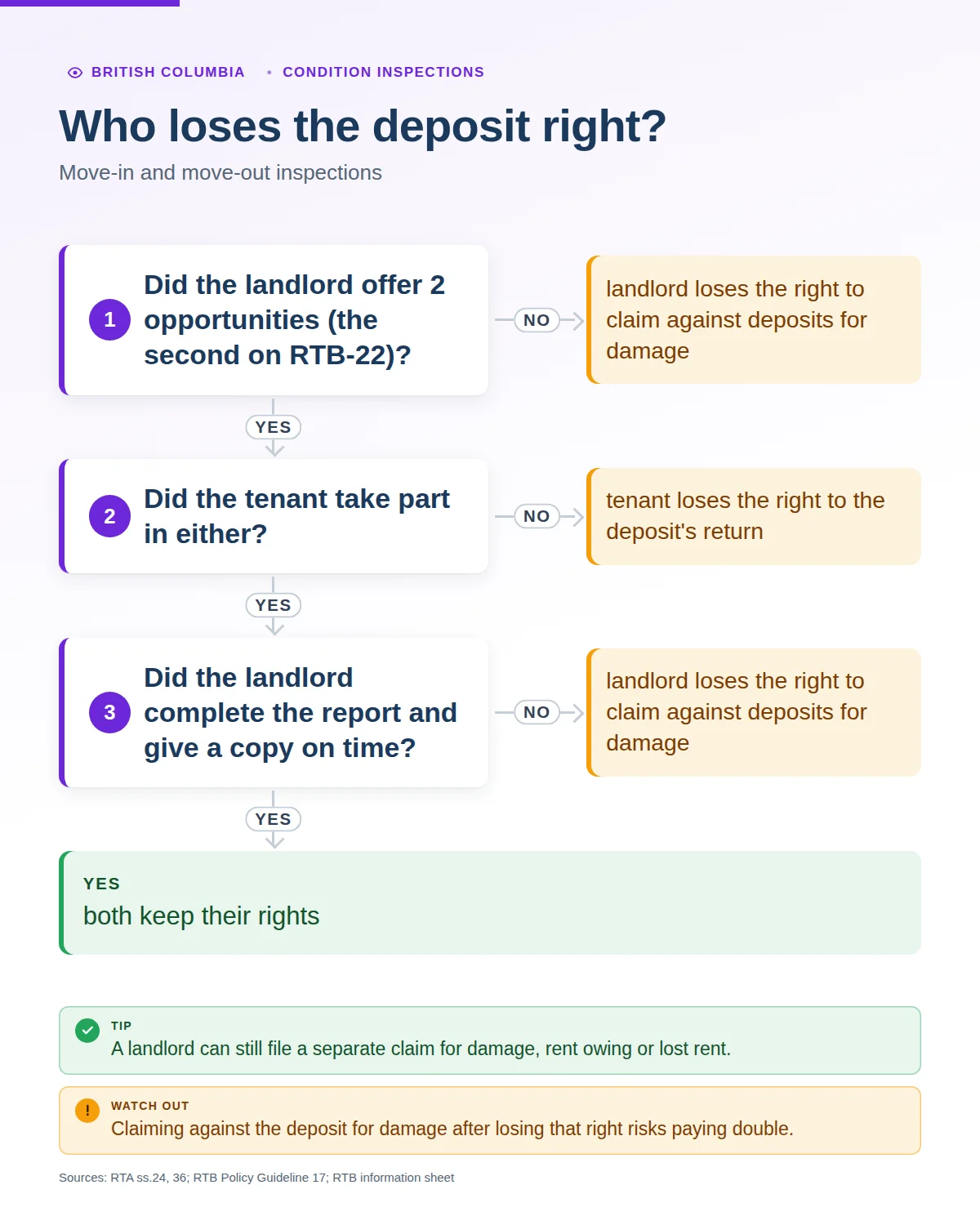
| Tenant | You offered two opportunities and the tenant took part in neither | The right to the return of the security and pet damage deposits | RTA ss.24(1), 36(1) |
| Landlord (move-in) | You didn't offer two opportunities, didn't take part, or didn't complete the report and give the tenant a copy as required | The right to claim against the deposits for damage | RTA s.24(2) |
| Landlord (move-out) | You didn't offer two opportunities, didn't take part, or, after inspecting with the tenant, didn't complete the report and give a copy as required (unless the unit was abandoned) | The right to claim against the deposits for damage | RTA s.36(2) |
The landlord's loss is limited to claims against the deposit for damage. The RTB's inspection information sheet notes that a landlord who can't claim against a deposit may still file a claim for rent owing, damage to the unit or loss of rental income. The 15-day deposit deadline in section 38 still applies either way.
Worked example
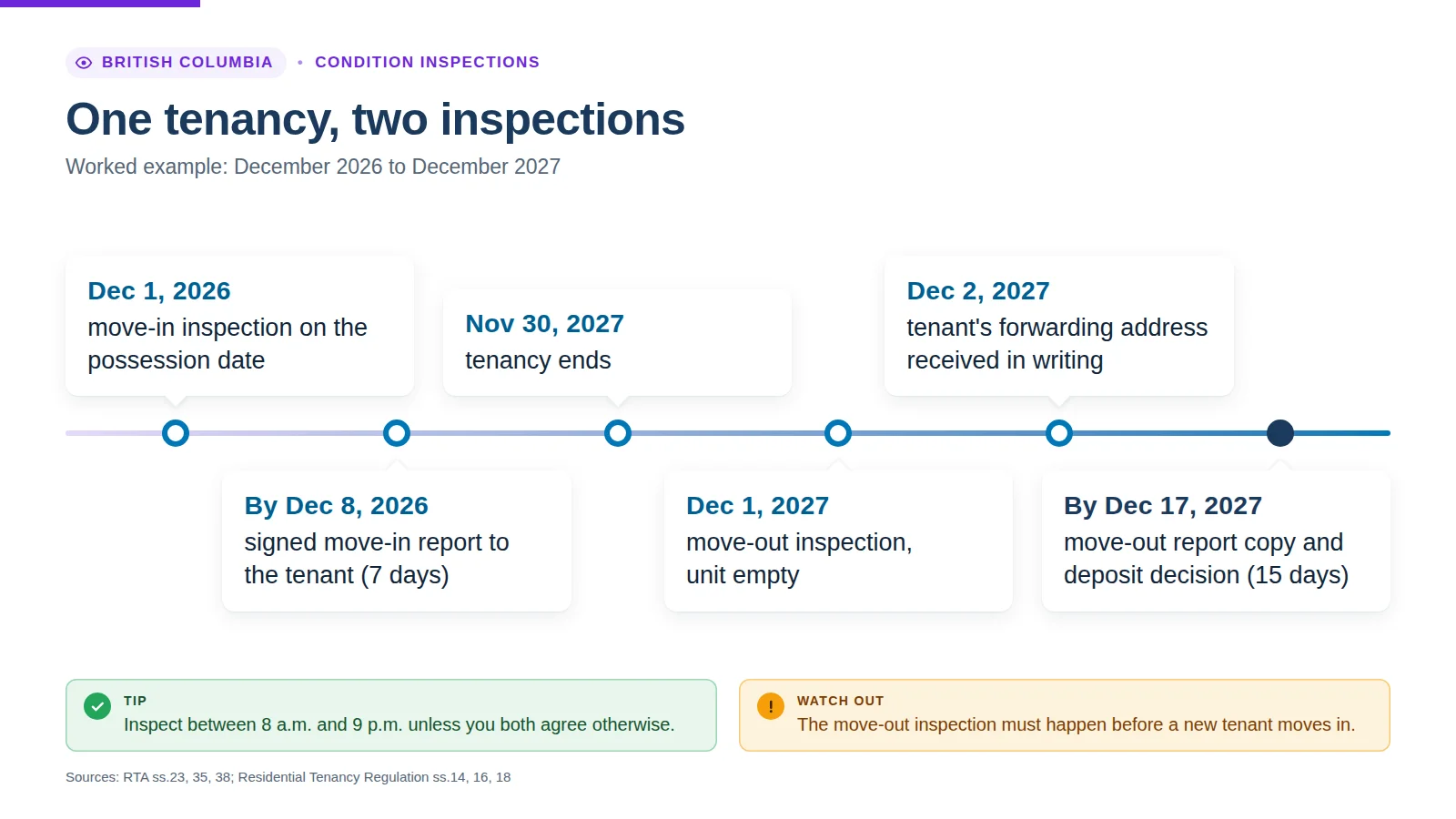
A tenancy starts December 1, 2026. You inspect with the tenant that afternoon and must give the signed copy by December 8, 2026. The tenancy ends November 30, 2027, you inspect on December 1, and the tenant's forwarding address reaches you in writing on December 2. The later of the two dates is December 2, so the move-out report copy is due by December 17, 2027. Under section 38, the deposit decision (return it, or apply for dispute resolution) is due by the same date.
Common mistakes
- Inspecting a half-furnished unit. The Regulation expects an empty unit. Boxes and furniture hide floors and walls, and the tenant can say the damage happened during the move.
- Offering one time and calling it done. Without the second opportunity on the RTB-22, a no-show tenant doesn't lose anything, but you can.
- Writing "fine" for every room. Vague entries carry little weight. Record what you see: "3 small holes above sofa", not "walls OK".
- Not letting the tenant record disagreement. The report must give the tenant space to disagree. The RTB says you must allow it.
- Forgetting the copy. A completed report that never reaches the tenant within 7 days at move-in is a reason you can lose your damage claim against the deposit.
- Booking outside 8 a.m. to 9 p.m. without the tenant's agreement.
Running inspections across a portfolio
With a handful of units, you can remember each tenant's move dates. With 30 or 300, inspections fail on scheduling, not on knowledge. A simple system:
- Book the move-in inspection at lease signing. Propose the possession date and a time between 8 a.m. and 9 p.m. in writing.
- Book the move-out inspection when notice arrives. As soon as a tenant gives notice or a fixed term is ending, send the first offer.
- Keep an RTB-22 ready. If the first offer fails, issue the second opportunity on the form straight away, not on the last day.
- Use one report format everywhere. Same rooms, same codes, same photo naming. Inspectors can swap buildings without learning a new form.
- Pull the move-in report before the move-out walk. The RTB suggests comparing past reports. Walk the unit with the old report in hand.
- Track two clocks per tenancy. The 7-day copy after move-in, and the 15-day window after move-out, which covers both the report copy and the deposit.
- File everything with the tenancy. Report, offers, RTB-22, photos and proof of service, together.
How Tenon10 helps
Tenon10 includes a fillable Condition Inspection Report (RTB-27) with a room-by-room grid, so every unit is inspected against the same list of rooms and features. Deposit tracking follows the 15-day return clock after move-out and flags the risk of paying back double.
The report sits with the lease, notices and payment records for the tenancy, which together form your evidence record if a deposit dispute reaches the RTB. The RTB-22 itself is a government form; Tenon10 links to it rather than generating it.
Frequently asked questions
Do I have to use the RTB-27?
No. The RTB says landlords can use their own form, but it must meet sections 19 and 20 of the Regulation. The RTB-27 already does.
The tenant won't sign the report. What now?
The tenant has the right to record disagreement on the report. If they still refuse to sign, make a dated note of the refusal, keep your own copy and photos, and give them a copy within the deadline.
Can I inspect after the new tenant moves in?
No. Section 35 requires the move-out inspection before a new tenant begins to occupy the unit.
Does a manufactured home site need an inspection?
The RTB's information sheet says that where a tenant owns the home and rents only the site, a condition inspection isn't required, unless the tenant rents both the home and the site under a residential tenancy agreement.
The tenant didn't show up twice. Can I keep the whole deposit?
Their right to its return is extinguished under section 24(1) or 36(1). RTB Policy Guideline 17 says the deposit is then set off against any amount awarded to you, and the balance may be kept. Keep the RTB-22 and your first offer as proof.
BC Condition Inspection Checklist
A landlord checklist for BC move-in and move-out inspections: timing, the two opportunities and RTB-22, what the report must contain, and the 7-day and 15-day copy deadlines.
Get Free PDF →Inspect every unit the same way
Use Tenon10's fillable RTB-27 with a room-by-room grid, and track each deposit against the 15-day return clock.
Built for Canadian landlords and property managers.
Related BC guides
- BC Security and Pet Damage Deposits: The Complete Landlord Guide
- The 15-Day Rule: Returning a Deposit at the End of a BC Tenancy
- When a BC Landlord Must Pay Back Double the Deposit
- Serving Documents in BC: Every Method the RTA Allows
Sources: Residential Tenancy Act; Residential Tenancy Regulation; RTB: Move-in condition inspection; Condition Inspection Report (RTB-27); RTB-22; RTB: Inspecting the Rental Unit; RTB Policy Guideline 17. This article is a summary of British Columbia rules as of October 2026, not legal advice. Check the Residential Tenancy Branch for your situation.