The move-in walk-through takes 30 minutes. Filling in the form properly decides whether those 30 minutes protect you later. A box left blank, a code nobody understands or a missing signature can turn a solid deposit claim into an argument you can't win.
The Residential Tenancy Branch (RTB) publishes the Condition Inspection Report, form RTB-27. It is seven pages long and uses letter boxes, numbered boxes and condition codes that are easy to misread on the day.
This guide goes through the current version (RTB-27, 2024/11) box by box, explains the codes, and flags the entries that most often cause problems at a hearing.
RTB-27 Fill-In Checklist
A landlord checklist for completing the BC Condition Inspection Report (RTB-27) box by box, with the condition codes and the copy deadlines.
Get Free PDF →The rule behind the form
Sections 23 and 35 of the Residential Tenancy Act require a landlord to complete a condition inspection report at the start and end of a tenancy, signed by both parties, with a copy to the tenant. Sections 19 and 20 of the Residential Tenancy Regulation say what the report must look like and contain.
You don't have to use the RTB-27. Its own instructions call it a sample and say that if you use another form, it must comply with sections 19 and 20 of the Regulation. Most landlords use the RTB-27 because it already does.
The form has columns for the condition at the beginning and at the end of the tenancy. The RTB's guide to completing the report says to fill in only the beginning column at move-in.
Page 1: the parties and the dates
| Box | What to enter | Tip |
|---|---|---|
| A. Legal name of landlord(s) | The landlord's legal name, or business name | Match the tenancy agreement exactly. |
| B. Landlord's address for service | Your address for service at the start of the tenancy | The Regulation requires it (s.20(1)(d)). |
| C. Legal name of tenant(s) | Each tenant's legal name | For more tenants, the RTB uses a Schedule of Parties (RTB-26). |
| D. Address of rental unit | Unit and street address as in the tenancy agreement | Include the suite number. |
| E. Possession date | The date the tenant is entitled to possession | Not necessarily the move-in day. |
| F. Move-in inspection date | The date of the move-in inspection | Starts the 7-day clock for the tenant's copy. |
| G. Move-out date | The date the tenant moves out | Leave blank until the end of the tenancy. |
| H. Move-out inspection date | The date of the move-out inspection | Leave blank until the end of the tenancy. |
| I. Legal name of tenant's agent | Anyone attending for the tenant, on move-in and on move-out | The tenant must tell you in advance (Regulation s.15). |
Pages 2 to 4: rooms, features and codes
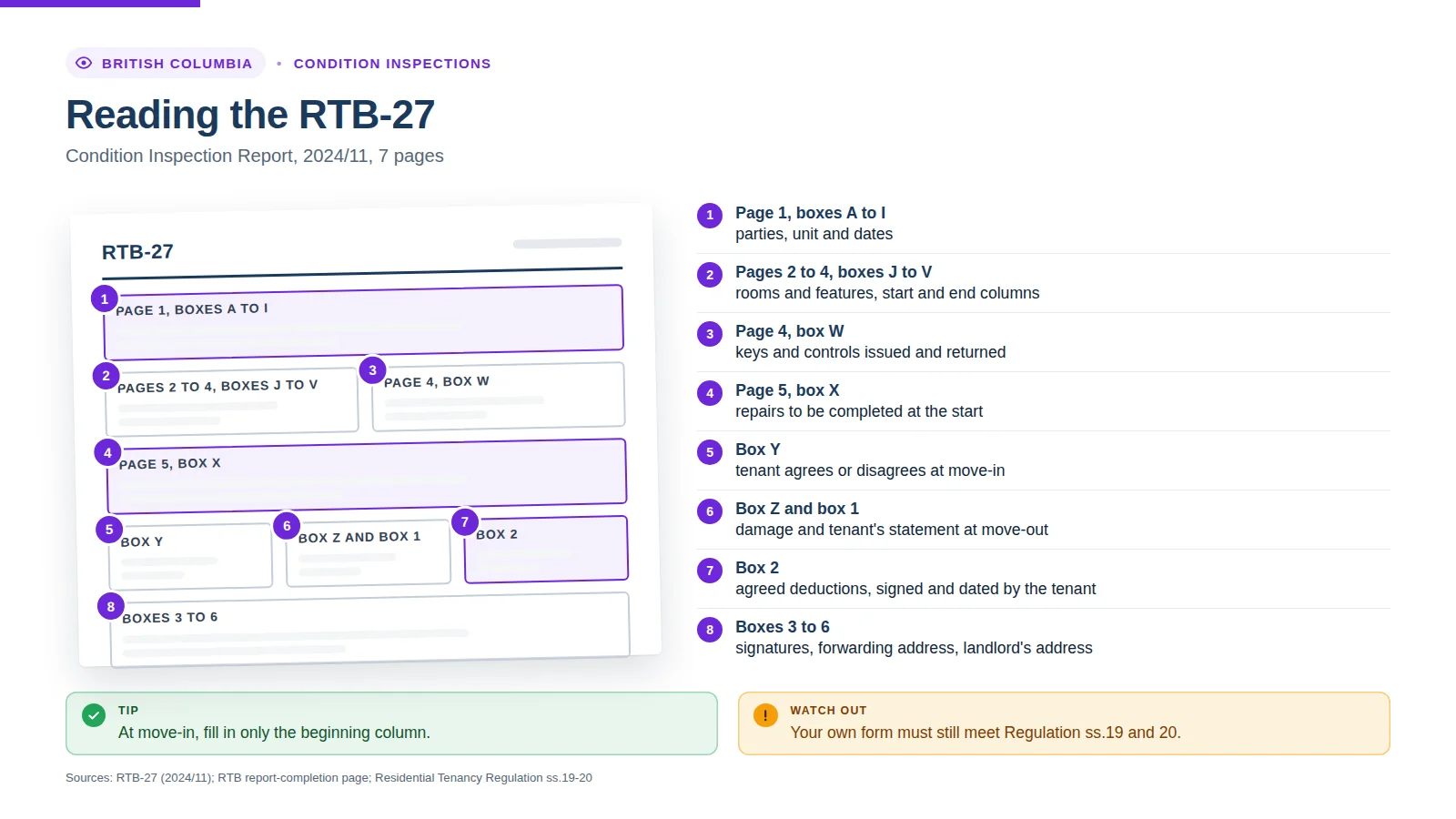
Boxes J to V cover the rooms and areas: J Entry, K Kitchen, L Living Room, M Dining Room, N Stairwell and Hall, O Main Bathroom, P Master Bedroom (1), Q Bedroom (2), R Exterior, S Utility Room, T Garage or Parking Area, U Basement and V Storage. Each lists features, such as walls and trim, ceilings, floors, windows and coverings, lighting and outlets. The kitchen adds the stove, oven, fridge, freezer, dishwasher and exhaust fan.
For each feature there is a "Comment" and a "Code" column for the beginning and for the end of the tenancy.
The condition codes
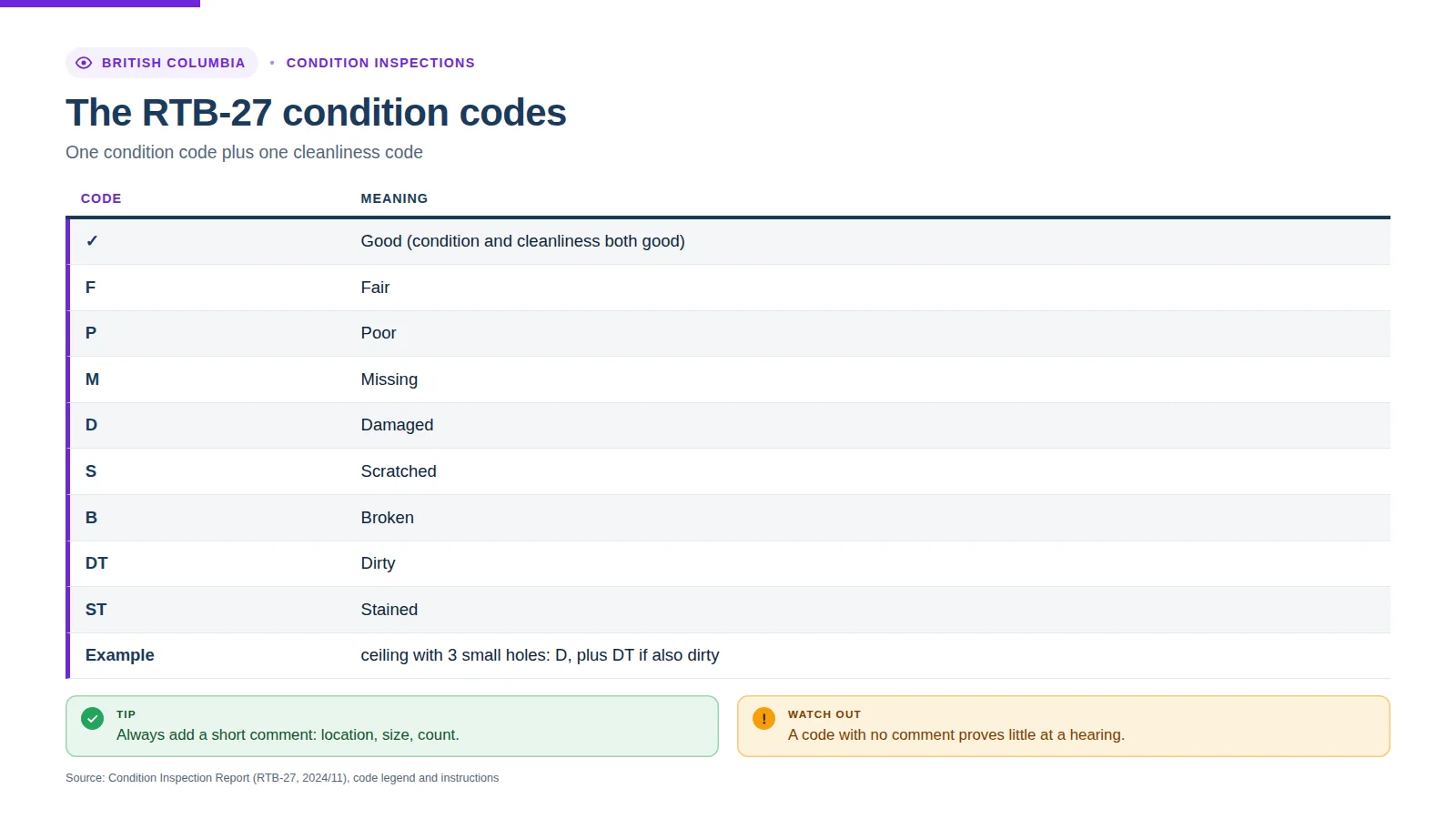
| Code | Meaning on the RTB-27 |
|---|---|
| ✓ | Good |
| F | Fair |
| P | Poor |
| M | Missing |
| D | Damaged |
| S | Scratched |
| B | Broken |
| DT | Dirty |
| ST | Stained |
The form's instructions say: if condition and cleanliness are both good, use the check mark. If not, use one code for condition and one code for cleanliness (DT or ST). The comment column adds detail. The RTB's own example: a clean ceiling with three small holes gets "D" in the code column and "3 small holes" in the comment. If it was also dirty, add "DT".
Rooms that don't match the form
The RTB says to cross out or write "not applicable" for rooms the unit doesn't have. For extra rooms, print additional pages, cross out the existing room name and add a new name that clearly describes the room, such as "Bedroom 3 (north)". Use the blank lines to add items the form doesn't list, such as furniture or appliances.
Page 4: keys and controls (box W)
Record how many of each key or control you hand over: building entrance keys, unit entrance keys, deadbolt keys and parking remotes. At move-out, record how many come back. The Act requires the tenant to return all keys and other means of access when they leave (s.37(2)(b)), so this count is your evidence.
Pages 5 and 6: repairs, agreement and signatures
| Box | When | What it records |
|---|---|---|
| X. Start of Tenancy | Move-in | Repairs to be completed at the start of the tenancy |
| Y. Tenant's statement | Move-in | The tenant agrees, or does not agree, that the report fairly represents the unit, with reasons |
| Z. End of Tenancy | Move-out | Damage to the unit or property for which the tenant is responsible |
| 1. Tenant's statement | Move-out | Agreement or disagreement with the move-out report, with reasons |
| 2. Agreed deductions | Move-out | Amounts the tenant agrees may be deducted from the security and pet damage deposits, with date and tenant's signature |
| 3. Landlord's signature | Both | Signed on move-in and on move-out |
| 4. Tenant's signature | Both | Signed by the tenant or their agent on move-in and on move-out |
| 5. Tenant's forwarding address | Move-out | Forwarding address and an email address for service |
| 6. Landlord's name and address | Move-out | Your current name and address at the end of the tenancy |
The RTB says not to complete sections 1 and 2 at the start of the tenancy. The form's instructions add that a tenant's agent cannot agree to deposit deductions without the tenant's authorization.
Copy deadlines printed on the form
- Move-in: give the tenant a signed copy immediately if possible, and in any event within 7 days of the inspection (Regulation s.18(1)(a)).
- Move-out: within 15 days after the later of the inspection date and the date you receive the tenant's forwarding address in writing. The form notes this includes an email address the tenant provides as an address for service (Regulation s.18(1)(b)).
Common mistakes on the RTB-27
- Codes with no comments. "D" on a carpet tells nobody where or how big the damage is. Add a short, measurable comment.
- Filling in the end column at move-in. It invites confusion about which inspection recorded what.
- Leaving box X empty when repairs were promised. If you agreed to fix something, write it down with a date. It protects you from a later claim that you ignored it.
- No tenant statement. The tenant must be given the chance to agree or disagree. A blank Y box invites the argument that they weren't offered it.
- Deductions written in box Z instead of box 2. Box Z lists damage. Only box 2, signed and dated by the tenant, records an agreed deduction.
- Improvements not recorded. If you renovate during the tenancy, the instructions recommend a new report or an addendum signed by both of you.
Using the form across many units
- Pre-fill page 1 from the lease so names and addresses match exactly.
- Standardise extra rooms. Use the same name for the same kind of room in every building ("Den", "Bedroom 3").
- Agree on comment style. Short, measurable notes: location, size, count.
- Keep the move-in report with the tenancy and bring it to the move-out walk, as the RTB suggests.
- Track the copy date as a separate task, not something you'll "send later".
How Tenon10 helps
Tenon10's Condition Inspection Report (RTB-27) is fillable, with a room-by-room grid that follows the form. Each unit is inspected against the same rooms and features, and the move-in and move-out entries sit side by side.
The finished report is stored with the lease, notices and payment records for the tenancy. Deposit tracking follows the 15-day return clock and flags the risk of paying back double, so the report and the deposit decision stay linked.
Frequently asked questions
Is the RTB-27 mandatory?
No. It is a sample form. Your own form must still meet sections 19 and 20 of the Regulation, including type no smaller than 8 point.
What if the tenant disagrees with my codes?
They tick "do not agree" in box Y (move-in) or box 1 (move-out) and write which parts they disagree with and why. The RTB says you must give them that opportunity.
Can the tenant sign box 2 later?
Box 2 records an agreement the tenant makes at the end of the tenancy. Section 38(4) of the Act lets you keep an amount if the tenant agrees in writing at the end of the tenancy. Without that agreement or an earlier unpaid order, you must either return the deposit or apply for dispute resolution within the 15-day window (RTA s.38(1)).
How many photos should I take?
The RTB recommends many photos and videos, showing damage, stains, wear and tear and missing features. There is no set number.
RTB-27 Fill-In Checklist
A landlord checklist for completing the BC Condition Inspection Report (RTB-27) box by box, with the condition codes and the copy deadlines.
Get Free PDF →Fill in the RTB-27 room by room
Tenon10's fillable Condition Inspection Report uses a room-by-room grid and keeps each report with the tenancy's lease and deposit records.
Built for Canadian landlords and property managers.
Related BC guides
- BC Security and Pet Damage Deposits: The Complete Landlord Guide
- The 15-Day Rule: Returning a Deposit at the End of a BC Tenancy
Sources: Condition Inspection Report (RTB-27); RTB: Complete a move-in condition inspection report; RTB: Move-in condition inspection; Residential Tenancy Act; Residential Tenancy Regulation. This article is a summary of British Columbia rules as of October 2026, not legal advice. Check the Residential Tenancy Branch for your situation.