Owning rentals in both Ontario and British Columbia means running two rulebooks that look alike and differ in the details. Both provinces cap rent increases, both require written notice, both limit deposits. But the cap is different, the notice is counted differently, the deposit you may take is different, and the clock on an arrears notice is different. A habit that is correct in Toronto can be a breach in Vancouver.
This guide sets the two systems side by side for the decisions you make most often: setting and raising rent, taking a deposit, entering the unit, and acting on unpaid rent. Every figure comes from the governing statute or the provincial government's own pages, current as of October 2026.
Ontario and BC Landlord Rules Checklist
A two-province checklist for landlords: 1.9% vs 2.2% for 2027, 90 days vs three full months, deposit limits, entry windows and arrears notices in Ontario and BC.
Get Free PDF →The rules side by side
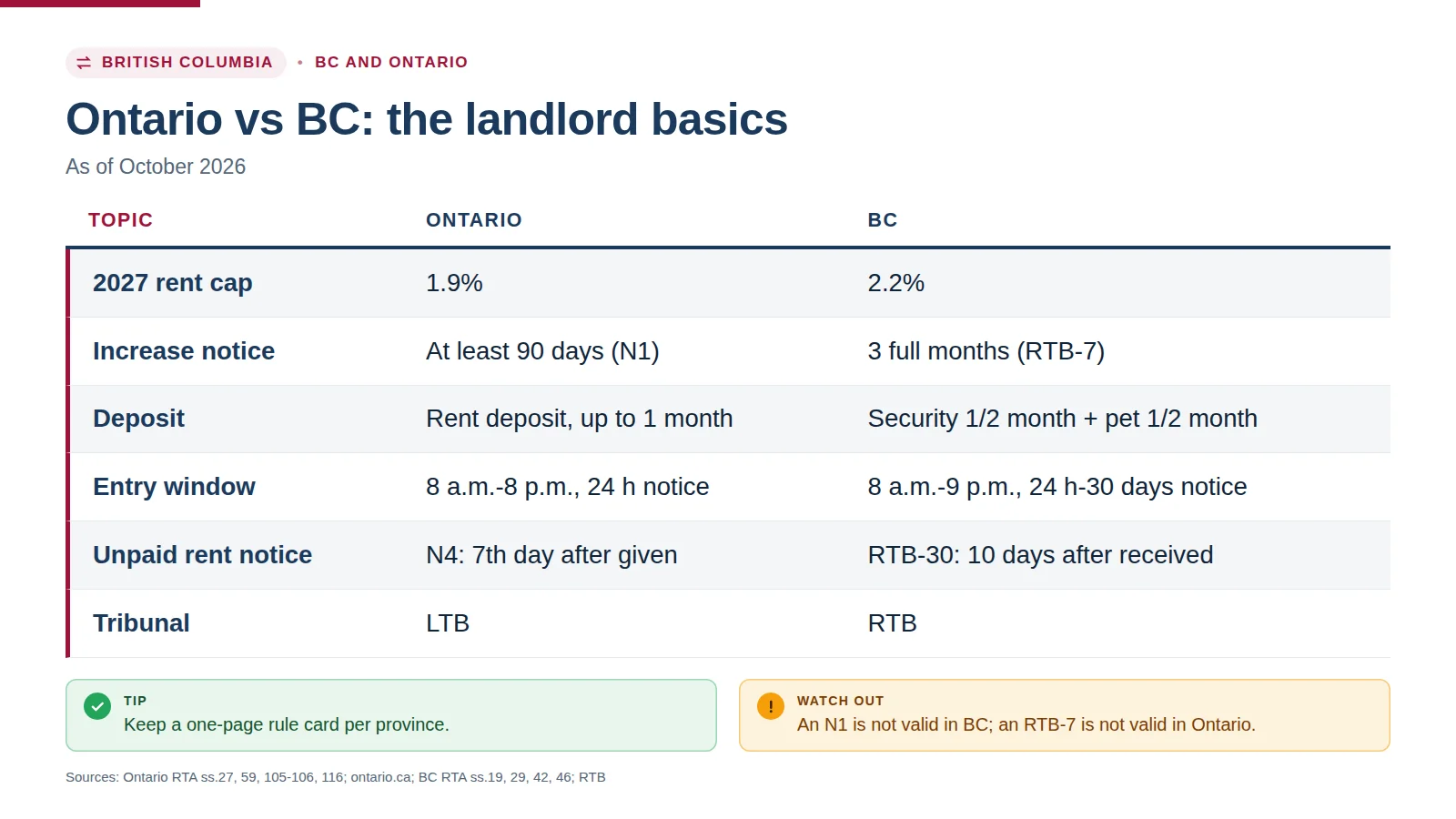
Ontario tenancies run under the Residential Tenancies Act, 2006 and the Landlord and Tenant Board (LTB). BC tenancies run under the Residential Tenancy Act and the Residential Tenancy Branch (RTB).
| Topic | Ontario | British Columbia |
|---|---|---|
| 2027 rent increase cap | 1.9% guideline | 2.2% limit |
| 2026 cap | 2.1% | 2.3% |
| How often | Once 12 months have passed since the last increase or the start of the tenancy | Once every 12 months, from when rent was first payable or the last lawful increase |
| Notice of increase | At least 90 days' written notice, on the LTB form (N1) | At least 3 full months, on Form RTB-7 |
| Newer buildings | New buildings, additions and most new basement apartments first occupied for residential purposes after Nov 15, 2018 are exempt from the guideline | The RTB's rent increase page sets one limit and lists no such exemption |
| Deposits | Only a rent deposit, no more than one month's rent (or one rent period if shorter) | Security deposit up to 1/2 month's rent, plus a pet damage deposit up to 1/2 month's rent |
| Deposit interest | Paid annually at the guideline rate | Set by regulation; 0% for 2026 |
| Entry with notice | 24 hours' written notice; time between 8 a.m. and 8 p.m. | 24 hours to 30 days' written notice; time between 8 a.m. and 9 p.m. |
| Unpaid rent notice | N4: termination date not earlier than the 7th day after the notice is given | RTB-30: effective not earlier than 10 days after the tenant receives it; tenant has 5 days to pay or dispute |
| Lease | Ontario standard lease template for most private units | Written tenancy agreement containing the standard terms |
Rent increases: the biggest difference
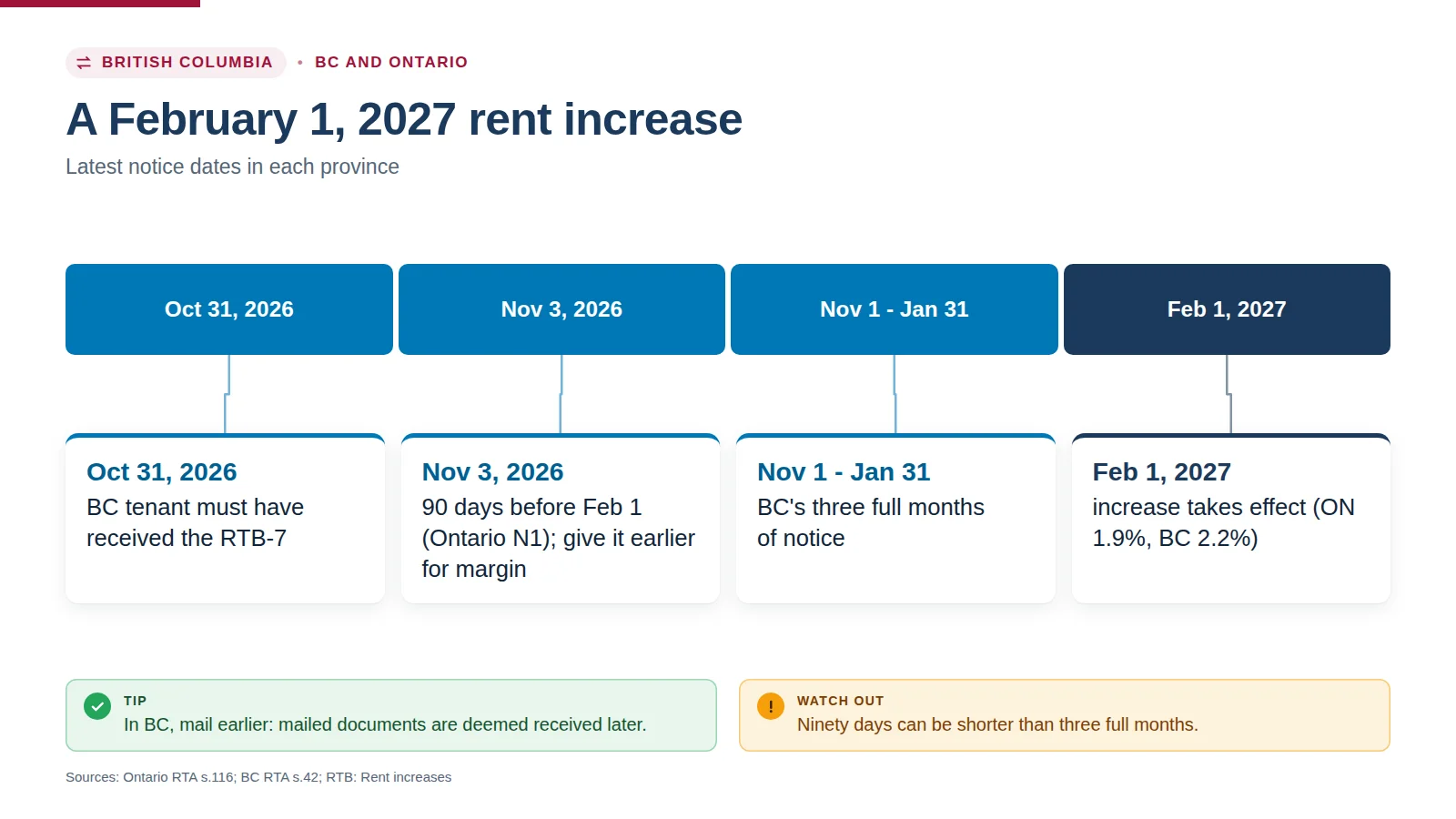
For increases taking effect in 2027, Ontario's guideline is 1.9% and BC's limit is 2.2%. Ontario's page says its guideline is based on the Ontario Consumer Price Index and capped at 2.5%.
Same rent, two provinces
| Current rent | Ontario, 1.9% | BC, 2.2% |
|---|---|---|
| $1,800 | $1,834.20 | $1,839.60 |
| $2,000 | $2,038.00 | $2,044.00 |
| $2,500 | $2,547.50 | $2,555.00 |
Notice is counted differently
Ontario requires at least 90 days' written notice (s.116). BC requires the notice at least 3 months before the effective date (s.42), which the RTB describes as three full months. For an increase on February 1, 2027:
- BC: the tenant must receive the RTB-7 by October 31, 2026, so November, December and January are full months of notice. Serving by mail means mailing earlier still, because mailed documents are deemed received later.
- Ontario: counting back 90 days from February 1, 2027 lands on November 3, 2026. Give the N1 earlier than that to leave margin for delivery.
The two provinces also differ on which units are covered. Ontario exempts units in new buildings, additions and most new basement apartments first occupied for residential purposes after November 15, 2018. BC's rent increase page sets one limit for residential tenancies under its Act and lists no comparable exemption.
Deposits, entry and arrears
Deposits
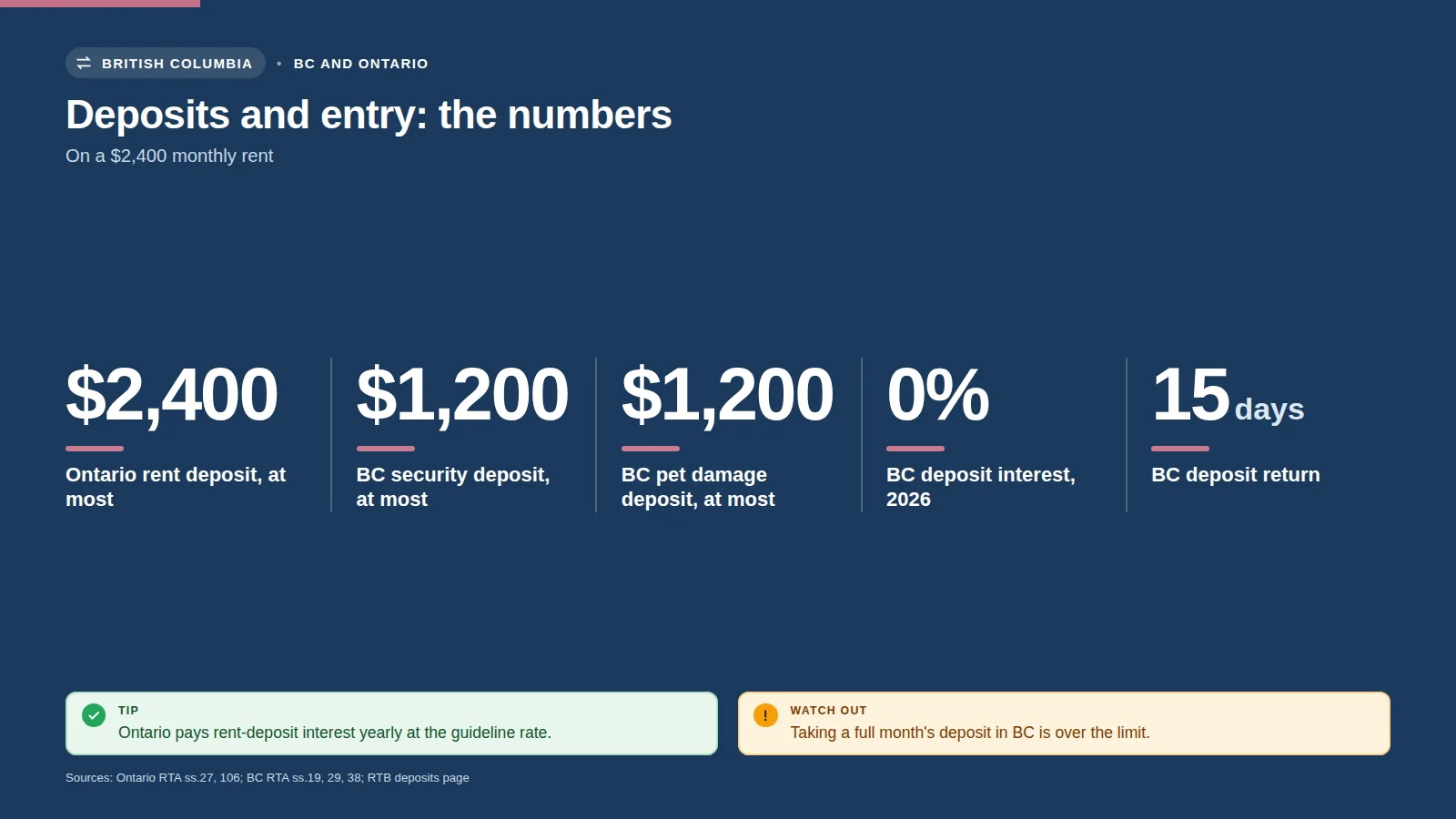
On a $2,400 monthly rent, an Ontario landlord may take a rent deposit of up to $2,400, and nothing else as a security deposit (ss.105-106). A BC landlord may take a security deposit of up to $1,200 and, if a pet is allowed, a pet damage deposit of up to $1,200 (s.19). In BC, if you accept more than the limit, the tenant may deduct the overpayment from rent (s.19(2)).
Ontario landlords pay interest on the rent deposit every year at the guideline rate in effect when the payment is due (s.106(6)). BC landlords apply the regulated rate when the deposit is returned; the RTB lists 0% for 2026. In BC, the deposit must be repaid, or a claim filed, within 15 days after the later of the end of the tenancy and receiving the tenant's forwarding address in writing.
Entering the unit
Both provinces require 24 hours' written notice for most entries. Ontario's notice must give the reason, the day, and a time between 8 a.m. and 8 p.m. (s.27). BC's notice must be given at least 24 hours and not more than 30 days before, with a reasonable purpose and a date and time between 8 a.m. and 9 p.m. unless the tenant agrees otherwise (s.29). An 8:30 p.m. showing is fine in BC and outside the window in Ontario.
Unpaid rent
Ontario's N4 can set a termination date not earlier than the 7th day after the notice is given (s.59(1), as amended in 2025 and in the consolidated Act since September 21, 2026). The tenant avoids termination by paying the rent owing by that date. BC's 10 Day Notice (RTB-30) can be given the day after rent is due and takes effect not earlier than 10 days after the tenant receives it; within 5 days of receiving it the tenant may pay in full, which cancels it, or dispute it (s.46).
Common mistakes for two-province owners
- Taking a full month's deposit in BC. The Ontario habit is over the BC limit.
- Using 90 days in BC. Ninety days can be shorter than three full months. Count whole rental months.
- Applying 2.2% to an Ontario unit. Ontario's 2027 guideline is 1.9%.
- Assuming a post-2018 BC building is exempt. That exemption is Ontario's.
- Booking evening entries on BC times in Ontario. Ontario's window closes at 8 p.m.
- Using the wrong form. An N1 is not valid in BC, and an RTB-7 is not valid in Ontario.
Running both portfolios
- One calendar, two rule sets. Track each tenancy's 12-month date and the serve-by date calculated under its own province's rule.
- One deposit register. Record the type (rent deposit or security/pet), amount, and the interest rule that applies.
- Province-specific templates for entry notices, so the time window is right by default.
- Keep the evidence together. The LTB and the RTB both decide on the documents you bring.
How Tenon10 helps
For BC units, Tenon10 generates the Notice of Rent Increase (RTB-7), the 10 Day Notice (RTB-30), the One Month Notice for Cause (RTB-33) and a BC tenancy agreement with every detail the Act requires and the standard terms copied word for word from the current Regulation, and tracks deposits against the 15-day return clock with a flag for the double-penalty risk.
FAQ
Which province allows the bigger 2027 increase?
BC: 2.2%, compared with Ontario's 1.9% guideline.
Can I collect a pet deposit in Ontario?
Ontario's Act says the only security deposit a landlord may collect is a rent deposit under section 106.
Is the notice for a rent increase the same length?
No. Ontario counts at least 90 days; BC counts at least three full months before the effective date.
Who hears disputes?
The Landlord and Tenant Board in Ontario, and the Residential Tenancy Branch in BC.
Ontario and BC Landlord Rules Checklist
A two-province checklist for landlords: 1.9% vs 2.2% for 2027, 90 days vs three full months, deposit limits, entry windows and arrears notices in Ontario and BC.
Get Free PDF →Own in BC as well as Ontario?
Tenon10 generates BC's RTB-7, RTB-30 and RTB-33 and a BC tenancy agreement with the current standard terms, and tracks the 15-day BC deposit return clock.
Built for Canadian landlords and property managers.
Ontario details: read our Ontario 2027 N1 guide.
Related BC guides
- BC Rent Increase Limit for 2027: 2.2%, and What Landlords Can Charge
- Three Full Months: Serve-Date Maths for BC Rent Increases
- BC Security and Pet Damage Deposits: The Complete Landlord Guide
- How to Give a 10 Day Notice to End Tenancy for Unpaid Rent in BC (RTB-30)
Sources: Ontario.ca: Residential rent increases; Ontario Residential Tenancies Act, 2006; Ontario.ca: Renting in Ontario, your rights; Tribunals Ontario: LTB forms; BC Residential Tenancy Act; RTB: Rent increases; RTB: Tenancy deposits and fees. This article is a summary of British Columbia and Ontario rules as of October 2026, not legal advice. Check the Residential Tenancy Branch or the Landlord and Tenant Board for your situation.