You have found a tenant for your Vancouver suite and want the lease signed this week. You could print the government PDF and fill it in by hand, copy last year's agreement and edit it, or start from a generic template you found online. Each route has a trap: handwriting errors, stale clauses, or missing standard terms.
In British Columbia the law decides what a tenancy agreement must contain, not the template. If a required item is missing or a term contradicts the Residential Tenancy Act (RTA), that part of your lease won't hold up when you need it.
This walkthrough covers what a BC tenancy agreement must include, the mistakes that cause trouble later, and how to prepare a clean BC tenancy agreement in Tenon10.
BC Tenancy Agreement Checklist
A landlord checklist for preparing a BC tenancy agreement: every detail section 13 requires, the format rules, deposits, fees, the end-of-term choice and the 21-day copy.
Get Free PDF →What a BC tenancy agreement must contain
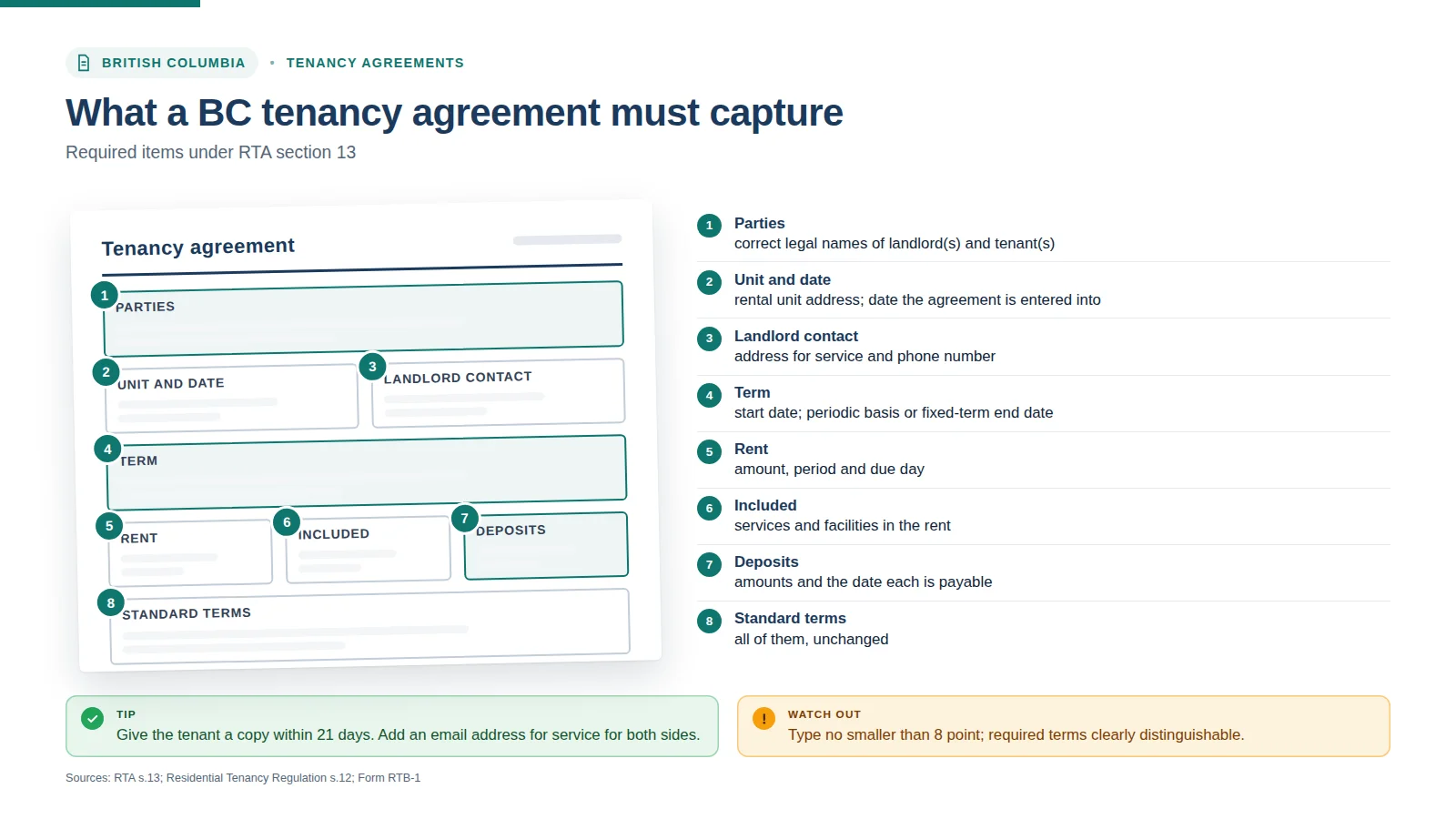
Section 13 of the Residential Tenancy Act says a landlord must prepare every tenancy agreement in writing. It must set out:
- the standard terms;
- the correct legal names of the landlord and tenant;
- the address of the rental unit;
- the date the agreement is entered into;
- the address for service and telephone number of the landlord or the landlord's agent;
- the start date, and whether the tenancy is weekly, monthly or another periodic basis, or for a fixed term (with the end date);
- the rent for a specified period, and the amount it varies by if it changes with the number of occupants;
- the day rent is due;
- which services and facilities are included in the rent; and
- the amount of any security or pet damage deposit and the date it was or must be paid.
The Residential Tenancy Regulation adds format rules in section 12: the agreement must be signed and dated by both parties, in type no smaller than 8 point, easy for a reasonable person to read, and the required terms must be clearly distinguishable from any terms you add.
Within 21 days after you and the tenant enter into the agreement, you must give the tenant a copy (RTA s.13(3)).
The RTB-1 and your own agreement
The Residential Tenancy Branch (RTB) publishes a template, the Residential Tenancy Agreement (RTB-1), but BC has no mandatory lease form. The RTB's tenancy agreements page says landlords can create their own agreement as long as it includes all the standard terms.
The standard terms are the Schedule to the Regulation. The Regulation was last amended on July 30, 2026 (B.C. Reg. 142/2026), and that amendment changed the Schedule. The RTB-1 PDF, version 2023/06, prints an older wording of some of them: where it says "an arbitrator's order", the Schedule now says "an order of the director". Whatever you use, the terms in force are the Schedule's.
Common mistakes when preparing the agreement
Nicknames instead of legal names
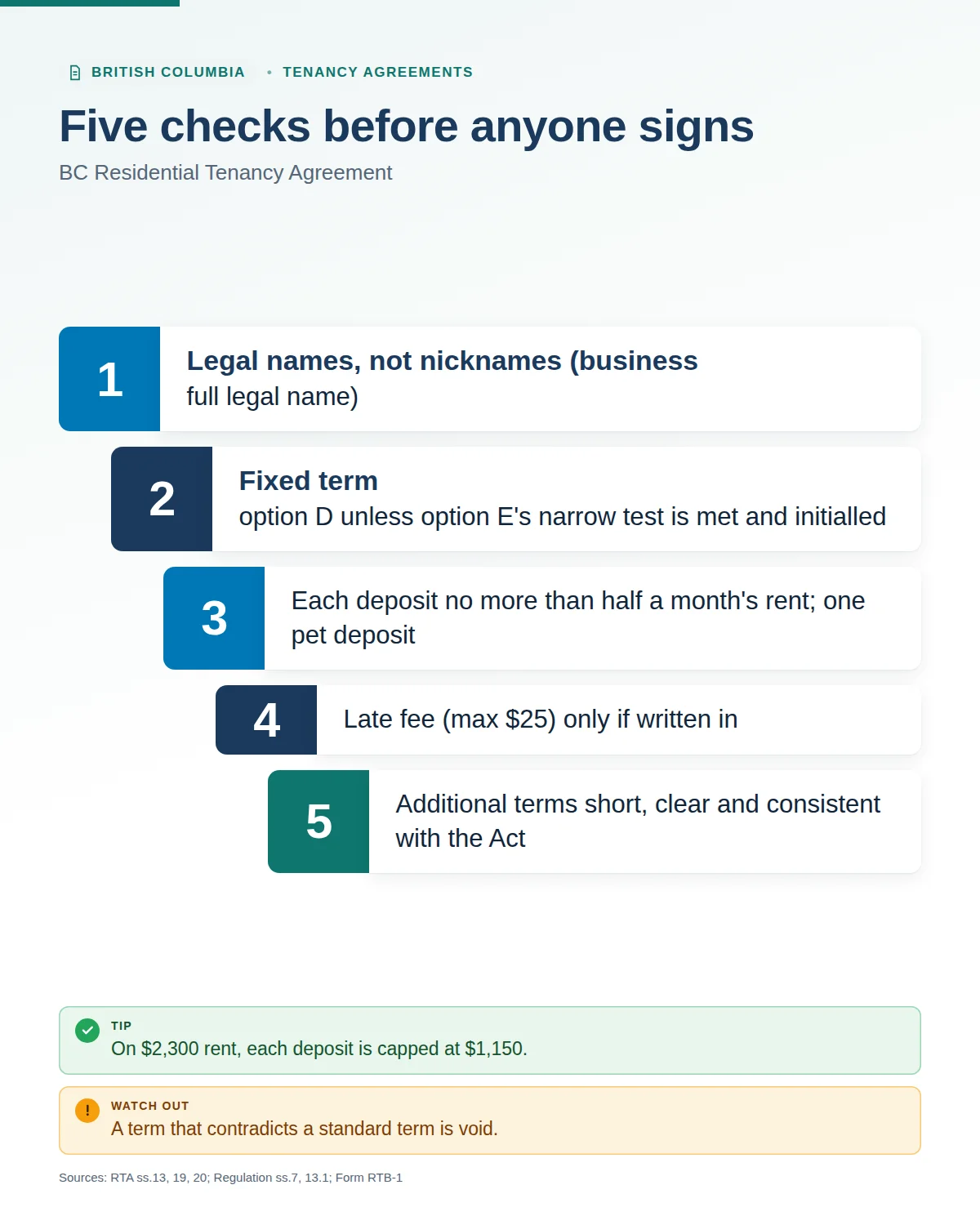
The Act requires the correct legal names. If the landlord is a company, the RTB-1 tells you to put the full legal business name in the last-name box. A wrong name can cause problems later, for example when you need an order to be enforced.
Picking the wrong end-of-term option
For a fixed term, the agreement must say what happens at the end. On the RTB-1 these are options D and E. Option D: the tenancy continues month to month (or for another fixed term) unless the tenant ends it. Option E: the tenancy ends and the tenant must move out. Option E is only allowed where the landlord is an individual who, or whose close family member, will occupy the unit at the end of the term (Regulation s.13.1), or for a sublease agreement as defined in the Act. The reason is required, and both of you must initial it.
Deposits over the cap
A security deposit and a pet damage deposit are each capped at half of one month's rent (RTA s.19). On $2,300 rent, that is $1,150 each at most. Only one pet damage deposit is allowed per tenancy, however many pets (s.20). Write the due date in the agreement; a tenant who fails to pay a deposit within 30 days of the date it is required is a ground for a cause notice under s.47(1)(a).
Fees the agreement doesn't mention
A late-payment fee of up to $25 and a fee for moving between units in the same building can only be charged if the tenancy agreement provides for them (Regulation s.7(2)). If you want them, they must be written in.
Additional terms that override the Act
Additional terms are fine as long as they don't contradict the Act or the standard terms. The RTB-1 says a term that does is void. Guest bans, entry without notice and automatic deposit forfeiture are typical examples that fail.
Step by step: creating the agreement in Tenon10
Tenon10 does not fill in the RTB-1. It generates its own BC tenancy agreement that asks for every detail section 13(2) of the Act requires and carries the standard terms copied word for word from the Regulation as currently in force. The agreement is built in five steps:
- Parties. Full legal names of up to two landlords (a business enters its full legal business name as the last name) and up to four tenants, with an optional email address for service and phone for each tenant. For more than four tenants, attach a Schedule of Parties (RTB-26). Then the rental unit's address, and your address for service, daytime phone and, ideally, an email address for service.
- Term and rent. The date the agreement is entered into and the start date. Choose periodic (monthly, weekly or another basis) or a fixed term with its end date. For a fixed term there is a separate switch for a tenant who must move out at the end, which asks for the reason. Then the rent, whether it is payable each month, week or day, the due day, and the amount per occupant if rent varies with occupants. Last, tick the services and facilities included in the rent, such as heat, water, electricity, parking, storage or laundry, and add any others. Anything not listed may later be disputed.
- Deposits and fees. Security and pet damage deposit amounts (each no more than half a month's rent) and the date each is payable. Any late-payment or returned-cheque administration fee you want must be written in here, such as a late-payment fee up to $25. You also record whether pets are permitted.
- Terms. The standard terms appear word for word and set apart from your own terms; they cannot be edited. Below them, add your additional terms. Keep each one short and clear, and check none of them changes a standard term.
- Sign. A signature and date line for the landlord and for each tenant. Then give the tenant a copy within 21 days.
Doing it across several units
If you sign several leases a year, consistency matters more than speed:
- Keep one approved list of additional terms and reuse it, with a version date.
- Record each unit's included services once, so every new agreement for that unit matches.
- Set the same rent due day across a building where you can; it simplifies notices later, because many notice dates are tied to the day rent is due.
- Store the signed agreement with the tenancy, not in an email thread, so it is easy to find when you serve a notice or prepare for a hearing.
How Tenon10 helps
Tenon10 generates a BC tenancy agreement with every detail the Act requires and the standard terms copied word for word from the current Regulation, so you are not retyping the terms or working from an older printed version. It also generates the BC notices you are most likely to need later, including the Notice of Rent Increase (RTB-7), the 10 Day Notice (RTB-30) and the One Month Notice for Cause (RTB-33), and a fillable Condition Inspection Report (RTB-27) with a room-by-room grid.
The lease, notices and payment records for each tenancy are kept together. If a dispute ever reaches the RTB, that record is your evidence of what was agreed and when.
Frequently asked questions
Can I make my own lease instead of the RTB-1?
Yes. The RTB says landlords can create their own agreement, but it must include all the standard terms and meet the Act and Regulation. A required term can't be removed or changed (RTA s.14). The agreement Tenon10 generates is this kind of agreement.
Does a verbal tenancy count?
The standard terms apply whether or not the agreement is in writing (RTA s.12). But section 13 requires the landlord to prepare it in writing, so put every tenancy on paper.
Can I add a clause after signing?
Only if the tenant agrees. The RTB-1 says any change or addition must be agreed in writing and initialled by both of you, or it is not enforceable. Rent increases given under the Act are the main exception.
How fast must the tenant get a copy?
Within 21 days after you enter into the agreement (RTA s.13(3)).
BC Tenancy Agreement Checklist
A landlord checklist for preparing a BC tenancy agreement: every detail section 13 requires, the format rules, deposits, fees, the end-of-term choice and the 21-day copy.
Get Free PDF →Start every BC lease with the current standard terms
Tenon10 generates a BC tenancy agreement with every detail the Act requires and the standard terms word for word from the current Regulation, and keeps it with the notices and payment records for the tenancy.
Built for Canadian landlords and property managers.
Related BC guides
- The BC Residential Tenancy Agreement (RTB-1): The Complete Landlord Guide
- What You Can and Can't Add to a BC Tenancy Agreement
- Fixed-Term vs Month-to-Month in BC: What Happens When the Term Ends
- The Half-Month Cap: How Much Deposit a BC Landlord Can Collect
Sources: Residential Tenancy Act; Residential Tenancy Regulation; RTB: Tenancy agreements; Residential Tenancy Agreement (RTB-1). This article is a summary of British Columbia rules as of October 2026, not legal advice. Check the Residential Tenancy Branch for your situation.