A BC landlord can raise the rent after new windows beyond the annual limit only through a Residential Tenancy Branch order for an additional rent increase for capital expenditures, or with the tenant's written agreement (RTA s.43(1)). The landlord must apply within 18 months of the final payment, deduct rebates, and impose no more than 3% of rent a year.
New windows are one of the larger bills a BC landlord pays, and the question that follows is whether any of it can be recovered through rent. The answer is yes, sometimes, but not by simply adding it to the annual increase. A landlord must apply to the Residential Tenancy Branch (RTB) for an additional rent increase for capital expenditures (the RTB calls it an ARI-C), meet strict tests in the Residential Tenancy Regulation, and then phase in whatever is approved. This guide explains what is and is not allowed, and what tenants who receive an application can do.
How can a BC landlord raise the rent beyond the annual limit?

In BC, rent can go up in only three ways under section 43(1) of the Residential Tenancy Act: by the annual amount calculated under the regulations, by an amount the director orders on an application, or by an amount the tenant agrees to in writing. Section 43(3) lets the landlord apply for a larger increase in circumstances the regulations prescribe; for window work, that is eligible capital expenditures under section 23.1 of the Residential Tenancy Regulation.
| Route to a BC rent increase | What it needs | Source |
|---|---|---|
| Annual increase | No more than the amount calculated under the regulations, with three months' notice on the approved form | RTA s.43(1)(a) |
| Tenant's agreement | The tenant agrees to the amount in writing | RTA s.43(1)(c) |
| Additional rent increase for capital expenditures (ARI-C) | An RTB order on the landlord's application, meeting the Regulation's tests | RTA s.43(1)(b), (3); Regulation ss.23.1–23.3 |
Our guides to the BC rent increase limit and the Notice of Rent Increase (RTB-7) cover the annual part.
Are new windows an eligible capital expenditure in BC?
They can be: the RTB's Policy Guideline 37C lists windows and entry doors among examples of major components, and names replacing single-pane windows with double-paned windows as an example of work that may reduce energy use. Under section 23.1(4) of BC's Residential Tenancy Regulation, the RTB must grant the part of the expenditure the landlord proves meets all three of these tests:
- The reason. The money was spent to install, repair or replace a major system or major component (a) to keep the property in a state of repair that meets health, safety and housing standards under section 32(1)(a) of the Act, (b) because it has failed, is malfunctioning or inoperative, or is close to the end of its useful life, or (c) to reduce energy use or greenhouse gas emissions, or improve the security of the property.
- The timing. The expenditure was incurred in the 18 months before the application. Policy Guideline 37C treats it as incurred on the date of the final payment for the project, and says the work must be complete before the landlord applies.
- Not recurring. The expenditure is not expected to be incurred again for at least five years. The guideline lists windows as an example of a component expected to last that long.
The Regulation defines a "major component" as a component integral to the residential property, or a significant component of a major system. Policy Guideline 37C says repairs should be substantive, not minor: its example is that replacing a picket in a railing is a minor repair, while replacing the whole railing is a major one. On that reasoning, replacing one cracked pane or a crank handle is unlikely to qualify, while replacing the windows across a building may. Cosmetic changes alone do not count.
The RTB's Policy Guideline 40 estimates useful life at about 20 years for vinyl-frame windows and 35 years for wood or aluminum frames, and 30 years for exterior doors. The RTB may use those figures to judge whether windows were near the end of their life, but expects the landlord to file evidence if the age is disputed.
What window costs cannot be passed on to BC tenants?
In BC, window costs caused by the landlord's own neglect, costs covered by rebates, insurance or settlements, the value of the landlord's own labour, and routine maintenance are not eligible for an additional rent increase. Section 23.1(5) of the Regulation and Policy Guideline 37C set out these exclusions:
- Neglect. Costs required because of the landlord's own inadequate repair or maintenance are not eligible. If leaking windows could have been repaired but were left until the frames rotted, only what a timely repair would have cost may qualify.
- Money from another source. Amounts the landlord has been paid, or is entitled to be paid, from a grant or similar scheme, an insurance plan or a settlement are not eligible. Guideline 37C says rebates that were or could have been recovered must be deducted. Tax deductions such as capital cost allowance do not count as another source.
- The landlord's own labour. The value of a landlord's own work is excluded, although materials, disposal, permits and inspections can count.
- Routine maintenance. Recurring work such as servicing or minor repairs is not a capital expenditure.
The tenant carries the burden of proving that an otherwise eligible expenditure falls into one of these exclusions, but under the RTB's rules the landlord must file the documents they hold about maintenance of the replaced windows and about rebates received or available.
How much can a BC landlord add to the rent for new windows?
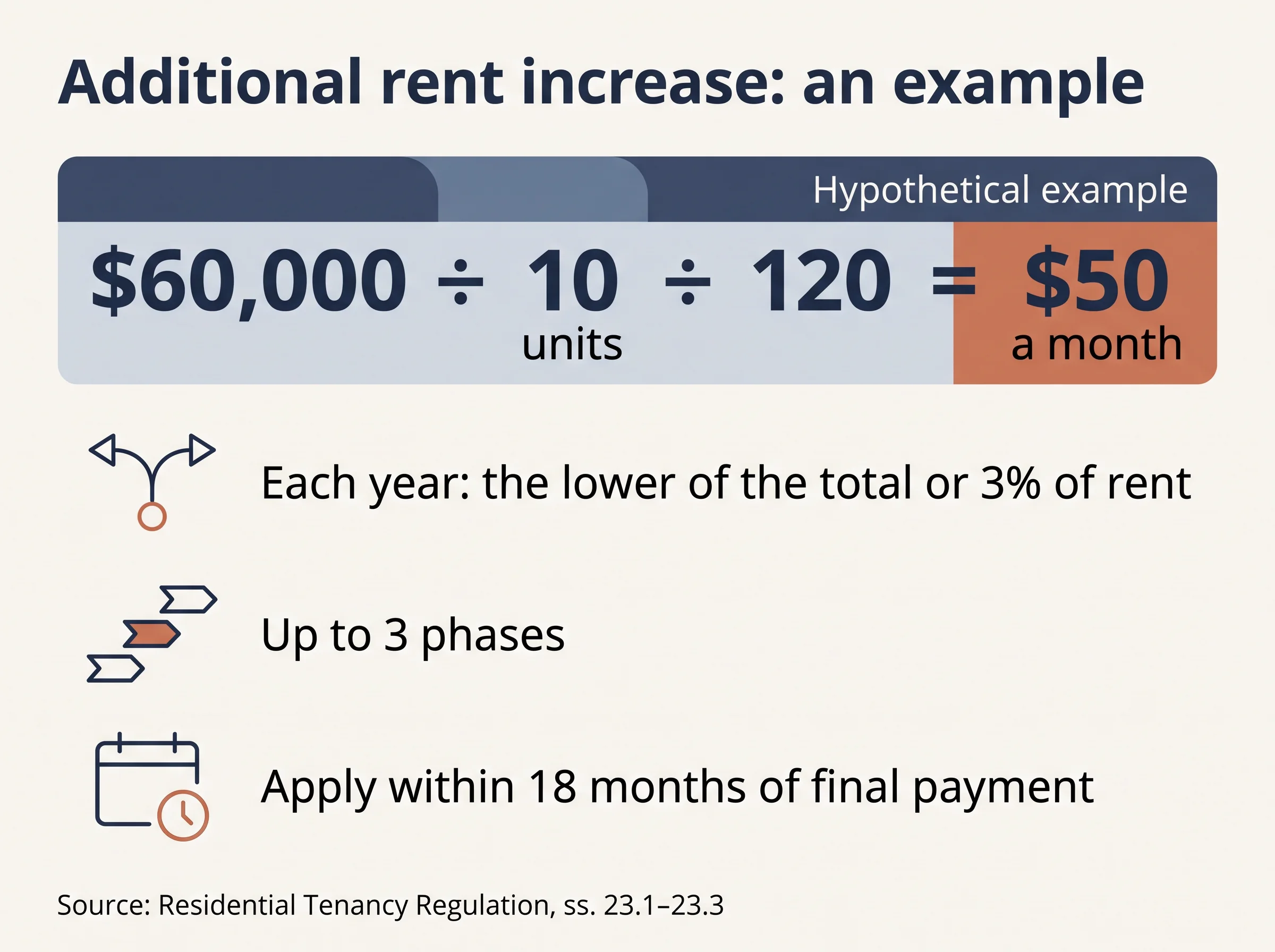
A BC landlord can add no more than the lower of the "Total ARI" set by the arbitrator and 3% of the rent in any year, phased in over up to three years. If the RTB grants the application, section 23.2 of the Regulation sets the amount:
- The arbitrator divides the eligible expenditure by the number of "specified dwelling units" (units in the building where the work was done, or affected by it), then divides by 120. Policy Guideline 37C calls the result the "Total ARI", recorded in the decision.
- In each year, the landlord may impose only the lower of the Total ARI (or what remains of it) and 3% of the rent, where "rent" is the rent payable that year plus the annual increase.
- If the Total ARI is more than the cap, it is phased in over up to three yearly phases (section 23.3). Anything not imposed in its 12-month window cannot be carried forward, and an increase not yet imposed when a tenant moves out cannot be imposed on the next tenant.
Worked example (hypothetical): a landlord spends $60,000 on eligible window replacement in a 10-unit building and receives no rebate. $60,000 ÷ 10 ÷ 120 = a Total ARI of $50 a month per unit. Suppose a tenant's rent, plus that year's annual increase, is $1,840. Three percent of $1,840 is $55.20, so the full $50 can be imposed in phase 1. On a $1,500 rent the cap would be $45, leaving $5 for phase 2. Dwelling units that are not rented, such as the owner's own unit, still count in the divisor; Policy Guideline 37C explains how to count them.
The RTB publishes notice forms for the first two phases (RTB-53-P1 and RTB-53-P2) that set out the calculation step by step; use the RTB's own versions.
How does a BC landlord apply for an additional rent increase for windows?
A BC landlord finishes the window work, pays the final invoice, and then makes a single application to the RTB within 18 months covering every rental unit they intend to increase. The steps:
- Finish the work and pay the final invoice.
- Within 18 months, make a single application covering every rental unit you intend to increase.
- Serve each named tenant with the application and evidence. Guideline 37C notes a director's standing order allowing service by attaching to the door, and longer evidence deadlines (30 days before the hearing for the landlord, 15 days for tenants).
- Attend the hearing. The arbitrator may grant all, part or none.
- Impose any approved amount with the annual increase, phase by phase.
After a granted application, a landlord cannot apply again for the same unit until at least 18 months after the month the last application was made (section 23.1(2)).
What can a BC tenant do about an additional rent increase for windows?
A BC tenant can test the landlord's evidence at the hearing, argue the exclusions (neglect, rebates and the landlord's own labour), and later challenge a phase the landlord calculates wrongly. In practice:
- Read the evidence. Check the age and condition of the old windows, the final payment date, and whether rebates or insurance were available.
- Raise the exclusions. Neglect, rebates and the landlord's own labour are the main grounds to reduce an award. Ask for documents early.
- Check the math later. You cannot dispute the amount an arbitrator orders, but if the landlord calculates a phase wrongly and will not correct it, you can apply for dispute resolution, and a rent increase collected beyond what is allowed can be deducted or recovered (section 43(5)). Our guide to disputing a BC rent increase explains how.
How do you choose a licensed window contractor if you may apply for an ARI in BC?
If you may apply for an additional rent increase, the contractor's documents become your evidence. Ask for:
- An invoice that separates materials, labour, disposal and permit costs.
- The date of the final payment, which starts the 18-month clock.
- A written assessment of the old windows: age, condition and why replacement, not repair, was needed.
- Product specifications and warranty showing the expected life of the new units.
- Proof of a valid business licence and liability insurance.
Frequently asked questions
How long does a BC landlord have to apply for an additional rent increase after new windows?
Eighteen months. Section 23.1(4) of BC's Residential Tenancy Regulation requires the expenditure to have been incurred in the 18 months before the application, and RTB Policy Guideline 37C treats it as incurred on the date of the final payment. The work must be finished before the landlord applies.
What is the most a BC landlord can add each year for new windows?
The lower of the remaining Total ARI and 3% of the rent, where rent means the rent payable that year plus the annual increase (Regulation s.23.2). A Total ARI larger than the cap is phased in over up to three yearly phases, and any part not imposed in its 12-month window cannot be carried forward.
Can a BC landlord charge a window ARI to the next tenant?
No. Under Policy Guideline 37C, an additional rent increase not yet imposed when a tenant moves out cannot be imposed on the next tenant. Each phase also has to be imposed together with the annual rent increase, with proper notice.
Can a BC tenant dispute the amount of an approved additional rent increase?
Not the amount the arbitrator ordered. But if the landlord calculates a phase wrongly and will not correct it, the tenant can apply for dispute resolution, and a rent increase collected beyond what is allowed can be deducted or recovered under section 43(5) of BC's Residential Tenancy Act.
Does replacing one cracked window pane qualify for an additional rent increase in BC?
Unlikely. RTB Policy Guideline 37C says repairs should be substantive, not minor, and contrasts replacing a picket in a railing (minor) with replacing the whole railing (major). A single cracked pane is closer to the picket. Routine maintenance and minor repairs are not capital expenditures.
Keep the evidence an RTB arbitrator will ask for
Tenon10 keeps each property's repair requests, work orders, vendor records and tenancy documents together, so the paper trail behind a capital project is easy to find.
Built for Canadian landlords and property managers.