The tenant was in a hurry, you knew the unit was in good shape, and the move-in inspection never happened. A year later the tenant moves out and leaves a burned countertop and a hole in the bedroom door. You plan to keep part of the deposit.
In British Columbia, that plan can cost you more than the repair. A landlord who skips the condition inspection, or does it but never gives the tenant a copy of the report, loses the right to claim against the deposit for damage. Claim against it anyway and the arbitrator can order you to pay back double.
This article explains the rule, what you can still do, and how to avoid turning a repair bill into a double-deposit order.
BC Deposit Claim Protection Checklist
A landlord checklist to keep the right to claim against a BC deposit for damage: two opportunities, the report and copy, and what to do if the right is already lost.
Get Free PDF →The rule: when a landlord's deposit claim is extinguished
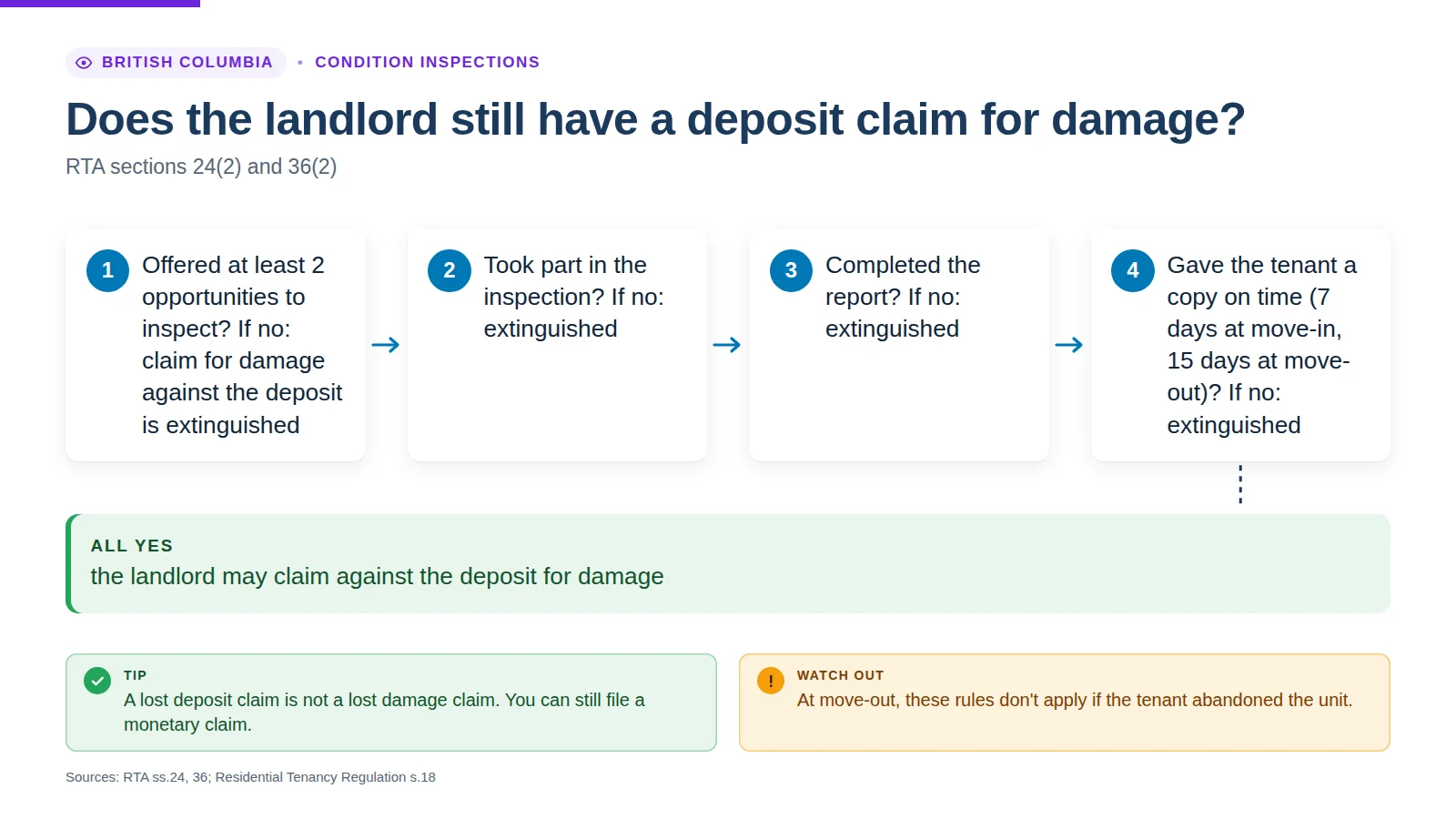
Sections 24(2) and 36(2) of the Residential Tenancy Act (RTA) set out three ways a landlord loses the right to claim against a security deposit or pet damage deposit for damage to the residential property.
| What went wrong | Move-in (s.24(2)) | Move-out (s.36(2)) |
|---|---|---|
| Landlord did not offer at least two opportunities to inspect | Right extinguished | Right extinguished (unless the tenant abandoned the unit) |
| Landlord offered two opportunities but did not take part on either occasion | Right extinguished | Right extinguished (unless abandoned) |
| Landlord did not complete the report and give the tenant a copy as the Regulation requires (at move-out, this applies once the landlord has inspected with the tenant) | Right extinguished | Right extinguished (unless abandoned) |
The copy deadlines come from section 18 of the Residential Tenancy Regulation: within 7 days after the move-in inspection, and within 15 days after the later of the move-out inspection and the date you receive the tenant's forwarding address in writing.
The rule is about damage. RTB Policy Guideline 17 says the lost right is the right to get the tenant's consent to keep, or to file a claim against, the deposit for damage to the rental unit.
The tenant can lose rights too
Sections 24(1) and 36(1) work the other way. If you offered the tenant two opportunities to inspect and the tenant did not take part on either occasion, the tenant's right to the return of the deposit is extinguished. Guideline 17 says that in that case the deposit is set off against any amount awarded to you, and if your award is smaller than the deposit, you may keep the balance.
When both sides lost their rights, Guideline 17 says the party who breached their obligation first bears the loss. Its example: a landlord who never gave the tenant a copy of the move-in report can't claim against the deposit even if the tenant skipped the move-out inspection, because the landlord's breach came first.
What you can still do after losing the claim
Losing the deposit claim for damage does not erase the damage claim. Guideline 17 lists the rights a landlord keeps:
- Getting the tenant's consent to deduct from the deposit money owing for something other than damage to the unit, such as unpaid rent.
- Filing a claim against the deposit for money owing for something other than damage to the unit.
- Deducting from the deposit an arbitrator's order that is still unpaid at the end of the tenancy.
- Filing a monetary claim for damages arising out of the tenancy, including damage to the rental unit.
The RTB's information sheet Inspecting the Rental Unit says the same thing in plain terms: a landlord who can't claim against the deposit may still file a claim for rent owing, damage to the unit or loss of rental income.
How a skipped inspection becomes a double-deposit bill
Under section 38(1) of the RTA, within 15 days after the later of the end of the tenancy and the date you receive the tenant's forwarding address in writing, you must either repay the deposit with any interest the Regulation requires, or apply for dispute resolution claiming against it.
Guideline 17 says that unless the tenant has specifically waived it, the arbitrator will order the return of double the deposit in several situations, including where:
- the landlord did not file a claim against the deposit within those 15 days;
- the landlord claimed against the deposit for damage after that right was extinguished; or
- the landlord got the tenant's written agreement to deduct for damage after the right to get that agreement was extinguished.
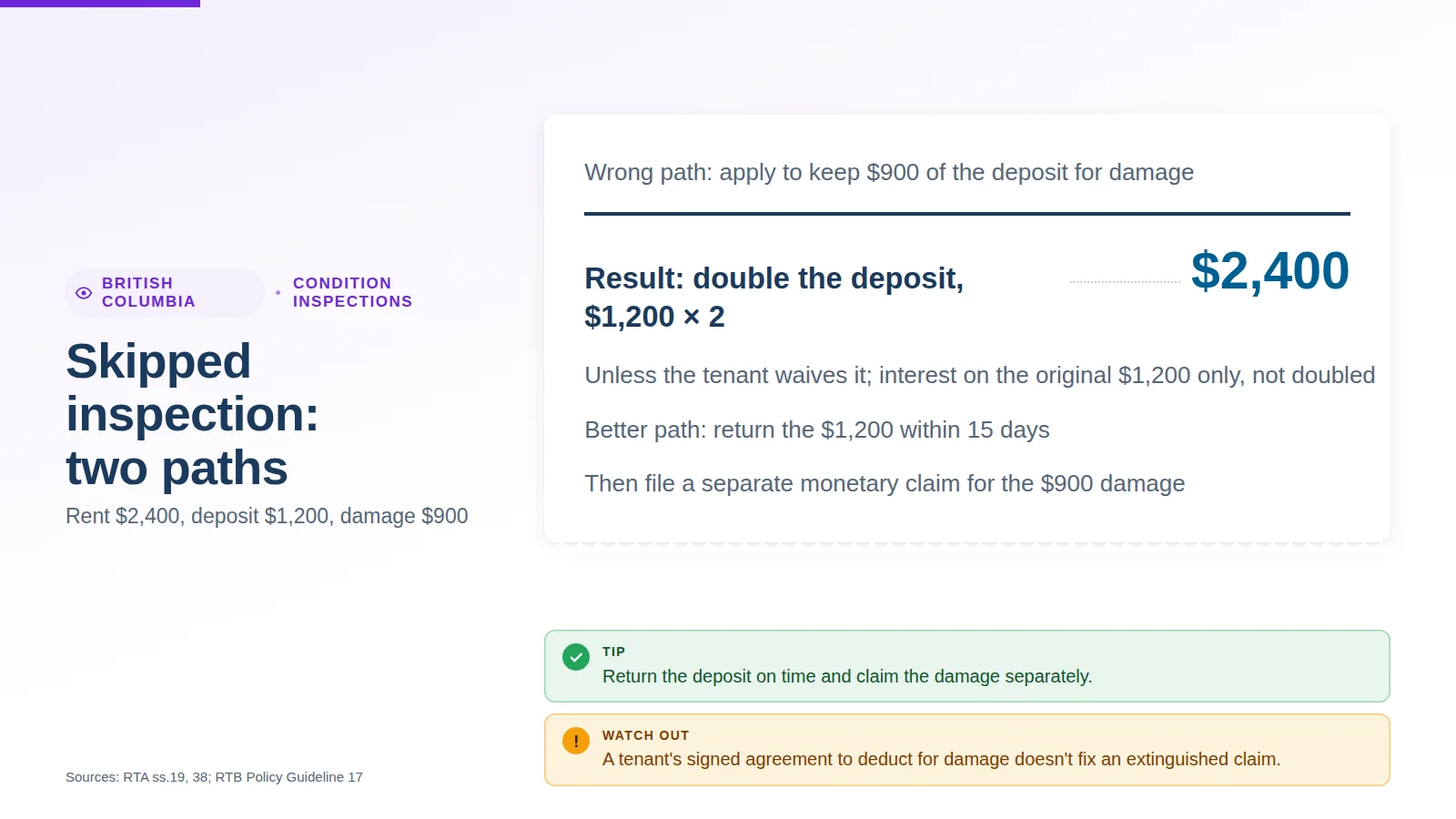
The last point matches section 38(5) of the Act: a tenant's written agreement to keep money for damage does not help a landlord whose damage claim against the deposit has been extinguished.
A worked example
| Item | Amount |
|---|---|
| Monthly rent | $2,400 |
| Security deposit (half a month's rent, the maximum) | $1,200 |
| Damage found at move-out | $900 |
| Move-in inspection | Never offered |
Wrong path: the landlord applies to keep $900 of the deposit for damage. The right to claim against the deposit for damage was extinguished at move-in. Unless the tenant waives it, the arbitrator orders double: $1,200 × 2 = $2,400, with interest calculated only on the original deposit and not doubled (Guideline 17).
Better path: within 15 days the landlord returns the $1,200 deposit, plus any interest owing, and files a separate monetary claim for the $900 of damage. If the arbitrator awards it, the landlord has a monetary order for $900. The landlord still has to prove the damage, and without a move-in report that is harder, because there is no record of the starting condition.
Common mistakes that extinguish the claim
- Offering one time only. The Act requires at least two opportunities. The second must be in the approved form, the Notice of Final Opportunity to Schedule a Condition Inspection (RTB-22), under section 17 of the Regulation.
- Inspecting but never handing over the report. The walk-through alone isn't enough. A late or missing copy extinguishes the claim just as a skipped inspection does.
- Treating a new pet as nothing. If no move-in inspection was done and you later allow a pet, section 23(2) requires an inspection on or before the day the tenant starts keeping it.
- Deducting first, explaining later. Holding back money for damage without the tenant's written agreement or a timely application puts you inside the doubling rule.
- Assuming the tenant's no-show helps you. It does only if you offered two proper opportunities, and only if you didn't breach first.
Keeping it from happening across a portfolio
For a manager with many turnovers, the risk is rarely a single decision. It's a missed step that nobody notices until the deposit is due back.
- Make the inspection part of key handover. No inspection, no keys, unless the tenant has had two proper opportunities and didn't come.
- Track the two opportunities on file. Keep the first proposal and the RTB-22 with dates.
- Track the copy as its own task with the 7-day and 15-day deadlines, and record how and when it was served.
- Flag every tenancy without a move-in report before move-out, so whoever handles the deposit knows the damage claim must go through a separate monetary claim.
How Tenon10 helps
Tenon10's Condition Inspection Report (RTB-27) is fillable with a room-by-room grid, and each report is stored with the lease, notices and payment records for the tenancy. That record is your evidence of the unit's starting condition if a claim reaches the RTB.
Deposit tracking follows the 15-day return clock and flags the risk of paying back double. The RTB-22 is a government form: Tenon10 links to it rather than generating it.
Frequently asked questions
Can I still sue for the damage if I skipped the inspection?
Yes. Guideline 17 says a landlord who lost the deposit claim for damage keeps the right to file a monetary claim for damages, including damage to the rental unit. You lose the shortcut of keeping the deposit, not the claim.
Can I keep the deposit for unpaid rent?
The extinguishment rule covers damage. Guideline 17 says you can still get the tenant's consent, or file a claim against the deposit, for money owing for something other than damage, such as rent. You still have to act within the 15-day window.
What if the tenant abandoned the unit?
Section 36(2) does not apply at move-out if the tenant abandoned the rental unit, and section 35(5) lets you inspect and complete the report alone in that case.
Is interest doubled too?
No. Guideline 17 says interest is calculated only on the original deposit amount and is not doubled.
BC Deposit Claim Protection Checklist
A landlord checklist to keep the right to claim against a BC deposit for damage: two opportunities, the report and copy, and what to do if the right is already lost.
Get Free PDF →Never lose a deposit claim to paperwork
Fill in the RTB-27 room by room, keep it with the tenancy, and let deposit tracking watch the 15-day clock.
Built for Canadian landlords and property managers.
Related BC guides
- When a BC Landlord Must Pay Back Double the Deposit
- The 15-Day Rule: Returning a Deposit at the End of a BC Tenancy
- The Half-Month Cap: How Much Deposit a BC Landlord Can Collect
- Move-In and Move-Out Condition Inspections in BC: What the RTA Requires
- The BC Condition Inspection Report (RTB-27), Field by Field
Sources: Residential Tenancy Act; Residential Tenancy Regulation; RTB Policy Guideline 17; RTB: Inspecting the Rental Unit; RTB-22. This article is a summary of British Columbia rules as of October 2026, not legal advice. Check the Residential Tenancy Branch for your situation.