You live in Ontario and own a condo in Kelowna, a house in Victoria, or a suite in Burnaby. The rent arrives, mostly. Then a dishwasher leaks, a tenant gives notice, or a rent increase is due, and you are three time zones and a flight away from a building that runs on BC rules, not Ontario's.
Managing from a distance is legal and common. What it needs is a plan for the parts of BC tenancy law that assume someone is there in person, and a clear view of when you need a licensed manager. This guide covers both.
Remote BC Landlord Checklist
A checklist for Ontario owners of BC rentals: address for service, inspections, entry, BC deposit and rent increase rules, and the licensing rule for paid help.
Get Free PDF →What BC law expects of an absent landlord
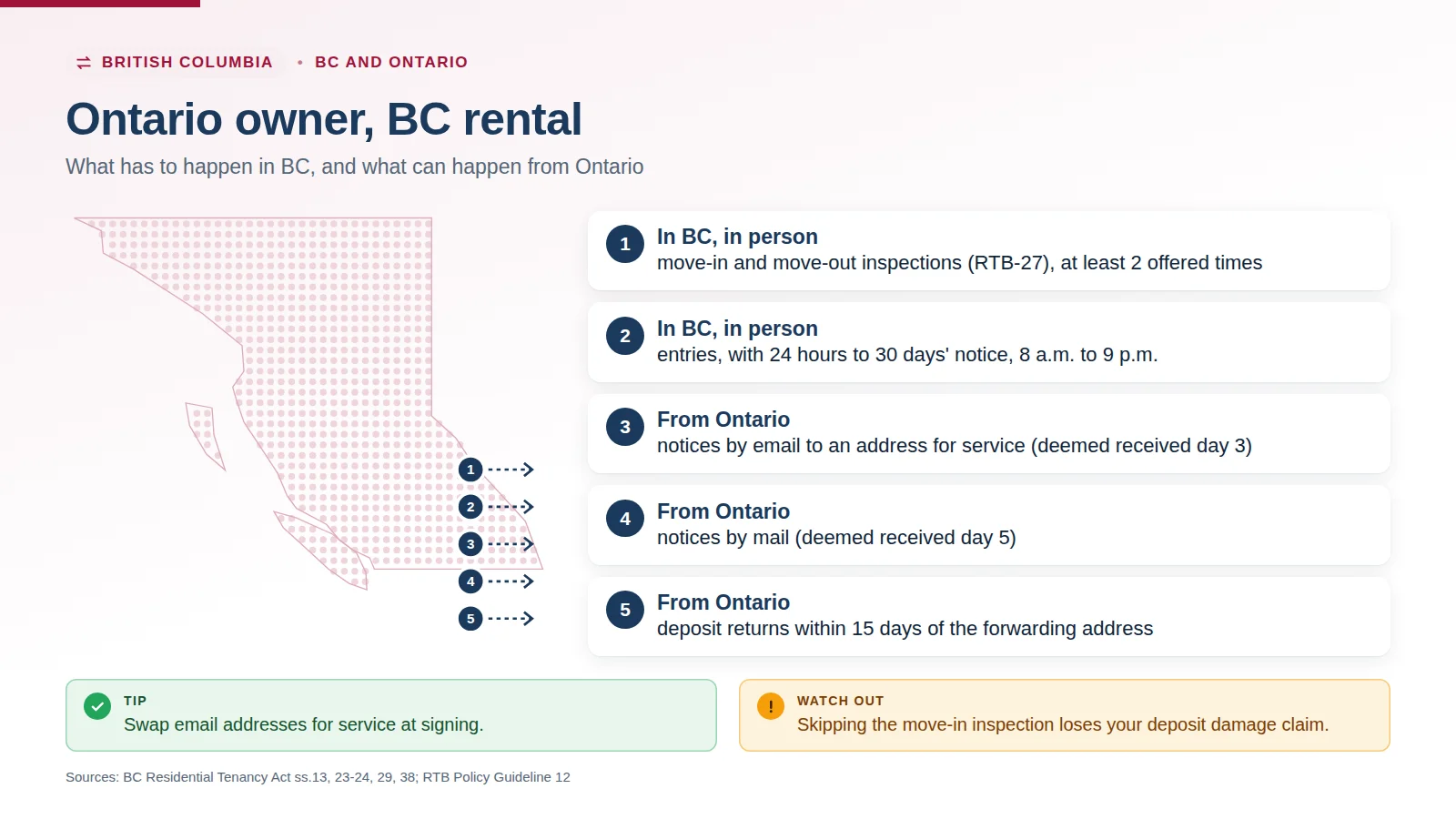
The Residential Tenancy Act does not care where you live, but several of its duties are physical or time-bound.
An address for service
Every BC tenancy agreement must set out the address for service and telephone number of the landlord or the landlord's agent (s.13(2)(e)). That is where the tenant sends notices and dispute papers. Under RTB Policy Guideline 12, either party may also provide an email address for service; a document emailed to that address is deemed received on the third day, and one sent by mail on the fifth.
Move-in and move-out inspections
The landlord and tenant must inspect the unit on the day the tenant is entitled to possession, or another agreed day, and the landlord must offer at least two opportunities and complete a condition inspection report (s.23). If you skip it, your right to claim against the deposit for damage is extinguished (s.24(2)). Someone has to be there to inspect and complete the report; the RTB's form for it is the RTB-27.
Entry
To enter, you or your agent need the tenant's permission or written notice at least 24 hours and not more than 30 days ahead, with a reasonable purpose and a time between 8 a.m. and 9 p.m. unless the tenant agrees otherwise (s.29). Note that BC's window ends at 9 p.m., not Ontario's 8 p.m.
Money deadlines
- Deposits: no more than half a month's rent each for the security deposit and any pet damage deposit (s.19).
- Deposit return: repay, or apply to claim, within 15 days after the later of the tenancy ending and receiving the tenant's forwarding address in writing. Miss it and you may have to pay double (s.38).
- Rent increases: once every 12 months, at most 2.2% for increases taking effect in 2027, on Form RTB-7 with three full months' notice.
Getting help on the ground: the licensing rule
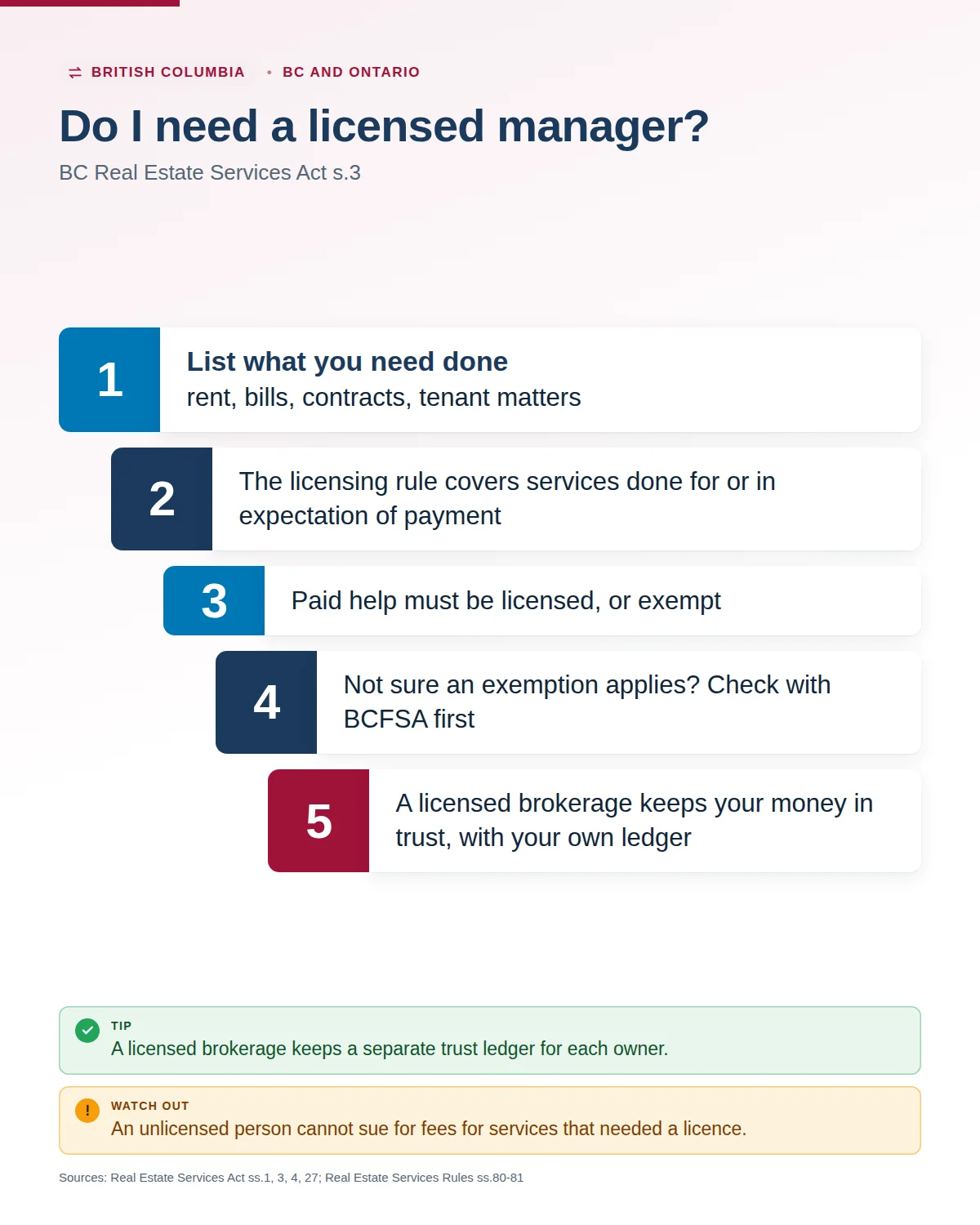
Most remote owners need someone local. The question is who, because BC regulates paid property management.
Under the Real Estate Services Act, a person must not provide real estate services to or for another person, for or in expectation of payment, unless licensed or exempt (s.3). "Rental property management services" include:
- collecting rents or security deposits;
- making payments to third parties;
- negotiating or entering into contracts;
- supervising employees or contractors hired by the owner; and
- managing landlord and tenant matters.
The Act lists specific exemptions, such as lawyers in practice and executors dealing with an estate's property, and the regulations add others. A friend or contractor who does these things for pay is a different matter. If you want to pay someone to collect rent or deal with tenants, the safe course is to use a licensed brokerage, or to check with the regulator, the BC Financial Services Authority (BCFSA), that an exemption really applies before you rely on it.
What a licensed brokerage must do with your money
A brokerage must promptly pay money it receives for you into a trust account (s.27), keep a separate trust ledger for each owner in a pooled trust account, and reconcile monthly no later than 5 weeks after month-end (Real Estate Services Rules ss.80-81). It must keep the tenancy agreements, accounting statements and invoices for your property and a record of tenants and deposits, generally for at least 7 years (ss.87, 92). If you leave, it must hand over those records on request within the later of 2 weeks after your request or 4 weeks after the services end (s.87(4)).
Common mistakes
- Skipping the move-in inspection because you cannot fly out. The deposit damage claim is lost; send an agent with the RTB-27.
- Applying Ontario habits. Ontario's 90 days of notice, 1.9% guideline and rent deposit rules do not apply to a BC unit.
- Paying a neighbour to collect rent. Collecting rent for an owner is a rental property management service, and doing it for pay needs a licence unless an exemption applies.
- Mailing notices late. A mailed document is deemed received on the fifth day, which can push a BC rent increase back a full month.
- Losing the forwarding address. The 15-day deposit clock starts when you receive it in writing. Make sure mail to your service address is watched.
Running more than one remote unit
- One contact sheet per unit: tenant, local agent or manager, strata manager if any, and trades.
- One date list: each tenancy's 12-month increase date and BC serve-by date, deposit amounts and inspection dates.
- One evidence file: lease, inspection reports, notices with proof of service, and payment history. If a dispute reaches the RTB, the file is what makes your case from a distance.
- A clear agent letter: if someone acts for you, set out in writing what they can do, and check whether that role needs a licence.
How Tenon10 helps
Tenon10 generates the BC documents you need from a distance: a BC tenancy agreement with every detail the Act requires and the standard terms copied word for word from the current Regulation, the Notice of Rent Increase (RTB-7), the 10 Day Notice (RTB-30) and the fillable RTB-27 Condition Inspection Report your local agent can complete room by room. Deposit tracking follows the 15-day return clock and flags the double-penalty risk.
FAQ
Can my BC tenancy agreement list an Ontario address for service?
The Act requires an address for service and phone number for you or your agent; it does not require the address to be in BC. Consider the delay for mailed documents, or provide an email address for service.
Do I need a BC property manager?
Not by law, if you manage it yourself. If you pay someone to collect rent or handle tenants, BC law generally requires them to be licensed.
Which rent increase rule applies, Ontario's or BC's?
The rules of the province where the unit is. A BC unit follows BC's 2.2% limit for 2027 and the RTB-7.
Can I rent my BC unit short-term while I'm away?
If it is not your principal residence and it is in a community where the provincial principal residence requirement applies, no. Check the Province's community list.
Remote BC Landlord Checklist
A checklist for Ontario owners of BC rentals: address for service, inspections, entry, BC deposit and rent increase rules, and the licensing rule for paid help.
Get Free PDF →Run your BC rental from Ontario
Tenon10 generates a BC tenancy agreement with the current standard terms and BC's RTB-7, RTB-30 and RTB-27, and tracks the 15-day deposit clock.
Built for Canadian landlords and property managers.
Related BC guides
- Serving Documents in BC: Every Method the RTA Allows
- The 15-Day Rule: Returning a Deposit at the End of a BC Tenancy
- Three Full Months: Serve-Date Maths for BC Rent Increases
Sources: Residential Tenancy Act; RTB Policy Guideline 12; RTB: Rent increases; Real Estate Services Act; Real Estate Services Rules; Province of B.C.: Principal residence requirement. This article is a summary of British Columbia rules as of October 2026, not legal advice. Check the Residential Tenancy Branch for your situation.