Your landlord owns the building, but the unit is your home. In British Columbia that difference is written into law. The Residential Tenancy Act sets out what a landlord must do, what a landlord cannot do, and what you can do when the line is crossed.
Most problems between renters and landlords are not dramatic. A landlord lets themselves in to "check something." A clause in the lease says guests can stay only a few nights a year. The heat goes off and stays off. Each of these feels small until it becomes a pattern, and by then many tenants are unsure whether they are allowed to push back.
This guide lists the main things a BC landlord cannot do, explains where each rule comes from, and walks through what you can do about it. It covers most private rentals that fall under the Residential Tenancy Act.
BC Tenant Rights Checklist
A renter's checklist of what a BC landlord cannot do: entry without notice, guest fees, lockouts, cutting services, ignoring repairs, plus what to do next.
Get Free PDF →The rules: what a BC landlord cannot do
Sign you out of the law
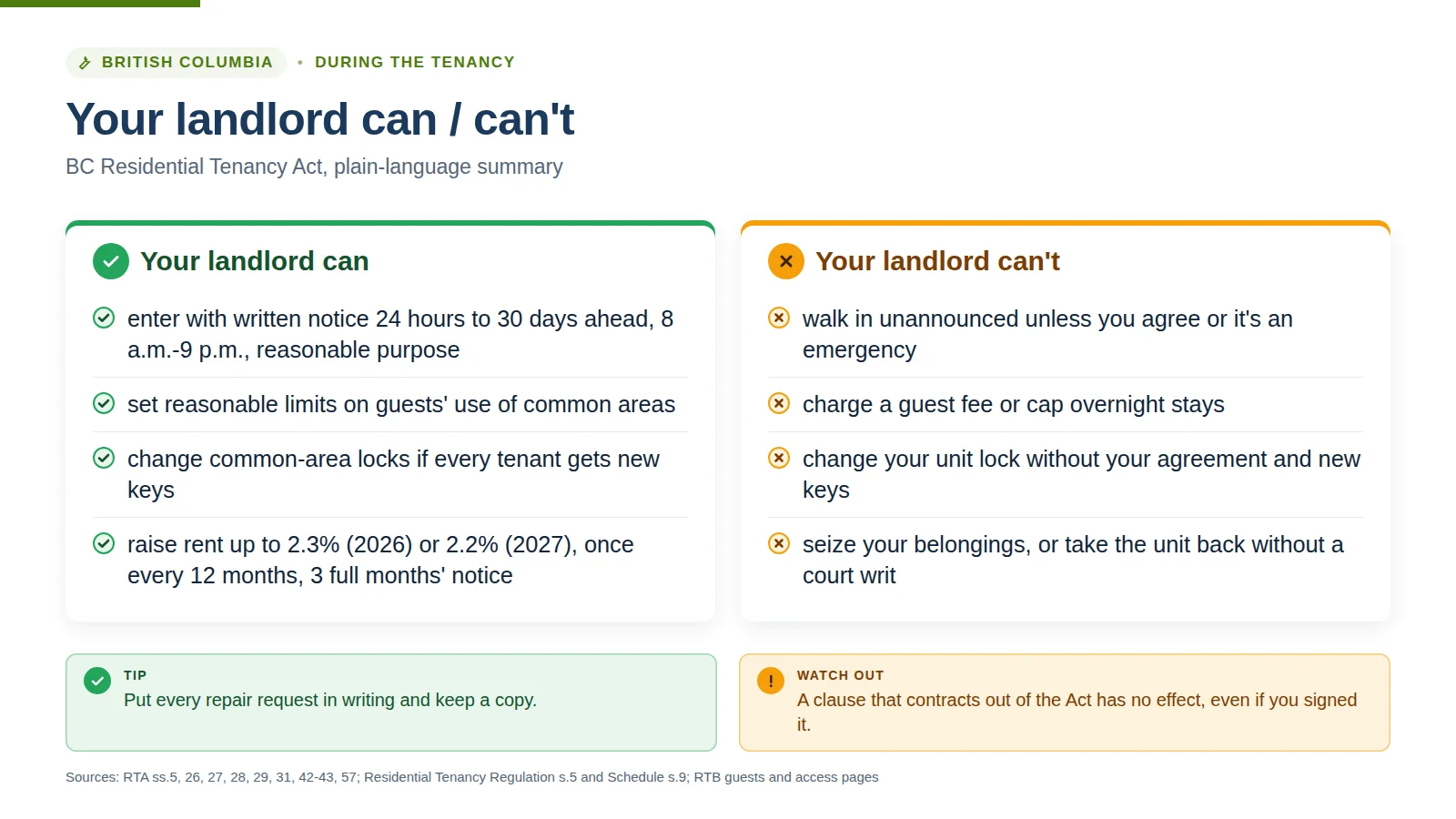
Section 5 of the Residential Tenancy Act says landlords and tenants cannot avoid or contract out of the Act or its regulations. Any attempt to do so has no effect. A lease clause that takes away a right the Act gives you does not bind you, even if you signed it.
Enter without notice or permission
Under section 29, a landlord may enter your unit only in set situations. The usual one is written notice given at least 24 hours and not more than 30 days before entry. The notice must state a reasonable purpose and the date and time, and the time must be between 8 a.m. and 9 p.m. unless you agree otherwise. Other routes are your permission at the time (or within the 30 days before), an RTB order, an abandoned unit, or an emergency where entry is needed to protect life or property.
The RTB adds that you have the right to be present when the landlord enters, and a landlord cannot make you leave. A landlord may inspect monthly, but only by following the written-notice rule.
Interfere with your quiet enjoyment
Section 28 gives you a right to quiet enjoyment, including reasonable privacy, freedom from unreasonable disturbance, exclusive possession of the unit (subject only to lawful entry) and use of common areas for reasonable and lawful purposes. The RTB's peace, quiet and privacy page says this includes having guests, cooking the food you choose and practising your religion.
Charge guest fees or ration your guests
The Residential Tenancy Regulation bans guest fees, whether or not the guest stays overnight. The standard terms also say a landlord must not stop you from having guests under reasonable circumstances or charge extra for daytime visits or overnight stays. The RTB's guests page calls limits such as a 14-day-per-year overnight policy unreasonable, and says check-in rules for guests are unreasonable too. A landlord may set reasonable limits on guests' use of common areas, and a guest who actually moves in is a different matter.
Change the locks on you
Section 31 says a landlord must not change the locks to your unit unless you agree and you get new keys. Locks to common areas can only be changed if every tenant gets new keys. The RTB states plainly that locking a tenant out is illegal.
Take your belongings or remove you
Whether or not rent is paid, section 26 says a landlord must not seize your personal property or block your access to it. The only exceptions to the ban on seizing are a court order, or a unit you have abandoned where the landlord follows the regulations. Even after a tenancy has ended, section 57 says the landlord cannot take possession of a unit you still occupy without a writ of possession from the Supreme Court.
Cut off essential services
Under section 27, a landlord must not end or restrict a service or facility that is essential to living in the unit, or one that is a material term of your agreement. For other services, the landlord must give 30 days' written notice on the approved form and reduce your rent by the drop in value.
Ignore repairs
Section 32 requires the landlord to keep the property in a state of decoration and repair that meets health, safety and housing standards and suits it for living in, given its age, character and location. The health, safety and housing standards part of this duty applies even if you knew about the problem when you moved in. You are responsible for damage you, your guests or occupants cause, but not for reasonable wear and tear.
Charge what the Act forbids
| Charge | The rule |
|---|---|
| Application or processing fee | Not allowed (section 15) |
| Guest fee | Not allowed (Regulation, section 5) |
| Rent increase for 2026 | Up to 2.3%, once every 12 months, with 3 full months' notice on Form RTB-7 |
| Rent increase taking effect in 2027 | Up to 2.2%, same notice and timing rules |
| Keeping your deposit | Only with your written agreement at the end of the tenancy or an RTB order. Within 15 days after the later of the tenancy ending and the landlord receiving your forwarding address in writing, the landlord must return it or apply for dispute resolution to claim against it (section 38) |
If a landlord collects an increase above what the Act allows, section 43 lets you deduct it from rent or otherwise recover it.
Common mistakes tenants make
- Withholding rent to force a repair. Section 26 says you must pay rent when it is due, whether or not the landlord follows the Act, unless the Act gives you a specific right to deduct. Unpaid rent can lead to a 10 Day Notice even when your complaint is fair.
- Treating a bad clause as binding. A clause that conflicts with the Act has no effect. You do not have to follow a guest limit or a fee the law forbids.
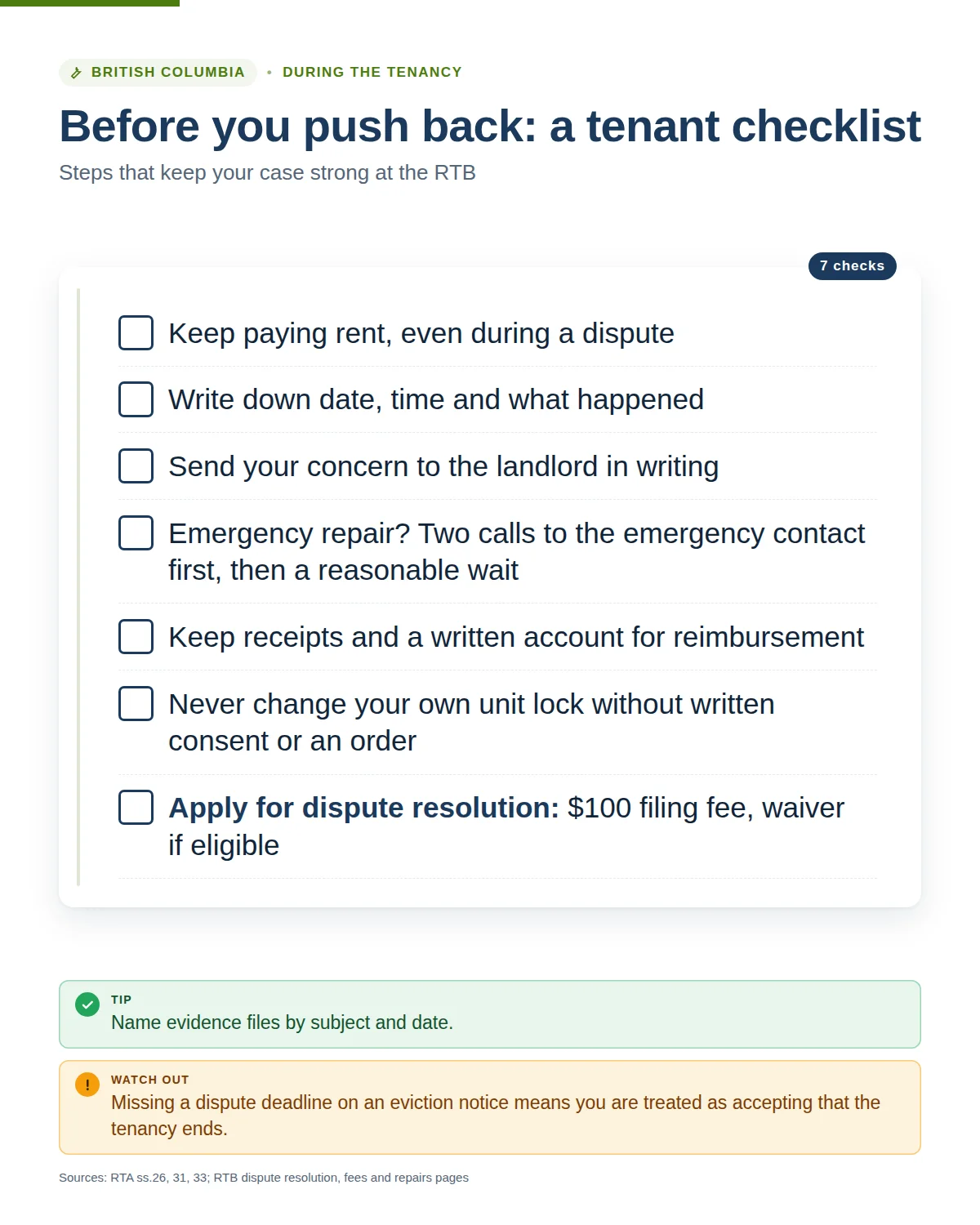
- Doing an "emergency" repair too early. Section 33 lets you arrange emergency repairs only after two attempts to phone the landlord's emergency contact and a reasonable wait. Keep the receipts and give the landlord a written account to be reimbursed.
- Asking for repairs only out loud. The RTB says repair requests should be in writing, with a reasonable time to fix the problem. Keep a copy.
- Ignoring an eviction notice. Notices have strict dispute deadlines. If you miss one, the law treats you as having accepted that the tenancy ends.
What to do next if your landlord crosses the line
- Write it down the day it happens. Date, time, who was there, what was said. Photos or video if relevant.
- Put your concern in writing to the landlord. Name the problem, refer to the rule, and give a reasonable time to fix it. For an unlawful entry, the RTB suggests asking the landlord to leave, reminding them of the notice rules and recording the incident.
- Keep paying rent. The RTB repeats this on its dispute resolution page: tenants must keep paying rent even during a dispute.
- Apply for dispute resolution if it continues. An arbitrator can order repairs, compensation or compliance. Applications cost a $100 filing fee, and you can apply for a fee waiver if you qualify, for example on low income. Most monetary claims at the RTB are limited to $35,000.
- Use the expedited process for urgent problems. A lockout or an emergency repair can qualify. The RTB aims to schedule expedited hearings within 12 days, and sooner in urgent cases.
- Report repeated or deliberate breaches. The RTB's Compliance and Enforcement Unit investigates serious or repeated violations. It does not pay you compensation; that still comes through dispute resolution.
Discrimination complaints are a different track. The RTB points tenants to the BC Human Rights Tribunal for those.
How Tenon10 helps
Tenon10 keeps the lease, notices and payment records for a tenancy together. If something goes wrong, that shared record is the evidence both sides can point to at an RTB hearing, instead of a pile of screenshots.
Landlords who use Tenon10 also generate the standard BC forms, such as the Notice of Rent Increase (RTB-7) and the RTB-27 Condition Inspection Report, so the paperwork you receive follows the approved format. If your landlord uses Tenon10, you can submit repair requests with photos and an emergency priority, and every request can be tracked from the web or the mobile app.
FAQ
Can my landlord show up without notice if I'm home?
Only with your permission, in an emergency, or in a narrow case the Act lists, such as an RTB order. You can say no to an unannounced visit. With proper written notice, the landlord may enter even if you are out.
Can my landlord limit how often my partner stays over?
No. The RTB calls caps on overnight guest stays unreasonable. If someone moves in for good, though, they may be an occupant rather than a guest, which your tenancy agreement may address.
My landlord won't fix the heat. Can I stop paying rent?
No. Report it in writing. If heat is an emergency repair, follow the two-phone-call rule in section 33. Otherwise, apply for dispute resolution for a repair order and compensation.
Is a clause I signed always enforceable?
No. A term that tries to contract out of the Residential Tenancy Act has no effect, signed or not.
BC Tenant Rights Checklist
A renter's checklist of what a BC landlord cannot do: entry without notice, guest fees, lockouts, cutting services, ignoring repairs, plus what to do next.
Get Free PDF →One record of your tenancy
Tenon10 keeps your lease, notices and payment records together, so the facts of your tenancy are in one place if you ever need them at the RTB.
Built for Canadian landlords and property managers.
Related BC guides
- Disputing a BC Rent Increase: A Tenant's Guide
- Getting Your Deposit Back in BC: A Tenant's Step-by-Step Guide
- Got a 10 Day Notice in BC? What Tenants Should Do Now
- The 2027 BC Rent Increase Limit: A Renter's Guide
Sources: Residential Tenancy Act; Residential Tenancy Regulation; RTB: Tenant rights; RTB: Landlord access to rental units; RTB: Guests; RTB: Repairs and maintenance; RTB: Rent increases; RTB: Tenancy dispute resolution. This article is a summary of British Columbia rules as of October 2026, not legal advice. Check the Residential Tenancy Branch for your situation.