You own a condo or townhouse in a BC strata and want to rent it out. Maybe you are moving for work, maybe you bought it as an investment, or maybe an older building's rental cap kept it empty for years. The good news is that the strata can no longer stop you. The less obvious news is that you now answer to two sets of rules at once.
The Residential Tenancy Act governs your relationship with the tenant: the lease, the deposit, rent increases and notices. The Strata Property Act governs your relationship with the strata corporation: bylaws, fines and a short list of paperwork that only strata landlords have to do. Miss the strata side and a tenant can walk away from a fixed-term lease, with you paying their moving costs.
This guide covers what a strata can and cannot do, the duties you take on as a strata landlord, the mistakes that cost owners money, and how to keep it organised across several units.
BC Strata Landlord Checklist
A checklist for BC landlords renting a strata unit: bylaws to check, Form K before renting and to the strata within 2 weeks, fines, and what to do about repeated bylaw breaches.
Get Free PDF →What the strata can and cannot do
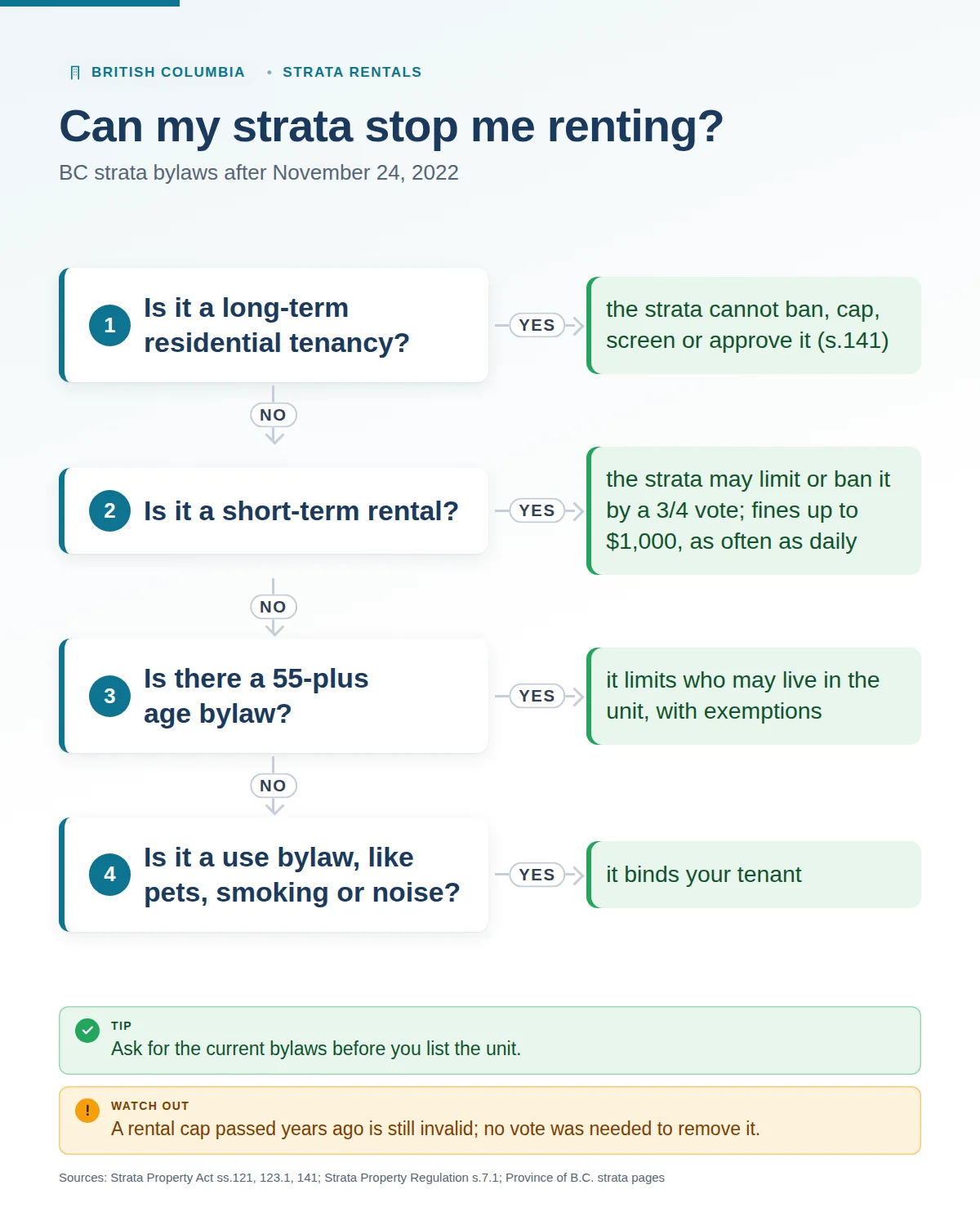
Since November 24, 2022, no strata corporation or section in BC may have a residential rental-restriction bylaw. The Province says every such bylaw is invalid and that stratas did not need to amend anything, because the change came from the legislation itself. Section 141 of the Strata Property Act now says the strata must not:
- screen tenants or set screening criteria;
- require that it approve your tenants;
- require you to insert terms into your tenancy agreement; or
- otherwise restrict the rental of a strata lot.
Section 121 backs this up: a bylaw that prohibits or restricts an owner's right to lease the strata lot is not enforceable. The only two exceptions are a bylaw governing sale activities such as signs and open houses (s.122) and a "55 and over" age bylaw (s.123.1).
What a strata can still restrict
| Bylaw type | Still allowed? | Source |
|---|---|---|
| Ban or cap on long-term residential rentals | No, invalid since Nov 24, 2022 | SPA s.141; Province of B.C. |
| Short-term rental limit or ban | Yes, passed by a 3/4 vote; fines up to $1,000 per contravention, as often as daily | Strata Property Regulation s.7.1; Province of B.C. |
| Age restriction | Only a "55 and over" bylaw (age not less than 55), with exemptions | SPA ss.121, 123.1, 123.2; Regulation s.7.01 |
| Pets, smoking, noise, move-in rules and other use bylaws | Yes, and they bind your tenant | SPA ss.119, 130; Form K |
The age rule is the one investors overlook. If your building has a valid 55-plus bylaw, it applies to who may live in the unit, whether they own or rent. The Regulation exempts some people, such as a resident's spouse and certain children and caregivers, but the bylaw still shapes who you can rent to.
Your duties as a strata landlord
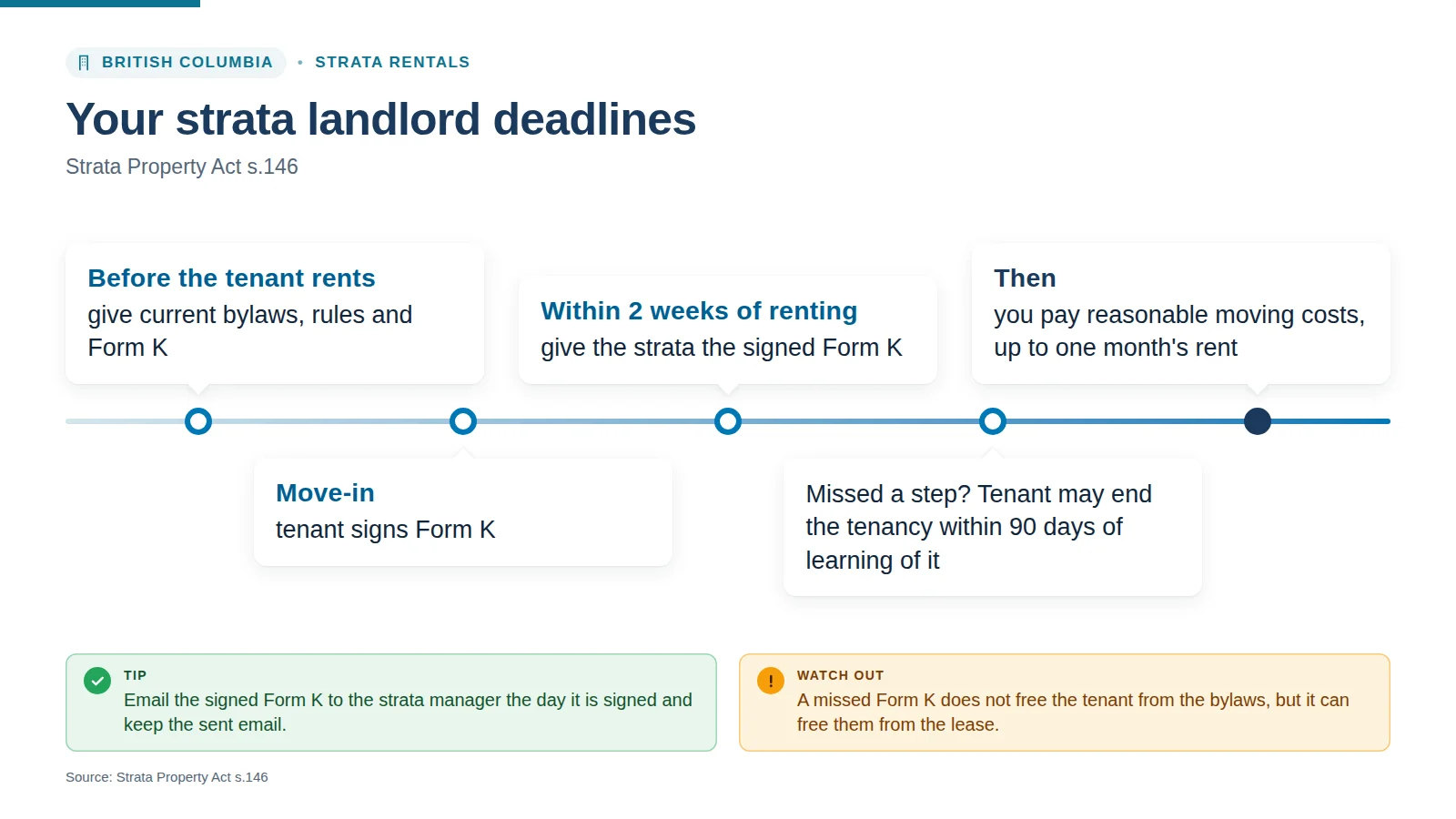
Section 146 of the Strata Property Act sets out the extra steps. They are short, but each one has a consequence if you skip it.
- Before you rent: give the prospective tenant the current bylaws and rules, and a Notice of Tenant's Responsibilities on the prescribed form, Form K.
- Within 2 weeks of renting: give the strata corporation a copy of the Form K signed by the tenant.
- If you miss either step: the tenant is still bound by the bylaws and rules, but may end the tenancy without penalty by notice to you within 90 days of learning that you failed to comply.
- If the tenant does end it: you must pay the tenant's reasonable moving expenses, up to a maximum of one month's rent.
On a $2,600 rent, that is up to $2,600 in moving costs, plus the vacancy, for a form that takes five minutes to sign.
Fines and who pays them
The strata can fine a tenant for a bylaw breach by the tenant, the tenant's visitors, or an occupant (s.130). It can collect the fine or the cost of fixing the problem from the tenant, the landlord or the owner, but not more than the total amount (s.131). If you pay a fine your tenant owes, the tenant owes you that amount.
Before fining a tenant, the strata must have a complaint, give the tenant the particulars in writing and a reasonable chance to answer, including a hearing if requested, and give notice of the complaint to you and to the owner (s.135). Most bylaw fines are capped at $200 per contravention of a bylaw and $50 per contravention of a rule, imposed no more often than every 7 days for a continuing breach (Regulation s.7.1).
When a tenant keeps breaking the bylaws
A repeated or continuing breach of a reasonable and significant bylaw or rule by a tenant lets you give a notice to end the tenancy for cause under section 47 of the Residential Tenancy Act (SPA s.137). In BC that is the One Month Notice to End Tenancy for Cause, RTB-33. The strata itself can also give that notice where the breach seriously interferes with another person's use and enjoyment of a strata lot or common property (s.138).
Assigning your strata rights to a tenant
You may assign some or all of your powers and duties under the Act, bylaws and rules to a tenant, such as voting, but not your responsibility for the tenant's fines and remedy costs. The assignment only takes effect once you give the strata written notice naming the tenant, the powers assigned and the period (s.147). A lease to the same person for a set term of 3 years or more assigns your landlord powers and duties to the tenant for the term, though the tenant must give the strata written notice before exercising them (s.148). Neither kind of assignment moves your responsibility for the tenant's fines.
Common mistakes
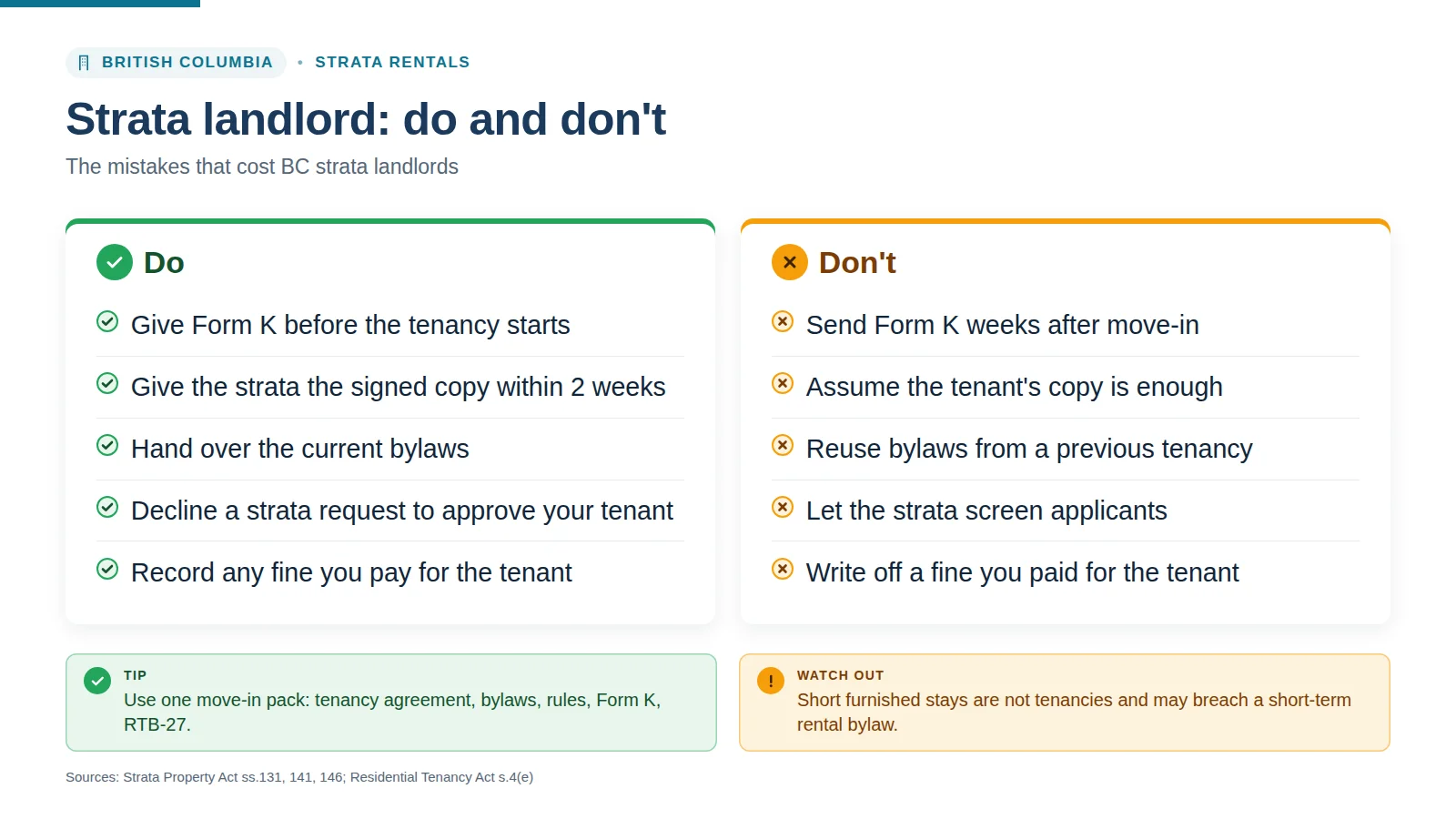
- Signing the lease, then sending Form K "later." The Act says before you rent. A Form K signed after move-in does not fix the timing.
- Forgetting the strata's copy. Giving Form K to the tenant is half the job. The signed copy goes to the strata within 2 weeks.
- Handing over old bylaws. Stratas amend bylaws. Ask for the current set each time you re-rent.
- Accepting a strata "rental application" or "tenant approval." A strata that asks to vet or approve your tenant is doing something section 141 prohibits. You can politely decline.
- Treating a short stay as a tenancy. A furnished stay for vacation or travel is excluded from the Residential Tenancy Act (s.4(e)) and may breach a short-term rental bylaw that carries daily fines.
- Paying a tenant's fine and writing it off. Under s.131(2) the tenant owes you what you paid. Record it and ask for it.
Renting several strata units
With one condo, a paper folder works. With five units across three buildings, the strata side multiplies: different bylaws, different strata managers, different move-in fee rules, and a 2-week deadline every time a tenant changes. A simple routine keeps it under control:
- Keep a building sheet for each strata: strata plan number, strata manager contact, date of the bylaws you hold, and any short-term rental or age bylaw.
- Refresh the bylaws at every turnover. Ask for the current set before the new tenant signs.
- Use one move-in pack: a BC tenancy agreement with the standard terms, current bylaws and rules, Form K, and the move-in condition inspection report (RTB-27).
- Diary the 2-week date for each new tenancy on the day the lease is signed.
- Log every strata letter. Complaints, fines and decisions arrive at different times; a dated log is what you will need if a breach becomes a notice for cause.
How Tenon10 helps
Tenon10 generates a BC tenancy agreement with every detail the Act requires and the standard terms copied word for word from the current Regulation, the fillable RTB-27 Condition Inspection Report with a room-by-room grid, and the One Month Notice for Cause (RTB-33) if a bylaw problem gets that far.
FAQ
Can my strata still enforce a rental cap passed years ago?
No. As of November 24, 2022 the Province says all strata rental-restriction bylaws are invalid, whenever they were passed. No vote was needed to remove them.
Can the strata charge my tenant a move-in fee or make them sign its own form?
The strata cannot require terms in your tenancy agreement or approve your tenant (s.141). Bylaws on matters such as moving times still bind the tenant. If a strata form looks like screening or approval, ask the strata manager which bylaw it relies on.
Is my tenant bound by bylaws passed after they moved in?
Yes. Form K itself tells the tenant that bylaws and rules can change and that they must comply with the changed versions.
Can I rent my condo on Airbnb instead?
Only if your strata's bylaws and local and provincial short-term rental rules allow it. Stratas can still ban or limit short-term rentals, and many BC communities limit them to the host's principal residence.
BC Strata Landlord Checklist
A checklist for BC landlords renting a strata unit: bylaws to check, Form K before renting and to the strata within 2 weeks, fines, and what to do about repeated bylaw breaches.
Get Free PDF →Rent your strata unit with the right paperwork
Tenon10 generates a BC tenancy agreement with the current standard terms, the fillable RTB-27 inspection report, and the One Month Notice for Cause (RTB-33).
Built for Canadian landlords and property managers.
Related BC guides
- The BC Residential Tenancy Agreement (RTB-1): The Complete Landlord Guide
- What You Can and Can't Add to a BC Tenancy Agreement
- BC Security and Pet Damage Deposits: The Complete Landlord Guide
Sources: Strata Property Act, Part 8; Strata Property Act, Part 7; Strata Property Regulation; Province of B.C.: Changes to strata legislation; Province of B.C.: Landlords and strata corporations; Province of B.C.: Strata short-term rental bylaws; Residential Tenancy Act. This article is a summary of British Columbia rules as of October 2026, not legal advice. Check the Residential Tenancy Branch for your situation.