Florida abandoned property left by a tenant can be handled under Chapter 715 of the Florida Statutes: once the tenant has vacated, a Florida landlord may send a written notice describing the property and giving at least 10 days (personal delivery) or 15 days (mail) to claim it, then sell it at public sale or, if worth under $500, keep or dispose of it.
The procedure is the Disposition of Personal Property Landlord and Tenant Act, sections 715.10 to 715.111 of Chapter 715. It is optional, but it is the route that carries the statutory limit on liability in section 715.11. This guide walks through it as it reads in the 2026 Florida Statutes, along with the Chapter 83 rules on when a landlord may touch a tenant's belongings at all.
Florida Abandoned Property: Landlord Checklist
A one-page checklist for Florida landlords: when you may remove belongings, the Chapter 715 notice and deadlines, storage costs, the $500 rule and public sale.
Get Free PDF →When can a Florida landlord remove a tenant's belongings?
Only in the situations Chapter 83 allows. Under section 83.67(5), a residential landlord may not remove the tenant's personal property from the dwelling unit unless the action is taken after:
- the tenant surrenders the unit,
- the tenant abandons the unit,
- recovery of possession after the death of the last remaining tenant under section 83.59(3)(d), or
- a lawful eviction.
Getting this wrong is expensive. A landlord who violates section 83.67 is liable to the tenant for actual and consequential damages or 3 months' rent, whichever is greater, plus costs including attorney's fees, and later violations that are not contemporaneous with the first are subject to separate awards (s. 83.67(6)). Our guide to Florida lockouts, utility shutoffs and retaliation covers the rest of that section.
When is a Florida rental presumed abandoned?
For section 83.67, abandonment means what section 83.59(3)(c) says. Without evidence to the contrary, abandonment is presumed when the landlord reasonably believes the tenant has been absent for a period equal to one-half the time for periodic rental payments, the rent is not current, and the tenant has not notified the landlord in writing of an intended absence. For a monthly tenancy, that is about 15 days. The presumption does not apply if the rent is current or the tenant gave written notice of the absence.
What does Chapter 715 cover?
Section 715.101 makes the Act an optional procedure for disposing of personal property that remains on premises after a tenancy has terminated or expired and the premises have been vacated by the tenant. It applies to tenancies under Part I or Part II of Chapter 83, so both commercial and residential rentals can use it.
Section 83.67(5) also lets the parties waive the section 715.104 notice. If the rental agreement, or a separate written agreement, provides that on surrender or abandonment the landlord need not comply with section 715.104 and is not responsible for storing or disposing of the tenant's property, the landlord is relieved of the notice. When the waiver is in the rental agreement itself, a legend must be printed or clearly stamped on it, substantially stating that by signing, the tenant agrees that upon surrender, abandonment or recovery of possession due to the death of the last remaining tenant, the landlord is not liable or responsible for storage or disposition of the tenant's personal property.
What must the Florida Chapter 715 notice say?
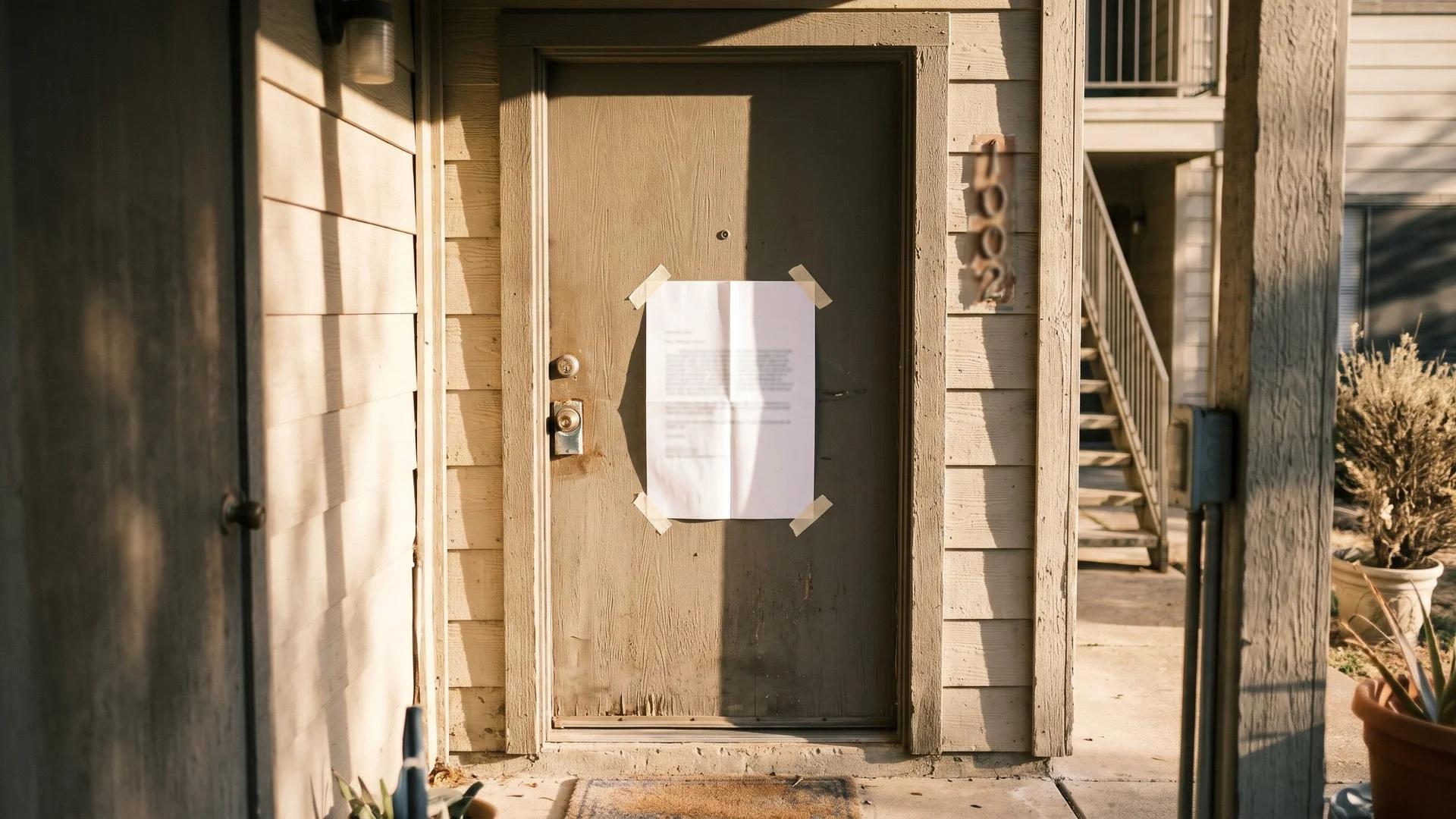
Under section 715.104, when the tenant has vacated, by eviction or otherwise, and personal property remains, the landlord gives written notice to the former tenant and to any other person the landlord reasonably believes to be the owner of the property. The notice must:
- Describe the property in a way reasonably adequate to let the owner identify it. A trunk, valise, box or other container that is locked, fastened or tied so its contents are not immediately accessible may be described as a container without listing its contents.
- Advise that reasonable costs of storage may be charged before the property is returned.
- State where the property may be claimed and the date by which it must be claimed.
The claim date must be not fewer than 10 days after the notice is personally delivered, or, if mailed, not fewer than 15 days after it is deposited in the mail. A mailed notice goes by first-class mail, postage prepaid, to the person's last known address and, if there is reason to believe that address will not reach the person, to any other address known to the landlord where the person may reasonably be expected to receive it (s. 715.104).
Section 715.105 supplies the form for the former tenant, titled "Notice of Right to Reclaim Abandoned Property", and the notice should be substantially in that form. It ends with one of two statements:
- Public sale. Property not claimed by the deadline may be sold at a public sale after notice is published; the tenant may bid at the sale; after storage, advertising and sale costs are paid, the remaining money goes to the county, and the tenant may claim it within 1 year after the county receives it.
- Under $500. Because the landlord believes the property is worth less than $500, it may be kept, sold or destroyed without further notice if not claimed by the deadline.
Section 715.106 supplies the matching form for a person other than the former tenant whom the landlord believes owns the property.
| Step | Rule | Section |
|---|---|---|
| Who gets notice | Former tenant and anyone reasonably believed to own the property | 715.104 |
| Deadline if delivered in person | At least 10 days after delivery | 715.104 |
| Deadline if mailed | At least 15 days after mailing, first-class | 715.104 |
| Storage | Left in place or in a secure location, reasonable care | 715.107 |
| Release | On payment of reasonable storage and advertising costs | 715.108 |
| Property under $500 | May be kept or disposed of | 715.109 |
| Other property | Public sale after newspaper notice; surplus to the county | 715.109 |
How must a Florida landlord store the property?
Under section 715.107, the property described in the notice may be left on the vacated premises or stored by the landlord in a place of safekeeping until it is released or disposed of. The landlord must exercise reasonable care in storing it, and is not liable to the tenant or any other owner for loss unless it results from the landlord's deliberate or negligent act.
Storage costs follow section 715.111. A former tenant who claims property may be required to pay the storage costs for all the property left on the premises when the tenancy ended, if still unpaid. Another owner may be required to pay only for the property in which that owner claims an interest. The landlord may not charge more than one person for the same costs. If the property is stored on the premises, the cost is the fair rental value of the space reasonably required for the storage period.
Under section 715.108, the landlord releases the property to the former tenant, or to a person the landlord reasonably believes is the owner, who pays the reasonable costs of storage and advertising and takes possession by the date in the notice. If the notice said the property would be sold at public sale, it may also be claimed before the sale by paying storage, advertising and sale costs incurred to that point.
How does a Florida landlord sell or dispose of unclaimed property?
If the property is not released, section 715.109 controls what happens next.
Property the landlord reasonably believes is worth less than $500. The landlord may keep it or dispose of it in any manner.
All other property. It must be sold at public sale by competitive bidding. The landlord and the former tenant may both bid, and the buyer takes the property subject to liens and security interests that have priority. Notice of the sale is published once a week for 2 consecutive weeks in a newspaper of general circulation where the sale is to be held. The notice describes the property, names the former tenant, and gives the time and place of the sale. The sale must be at least 10 days after the first publication, and the last publication must be at least 5 days before the sale. If there is no newspaper of general circulation where the sale is held, the notice is posted in at least six conspicuous places in the area.
After the sale, the landlord may deduct the reasonable costs of storage, advertising and sale, and must pay any balance not claimed by the former tenant or another owner to the county treasury within 30 days. The owner may claim that money within 1 year after it is paid to the county (s. 715.109).
What protection does a Florida landlord get after following Chapter 715?
Section 715.11 limits the landlord's liability once property is released or disposed of under the Act:
- Property released to the former tenant: the landlord is not liable with respect to it to any person.
- Property released under section 715.108 to someone else the landlord reasonably believes is the owner, or disposed of under section 715.109: the landlord is not liable to anyone who was given notice under section 715.104.
- A person who was not given notice can still recover only by proving that the landlord believed, or reasonably should have believed, that the person had an interest in the property, and knew or should have known on reasonable investigation where to reach them.
The limit does not reach property the notice failed to describe (s. 715.104).
What happens to belongings after a Florida eviction?
An eviction has its own rule. Under section 83.62, the sheriff puts the landlord in possession after 24 hours' notice is conspicuously posted on the premises, and Saturdays, Sundays and legal holidays do not stay the 24-hour period. When the writ is executed, or at any time after, the landlord or the landlord's agent may remove personal property found on the premises to or near the property line. The landlord may ask the sheriff to stand by to keep the peace while the locks are changed and the property is removed, at a reasonable hourly rate paid by the landlord. Neither the sheriff nor the landlord is liable to the tenant or anyone else for loss, destruction or damage to the property after it has been removed.
For the court steps that lead to a writ, see our guide to the Florida eviction process in county court.
Frequently asked questions
How long must a Florida landlord keep a tenant's belongings?
Under Chapter 715, until the claim date in the notice: at least 10 days after personal delivery, or at least 15 days after mailing (s. 715.104). After that, unclaimed property is sold at public sale or, if reasonably believed to be worth less than $500, kept or disposed of (s. 715.109).
Can a Florida landlord throw away a tenant's things right away?
Not after a move-out without a waiver. Section 83.67(5) bars removing a tenant's property except after surrender, abandonment, the death of the last remaining tenant or a lawful eviction, and the Chapter 715 notice is what limits the landlord's liability for what happens next. A lease waiver of the 715.104 notice must carry the statutory legend.
Can a Florida landlord charge for storing abandoned property?
Yes, reasonable storage costs, if the notice said so. On-premises storage is charged at the fair rental value of the space reasonably required, and the same costs cannot be charged to more than one person (ss. 715.104, 715.111).
What happens to money from a Chapter 715 sale?
The landlord deducts reasonable storage, advertising and sale costs and pays the unclaimed balance to the county treasury within 30 days; the owner may claim it within 1 year (s. 715.109).
Does Chapter 715 cover a tenant's car?
Towing a vehicle from private property is dealt with separately, in section 715.07, so check that section before moving one.
Florida Abandoned Property: Landlord Checklist
A one-page checklist for Florida landlords: when you may remove belongings, the Chapter 715 notice and deadlines, storage costs, the $500 rule and public sale.
Get Free PDF →The bottom line
In Florida, decide first whether you can touch the property at all (surrender, abandonment, the last tenant's death or an eviction), then follow Chapter 715: a written notice describing every item, at least 10 or 15 days to claim, reasonable storage, and a public sale or the under-$500 option. Arizona landlords follow a different clock; compare our guide to abandoned rentals in Arizona, and see the Florida security deposit rules for the money side of a move-out. More Florida guides are in the Tenon10 guides by topic.
More guides for Florida landlords
Read our free guides on Florida deposits, notices, repairs and evictions.
Free • No signup required