SCRA lease termination lets a servicemember end a residential lease early, without an early termination charge, when they enter military service or receive orders for a permanent change of station or a deployment of at least 90 days. The rule is federal (50 U.S.C. 3955, part of the Servicemembers Civil Relief Act), so it applies to landlords in every state.
This guide explains which tenants and leases qualify, how the tenant must give notice, the date the lease ends, what you can and cannot charge, and the related eviction protection in 50 U.S.C. 3951. Section numbers below refer to Title 50 of the United States Code. Amounts are in US dollars.
SCRA Lease Termination: Landlord Checklist
A one-page checklist for US landlords: who qualifies under the SCRA, the notice and orders, the effective date, what you may charge and the refund deadline.
Get Free PDF →Who counts as a servicemember
The Act defines a servicemember as a member of the uniformed services (50 U.S.C. 3911). For members of the Army, Navy, Air Force, Marine Corps, Space Force and Coast Guard, "military service" means active duty. It also covers a National Guard member called to active service by the President or the Secretary of Defense for more than 30 consecutive days under 32 U.S.C. 502(f) to respond to a declared national emergency, and commissioned officers of the Public Health Service and NOAA on active service.
A "dependent" is the servicemember's spouse, child, or a person for whom the servicemember provided more than half of their support for the 180 days before relief is requested (3911(4)).
Which residential leases qualify

Section 3955(b)(1) covers a lease of premises occupied, or intended to be occupied, by a servicemember or their dependents for a residential (or professional, business, agricultural or similar) purpose, in three situations:
- Lease signed before service. The lease was signed by or for a person who later, during the lease term, enters military service.
- Orders received after signing. The servicemember signed the lease while in military service and then received orders for a permanent change of station, or to deploy with a unit or as an individual in support of a military operation, for at least 90 days.
- Stop movement order. The servicemember signed the lease after receiving such orders, and then a stop movement order of indefinite length or at least 30 days prevents them or their dependents from occupying the premises.
Two definitions widen this. A "permanent change of station" includes separation or retirement from military service (3955(i)(3)). "Military orders" means official orders, including separation or retirement orders, or any notification, certification or verification from the servicemember's commanding officer about current or future duty status (3955(i)(1)). A letter from a commanding officer can therefore be enough.
How the tenant gives notice

Under 3955(c)(1), the tenant ends the lease by delivering to the landlord, or the landlord's agent, two things: written notice of termination and a copy of the military orders.
Delivery may be made by any of these methods (3955(c)(2)):
- hand delivery;
- a private business carrier;
- US mail with sufficient postage and return receipt requested, addressed as the landlord designated; or
- electronic means, including email to an address you designated, a posting to a website or portal both sides can access, or other electronic means reasonably calculated to ensure you actually receive it.
If you offer a tenant portal or a leasing email address, a notice sent there counts. Make sure someone reads it.
When the lease ends
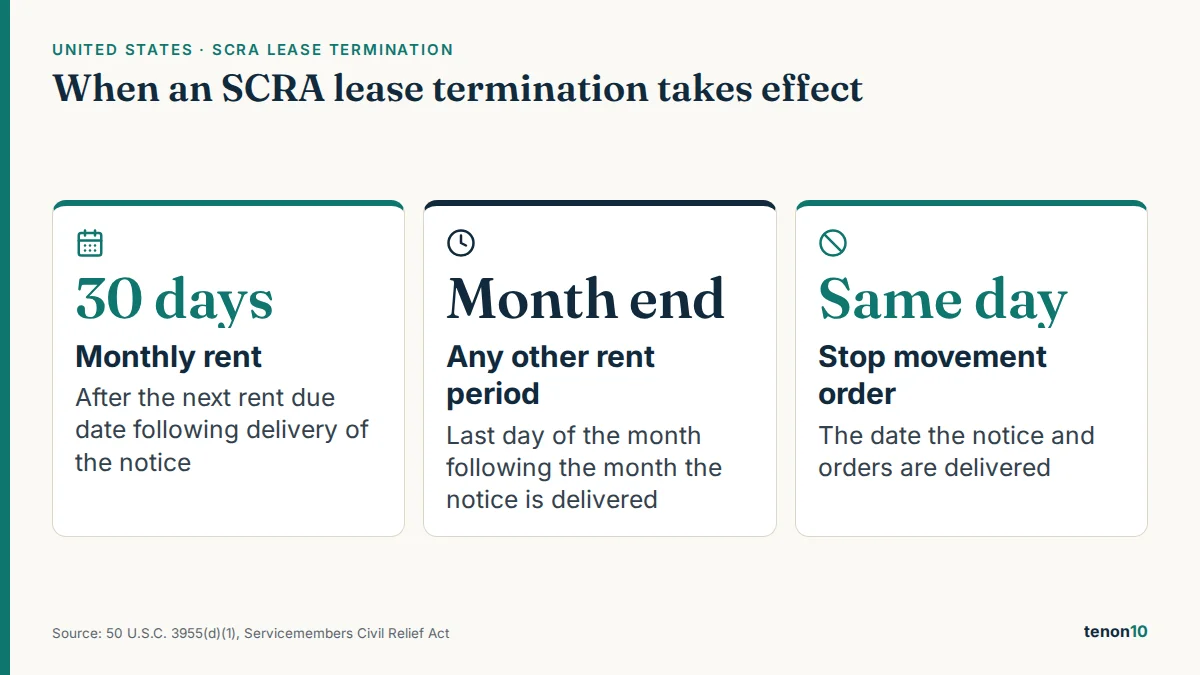
The effective date depends on the type of lease (3955(d)(1)):
| Situation | Termination is effective |
|---|---|
| Monthly rent, lease signed before service or orders received after signing | 30 days after the first date the next rent payment is due after the notice is delivered |
| Any other rent period in those same situations | The last day of the month following the month the notice is delivered |
| Stop movement order | The date the notice and orders are delivered |
Example. Rent is due on the 1st. The tenant delivers notice and orders on August 10. The next rent payment after delivery is due September 1, so the lease ends 30 days later, on October 1. The tenant owes rent through that date and nothing after it.
What you can and cannot charge
Section 3955(e)(1) sets the money rules for a residential lease:
- Prorated rent. Rent unpaid for the period before the effective date is paid on a prorated basis.
- No early termination charge. The landlord may not impose an early termination charge, so a lease-break fee in your lease does not apply to a lawful SCRA termination.
- Other lease obligations still apply. Taxes, summonses and other obligations and liabilities under the lease that are due and unpaid at termination, including reasonable charges for excess wear, remain payable.
- Advance rent comes back. Rent paid in advance for any period after the effective date must be refunded within 30 days of the effective date (3955(f)).
The security deposit and the tenant's belongings
Section 3955(h) makes it a federal misdemeanor to knowingly seize, hold or detain the personal effects, security deposit or other property of a servicemember or dependent who lawfully terminates, or to interfere with removing that property, in order to apply it to rent accruing after the termination date. The penalty is a fine under Title 18, up to one year in prison, or both.
You can still deduct for amounts the tenant genuinely owes under the lease, such as unpaid prorated rent or reasonable excess-wear charges, following your state's deposit rules. What you cannot do is keep the deposit as rent for months after the lease ended.
Joint leases, death and catastrophic injury
- Dependents on the lease. A servicemember's termination also ends any obligation a dependent has under the same lease (3955(a)(2)).
- Death in service. If the tenant dies while in military service or on full-time National Guard duty, active Guard and Reserve duty or inactive-duty training, the spouse or a dependent may terminate the lease within one year of the death (3955(a)(3)).
- Catastrophic injury or illness. If the tenant suffers a catastrophic injury or illness during military service or that covered service, the tenant may terminate within one year. If the tenant lacks the mental capacity to contract or manage their affairs because of it, the spouse or a dependent may terminate (3955(a)(4)).
Can a landlord ask a court for relief?
Yes. If you apply to a court before the termination date in the written notice, the court may modify the relief given to the servicemember "as justice and equity require" (3955(g)). The application has to be made before that date.
The related SCRA eviction protection
Separate from lease termination, 50 U.S.C. 3951 protects servicemembers and their dependents in their home during a period of military service:
- Court order required. Except by court order, a landlord may not evict them from premises occupied or intended to be occupied primarily as a residence where the monthly rent does not exceed a cap. The cap started at $2,400 for 2003 and is adjusted each year for housing inflation, with the new amount published in the Federal Register.
- A 90-day stay. In an eviction case, the court may on its own motion, and must on the servicemember's request where military service materially affects their ability to pay, stay the case for 90 days (or a longer or shorter period if justice and equity require) or adjust the lease obligation. The court may also grant the landlord equitable relief.
- Criminal penalty. Knowingly taking part in an eviction without the required court order is a misdemeanor with a fine, up to one year in prison, or both (3951(c)).
Enforcement
A person harmed by a violation of the Act may sue for equitable or declaratory relief and other appropriate relief, including monetary damages, and the court may award costs and a reasonable attorney fee (50 U.S.C. 4042). The Attorney General may also sue a person who engages in a pattern or practice of violations, or a violation raising an issue of significant public importance, and the court may assess civil penalties (50 U.S.C. 4041).
State military termination laws
Many states have their own military lease termination statutes alongside the federal rule. See our guides for Texas, Florida and Georgia. The federal rule applies in every state, so check both when a notice arrives.
A landlord's response checklist
- Date-stamp the notice and keep the copy of the orders with the lease file.
- Check that the tenant fits one of the three covered situations in 3955(b)(1).
- Calculate the effective date from the table above and confirm it to the tenant in writing.
- Remove any early termination charge from the final statement.
- Prorate rent to the effective date and refund any advance rent within 30 days after it.
- Handle the deposit under your state's rules, deducting only amounts the lease allows.
- If you believe the outcome is unfair, apply to court before the termination date.
Frequently asked questions
Can a landlord charge a fee when a servicemember breaks a lease?
No. For a lawful SCRA termination the landlord may not impose an early termination charge (50 U.S.C. 3955(e)(1)). Prorated rent to the effective date and other lease obligations, such as reasonable excess wear, are still owed.
How much notice does the SCRA require?
For a monthly lease, the termination takes effect 30 days after the next rent due date following delivery of the notice and orders. For a stop movement order, it takes effect on delivery.
Does the SCRA cover a tenant who is retiring or separating?
Yes, if they signed the lease while in military service. A permanent change of station includes separation or retirement (3955(i)(3)).
Do orders have to be official orders?
No. A notification, certification or verification from the commanding officer about the servicemember's duty status also counts (3955(i)(1)).
SCRA Lease Termination: Landlord Checklist
A one-page checklist for US landlords: who qualifies under the SCRA, the notice and orders, the effective date, what you may charge and the refund deadline.
Get Free PDF →The bottom line
When a servicemember gives written notice with a copy of qualifying orders, the lease ends on the date the statute sets, without an early termination charge. Prorate the rent, refund advance rent within 30 days, return the deposit under your state's rules, and go to court before the termination date if you need relief. More US guides are in the Tenon10 guides by topic.
More guides for US landlords
Read our free guides on US leases, deposits, disclosures and lease endings.
Free • No signup required