In Alberta, a landlord who ends your periodic tenancy for a stated reason, such as moving in a relative or renovating, and then does not use the unit for that reason within a reasonable time after you leave contravenes the Residential Tenancies Act (s.6(2)). You can claim damages in court or at the RTDRS, and it is an offence carrying a fine of up to $5,000.
This guide is for Alberta tenants who moved out after a landlord's notice and later found the landlord didn't use the unit for the notice reason: it was re-rented, listed or never used as promised. The rules come from the Residential Tenancies Act (RTA) and the Residential Tenancies Ministerial Regulation (AR 211/2004). The reasons a landlord may give are explained in Alberta landlord notice to end a monthly tenancy, and more renter topics are in the Alberta tenant resource center.
Alberta Notice Reason Not Followed: Renter Checklist
A one-page checklist for Alberta renters who moved out after a landlord's notice and found the unit was not used for the stated reason.
Get Free PDF →When has an Alberta landlord broken the follow-through rule?
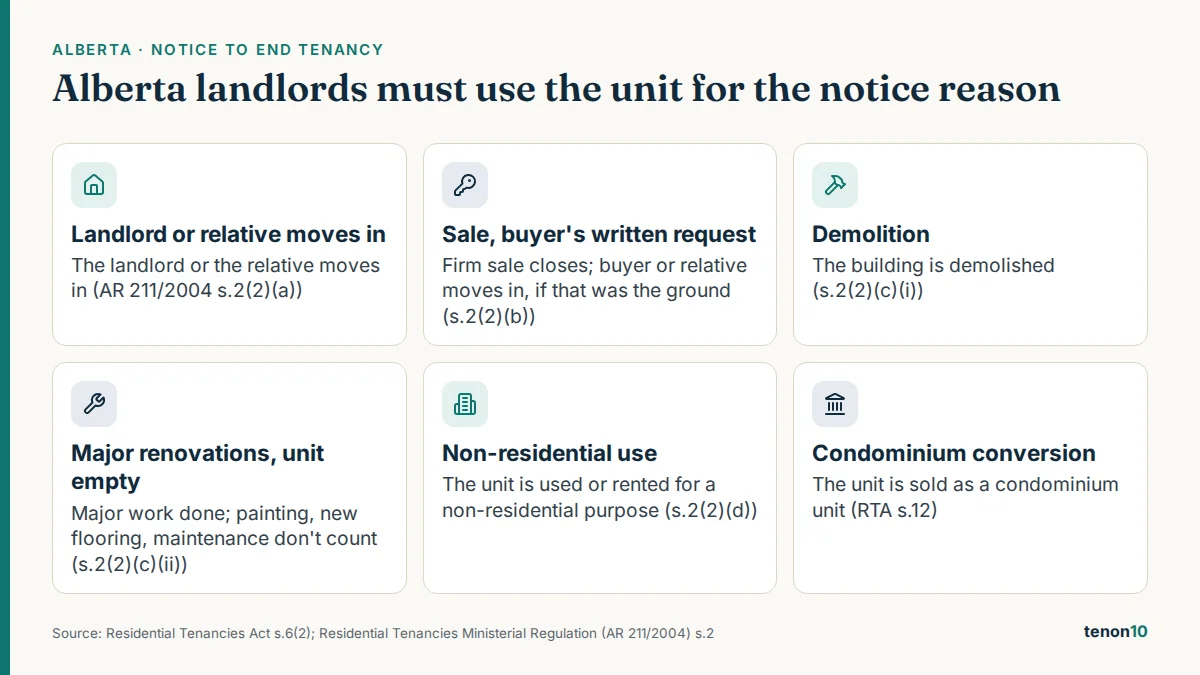
In Alberta, the follow-through rule is broken when three things line up: the landlord gave a notice to end a periodic tenancy for a prescribed reason or a condominium conversion, you moved out, and the landlord did not use the unit for the reasons in the notice within a reasonable time after the termination date (RTA s.6(2)). The Act does not define "a reasonable time".
| Reason in the notice | What following through looks like | Source |
|---|---|---|
| Landlord or a relative will live there | The landlord or the relative moves in | AR 211/2004 s.2(2)(a) |
| Firm sale; buyer asked in writing | The sale closes and the buyer or relative moves in, where that was the ground | s.2(2)(b) |
| Demolition | The building is demolished | s.2(2)(c)(i) |
| Major renovations needing the unit empty | The major work is done; painting, new flooring and routine maintenance do not count | s.2(1)(a), 2(2)(c)(ii) |
| Non-residential use | The unit is used or rented for a non-residential purpose | s.2(2)(d) |
| Condominium conversion | The unit is sold as a condominium unit, the purpose the vacant possession was sought for | RTA s.12 |
The rule applies to periodic tenancies. A fixed-term lease ends on its end date with no notice and no reason (s.15), so this route does not fit a tenancy that simply expired.
What you'll need

- The landlord's notice, which must state its reason (s.10).
- Proof of the date you moved out.
- Dated evidence of what happened to the unit afterwards: rental ads, screenshots, photos, or a neighbour's written account.
- Receipts for costs that flowed from the move, such as movers and the difference in rent at your new place.
Step 1: Gather evidence of how the unit is being used
Save any listing for the unit with the date showing, and note who is living there and when they arrived. An ad for the same unit soon after the termination date is the kind of evidence that speaks to the landlord's use; whether the time was reasonable is decided on the facts.
Step 2: Add up what the move cost you
A tenant may apply for recovery of damages resulting from a contravention of the Act (s.37(1)(a)). The application must be supported by an affidavit setting out the details of the contravention and the amount of damages claimed (s.37(2)(a)). The Act does not list which costs count, so keep every receipt and let the decision-maker weigh them.
Step 3: Choose court or the RTDRS
A tenant who can apply to a court under Part 3 of the Act may apply to the Residential Tenancy Dispute Resolution Service (RTDRS) instead (s.54.2(2)). The choice binds both sides: once one party files with the RTDRS, neither can go to court for the same or a related remedy unless the RTDRS application is withdrawn first (s.54.3). Filing in court first likewise blocks the RTDRS (s.54.2(3)).
Step 4: File your claim
State the notice, its reason, your move-out date, what the landlord did instead, and the amount you claim, with your evidence attached. How the service works is set out in RTDRS explained, and proving a money claim in claiming damages at the RTDRS.
Is it also an offence?
Yes. In Alberta, contravening the Act as described in s.6(2) is an offence with a fine of up to $5,000 (RTA s.60(1)(a)), and officers or directors of a corporate landlord who authorized it can also be liable (s.60(2)). No prosecution may start more than three years after the offence (s.61). A fine is separate from the damages you claim for yourself.
Tips
- Keep the original notice: its stated reason is what the landlord's later use is measured against.
- If you have not left yet, check whether the notice is valid at all; a notice without a prescribed reason is of no effect (s.6(1)). See ending a tenancy in Alberta.
Troubleshooting
- The landlord says plans changed. The test in s.6(2) is whether the unit was used for the stated reason within a reasonable time; bring your evidence and let the decision-maker decide.
- You already filed in court. You cannot also go to the RTDRS for a related remedy unless the court application is withdrawn first (s.54.2(3)).
Frequently asked questions
How long does the landlord have to use the unit?
The Act says "within a reasonable time after the termination date" and sets no number of days (s.6(2)). What is reasonable depends on the reason; a renovation takes longer to start than a move-in.
Does this apply if my fixed-term lease ended?
No. Section 6(2) covers notices to end periodic tenancies. A fixed-term tenancy ends on its end date without a notice (s.15).
Do I get compensation automatically?
No. The Act does not require a landlord to pay compensation when it gives a notice; you recover money only by proving damages in court or at the RTDRS (s.37(1)(a), s.54.2(2)).
Alberta Notice Reason Not Followed: Renter Checklist
A one-page checklist for Alberta renters who moved out after a landlord's notice and found the unit was not used for the stated reason.
Get Free PDF →Key takeaways
- Not using the unit for the stated reason within a reasonable time contravenes the Act (s.6(2)).
- Claim damages by affidavit in court or at the RTDRS, not both (ss.37, 54.2, 54.3).
- It is also an offence, up to $5,000, with a three-year limit to prosecute (ss.60, 61).
Looking for your next place in Alberta?
Browse rentals in Calgary, Edmonton and across the province.
Free • No signup required