A North Carolina notice to quit ends a periodic tenancy. Under G.S. 42-14 a month-to-month tenancy needs seven days' notice, a week-to-week tenancy two days, and a year-to-year tenancy one month before the end of the current year. Renting only a space for a manufactured home needs 60 days' notice before the end of the current rental period.
These periods are short, and they apply to tenancies with no fixed end date. A lease for a fixed term ends on its own date. This how-to explains which period applies, how to give the notice, and the limits that still apply when you end a tenancy without a reason.
North Carolina Notice to Quit: Landlord Checklist
A one-page checklist for North Carolina landlords ending a periodic tenancy: the notice periods in G.S. 42-14, writing and delivering the notice, holdovers and the limits.
Get Free PDF →How much notice does North Carolina require to end a tenancy?
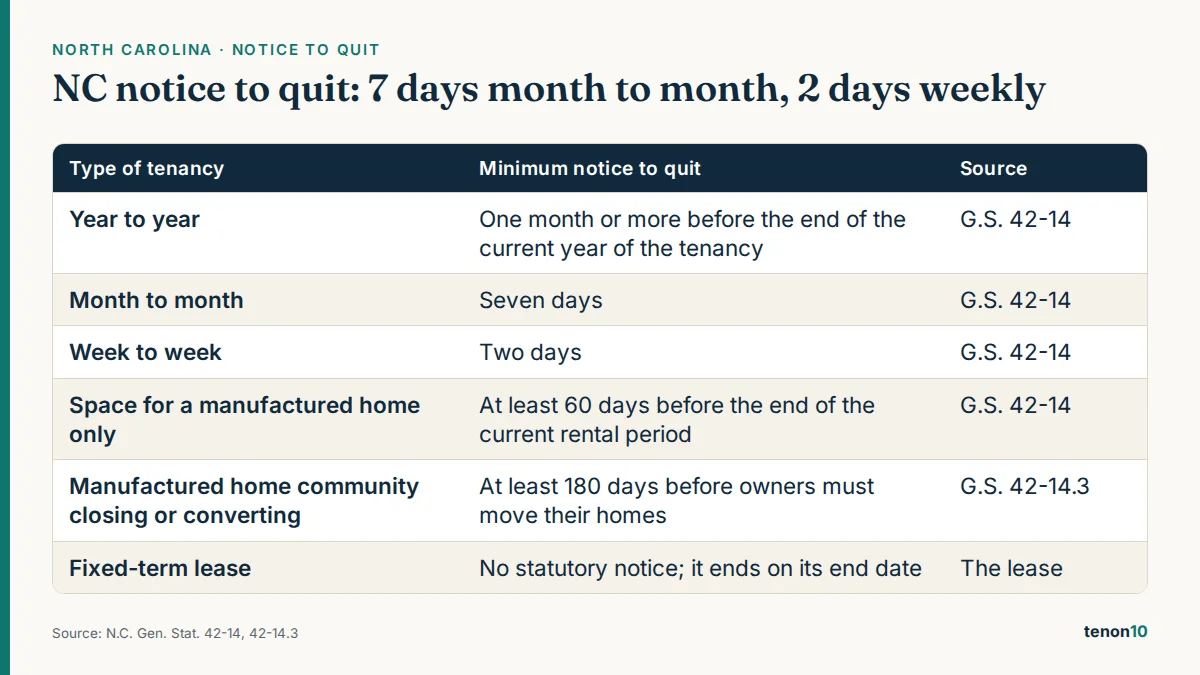
North Carolina sets the periods in G.S. 42-14:
| Type of tenancy | Minimum notice to quit | Source |
|---|---|---|
| Year to year | One month or more before the end of the current year of the tenancy | G.S. 42-14 |
| Month to month | Seven days | G.S. 42-14 |
| Week to week | Two days | G.S. 42-14 |
| Space for a manufactured home only | At least 60 days before the end of the current rental period, whatever the term | G.S. 42-14 |
| Manufactured home community closing or converting | At least 180 days before owners must move their homes | G.S. 42-14.3 |
| Fixed-term lease | No statutory notice; it ends on its end date | The lease |
The statute describes the month-to-month and week-to-week periods as a "like notice" to the year-to-year rule, which runs to the end of the current period. The safe practice is to pick an end date that falls at the end of a rental period and deliver the notice at least the required number of days before it.
How do you give a North Carolina notice to quit?

- Confirm the tenancy type. Check whether the lease has a fixed end date, and if not, whether rent is paid by the week, month or year. If the lease has an automatic renewal clause, follow its notice terms as well.
- Choose the end date. Use the last day of a rental period that is at least seven days away for month to month, two days for week to week, or one month before the end of the tenancy year for year to year.
- Write the notice. Name every tenant and the address, state that the tenancy ends, and give the date by which possession must be returned.
- Deliver it and keep proof. G.S. 42-14 does not set a delivery method, so use the method in the lease if there is one and keep a copy, a dated photo, or a mailing receipt. If the tenant stays, you will need to show the notice in court.
- Settle the deposit on time. After the tenant leaves, itemize and refund within 30 days under G.S. 42-52. See our North Carolina security deposit guide.
What if the tenant stays after the North Carolina notice ends?
A tenant who holds over after the term has ended, without permission and after a demand to surrender, may be removed through summary ejectment (G.S. 42-26(a)(1)). The landlord files with the clerk of superior court and a magistrate hears the case. A residential tenant may not be removed by lockout or other self-help (G.S. 42-25.6). Our North Carolina summary ejectment guide walks through the case.
Are there limits on ending a North Carolina tenancy without a reason?
Yes, North Carolina has three:
- Retaliation. In a summary ejectment case, a tenant may defend by showing the case is substantially a response to a protected act within the previous 12 months, such as a good-faith repair request or code complaint (G.S. 42-37.1). The landlord can still win if the good-faith notice to quit was delivered before the protected act, or if a fixed-term tenant with no option to renew holds over after the term.
- Victim protection. A landlord may not end or fail to renew a tenancy based substantially on a tenant's or household member's status as a victim of domestic violence, sexual assault or stalking (G.S. 42-42.2).
- Fair housing. Federal fair housing law applies to terminations as much as to rentals. See our Fair Housing Act guide.
Rent control is not one of the limits. Local governments in North Carolina may not regulate the amount of rent on privately owned residential property (G.S. 42-14.1).
Frequently asked questions
Does a tenant need to give the same notice?
G.S. 42-14 does not distinguish between landlord and tenant. It sets the notice to quit for each type of tenancy, so plan on the same periods when the tenant gives notice.
Can a protected tenant leave a fixed-term lease early?
A victim of domestic violence, sexual assault or stalking may end the agreement with written notice effective at least 30 days after the landlord receives it, with the documents listed in G.S. 42-45.1. The tenant owes rent prorated to the effective date.
Does a fixed-term lease need a notice to end?
Not under G.S. 42-14, which covers periodic tenancies. Read the lease for renewal or notice terms, and see our Florida and Texas guides for how other states handle this.
What about Georgia?
Georgia is very different: a landlord must give 60 days' notice to end a tenancy at will. See our Georgia 60-day notice guide.
North Carolina Notice to Quit: Landlord Checklist
A one-page checklist for North Carolina landlords ending a periodic tenancy: the notice periods in G.S. 42-14, writing and delivering the notice, holdovers and the limits.
Get Free PDF →More guides for North Carolina landlords
Read the rest of our North Carolina and US landlord guides in one place.
Free • No signup required