North Carolina self-help eviction is banned for residential tenants: a landlord may remove a tenant only through summary ejectment or the other court procedure in Chapter 42 (G.S. 42-25.6). Changing locks or removing belongings to force a tenant out lets the tenant recover possession or end the lease and sue for actual damages.
The rules sit in Article 2A of Chapter 42 of the General Statutes (G.S. 42-25.6 to 42-25.9), with the sheriff's role in G.S. 42-36.2. Any lease term that conflicts with the Article is void (G.S. 42-25.8). This how-to explains what is banned, the steps to recover possession lawfully, and what you may do with property a tenant leaves behind. Amounts are in US dollars.
North Carolina Lockout Ban: Landlord Checklist
A one-page checklist for North Carolina landlords: what self-help eviction means, the lawful route to possession and the rules for property a tenant leaves behind.
Get Free PDF →What counts as self-help eviction in North Carolina?
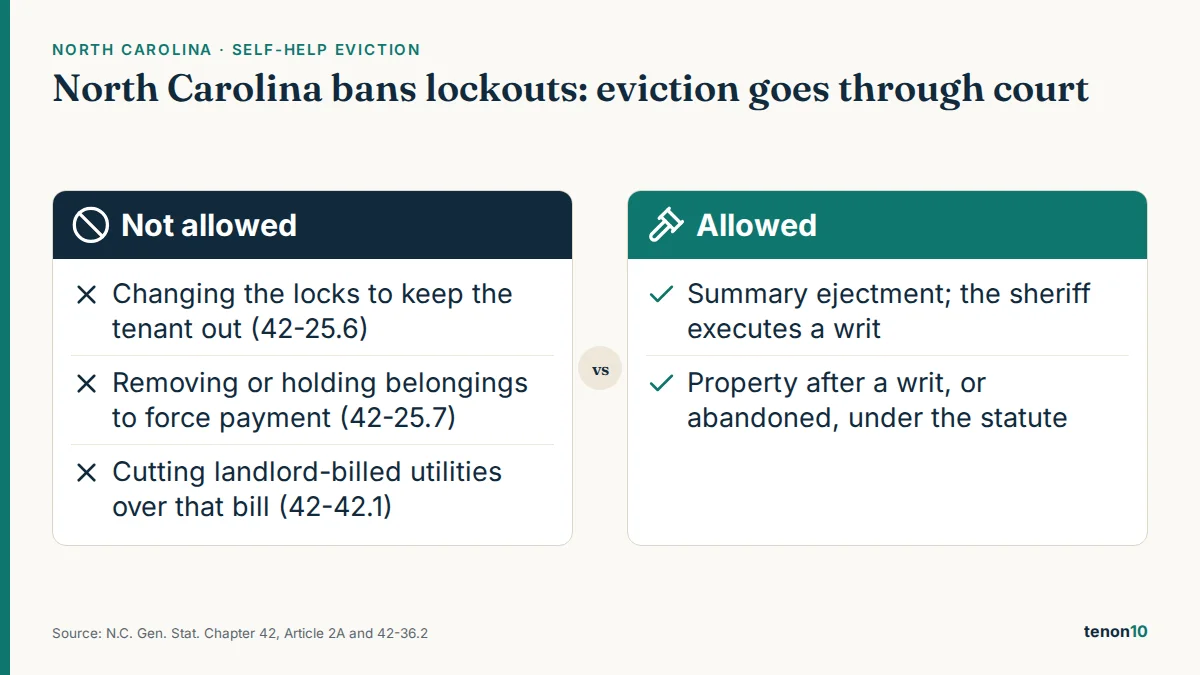
North Carolina policy is that a residential tenant may be evicted, dispossessed or otherwise constructively or actually removed from the dwelling only under Article 3 (summary ejectment) or Article 7 of Chapter 42 (G.S. 42-25.6). Distress and distraint, meaning seizing a tenant's belongings to secure rent, are prohibited (G.S. 42-25.7). A landlord who bills for water, sewer, electricity or gas also may not disconnect it because the tenant has not paid that bill (G.S. 42-42.1(b)).
| Landlord action | Allowed? | Source |
|---|---|---|
| Changing the locks to keep the tenant out | No | G.S. 42-25.6 |
| Removing or holding the tenant's belongings to force payment | No | G.S. 42-25.7, 42-25.9(b) |
| Disconnecting landlord-billed utilities for nonpayment of that bill | No | G.S. 42-42.1(b) |
| Filing summary ejectment and having the sheriff execute a writ | Yes | G.S. 42-26 to 42-36.2 |
| Dealing with property after a writ, or abandoned property, under the statute | Yes | G.S. 42-25.9(d)-(h), 42-36.2 |
What can a North Carolina tenant recover for an illegal lockout?

Under G.S. 42-25.9, a tenant removed or threatened with removal contrary to the Article may recover possession or end the lease, and the landlord or agent is liable for the damages the removal caused. A tenant or household member whose belongings were seized or whose access to them was blocked outside the statute may recover the property or its value plus actual damages. Damages in either case are limited to actual damages, as in a trespass or conversion action, and exclude punitive damages, treble damages and damages for emotional distress. These remedies sit alongside the tenant's other legal rights.
A forced move-out also affects the deposit. A landlord may not keep any of the deposit as damages for the tenant not completing the rental period where the tenant was forced to leave by the landlord's violation of Article 2A (G.S. 42-51(a)(3)). See our North Carolina security deposit guide.
How do you recover possession lawfully in North Carolina?
- End the tenancy or identify the breach. For a periodic tenancy, give the notice to quit in G.S. 42-14; see our North Carolina notice to quit guide. For unpaid rent, demand the past-due rent.
- Demand possession. Summary ejectment applies to a tenant who holds over after a demand to surrender (G.S. 42-26(a)).
- File summary ejectment. File with the clerk of superior court; a magistrate hears the case. Our summary ejectment guide covers each step.
- Let the sheriff execute the writ. The sheriff executes a writ of possession within five days of receiving it, after giving the tenant notice of the approximate time (G.S. 42-36.2).
What can a North Carolina landlord do with property left behind?
North Carolina gives the landlord three routes, and the rules differ by situation:
| Situation | What the landlord may do | Source |
|---|---|---|
| Writ executed; property stays on the premises | For seven days, release it to the tenant on request and move it only for storage; after that, dispose of it or sell it after at least seven days' written notice of sale by first-class mail | G.S. 42-25.9(g), 42-36.2(b) |
| Writ executed; all remaining property worth less than $500 | Deemed abandoned five days after execution and may be thrown away, but released to the tenant on request before then | G.S. 42-25.9(h) |
| Property worth $750 or less, abandoned or left at execution of a writ | Deliver it to a nonprofit that gives clothing and household goods to people in need, if it agrees to store it separately for 30 days and release it free to the tenant | G.S. 42-25.9(d) |
For a sale, the notice must give the date, time and place, and say that any surplus after unpaid rent, damages, storage fees and sale costs goes to the tenant on request within seven days of the sale and is then delivered to the county government. For the nonprofit route, the landlord must post a notice at the premises naming the recipient, post it for at least 30 days where rent is received, and mail it to the tenant's last known address, without describing the property.
For the nonprofit route, property is deemed abandoned if the landlord finds evidence clearly showing the premises were voluntarily vacated after the paid rental period expired and has no notice that a disability caused the vacancy. A presumption of abandonment arises 10 or more days after the landlord posts a notice of suspected abandonment conspicuously inside and outside the premises and receives no response (G.S. 42-25.9(e)). Manufactured homes have separate rules.
Frequently asked questions
Can the lease allow me to change the locks for nonpayment?
No. A lease provision contrary to Article 2A is void as against public policy (G.S. 42-25.8).
Can I keep belongings until the tenant pays?
No. Distress and distraint are prohibited, and a landlord's rights over a residential tenant's belongings exist only under the sections the statute lists (G.S. 42-25.7).
Who pays to store property after a writ?
The sheriff may require the landlord to advance the cost of moving the property to a storage warehouse plus one month's storage (G.S. 42-36.2(b)). Those costs can be charged to the tenant as court costs if the tenant does not ask for the property within seven days, and removal and storage costs after summary ejectment are a permitted use of the deposit (G.S. 42-51(a)(6)).
How do other states handle this?
See our guides to the Georgia dispossessory process and the Arizona special detainer process.
North Carolina Lockout Ban: Landlord Checklist
A one-page checklist for North Carolina landlords: what self-help eviction means, the lawful route to possession and the rules for property a tenant leaves behind.
Get Free PDF →More guides for North Carolina landlords
Read the rest of our North Carolina and US landlord guides in one place.
Free • No signup required