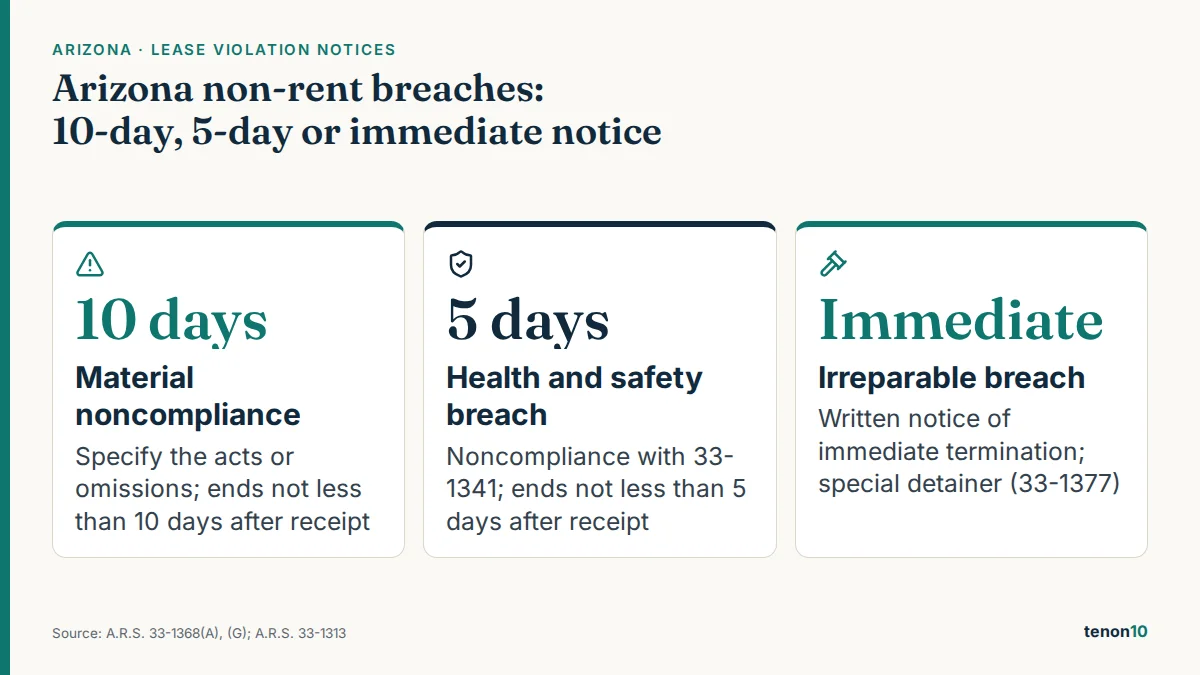
An Arizona landlord whose tenant materially breaks the lease, other than by not paying rent, can deliver a 10-day notice to cure or the lease ends. A breach of the tenant's health and safety duties uses a 5-day notice, and a material and irreparable breach allows immediate termination (A.R.S. 33-1368(A)).
This how-to follows section 33-1368 of the Arizona Residential Landlord and Tenant Act. Unpaid rent uses a separate notice: see the Arizona 5-day notice to pay rent.
Arizona 10-Day Notice: Landlord Checklist
A one-page checklist for Arizona landlords: choosing the 10-day, 5-day or immediate notice, writing it, proving receipt and handling a cure or a repeat.
Get Free PDF →What you'll need for an Arizona noncompliance notice
For an Arizona noncompliance notice you need the lease term or statutory duty broken, evidence of what happened, and proof of when the tenant received the notice.
- The duty broken. A lease term, or one of the tenant duties in A.R.S. 33-1341, such as keeping the unit clean and safe, disposing of garbage, not damaging the premises and not disturbing neighbors. The landlord's own duties are in Arizona landlord repair obligations.
- Evidence. Photos, complaints and dates.
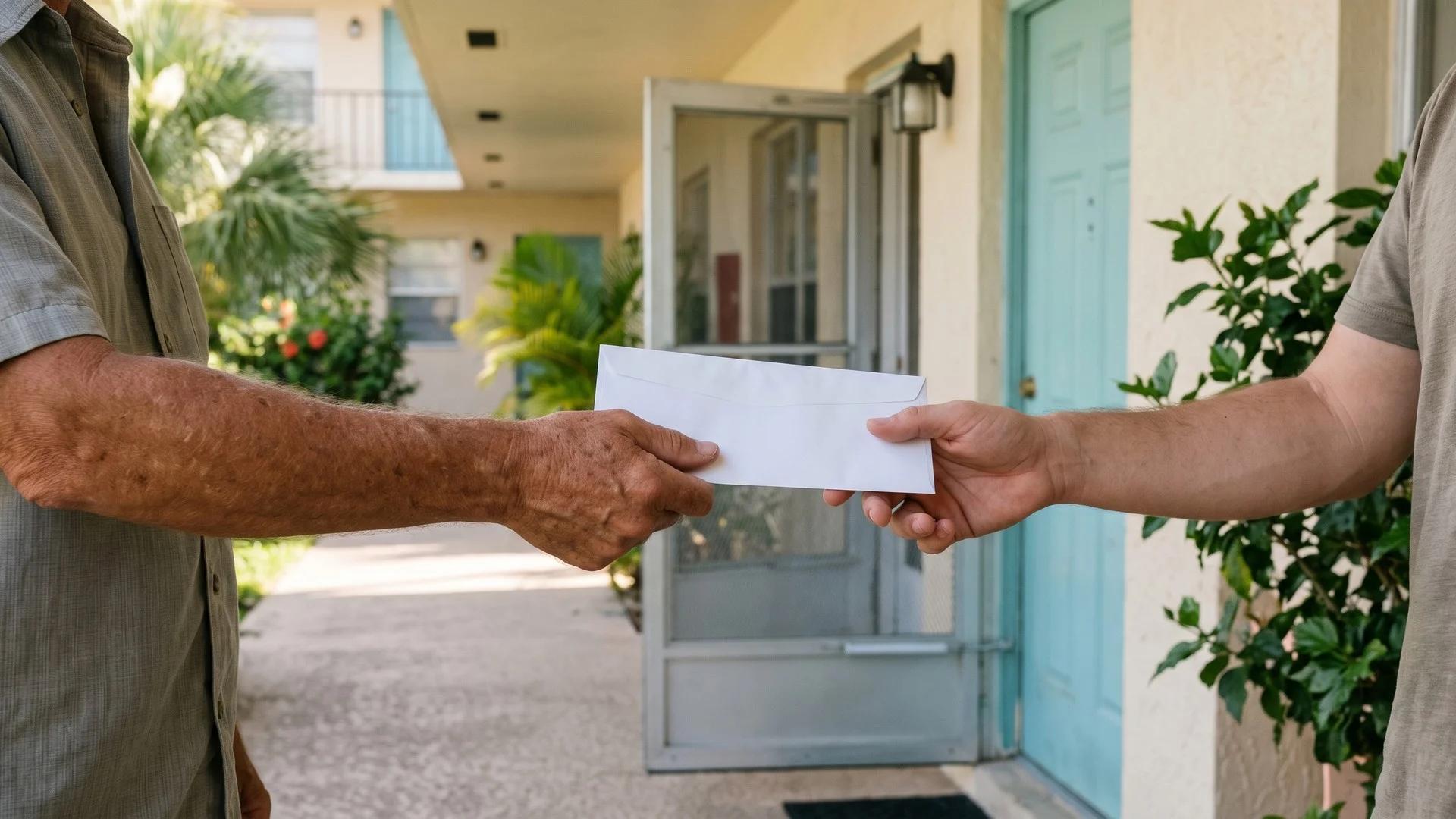
- Proof of receipt. The deadlines run from receipt, so hand delivery or registered or certified mail matters (33-1313).
Which Arizona notice fits the breach?

Arizona sets three tracks for non-rent breaches in 33-1368(A), and "days" means calendar days (33-1368(G)).
| Breach | Notice | Result if not remedied |
|---|---|---|
| Material noncompliance with the rental agreement, including material falsification on the application | 10-day notice specifying the acts or omissions | Agreement terminates on a date not less than 10 days after receipt |
| Noncompliance with 33-1341 materially affecting health and safety | 5-day notice specifying the acts or omissions | Agreement terminates on a date not less than 5 days after receipt |
| Material and irreparable breach on the premises | Written notice of immediate termination | Landlord proceeds under 33-1377 (special detainer) |
Steps: how does an Arizona landlord serve a 10-day or 5-day notice?
Step 1: Identify the breach type
Material falsification includes untrue or misleading information about the number of occupants, pets, income, Social Security number, current employment, criminal records, prior eviction record and current criminal activity. Falsification about criminal records, prior evictions and current criminal activity is not curable under the section.
The statute lists examples of material and irreparable breaches, including an illegal discharge of a weapon, homicide, prostitution, criminal street gang activity, unlawful controlled-substance activity, threatening or intimidating, assault, acts found to be a nuisance, and breaches that jeopardize the health, safety and welfare of the landlord, the landlord's agent or another tenant or involve imminent or actual serious property damage. The list is not exhaustive.
Step 2: Write the notice
The notice must be written, must specify the acts and omissions constituting the breach, and must state that the rental agreement will terminate on a date not less than 10 days (or 5 days for health and safety) after receipt if the breach is not remedied.
Step 3: Deliver it so receipt can be proven
Under 33-1313(B), a tenant receives a notice when it is delivered in hand or mailed by registered or certified mail to the place the tenant holds out for notices, or to the last known residence. A mailed notice is deemed received on actual receipt or five days after mailing, whichever is first.
Step 4: Watch the cure
If the breach can be remedied by repair, payment of damages or otherwise, and the tenant adequately remedies it before the date in the notice, the rental agreement does not terminate.
Step 5: Handle a repeat
If the tenant commits another noncompliance of the same or a similar nature during the lease after remedying the first, the landlord may file a special detainer action under 33-1377 ten days after delivering a written notice that a second noncompliance has occurred. The court process is in our Arizona special detainer guide.
Troubleshooting
The problem is a guest. Under 33-1368(F), the tenant is responsible for guests' lease or rule violations if the tenant could reasonably be expected to know they might occur and did not try to prevent them.
You want to recover costs. The landlord may recover reasonable damages from the noncompliance, court costs, reasonable attorney fees and quantifiable damage to the premises (33-1368(C)).
The tenant just complained. Arizona's retaliation presumption can apply; see Arizona landlord retaliation rules.
Frequently asked questions
How many days does an Arizona tenant get to fix a lease violation?
Ten calendar days after receipt for a material noncompliance, or five calendar days for a health and safety breach of 33-1341 (A.R.S. 33-1368(A), (G)).
Can an Arizona landlord end a lease immediately?
Yes, for a material and irreparable breach on the premises such as an illegal weapon discharge or assault, by written notice of immediate termination and a special detainer under 33-1377.
Is lying on a rental application grounds to end an Arizona lease?
Material falsification is a material noncompliance under 33-1368(A). Falsified criminal records, prior evictions or current criminal activity cannot be cured.
Arizona 10-Day Notice: Landlord Checklist
A one-page checklist for Arizona landlords: choosing the 10-day, 5-day or immediate notice, writing it, proving receipt and handling a cure or a repeat.
Get Free PDF →The bottom line
Match the Arizona breach to the 10-day, 5-day or immediate track, specify the acts in writing, prove the receipt date and count calendar days from it. More guides are in the Tenon10 guides by topic.
More guides for Arizona landlords
Read our free guides on Arizona notices, deposits, repairs and evictions.
Free • No signup required