Alberta has no cap on how much rent can go up, but a landlord can raise it only once every 365 days, never during a fixed term of a year or more, and only with written notice of at least three tenancy months for a monthly tenancy (Residential Tenancies Act, s.14; Ministerial Regulation s.3). If any of those rules is broken, the notice is void.
This how-to is for Alberta tenants who have received a rent increase notice that feels too high and want to know their options. It follows the Residential Tenancies Act (RTA), the Residential Tenancies Ministerial Regulation and the government's During a tenancy page. The topic hub is the Alberta rent increase series, and more tenant help is in the Alberta tenant resource center.
Alberta Rent Increase Notice: Renter Checklist
A one-page checklist for Alberta tenants checking a rent increase notice and deciding what to do next.
Get Free PDF →Step 1: Accept that the amount itself is not capped
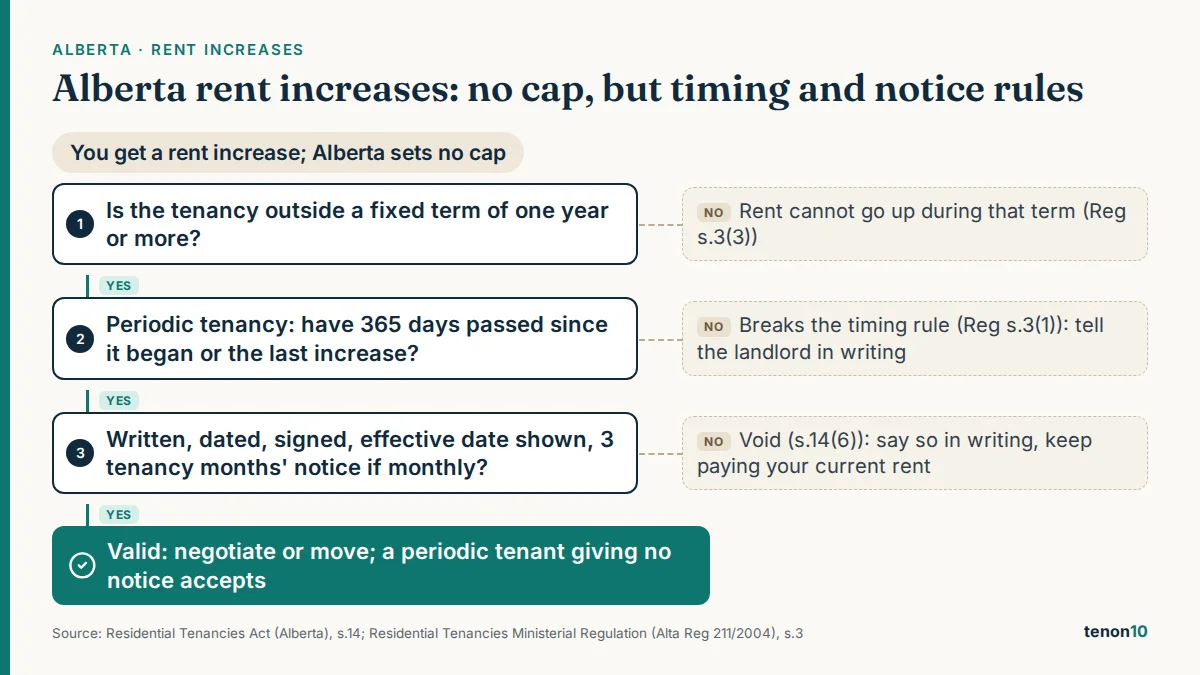
Alberta sets no limit on the size of a rent increase. The government's During a tenancy page says there is "no limit on the amount by which the landlord may raise the rent". A large increase is therefore not unlawful on its own. What the law controls is timing and notice, so check those next.
Step 2: Check the timing

For a periodic tenancy, at least 365 days must have passed since the tenancy began or since the last increase, whichever is later (Ministerial Regulation s.3(1)). For a fixed-term tenancy of one year or more, rent cannot go up during the term (s.3(3)). For back-to-back fixed terms of less than a year in the same unit, the 365-day rule applies across them, and if the 365th day falls inside a term the increase waits until that term ends (s.3(4), s.3(5)).
A landlord also may not raise a periodic tenant's rent after serving a condominium-conversion termination notice or a notice to end the tenancy for major renovations (s.3(2)). Fixed-term questions are covered in can a landlord raise rent during a fixed-term lease in Alberta.
Step 3: Check the notice
A rent increase notice in Alberta must be in writing, show the date the increase takes effect, and be dated and signed by the landlord (RTA s.14(2)). It must be served at least:
| Tenancy | Minimum notice | Source |
|---|---|---|
| Weekly | 12 tenancy weeks | RTA s.14(1)(a) |
| Monthly | 3 tenancy months | s.14(1)(b) |
| Any other periodic tenancy | 90 days | s.14(1)(c) |
If your tenancy agreement promises a longer notice period, the landlord must give that longer period (s.14(3)). Counting tenancy months is explained in how much notice is needed for a rent increase in Alberta.
Step 4: If the notice breaks a rule, say so in writing
A notice of rent increase that does not comply with section 14 "is void" (RTA s.14(6)). Tell the landlord in writing which rule the notice breaks, keep paying your current rent, and keep a copy. If you have already paid the higher rent under a non-compliant notice, you may recover the amount of the increase in an action in debt (s.14(7)). Disputes can go to the Residential Tenancy Dispute Resolution Service (RTDRS) or the courts; see how to apply to the RTDRS.
Step 5: If the notice is valid, negotiate or decide to move
If the timing and notice are correct, your choices are to pay, to negotiate, or to leave. A lower increase can be agreed at any time; the government's page notes that tenancy agreements can be amended when both sides agree, and that it is advisable to put the change in writing.
Be careful with the deadline. A periodic tenant who receives a valid notice and does not give notice to end the tenancy effective on or before the date the increase takes effect is deemed to have agreed to the increase (RTA s.14(5)). For a monthly tenancy, a tenant's notice must be served on or before the first day of a tenancy month to take effect on the last day of that month (s.8(1)(a)), and it must be in writing, signed, identify the premises and state the end date (s.10(1)). See how a tenant gives notice in Alberta.
Alberta Rent Increase Notice: Renter Checklist
A one-page checklist for Alberta tenants checking a rent increase notice and deciding what to do next.
Get Free PDF →Key takeaways
- No cap on the amount, but strict rules on timing and notice (RTA s.14; Reg. s.3).
- Monthly tenancies need 3 tenancy months' written, signed notice (s.14(1)(b), s.14(2)).
- A non-compliant notice is void, and overpaid increases can be recovered (s.14(6), s.14(7)).
- Staying past the effective date without giving notice means you accept a valid increase (s.14(5)).
Check your notice against the rules
Free landlord and tenant forms, ready when you need them.
Free • No signup required