ALBERTA, October 30, 2026: The Alberta education property tax, the provincial part of every property tax bill, will be cut, standardized and locked for three years, the government announced on October 30, 2026. Starting in 2027, municipalities will apply one provincial rate of $2.65 per $1,000 of assessment to residential and farmland property and $3.98 to non-residential property. For landlords, that sets the provincial share of a rental's tax bill; the municipal share is still set locally.
What is changing with Alberta's education property tax, and when?
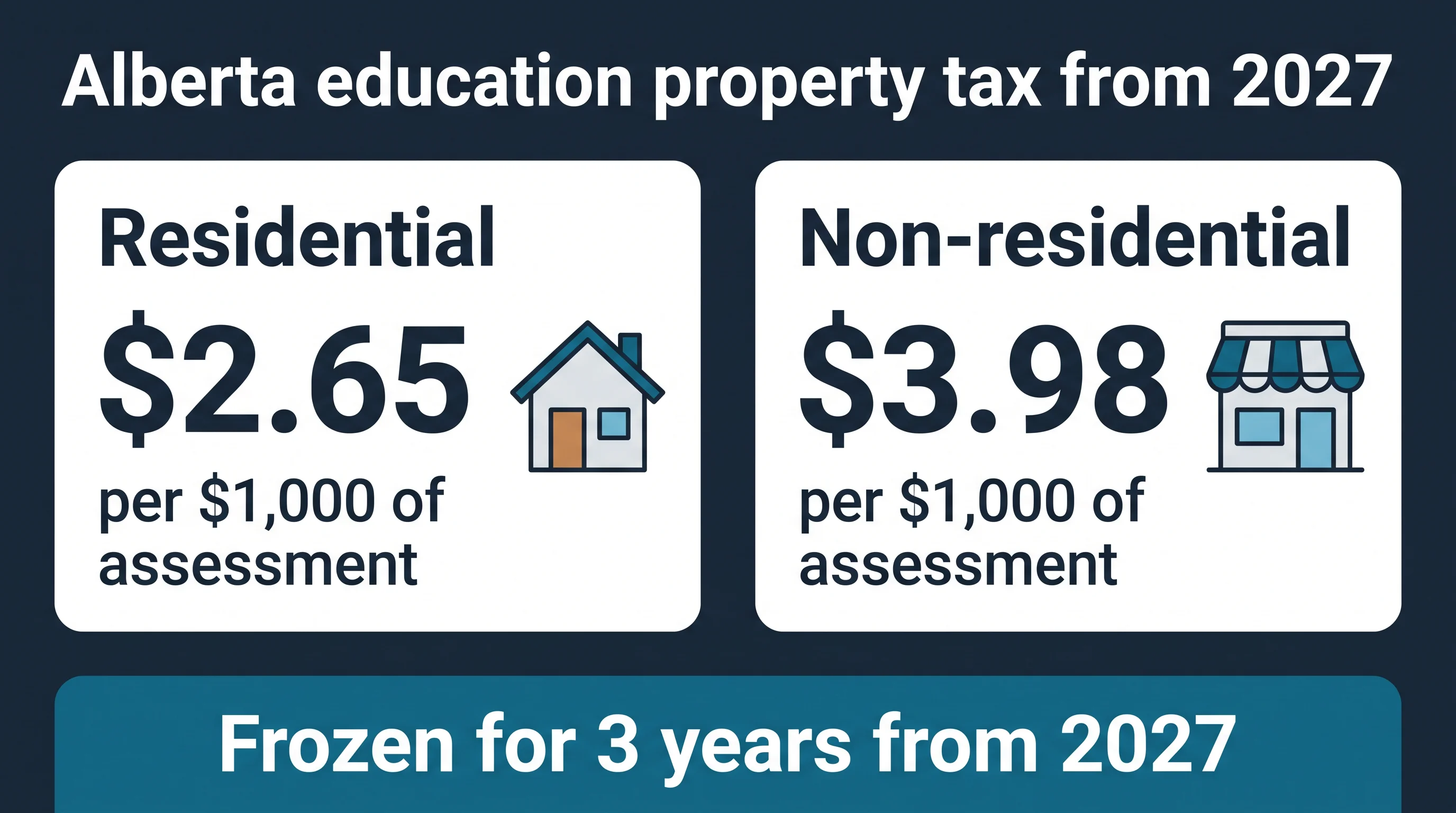
Alberta's education property tax will move to one provincial rate for all municipalities, applied to assessed values starting in 2027 and locked in for three years. According to the government's October 30 announcement, the rates will be:
| Property class | Rate from 2027 |
|---|---|
| Residential and farmland | $2.65 per $1,000 of assessment |
| Non-residential | $3.98 per $1,000 (the residential rate with a 1.5 multiplier) |
The government estimates owners will save $98.7 million overall in 2027-28. Where the new provincial rate is higher than a community's current local rate, it says it will provide a one-time transition tax credit in 2027. The announcement does not say who applies for the credit or how it appears on a tax bill; it says rates, detailed calculations and municipal guidance will be shared before municipalities adopt their 2027 tax bylaws.
Under the Education Act, s.167, the province sets rates each year and applies them to each municipality's equalized assessment to fix what the municipality must pay into the Alberta School Foundation Fund; each municipality then sets its own local rate. For 2026-27 the province's education property tax page lists rates of $2.84 (residential/farmland) and $4.17 (non-residential) per $1,000 of equalized assessment, raising the requisition from $3.1 billion in 2025-26 to $3.6 billion. Because those rates apply to equalized assessment, they are not directly comparable with the new rates on a single bill.
What it means for landlords
For Alberta landlords, the new residential rate of $2.65 per $1,000 is the provincial part of the tax on a rental home, suite or apartment building, and it stays the same for three years. Under the Municipal Government Act, s.297(4)(b), "non-residential" excludes land used or intended to be used for permanent living accommodation, so long-term rentals fall in the residential class.
Illustrative example: on a rental assessed at $400,000, $400,000 ÷ 1,000 × $2.65 = $1,060 for the provincial education portion. Your real figure depends on your assessment and on the final rules the province publishes.
Your total bill still depends on your municipality. Each council must pass a property tax bylaw every year (MGA s.353(1)), and the municipal rates are not part of this announcement.
Property tax on a rental remains a deductible expense. The CRA's Rental Income guide (T4036) says, under line 9180 of Form T776, that you can deduct property taxes incurred for your rental property for the period it was available for rent. Our T776 guide walks through the form.
Can Alberta landlords pass property tax changes on to tenants?
Alberta has no rent increase cap, but the Residential Tenancies Act sets the process: written notice of at least 3 tenancy months for a monthly tenancy (s.14(1)), and at least one year between increases (s.14(4)). A notice that does not comply is void (s.14(6)). Our Alberta rent increase rules article covers the details. The province's own page notes that people who rent may contribute to the education tax indirectly through their rent.
Does this need new legislation?
The announcement says the change comes "through Budget 2027" and does not name a bill or regulation. As the Education Act reads today (s.167), the Lieutenant Governor in Council sets the rates "in each year" and applies them to equalized assessment, so watch whether Budget 2027 brings amendments to put a three-year rate applied to assessed values into law.
What to do now
- Watch Budget 2027 and any bill or order that sets the new rates.
- Watch the province's guidance on the 2027 transition tax credit, to see whether your municipality qualifies and how the credit is applied.
- Follow your council's 2027 budget and tax bylaw, which set the municipal share of your bill.
- Check your 2027 assessment notice.
- Keep your tax bills for your T776, and give proper notice under RTA s.14 before any rent change.
For zoning and housing news in Calgary, see our report on Calgary's rezoning repeal and the Housing Accelerator Fund. For every Alberta rule in one place, read the Alberta Landlord Guide.
Keep your Alberta rentals organized
Create Alberta leases, run move-in and move-out inspections and send rent reminders with Tenon10.
Free • No signup required