Renting out a home in Alberta means working under one main law, the Residential Tenancies Act (RTA), plus a short list of regulations and a provincial housing standard. The rules are fewer than in Ontario or British Columbia, but the ones that exist are strict. A rent increase notice with the wrong timing is void. A deposit deduction without inspection reports is not allowed. A 14-day notice for unpaid rent falls away if the tenant pays in time.
This guide puts every core rule for Alberta landlords on one page, in the order a tenancy runs: before move-in, during the tenancy, when something goes wrong, and at the end. Each part links to a full guide on that topic.
Alberta Landlord Compliance Checklist
A one-page checklist of every core Alberta landlord duty: lease copy, deposit trust account, inspection reports, rent increase timing, entry notice, 14-day notices and the 10-day deposit return.
Get Free PDF →The laws that apply to Alberta rentals
Five sources cover almost every question a residential landlord will have:
- The Residential Tenancies Act (RTA). The main statute: leases, deposits, entry, rent increases, notices, evictions and tenant remedies. Its rules apply even when the lease does not mention them.
- The Residential Tenancies Ministerial Regulation (AR 211/2004). The 365-day rule for rent increases, the inspection report statements, the prescribed reasons for ending a periodic tenancy, and optional notice forms.
- The Security Deposit Interest Rate Regulation (AR 190/2004). The formula for the yearly interest rate on deposits.
- The Residential Tenancy Dispute Resolution Service Regulation (AR 98/2006). How the Residential Tenancy Dispute Resolution Service (RTDRS) runs hearings.
- The Minimum Housing and Health Standards (M.O. 57/2012). The habitability rules under the Public Health Act. Section 16(c) of the RTA makes meeting them a covenant in every lease.
Alberta has no rent control and no official standard lease. Those two facts surprise landlords who have rented in Ontario or BC, and both are covered below.
Before move-in: lease, deposit and inspection
The lease
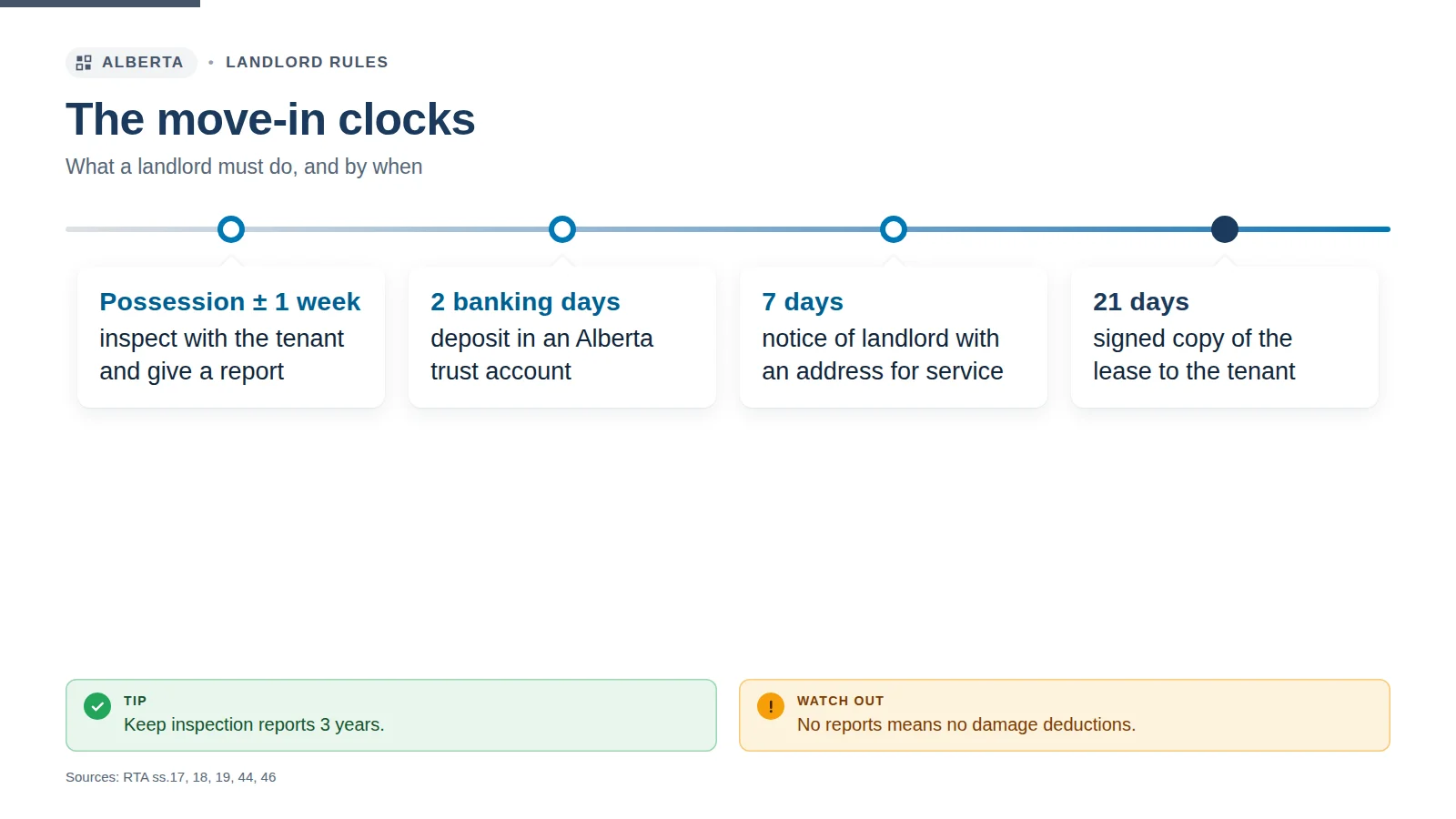
A residential tenancy agreement can be written, oral or implied, but Alberta's rights and responsibilities page says it should be written so both sides have a record. Alberta publishes no official lease form. If the tenant signs a written lease and returns it, the landlord must serve a copy signed by the landlord within 21 days (s.17). Until that copy is served, the tenant may withhold rent. Full detail: Alberta residential leases: what must be in writing.
The notice of landlord
Within 7 days of the tenancy starting, give the tenant a written, dated and signed "notice of landlord" with your name and an address for service, or post it in a visible place in the building's common area (s.18).
The security deposit
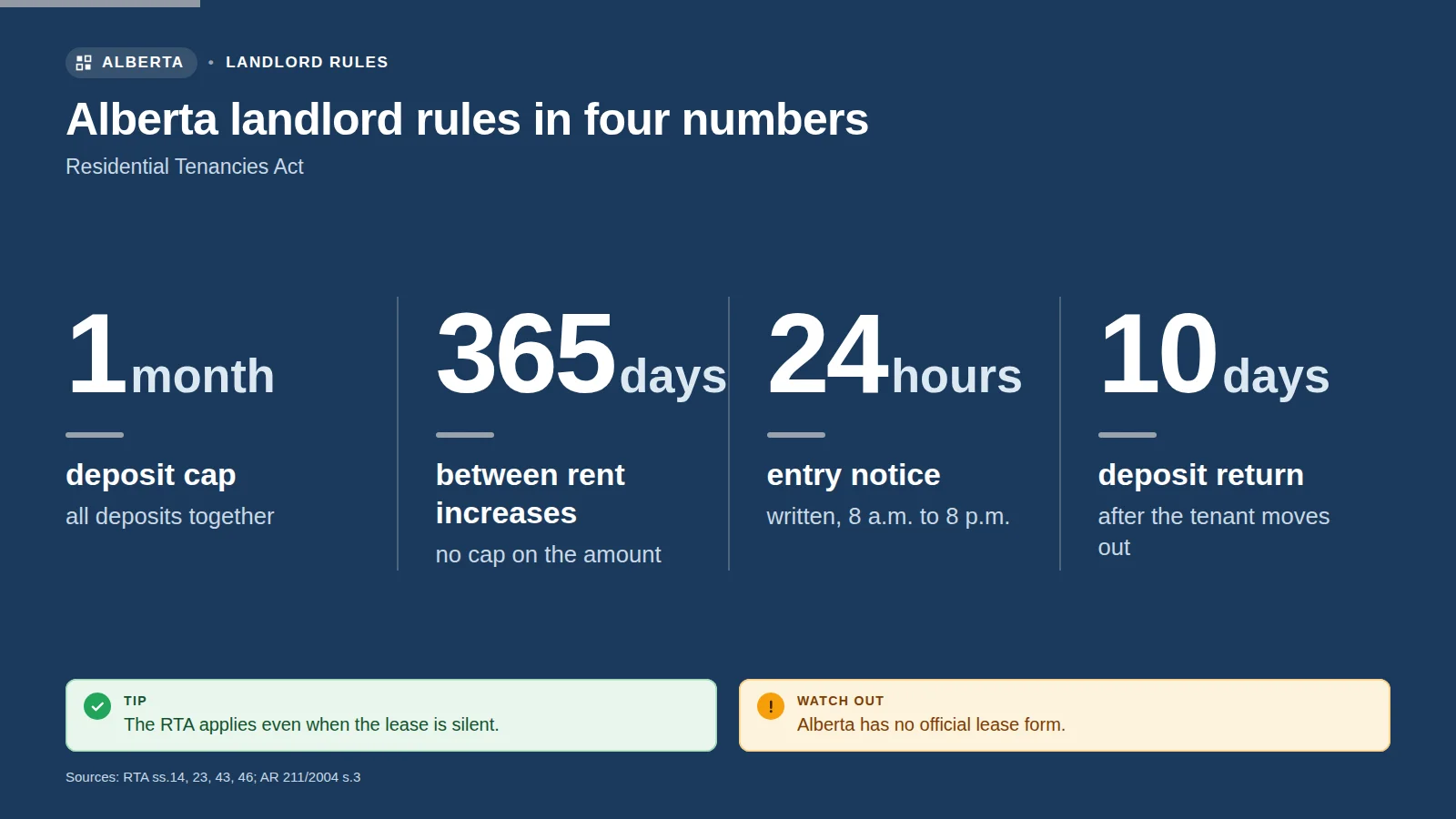
- At most one month's rent (s.43). You cannot ask for more when the rent goes up.
- Deposit it in an interest-bearing trust account at a bank, treasury branch, credit union or trust corporation in Alberta within 2 banking days (s.44).
- Keep deposit records for at least 3 years after the tenancy ends (s.44(6)).
- Pay interest at the prescribed rate. For 2026 the rate is 0% (alberta.ca).
Full detail: Alberta security deposits.
The move-in inspection report
Inspect the unit with the tenant within one week before or after the tenant takes possession, and complete a written report with the statements set out in AR 211/2004 s.4 (RTA s.19). If you propose two inspection times on different non-holiday days between 8 a.m. and 8 p.m. and no adult tenant agrees to take part, you may inspect alone. Keep the report for 3 years. Without move-in and move-out reports, you cannot deduct damage from the deposit (s.46(6)). Full detail: inspection reports in Alberta.
During the tenancy: rent, entry and repairs
Rent increases
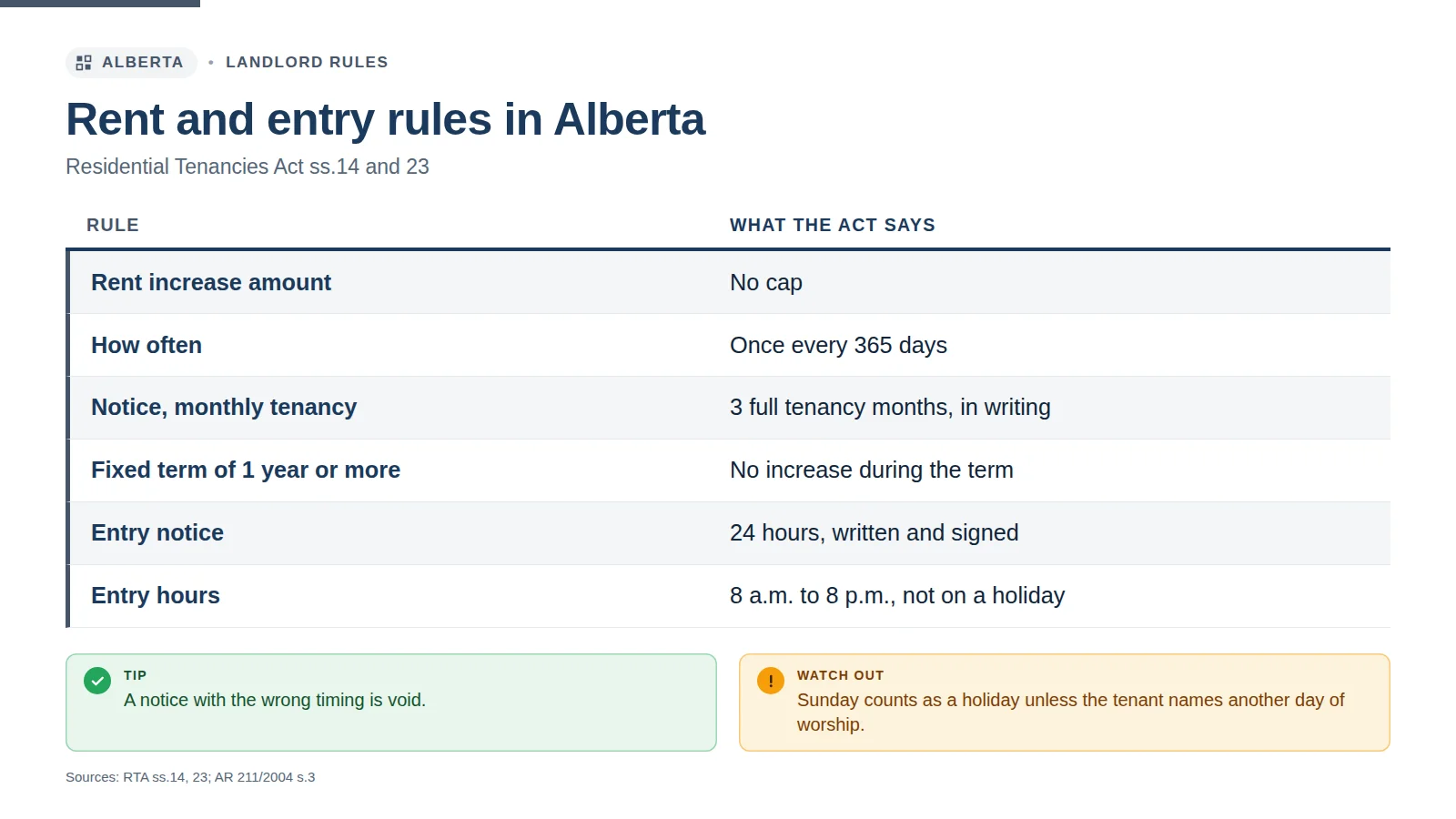
- No cap. Alberta does not limit how much rent can rise.
- Once every 365 days. At least 365 days must pass since the tenancy began or since the last increase (s.14 and AR 211/2004 s.3).
- Notice: 3 full tenancy months for a monthly tenancy and 12 full tenancy weeks for a weekly tenancy, in writing, dated and signed, with the date the increase takes effect.
- Fixed terms of one year or more: no increase during the term.
- A notice that does not follow these rules is void, and the tenant can recover any extra rent paid.
Full detail: Alberta rent increase rules.
Entering the unit
Under s.23 you may enter without notice in an emergency or if you believe the tenant has abandoned the unit. Otherwise you need to give at least 24 hours' written, signed notice stating the reason and the date and time window. Entry must be between 8 a.m. and 8 p.m. It cannot be on a holiday, which includes Sunday unless the tenant has named another day of worship, or on the tenant's day of worship.
Repairs and minimum standards
Every lease includes the landlord's promise that the premises meet at least the Minimum Housing and Health Standards (s.16(c)). The standards cover structure, plumbing, smoke alarms, pests and more. Two examples:
- Heat capable of keeping habitable rooms and bathrooms at 22 °C.
- Hot water between 46 °C and 60 °C at the tap.
Unless the lease makes the tenant solely responsible, the owner must keep electricity, water and heat continuously supplied. Public health inspectors enforce the standards on complaint. See repairs and minimum housing standards and the 22 °C heat rule.
Subletting and assignment
A tenant needs your written consent to sublet or assign, and you cannot refuse without reasonable grounds (s.22). A refusal must come with written reasons, you cannot charge a fee for consent, and if you do not answer within 14 days, consent is deemed given.
When something goes wrong: notices and disputes
Unpaid rent and other substantial breaches
For a substantial breach, including unpaid rent, a landlord may serve a notice at least 14 days before the termination date (s.29). The notice must list rent due and any additional rent separately, give reasons and a termination date, and be signed. For unpaid rent it must say the tenancy will not end if the tenant pays everything due by the termination date. AR 211/2004 offers an optional form for this notice. See Alberta's 14-day notice.
Serving notices
Serve notices in person or by registered mail (s.57). You may give the notice to an adult who lives with the tenant, or post it on the premises, only when the tenant is absent or avoiding service. Email works only as a last resort, and only to an electronic address the tenant gave for service. Serving one adult tenant is enough when several tenants share a lease (s.58(2)).
RTDRS or court
Most disputes can go to the court or to the RTDRS, and whoever applies first picks the forum for both parties. According to alberta.ca, the RTDRS hears claims up to $100,000 filed within 2 years of discovering the claim. Hearings are by telephone, and the filing fee is $75 for claims of $7,500 or less. It can end a tenancy, order possession, award rent arrears and damages, and decide deposit claims. It cannot order a landlord to do repairs. See RTDRS explained.
Ending a tenancy and returning the deposit
- Fixed term: ends on its end date with no notice needed (s.15). If a periodic tenancy is implied after a fixed term of one month or more, it is a monthly tenancy unless the facts show otherwise (s.13).
- Monthly periodic, landlord ending: 3 full tenancy months' notice, and only for a reason the regulation allows (s.6 and AR 211/2004 s.2). Allowed reasons include moving in yourself or a relative, a completed sale to a buyer who will live there, demolition, and major renovations that need the unit empty.
- Monthly periodic, tenant ending: notice on or before the first day of a tenancy month, ending on the last day of that month (s.8).
- Move-out time: a tenancy ends at 12 noon on its last day (s.20).
- Deposit: within 10 days after the tenant gives up possession, return the deposit or deliver the balance with a statement of account. If you cannot yet work out a deduction, send an estimate within those 10 days and a final statement within 30 days (s.46). No deduction for normal wear and tear.
Full detail: ending a tenancy in Alberta.
Common mistakes
- Counting the rent increase notice in days. For a monthly tenancy it is 3 full tenancy months, and the notice must be served before the first of those months begins.
- Taking a pet deposit on top of a full month's deposit. The safest reading is that every deposit counts toward the one-month cap.
- Skipping the move-in report. Without it, damage deductions are not allowed.
- Emailing a notice as the only copy. Email is a last resort under s.57. Serve in person or by registered mail.
- Late fees with no basis in the lease. Alberta sets no maximum, but a fee must be in the written lease, and an unreasonable amount can be challenged.
- Treating the "major renovation" reason loosely. Painting, new flooring and routine maintenance do not qualify.
Running several units
The rules do not change with the size of your portfolio, but the risk of a missed date grows. Three habits keep a larger Alberta portfolio in order:
- One calendar for every clock. Track each unit's last rent increase date, fixed-term end date, inspection windows and the 10-day deposit return.
- One trust account process. Deposits go in within 2 banking days, and each deposit's records sit with its tenancy for 3 years after the end.
- One service log. For every notice, record who served it, how, when and to whom.
How Tenon10 helps
Tenon10 lets you create an Alberta lease, run move-in and move-out inspection reports room by room, prepare a 14-day notice on Form 3 for a substantial breach, and track each tenancy's 10-day deposit return date.
Leases, inspection reports, notices and payment records stay together for each tenancy, so the documents you need for an RTDRS hearing are in one place.
Frequently asked questions
Is there rent control in Alberta?
No. Alberta has no cap on the amount of a rent increase. The limits are on timing: once every 365 days, with 3 tenancy months' notice for a monthly tenancy, and none during a fixed term of one year or more.
Does Alberta have an official lease form?
No. Alberta publishes no standard lease. Any lease you use is subject to the RTA, and a term that conflicts with the Act does not override it.
How much can I charge for a security deposit?
Up to one month's rent, in total. Hold it in a trust account in Alberta and pay interest at the prescribed rate, which is 0% for 2026.
Can I evict a tenant for any reason at the end of a month?
No. A landlord can end a periodic tenancy only for a reason the regulation allows, with the required notice. A fixed-term tenancy ends on its end date.
Where do Alberta landlords file disputes?
Either the court or the RTDRS. The RTDRS handles claims up to $100,000 by telephone hearing.
Alberta Landlord Compliance Checklist
A one-page checklist of every core Alberta landlord duty: lease copy, deposit trust account, inspection reports, rent increase timing, entry notice, 14-day notices and the 10-day deposit return.
Get Free PDF →Run your Alberta rentals in one place
Create an Alberta lease, run inspection reports and track every deposit deadline with Tenon10.
Built for Canadian landlords and property managers.
Related Alberta guides
- Alberta Tenant Guide: Your Rights From Move-In to Move-Out
- Calgary landlord and tenant guide
- Edmonton landlord and tenant guide
Sources: Residential Tenancies Act, SA 2004 c R-17.1; Residential Tenancies Ministerial Regulation, AR 211/2004; Security Deposit Interest Rate Regulation, AR 190/2004; RTDRS Regulation, AR 98/2006; Minimum Housing and Health Standards; Alberta.ca: Rights and responsibilities; Alberta.ca: Apply to the RTDRS. This article is a summary of Alberta rules as of October 2026, not legal advice. Check the RTA and alberta.ca for your situation.