In Alberta, a landlord who breaks certain rules in the Residential Tenancies Act commits an offence. Residential Tenancies Act offences carry a fine of up to $5,000 each, or up to $10,000 for short notice on a condominium conversion, and a court can also order the landlord to repay a tenant's deposit or prepaid rent (s.60). Prosecutions must start within 3 years (s.61).
This guide lists every provision that section 60 makes an offence, what each one requires, and how the province checks compliance. For the full rulebook, see the Alberta landlord guide and the Alberta landlords hub.
Alberta Landlord Offence-Proofing Checklist
A one-page checklist of the Alberta landlord duties that carry fines of up to $5,000 or $10,000 under section 60 of the Residential Tenancies Act.
Get Free PDF →Which Alberta Residential Tenancies Act rules are offences?
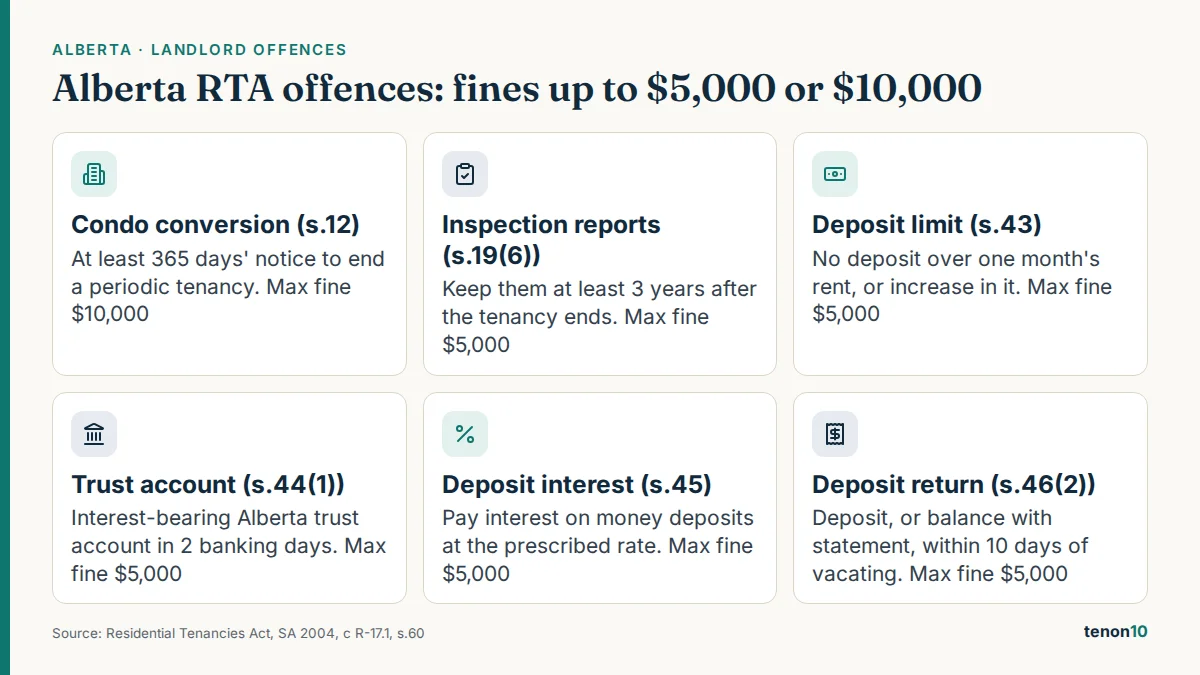
Section 60(1) makes it an offence, with a fine of up to $5,000, to contravene sections 18, 19(6), 23, 24, 25, 31(13) or (14), 43, 44(1), (3), (5) or (6), 45, 46(2) or (6), or 47.7, or the Act as described in s.6(2). It also covers regulation provisions declared offences under s.69(1)(b) or s.70(1)(l). Section 60(1.1) sets a higher fine of up to $10,000 for failing to give the minimum notice under s.12.
| Section | What the landlord must do or not do | Maximum fine |
|---|---|---|
| s.6(2) | Use the premises for the reason given after ending a periodic tenancy for a prescribed reason or under s.12 | $5,000 |
| s.12 | Give at least 365 days' notice to end a periodic tenancy for a condominium conversion | $10,000 |
| s.18 | Serve a dated, signed notice of landlord with a name and Canadian postal address and physical location within 7 days after the tenant takes possession, and update it when it changes | $5,000 |
| s.19(6) | Keep move-in and move-out inspection reports for at least 3 years after the tenancy ends, and make them available to the Director | $5,000 |
| s.23 | Enter only with consent, in an emergency or abandonment, or on 24 hours' written notice for a permitted reason, between 8 a.m. and 8 p.m. and not on a holiday | $5,000 |
| s.24 | Do not add or change locks without consent unless a key is made available to the tenant at once | $5,000 |
| s.25 | Do not end a tenancy or retaliate only because the tenant complained, applied or gave evidence | $5,000 |
| s.31(13)-(14) | Record the storage, sale or disposal of abandoned goods and keep the record for 3 years | $5,000 |
| s.43 | Do not require a deposit over one month's rent, or an increase in the deposit | $5,000 |
| s.44(1), (3), (5), (6) | Put money deposits in an interest-bearing Alberta trust account within 2 banking days, hold only deposits there, keep deposit records and keep them 3 years | $5,000 |
| s.45 | Pay interest on money deposits at the prescribed rate | $5,000 |
| s.46(2) | Return the deposit, or the balance with a statement of account, within 10 days after the tenant gives up possession | $5,000 |
| s.46(6) | Make no deduction for damage unless the s.19 inspection report requirements were met | $5,000 |
| s.47.7 | Keep information about a tenant who is a victim of domestic violence confidential | $5,000 |
What does each record-keeping rule require?
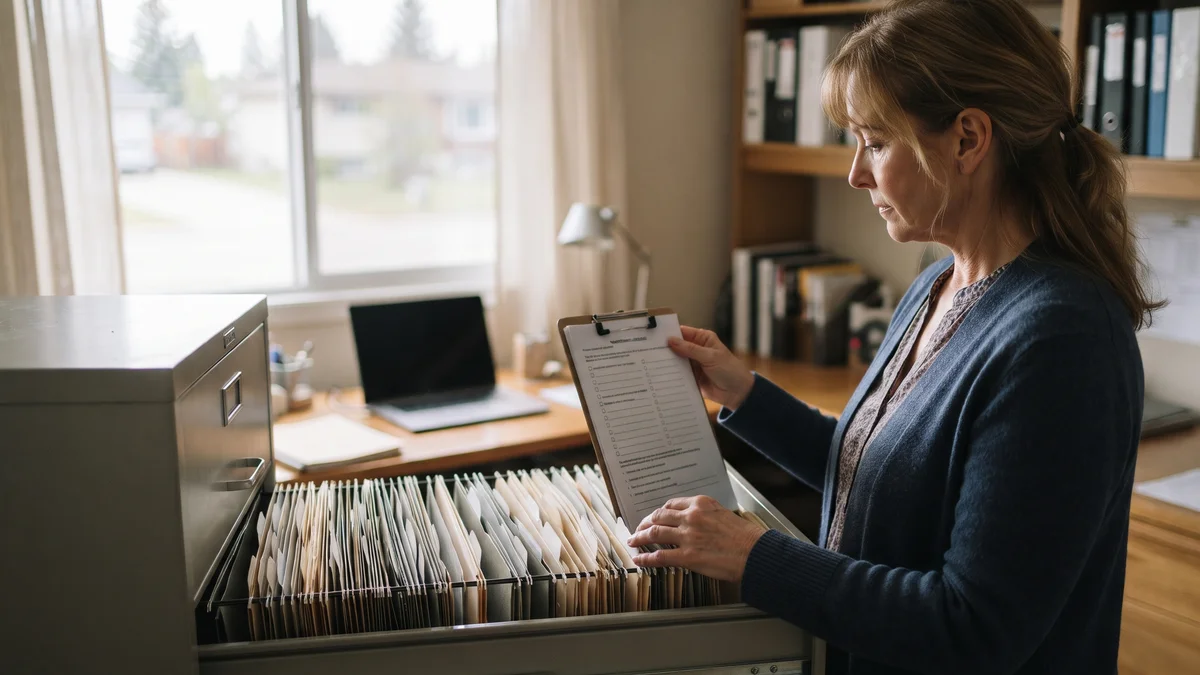
Three of the offence provisions are about records rather than conduct:
- Inspection reports. Landlord and tenant inspect within one week before or after move-in and move-out, and the landlord gives the tenant a report (s.19(1)-(2)). The landlord keeps each report for at least 3 years after the tenancy ends (s.19(6)). See inspection reports in Alberta.
- Deposit records. For each tenant: the date and amount received, the date and place deposited, interest paid and how the deposit was disposed of (s.44(5)), kept for at least 3 years (s.44(6)).
- Abandoned goods. A description of the goods, where and how long they were stored, any costs claimed, sale details and the manner of disposal (s.31(13)), kept for at least 3 years (s.31(14)).
How do the deposit offences fit together?
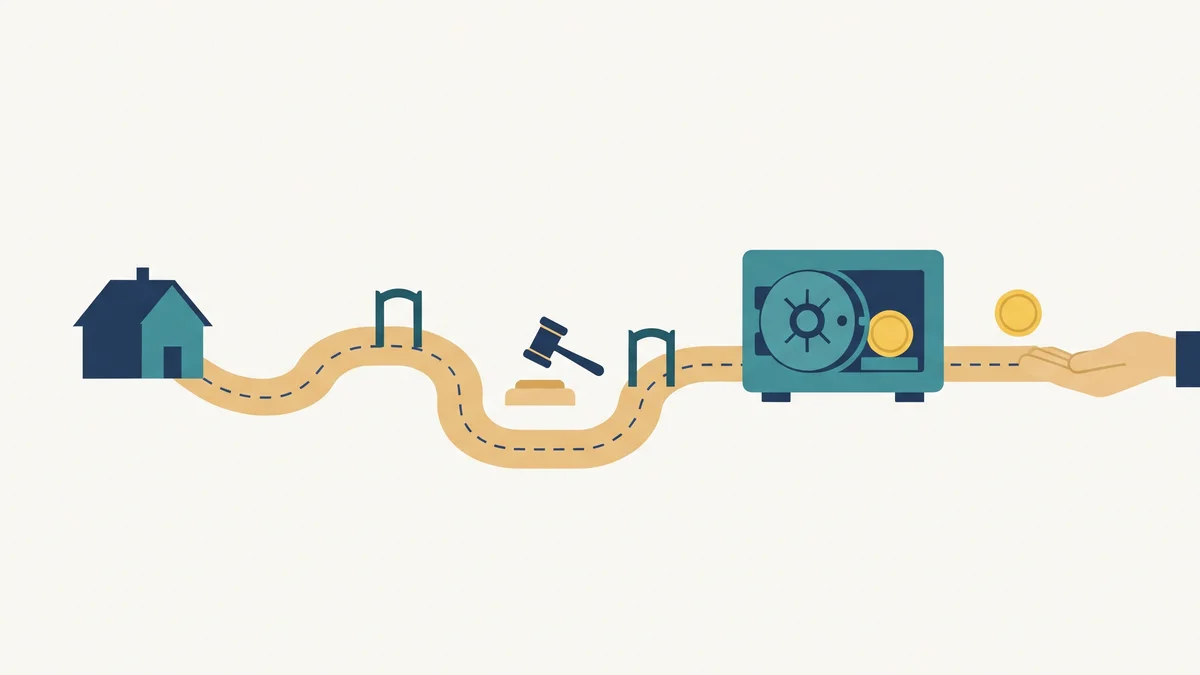
Alberta's deposit rules run from the start of the tenancy to the end, and most steps are offences if missed. The cap is one month's rent with no increases (s.43). Money goes into an interest-bearing trust account at a bank, treasury branch, credit union or trust corporation in Alberta within 2 banking days (s.44(1)). Interest is paid annually at the prescribed rate unless the parties agree in writing to compound it and pay it at the end (s.45). The deposit or balance goes back within 10 days after the tenant gives up possession (s.46(2)).
A deduction for damage is itself an offence if the inspection report rules were not followed (s.46(6)). The details are in Alberta security deposits: the cap, trust account, interest and 10-day return.
What else can a court order after a conviction?
Beyond the fine, a justice can order money back to the tenant:
- On a conviction under s.46(2) or (6), the justice may, on the tenant's application, order the landlord to pay all or part of the deposit with interest (s.60(3)).
- On any conviction under s.60(1) or (1.1), if the landlord wrongfully withheld prepaid rent, the justice may order it repaid (s.60(4)).
- If an order under s.60(3) or (4) is not paid on time, the tenant can file it in the Court of King's Bench, where it is enforceable as a judgment (s.60(5)).
How does Alberta enforce the Act?
The Director appointed under the Act, or a person the Director delegates, may enter a landlord's business premises at any reasonable time to inspect for compliance, ask questions, and examine or copy records (s.64). Where there are reasonable grounds to believe an offence was committed, the Director may ask permission to enter for an investigation and examine relevant records (s.66). The Act also provides for court orders compelling assistance with inspections and investigations (s.65, s.67).
No prosecution under s.60 may start more than 3 years after the alleged offence (s.61).
Is breaking other rules an offence too?
Section 60 lists specific provisions; it does not make every breach an offence. A breach of other parts of the tenancy can still lead to civil remedies. A tenant may apply to the court or the Residential Tenancy Dispute Resolution Service (RTDRS) for damages, rent abatement, compensation or termination when a landlord breaches the agreement or contravenes the Act (s.37(1), s.54.2(2)).
Frequently asked questions
What is the maximum fine for an Alberta landlord?
Up to $5,000 for each offence listed in s.60(1), and up to $10,000 for failing to give the minimum notice for a condominium conversion under s.12 (s.60(1.1)).
Is entering without proper notice an offence in Alberta?
Yes. Section 23 is listed in s.60(1). Notice must be written, signed, state the reason and give a date and time at least 24 hours ahead, between 8 a.m. and 8 p.m. (s.23(4)-(5)). See landlord entry in Alberta.
Can I be fined for not using the unit for the reason in my notice?
Yes. If you end a periodic tenancy for a prescribed reason or under s.12 and the tenant leaves, you contravene the Act if you do not use the premises for that reason within a reasonable time (s.6(2)), and s.60(1) makes that an offence.
How long do I need to keep tenancy records?
At least 3 years for inspection reports after the tenancy ends (s.19(6)), deposit records after the tenancy ends (s.44(6)) and abandoned-goods records after the goods are returned, sold or disposed of (s.31(14)).
Does changing the locks count?
Adding or changing locks without the tenant's consent is an offence unless a key is made available to the tenant as soon as the change is made (s.24(1)-(2)). See changing the locks in Alberta.
Alberta Landlord Offence-Proofing Checklist
A one-page checklist of the Alberta landlord duties that carry fines of up to $5,000 or $10,000 under section 60 of the Residential Tenancies Act.
Get Free PDF →Key takeaways
- Section 60(1) lists the offence provisions; each carries a fine of up to $5,000, or $10,000 for s.12 condominium notice.
- Deposits, inspection reports, entry, locks, records and retaliation are all on the list.
- Courts can order deposits and prepaid rent repaid, and prosecutions have a 3-year limit (s.60(3)-(5), s.61).
Keep your Alberta paperwork compliant
Free landlord forms for notices, inspections and records.
Free • No signup required