To enforce an RTDRS order in Alberta, the order must first be filed with the Court of King's Bench and a filed copy served on the other party. A money judgment that still goes unpaid is then collected through the court's civil enforcement process: a writ of enforcement, registered against property, and seizure or garnishment by a civil enforcement agency.
Winning at the Residential Tenancy Dispute Resolution Service (RTDRS) gives you an order, not money. The order "does not take effect until it is filed" with the Court of King's Bench "and served" (RTDRS Regulation, AR 98/2006, s.22(2)). Once filed it is enforceable in the same manner as an order of that court (s.22(1)). This guide follows the money side, for landlords with a rent or damages judgment and tenants with a deposit judgment. For what the RTDRS can award in the first place, see RTDRS explained.
How do you file an RTDRS order with the Court of King's Bench?
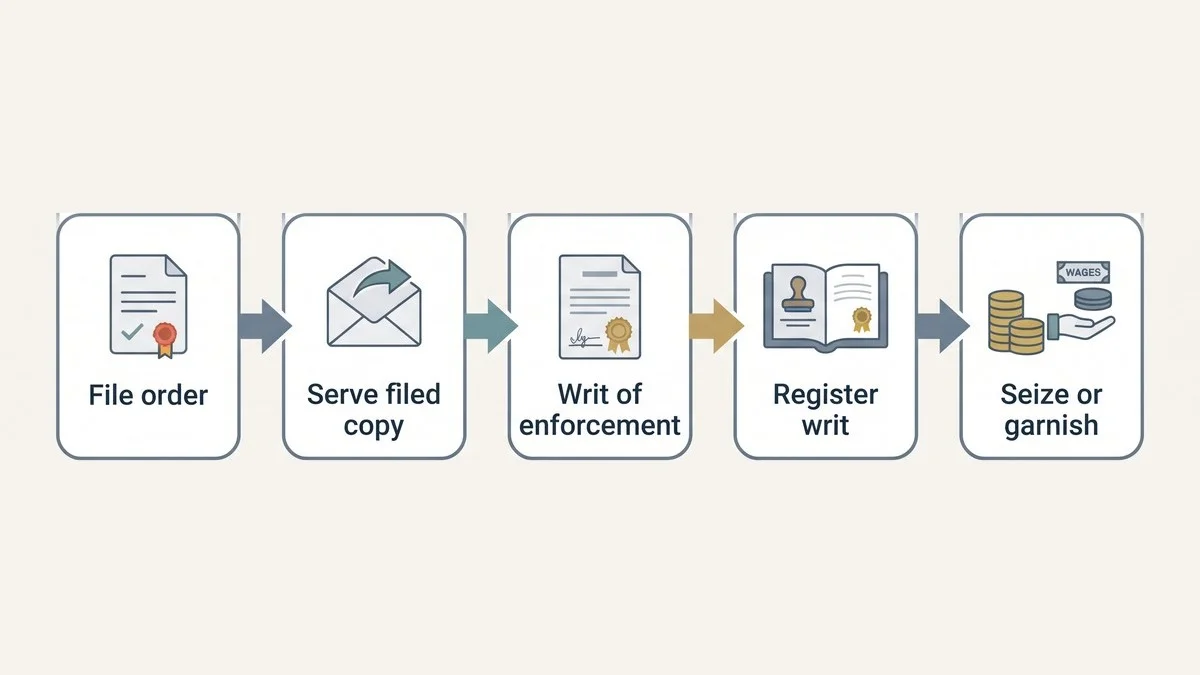
Either the RTDRS files the order with the Court of King's Bench for you, or you file it yourself, according to the province's Hearings and orders page. Its RTDRS Order: Next Steps sheet says that if you file it yourself, you print a copy for the court, one for yourself and one for each respondent, complete the address-for-service section at the top of the order, and bring all the copies to the Court of King's Bench.
The filed order carries a court action number and a court seal. The copy the respondent received at the hearing is a courtesy copy only.
Do you have to serve the filed order?

Yes. After filing, the applicant must serve a filed copy on the respondent. The province notes that the rules for serving court documents may differ from the RTDRS rules, and suggests asking the Court of King's Bench how to serve. Keep proof of how and when you served it, because enforcement steps depend on it.
What if the order sets out payment terms?
An order with dates and amounts of payment is a conditional order. If the respondent misses a payment, the applicant may serve a Notice of Default and then enforce the order at the Court of King's Bench, the province says. Where an order for possession is stayed while payments are made, the RTA bars enforcing it, unless the court orders otherwise, until a notice of default is served on the tenant (RTA s.35). If every payment is made on time, the province's order chart says the conditional order is no longer of any force or effect.
How is an unpaid Alberta judgment collected?
Through the Civil Enforcement Act. The broad sequence:
| Step | What happens | Source |
|---|---|---|
| Writ of enforcement | The judgment creditor asks the court clerk where the judgment was entered to issue a writ. If the judgment allows a period to pay, the writ cannot issue until that period ends. | CEA s.25.1 |
| Registration | Before acting against personal property, the writ must be registered in the Personal Property Registry. To act against land, it must also be registered under the Land Titles Act. | CEA s.26 |
| Seizure and sale | A civil enforcement agency's bailiffs seize and sell property such as vehicles, land, cash and equipment to pay the debt. | alberta.ca |
| Garnishment | A garnishee summons can attach money owed to the debtor, including employment earnings above the debtor's exemption and deposit accounts. | CEA Part 8, ss.81 and 83 |
The province's RTDRS sheets point to the Alberta Courts resource "Getting and Enforcing your Judgment in Alberta" for the court-side steps, and its property seizures and evictions page lists civil enforcement agencies you can hire.
How long does an RTDRS judgment last?
The province says RTDRS orders are valid for 10 years, with some exceptions. Under the Civil Enforcement Act, a writ is in force only while the judgment is, and a judgment stops being in force once it is satisfied or 10 years after it takes effect, unless it is renewed or an action is brought on it within that time (CEA s.27). A registration in the Personal Property Registry runs for a set period and must be renewed under the personal property rules (s.28), so diarize it.
Can the other side stop enforcement?
Only in limited ways. An appeal to the Court of King's Bench does not stay the order unless that court stays it on application (Regulation s.26). If a tenancy dispute officer sets aside, varies or stays the order and that order is filed with the court, any garnishee summons or execution under the original order is stayed unless the court orders otherwise (s.19.1(7)). The province's order chart also notes a respondent may contact the applicant to ask for time to pay, which the applicant may agree to or refuse.
What about getting the tenant out?
Possession is enforced by a civil enforcement agency, not by the landlord. The RTA lets the agency evict only under an order for recovery of possession and, unless the court orders otherwise, only after the order has been served and an affidavit of service filed in the Court of King's Bench (s.34.1). The province adds that a bailiff need not give advance notice unless the court directs it. The notice and application steps that lead to an order for possession are in Alberta's 14-day notice for unpaid rent.
Frequently asked questions
Does the RTDRS collect the money for me?
No. The RTDRS makes the order and can file it with the court, but collecting an unpaid judgment is the applicant's job through the Court of King's Bench and a civil enforcement agency.
Can a tenant enforce a security deposit judgment the same way?
Yes. An order for the return of a deposit is a judgment like any other once filed, and the same writ, registration and garnishment steps apply. The deposit rules themselves are in how long an Alberta landlord has to return a deposit.
When is the money due?
The province's next-steps sheet says that, unless otherwise specified, payments under an RTDRS order are due forthwith, meaning right away.
Can I complain about a civil enforcement agency?
Yes. Alberta has a complaint process for anyone who feels they were not treated fairly during a seizure or eviction.
More landlord guides
Notices, deposits, inspections and disputes in one place for landlords in Alberta and across Canada.
Free • No signup required