In Saskatchewan, Henry's Law requires every suite or unit in a multi-unit residential building, including apartments, condominiums and houses with secondary suites, to have a carbon monoxide (CO) alarm installed from November 1, 2026. It applies to existing buildings, whatever their age, and the building or suite owner is responsible for installing, maintaining and testing the alarms.
What does Henry's Law require in Saskatchewan rentals?
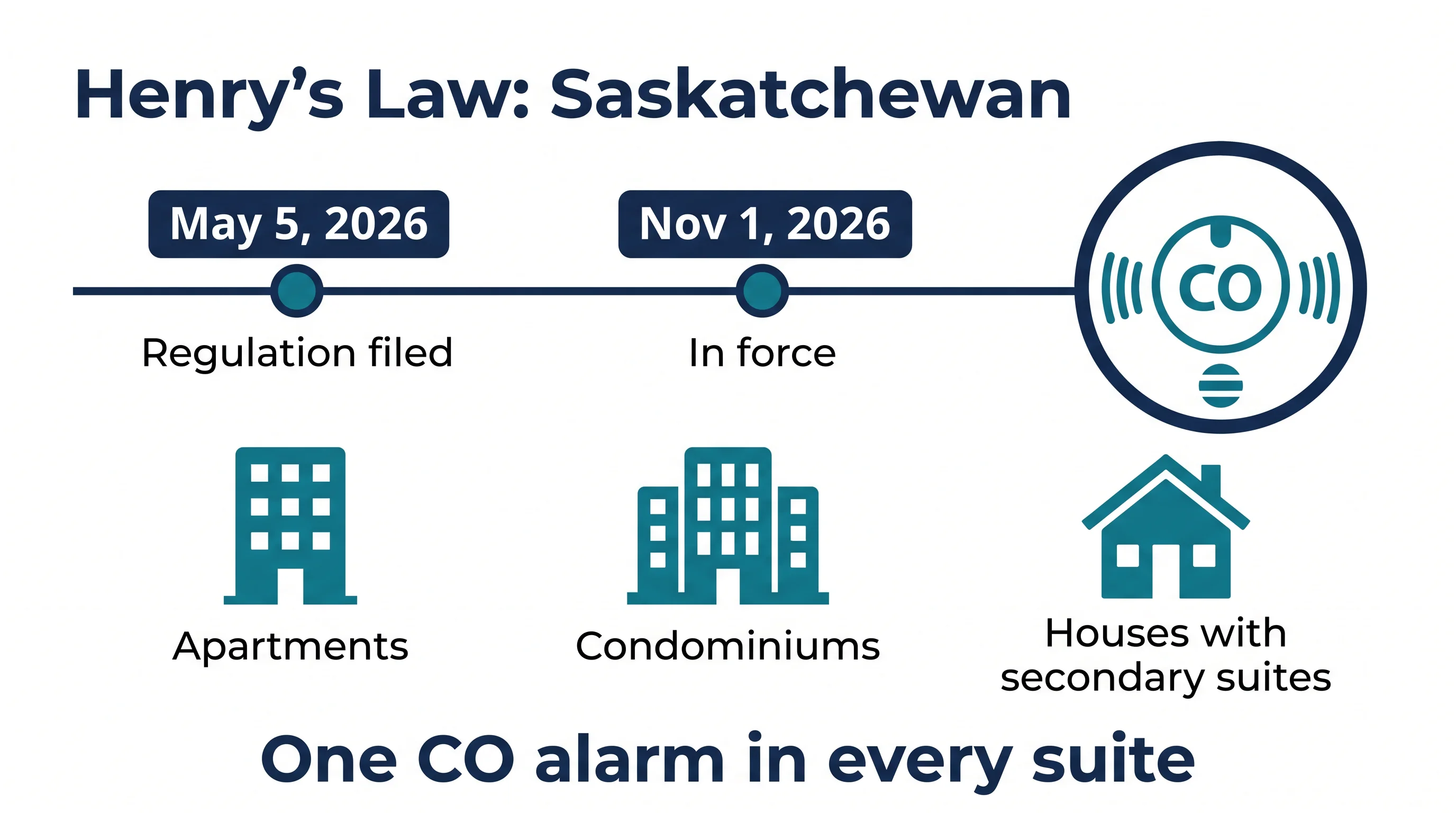
Henry's Law adds one rule to Saskatchewan's building code: in a multi-unit residential building, each suite or unit must have a CO alarm installed. The legal text is The Building Code (Henry's Law) Amendment Regulations, 2026 (SR 31/2026), filed May 5, 2026. It adds Sentence 6) to Article 6.9.3.1 and Sentence 8) to Article 9.32.3.9 of the Appendix to The Building Code Regulations, and section 3 brings it into force on November 1, 2026.
The law is named for Henry Losco, an 11-year-old who died in December 2025 after a boiler malfunction released CO into a Regina multi-unit building. Before the change, a suite needed a CO alarm only if it shared a wall, floor or ceiling with a parking garage or service room, or shared a crawl space or attic with a service room. The province decided that rule did not protect every resident, according to its Construction Codes Advisory for multi-unit residential buildings (revised July 2026).
The government's advisory names the regulation "The Building Code (Henry Losco) Amendment Regulations, 2026". The title filed in the Saskatchewan Gazette is "(Henry's Law)". Both refer to the same regulation, SR 31/2026.
Which Saskatchewan rental buildings does Henry's Law cover?
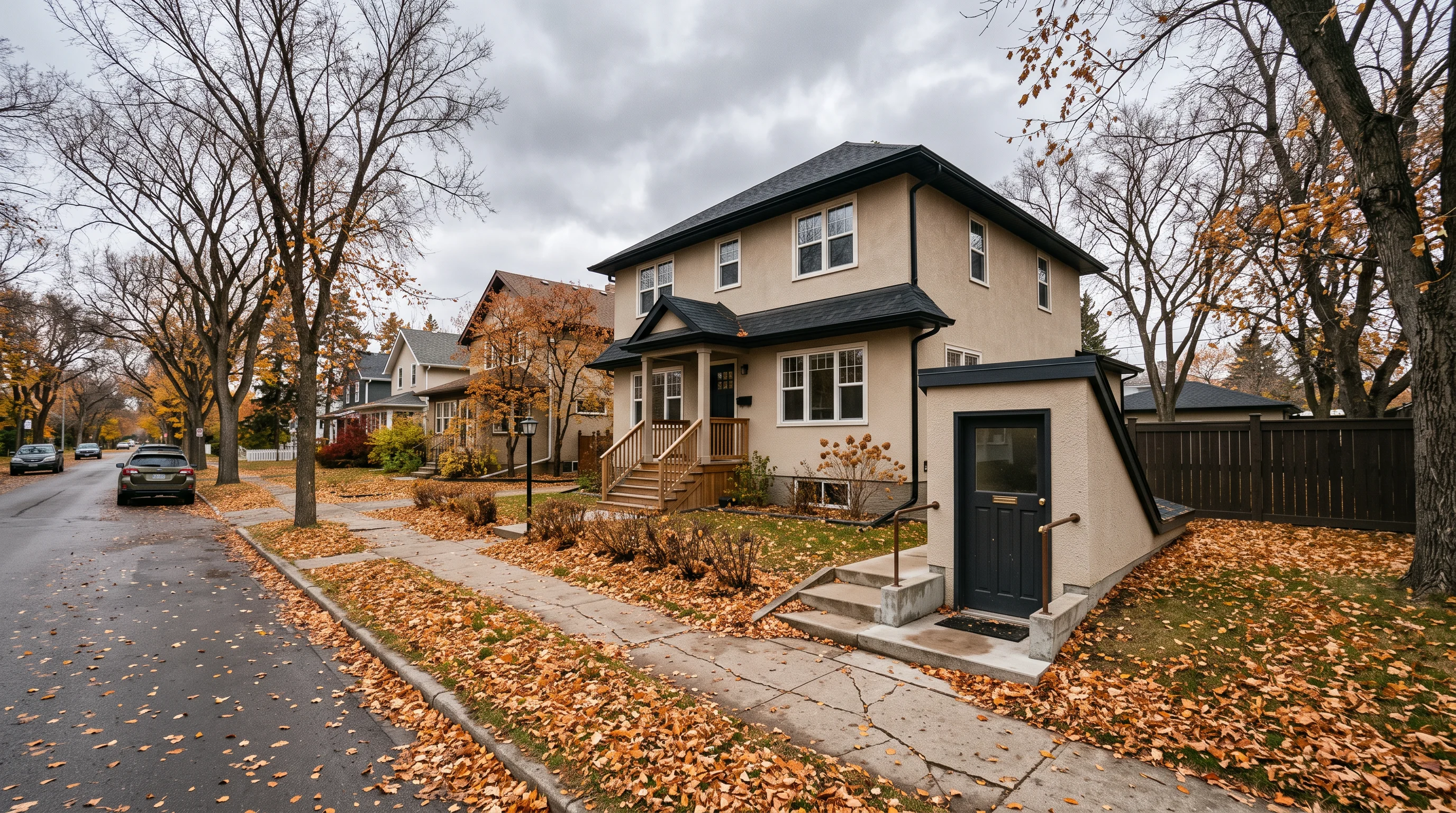
Henry's Law covers every Saskatchewan multi-unit residential building made up of apartments, condominiums, houses with secondary suites, and any other building with multiple residential suites. The province's CO alarm page says the requirement applies "regardless of when the building was initially built or last renovated", so an older walk-up is not exempt.
A house with a basement suite counts: both the main unit and the suite need a CO alarm. A rented condo unit needs one even if the condominium corporation owns the boiler. The advisory puts the duty on "the owner of each building, or the owner of each suite within a building", so a condo unit's owner and the corporation should agree on who does what.
A single detached house with no secondary suite is not a multi-unit building, but it is not free of alarm rules. The Building Code Regulations have required CO and smoke alarms in all residential buildings since enforcement began on July 1, 2022, with locations depending on the layout and the fuel-burning appliances.
Where must CO alarms go inside a Saskatchewan rental suite?
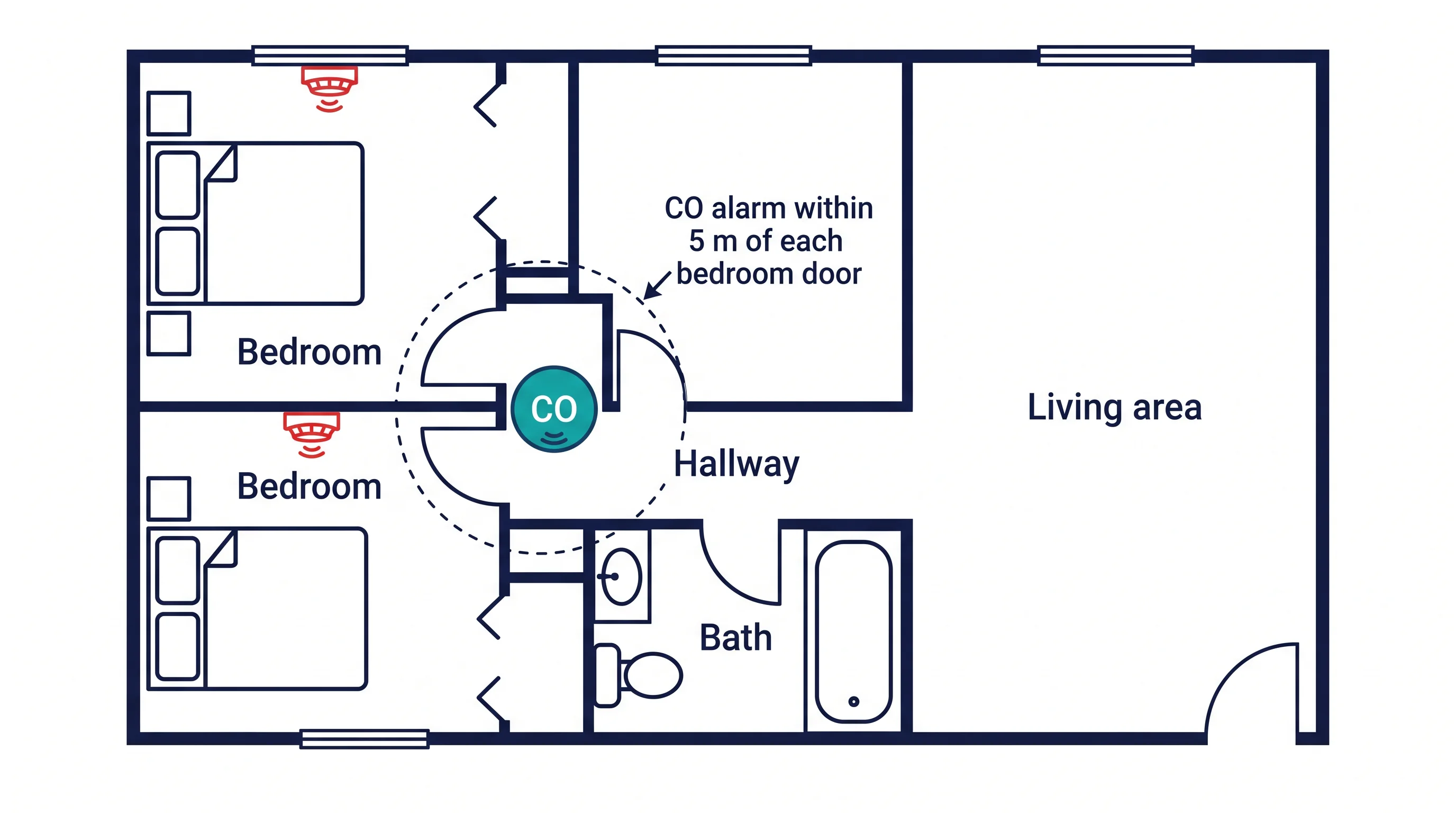
A CO alarm in a Saskatchewan suite goes inside each sleeping room, or outside each sleeping room within 5 metres (16 feet) of its door. Separate alarms are also required in fuel-burning service rooms outside the suites and in any room with a solid-fuel appliance, such as a wood stove. Smoke alarms have their own placement rules. The table sets out both, from the multi-unit advisory.
| Alarm | Where it is required |
|---|---|
| CO alarm | Inside each sleeping room, OR outside each sleeping room within 5 m (16 ft) of its door |
| CO alarm | Inside each service room (not in a suite) with a fuel-burning appliance |
| CO alarm | Inside each room with a solid-fuel-burning appliance |
| Smoke alarm | Inside each sleeping room, AND on each floor level of the suite between the sleeping rooms and the rest of the floor |
Alarms are mounted at the height the manufacturer recommends, or on or near the ceiling if there is no recommendation. One alarm in a hallway can serve several bedrooms only if every bedroom door is within 5 metres of it.
Which alarms are allowed, and who has to test them?
A Saskatchewan CO alarm must meet the CAN/CSA-6.19 standard, and a smoke alarm must meet CAN/ULC-S531. A CO alarm may be hardwired with battery backup, plug-in with battery backup, or battery-only with a 10-year tamper-resistant battery. A combination CO/smoke alarm may be used where either alarm is required, as long as it meets both standards.
Existing hardwired alarms must be kept in service. At the end of their life, usually every 7 to 10 years, hardwired interconnected alarms must be replaced with hardwired, interconnected alarms with battery backup. For rental properties, the advisory says owners must test all devices on a regular schedule and keep records of when they were tested.
Cities can add rules of their own. The City of Regina's rental property fire rules require hard-wired smoke alarms in rentals, installed by a licensed journeyman electrician under a permit. The owner must test them every six months and before each new tenancy, and keep a written log. Check your own municipality's bylaw as well.
Can a Saskatchewan landlord enter a suite to install an alarm?
Yes. A Saskatchewan landlord can enter to install or test an alarm with the tenant's permission, or after written notice given at least 24 hours and no more than seven days ahead, under section 45(1) of The Residential Tenancies Act, 2006. The notice states the reasonable purpose and the date and time of entry. Section 45(2) adds that it names a window of no more than four hours, between 8 a.m. and 8 p.m. unless the tenant agrees otherwise.
Entry without notice is allowed in an emergency, where it is needed to protect life or property (s.45(1)(f)). A sounding CO alarm is a reason to call 911 and get everyone out first.
What happens if a Saskatchewan landlord misses November 1, 2026?
Saskatchewan owners who do not comply can be ordered to comply and may be charged, according to the advisory. Municipalities enforce the building and fire codes and choose their approach. Under passive inspection, building officials and fire inspectors check alarms when they are already in a building for construction, an incident or a complaint. Under active inspection, buildings are inspected one by one after November 1, 2026.
Separately, section 49(1) of the Act requires a landlord to keep the property in a good state of repair and fit for habitation during the tenancy. Our guides to Ontario's carbon monoxide alarm rules and Alberta's minimum housing standards show how other provinces handle the same duty.
What should landlords and tenants do now?
Saskatchewan landlords should finish installation before November 1, 2026, and tenants should check that their suite has a working CO alarm. In order:
- List every suite. Count basement and secondary suites as separate units.
- Map the sleeping rooms. Put a CO alarm in each bedroom, or outside within 5 metres of every bedroom door.
- Check the service rooms. Add CO alarms to boiler, furnace and water-heater rooms outside the suites.
- Buy certified alarms. Look for CAN/CSA-6.19 for CO and CAN/ULC-S531 for smoke.
- Give written notice. Give 24 hours to seven days' notice with a four-hour window, under RTA s.45.
- Test and log. Record each test, and replace alarms at the expiry date.
A tenant who finds no CO alarm, or one that is chirping or expired, should tell the landlord in writing and keep a copy. Tenants should not disconnect or remove an alarm. For more on fire safety in rentals, see what landlords and tenants must do after a fire, or browse the Canadian Landlord Resource Center and the Canadian Tenant Resource Center.
Frequently asked questions
When does Henry's Law take effect in Saskatchewan?
Henry's Law comes into force on November 1, 2026, under section 3 of SR 31/2026. From that date every suite or unit in a multi-unit residential building must have a CO alarm installed. The province encourages owners to install early.
Does Henry's Law apply to a house with a basement suite?
Yes. The regulation lists houses with secondary suites among the buildings covered. Each unit, upstairs and down, needs its own CO alarm.
Are plug-in CO alarms allowed in Saskatchewan rentals?
Yes. The advisory allows plug-in CO alarms with a battery backup, as well as hardwired alarms with battery backup and battery-only alarms with a 10-year tamper-resistant battery. The alarm must meet CAN/CSA-6.19. Where an existing alarm is hardwired and interconnected, its replacement must be too.
Who pays for CO alarms in a Saskatchewan rental?
The advisory makes the owner of the building, or the owner of each suite, responsible for installing, maintaining and testing the alarms. The tenant's role is to leave them in place and report problems.
Can I use a combination CO and smoke alarm?
Yes. A combination alarm may go in any location where either a CO alarm or a smoke alarm is required, if it meets both CAN/CSA-6.19 and CAN/ULC-S531. It can save a second device outside the bedrooms.
Keep your rental paperwork in order
Notices, inspections and records belong together. Browse free landlord and tenant forms.
Free • No signup required