

Before any fire in an Ontario rental, the landlord must install, maintain and test the unit's smoke alarms and carbon monoxide alarms under the Fire Code, and must repair fire damage to the building under section 20 of the Residential Tenancies Act, 2006. A tenancy ends after a fire only if the unit can no longer be lived in, which the Act treats as frustration (s. 19). A tenant who caused a fire wilfully or negligently pays for the repairs (s. 34).
This guide quotes the Fire Code (O. Reg. 213/07, consolidated from January 1, 2026) and the Residential Tenancies Act (RTA) as they read in October 2026.
What must an Ontario landlord do about smoke and carbon monoxide alarms?
An Ontario landlord must install the required smoke and carbon monoxide (CO) alarms, keep them working, test them on a fixed schedule and replace them on the manufacturer's timetable. Division B, Articles 2.13.1.2 and 2.16.1.2 of the Fire Code make only the landlord the owner for these duties in a rental suite; "landlord" includes the owner's agent but never the tenant.
Where the smoke alarms go. Under Division B, Article 2.13.2.1, a smoke alarm must be installed in the hallway serving each sleeping area (or between the sleeping area and the rest of the unit if there is no hallway) and on each storey that has no sleeping area. It may be hard-wired or battery-operated. Section 2.13 does not apply where alarms were installed under the Building Code as it read on or after April 6, 1998, or to buildings under the Part 9 retrofit rules, which set their own requirements: many two-unit houses need interconnected smoke alarms (Section 9.8), and rooming houses need one in each sleeping room (Article 9.3.4.5).
Where the CO alarms go. CO alarms are required where a building has a fuel-burning appliance, a fireplace or a storage garage (Article 2.16.1.1). In a unit with a fuel-burning appliance, flue or fireplace, one goes adjacent to each sleeping area and on each storey without one (Article 2.16.2.1(1)). See our article on Ontario carbon monoxide alarm rules.
Testing and replacement. The maintenance rules now sit in Division B, Subsections 6.3.3 (smoke alarms) and 6.3.4 (CO alarms):
| Duty | Smoke alarms | CO alarms |
|---|---|---|
| Keep the alarm and its power supply in operating condition | Art. 6.3.3.3 | Art. 6.3.4.3 |
| Give the tenant the manufacturer's maintenance instructions | Art. 6.3.3.4 | Art. 6.3.4.4 |
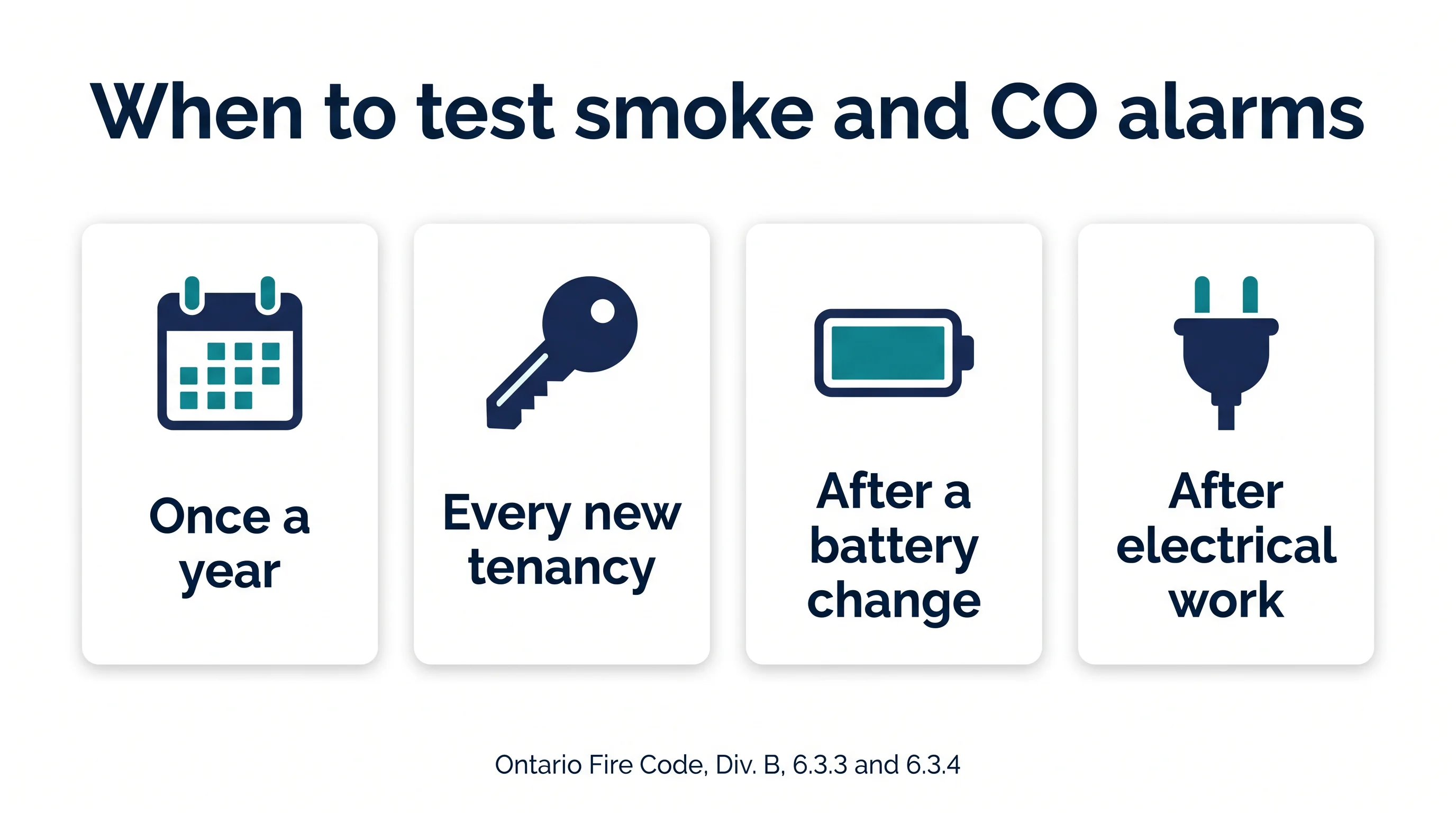
| Test once a year and after every change in tenancy | Art. 6.3.3.8(2) | Art. 6.3.4.8(2)(a) |
| Test after a battery is replaced | Art. 6.3.3.8(3) | Art. 6.3.4.8(2)(b) |
| Test after any change to the electrical circuit (hard-wired alarms) | Art. 6.3.3.8(4) | Art. 6.3.4.8(2)(c) |
| Replace within the manufacturer's time frame | Art. 6.3.3.7(1) | Art. 6.3.4.7(3) |
A test means pressing the alarm's own test feature (Article 6.3.3.8(5)), and a replacement may not give a lower level of protection (Article 6.3.3.7(2)).
Who replaces the batteries, and can a tenant disable an alarm in Ontario?
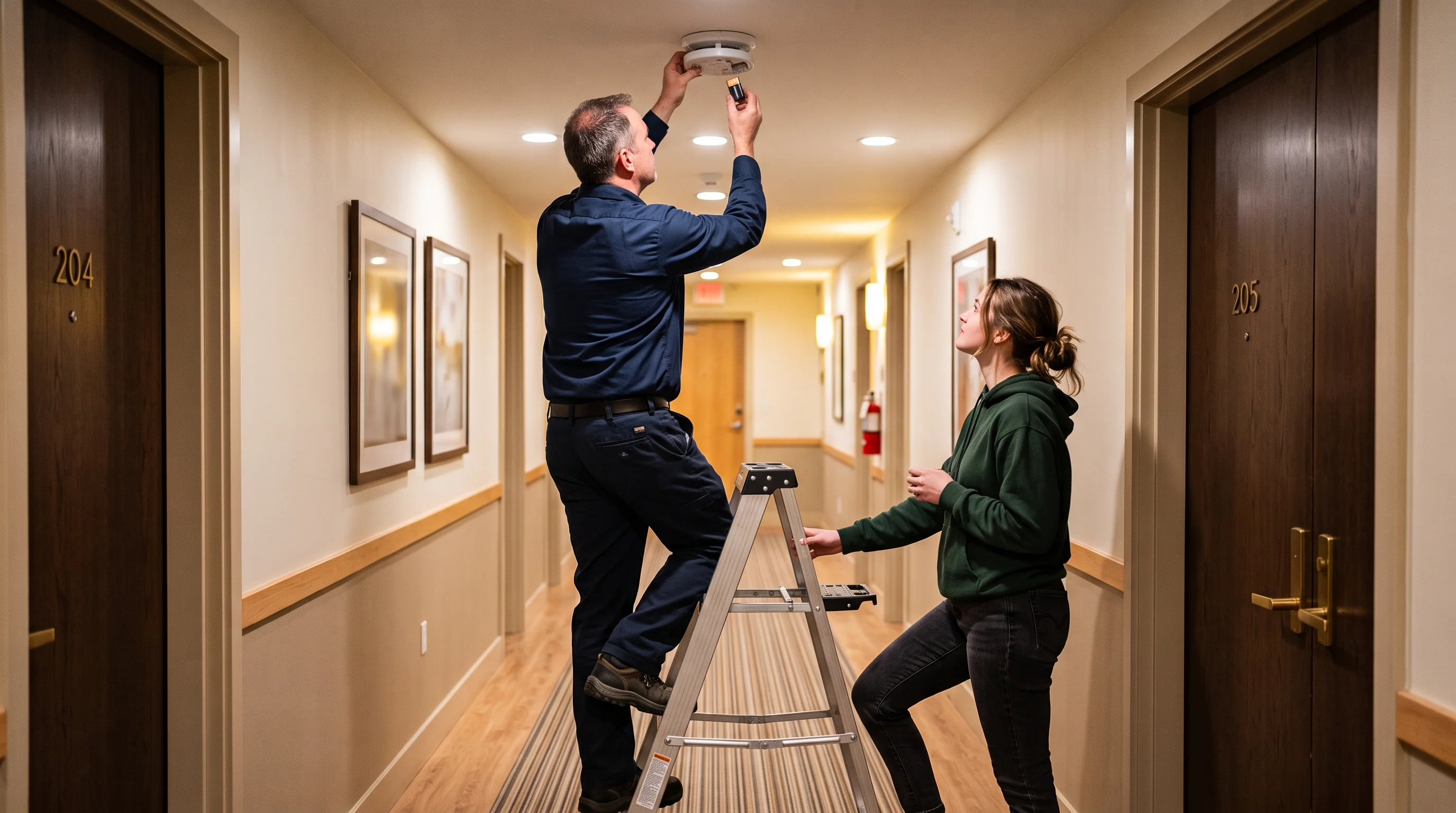
In an Ontario rental, keeping alarms and their batteries working is the landlord's duty, and no one may disable a smoke or CO alarm. The Fire Code requires an alarm's primary and secondary power supplies to be kept in operating condition (Division B, Articles 6.3.3.3(2) and 6.3.4.3(2)), and it places that duty on the landlord; nothing in it shifts battery replacement to the tenant.
The tenant must notify the landlord as soon as they become aware that an alarm is disconnected, not operating or impaired (Articles 6.3.3.5 and 6.3.4.5). And Articles 6.3.3.6 and 6.3.4.6 say: "No person shall disable" a smoke alarm or a carbon monoxide alarm. Pulling the battery is disabling it.
The penalties are serious. Contravening the Fire Code is an offence under section 28(1) of the Fire Protection and Prevention Act, 1997. An individual can be fined up to $50,000 for a first offence and up to $100,000 for a later one, or imprisoned for up to one year, or both (s. 28(3)). A corporation can be fined up to $500,000 for a first offence and up to $1,500,000 for a later one (s. 28(4)).
Does an Ontario rental building need a fire safety plan?
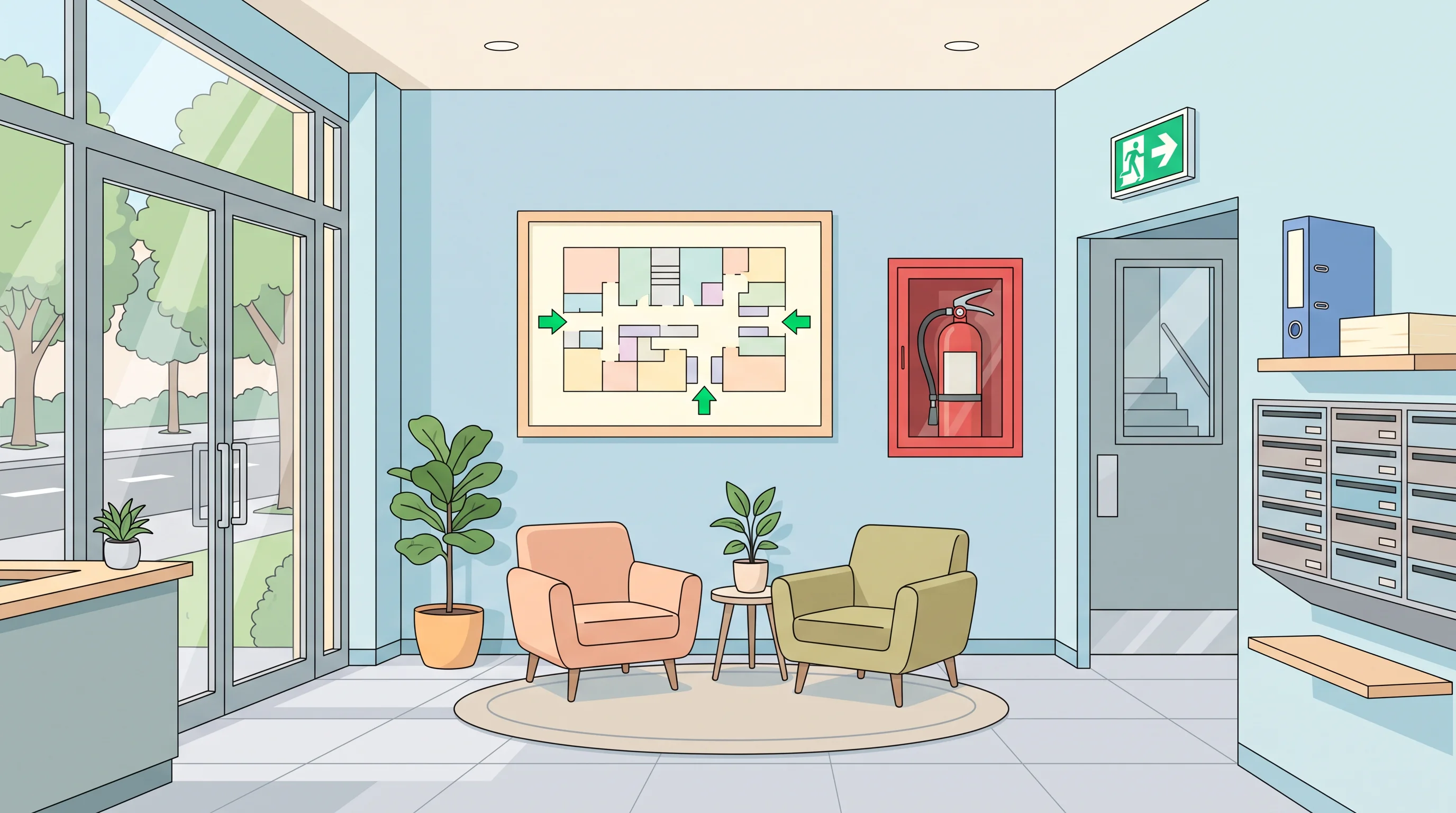
A fire safety plan is required in an Ontario building with a residential occupancy whose occupant load exceeds 10, or with four or more storeys counting those below grade, among other cases (Fire Code, Division B, Article 2.8.1.1).
The plan must be prepared, approved and implemented (Article 2.8.2.1(1)). It sets out evacuation, fire drills and supervisory staff duties (Article 2.8.2.1(2)). It is kept in the building in an approved location and reviewed at least every 12 months (Article 2.8.2.1(3) and (4)). "Approved" means approved by the Chief Fire Official, so ask the local fire department.
Under RTA section 20(1) the landlord must also comply with health, safety, housing and maintenance standards, and the LTB's Interpretation Guideline 5 names the fire code as one of those standards, so a missing or dead alarm is also a maintenance problem a tenant can raise at the Landlord and Tenant Board (LTB).
What happens to the tenancy after a fire in an Ontario rental?
After a fire in Ontario the tenancy carries on and the landlord repairs, unless the unit cannot be lived in for a long time, in which case the tenancy may be frustrated and end automatically. Section 19 of the Residential Tenancies Act says the doctrine of frustration of contract and the Frustrated Contracts Act apply to tenancy agreements. The Act does not say when a fire is bad enough, and the LTB has no guideline on frustration, so it turns on how badly the unit is damaged and for how long.
- The tenancy continues. Damage repairable in a reasonable time does not end the tenancy; the landlord repairs under section 20(1).
- The tenancy is frustrated. If the unit is destroyed or cannot be lived in for a long time, both sides are released from the agreement. Under the Frustrated Contracts Act, sums not yet due stop being payable and rent paid in advance for the time after that point is generally recoverable (s. 3(1)); rent periods already fully performed are treated separately (s. 3(7)).
Frustration needs no notice to end the tenancy; if the two sides disagree, the LTB decides. Interpretation Guideline 5 says that where a disaster such as flooding leaves a unit unfit, and the landlord does not wish to restore it immediately and make provisions such as a hotel, the tenancy could be terminated retroactively to the date of the disaster, with an abatement from then.
Does a tenant pay rent while a fire-damaged unit is repaired in Ontario?
If the tenancy is frustrated, rent stops being payable from that point and prepaid rent for the period after it is generally the tenant's to recover (Frustrated Contracts Act, s. 3(1)). If the tenancy continues, the RTA has no rule that suspends rent automatically during repairs; the two sides can agree in writing on a reduction, and otherwise a tenant who believes the landlord breached the repair duty can apply to the LTB on Form T6 for a rent abatement.
Other remedies include a repair order and ending the tenancy (s. 30(1)). The T6 instructions cap an order at $50,000, and the application must be filed within one year (s. 29(2)).
An abatement is not automatic after a fire. Interpretation Guideline 5 says an abatement is not appropriate if the landlord fixed the problem within a reasonable time, or had a reasonable maintenance program and acted responsibly on a problem needing extensive repairs.
The rent deposit is applied to the last rent period (s. 106(10)); see the last month's rent deposit guide.
Does an Ontario tenant have the right to move back after fire repairs?
A tenant whose tenancy continues simply resumes it when repairs finish. The statutory right of first refusal is narrower. It applies only where the landlord ends the tenancy with a notice under section 50 for repairs so extensive that they need a building permit and vacant possession, on Form N13 (s. 53). It is not created by a tenancy ending through frustration.
Under an N13 for repairs, the termination date must be at least 120 days after the notice (s. 50(2)). A tenant who wants to return must say so in writing before moving out (s. 53(2)), and gets at least 60 days after the unit is ready to move back (s. 53(2.2)), at no more than the lawful rent (s. 53(3)). Section 54 compensation does not apply to a repair ordered under the RTA or any other Act.
Can an Ontario landlord enter a unit after a fire?
Yes. An Ontario landlord may enter without written notice in an emergency or with the tenant's consent at the time (RTA s. 26(1)). After the emergency, entry to repair, or for an insurer to view the unit, needs 24 hours' written notice giving the reason, the day and a time between 8 a.m. and 8 p.m. (s. 27(1) and (3)). Our article on the 24-hour notice of entry rule covers the details.
Who pays if the tenant caused the fire in Ontario?
An Ontario tenant is responsible for repairing undue damage caused by the wilful or negligent conduct of the tenant, another occupant, or someone the tenant let into the building (RTA s. 34). An accident is not automatically negligence; the landlord must prove the cause. The options are:
- Form N5 (s. 62). The notice gives a termination date at least 20 days away and requires the tenant to repair, or pay the reasonable cost of repairing, within seven days. It is void if the tenant complies within those seven days (s. 62(3)). See Form N5 and our N5 guide.
- Form N7 (s. 63). Where the damage was caused wilfully, the landlord may give a notice with a termination date at least 10 days away. See Form N7.
- Compensation (s. 89). The landlord can apply to the LTB for the reasonable cost of repair or replacement, using Form L2 for a sitting tenant, while the tenant is in possession or within one year after they move out (s. 89(1.1)).
It works the other way too: where the landlord's breach of the repair duty caused the tenant's loss, section 30(1), paragraph 5 lets the LTB order the landlord to pay for the tenant's damaged property and reasonable out-of-pocket expenses.
Who insures what after a rental fire in Ontario?
In Ontario, the landlord's property insurance covers the building on its terms; the tenant's belongings and liability are covered only by the tenant's own policy, which the RTA does not require. The province's guide to the standard lease says a landlord and tenant can agree whether the tenant must have liability insurance, that the tenant must provide proof if the landlord asks, and that contents insurance is up to the tenant.
| Loss | Usually responds | Where the Act comes in |
|---|---|---|
| The building and the landlord's fixtures | The landlord's property policy, on its terms | The landlord must repair (s. 20(1)) |
| The tenant's furniture, clothes and electronics | The tenant's contents insurance, if they have it | The landlord pays only if their breach caused the loss (s. 30(1), para. 5) |
| Damage the tenant caused to the building or a neighbour's unit | The tenant's liability insurance, if they have it | The tenant is responsible for undue damage (s. 34) |
| Somewhere to stay while the unit is repaired | Depends entirely on each policy's terms | No RTA rule requires the landlord to pay for it |
We go further in what an Ontario landlord can require for tenant insurance, tenant insurance in Ontario: what's required and what's smart, and landlord insurance in Ontario.
What should each side do? Two short checklists
Landlord checklist
- At move-in, test each required alarm and give the tenant the maintenance instructions.
- Test yearly, at each change in tenancy, after a battery change and after electrical work; note the date.
- Replace alarms by the manufacturer's date.
- If the building needs a fire safety plan, review it at least every 12 months.
- After a fire: make the building safe, call your insurer, and tell the tenant in writing whether you are repairing, and by when.
- Give 24 hours' written notice for repair entries after the emergency.
- If the tenant caused it, gather the evidence before choosing an N5, N7 or L2.
Tenant checklist
- Never remove a battery or disable an alarm; report a faulty one in writing as soon as you notice.
- Know your exits and your building's fire emergency procedures.
- Consider contents and liability insurance; keep proof if your lease requires it.
- After a fire: get out, call 911, then tell your landlord and insurer; photograph the damage when safe.
- Ask the landlord in writing whether the unit is being repaired and by when.
- If repairs drag on, keep a dated record and consider a T6 within one year.
Frequently asked questions
Is an Ontario landlord required to install smoke alarms in a rental?
Yes. The Fire Code makes the landlord responsible for installing, maintaining and testing them (O. Reg. 213/07, Division B, Article 2.13.2.1 and Subsection 6.3.3).
Can a tenant take the battery out of a smoke alarm in Ontario?
No. No person may disable a smoke or carbon monoxide alarm (Division B, Articles 6.3.3.6 and 6.3.4.6), and a tenant must report one that is not working.
Does a fire automatically end a lease in Ontario?
No. It ends only if it is frustrated because the unit cannot be lived in for a long time (RTA s. 19); otherwise the landlord repairs and the tenancy continues.
Does an Ontario landlord have to pay for a hotel after a fire?
The Residential Tenancies Act has no rule requiring it, though some insurance policies pay additional living expenses. If the landlord neither restores an unfit unit quickly nor arranges interim housing, Interpretation Guideline 5 says the tenancy could be ended retroactively.
Keep a dated record of every unit's condition
Tenon10 runs move-in and move-out inspection reports and fills the Ontario N-forms, so the condition of the unit and the notices you give are on file if a fire ever puts them in question.
Free • No signup required


