TORONTO, Oct. 24, 2026: Toronto votes for mayor and council on Monday, October 26, 2026, from 10 a.m. to 8 p.m. Of the 53 certified mayoral candidates, Brad Bradford and Olivia Chow, the two still campaigning who were invited to the Toronto Region Board of Trade debate, have each published rental-housing commitments, set out below from their own campaign sites beside the city's current rental rules.
When and how do Toronto tenants and landlords vote on October 26?
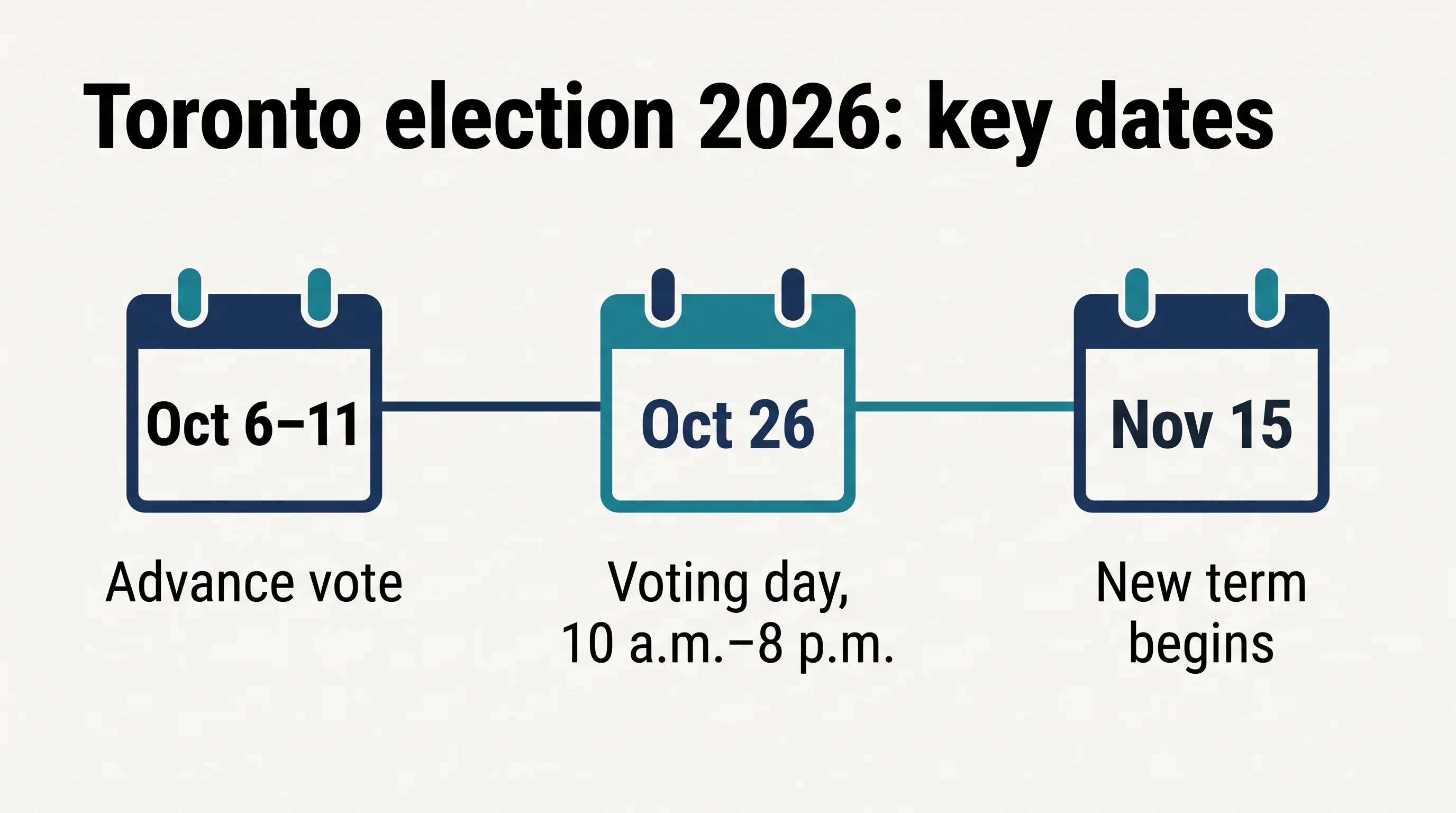
Voting day in an Ontario regular municipal election is the fourth Monday in October (Municipal Elections Act, 1996, s. 5), so every municipality in the province votes on October 26. In Toronto, voting places are open from 10 a.m. to 8 p.m.; the advance vote ran from October 6 to 11 (City of Toronto fact sheet).
- Who can vote: a Canadian citizen aged 18 or older who lives in Toronto, or who (or whose spouse) owns or rents property in the city, and is not barred by law (Act, s. 17(2)). Each person votes once.
- Tenants: a tenant votes as a resident, in the ward where they live, even if they also own or rent property in another ward. Bring one piece of ID showing your name and Toronto address; photo ID is not required.
- Landlords who live outside Toronto: may vote as non-resident owners, but still only once.
What are Toronto's rental rules today?
Whoever wins inherits these Toronto Municipal Code rules, which apply now:
- RentSafeTO (Chapter 354): covers purpose-built rental buildings with three or more storeys and ten or more rental units (§354-1.1), which must be registered with the City (§354-2.1).
- Vacant Home Tax (Chapter 778): 3% of the property's Current Value Assessment from the 2024 tax year. Every residential owner must declare occupancy each year, even if they live there (§778-4.1); a false declaration can bring a fine of up to $10,000 (City Vacant Home Tax page).
- Rental Renovation Licence (Chapter 662): the "renoviction" bylaw. Enforcement began July 31, 2025, for N13 notices given on or after that date. A landlord applies within seven days of the N13, pays $728 per unit (2026 fee) and must arrange temporary housing or rent-gap payments (City landlord page).
- Multiplexes: four-unit multiplexes are permitted city-wide; six-unit permissions apply in Toronto and East York District and Ward 23 (City multiplex page).
- Garden and laneway suites: garden suites are permitted in most residential zones under Zoning By-law 569-2013 (Council, February 2, 2022); laneway suites are permitted in R, RD, RS, RT and RM zones city-wide (Council, July 16, 2019).
- Multi-tenant (rooming) houses (Chapter 575): a licence is required for a premises with four or more multi-tenant house rooms (§575-1.1); the city-wide licensing bylaw came into force March 31, 2024.
Our guides cover these in more depth: renoviction licensing by city, vacant home taxes by city and garden and laneway suites in Toronto.
Planning renovations that need the unit empty? Toronto's licence runs alongside the provincial N13 process, not instead of it. Read the N13 guide
What have the mayoral candidates promised on rental housing?
Toronto has 53 certified mayoral candidates (City candidate list). We compare the candidates the Toronto Region Board of Trade and the Toronto Star invited to their September 22 debate as "leading mayoral candidates" and who are still campaigning. The third invitee, Chris Alexander, announced on October 6 that he was leaving the race, CTV News reported; his name remains on the certified list. Each entry below is taken only from the candidate's own campaign site (bradford26.ca, oliviachow.ca), read on October 24. Candidates are listed alphabetically.
| Topic | Brad Bradford | Olivia Chow |
|---|---|---|
| Rental licensing and enforcement | A quarterly public dashboard of Rental Renovation Licence applications, licences, investigations, charges, fines and tenant compensation; a costed staffing plan for Toronto Building | Continue enforcing the Renovictions By-law; a Bad Landlords Task Force of enforcement officers and lawyers to pursue the worst buildings and seek court orders for repairs; more "remedial action", where the City makes repairs and bills the landlord |
| Vacant Home Tax | Not stated | Not stated |
| Multiplexes and zoning | Multiplexes not stated; a Non-Profit Density Framework with standard density terms for non-profit builders | Not stated |
| Housing supply | Expand the City's revolving pre-development loan fund for non-profit builders | Start construction on 10,000 more rental homes next year through the Rental Housing Supply Program; a goal of 65,000 homes by 2030 |
| Renovictions and tenant support | Expand eviction prevention programs, including the Toronto Rent Bank; ask the Province for tougher rules on bad-faith renovation and own-use evictions; a maximum heat standard with at least one cooled room in every rental home, for Council approval by June 2027 | Pass a Maximum Temperature By-law; continue asking the Province for rent control |
| Property tax | Freeze the City property tax rate for homes and businesses for one year during an independent spending review, then keep increases below inflation | Not stated |
| Municipal land transfer tax | Remove it on a principal residence up to $1.1 million for first-time buyers and owners moving within Toronto; landlords who own more than one Toronto property would not qualify | Not stated |
"Not stated" means we found no position on that topic on the candidate's campaign site. Any change would need a City Council vote, and some items depend on the Province.
What it means for landlords
Nothing changes on voting day. The bylaws above, the Vacant Home Tax declaration and the Rental Renovation Licence stay in force unless the new Council amends them.
What it means for tenants
Your rights under the Residential Tenancies Act and the City bylaws stay the same after the vote. You can vote in your ward of residence with ID showing your address; a lease or utility bill may count, and the City lists acceptable ID.
What happens after the vote?
The City posts unofficial results at toronto.ca/election-results after voting places close on October 26. The new Council's four-year term begins on November 15, 2026 (Municipal Elections Act, s. 6(1)). Tenon10 will follow up on what the result means for Toronto landlords and tenants once Council sets its agenda.
What to do now
- Check where you vote with the City's MyVote tool at toronto.ca/elections.
- Read each candidate's platform on their own site before you vote.
- Landlords: keep your Vacant Home Tax declaration and any renovation licence paperwork current; see the Ontario Landlord Resource Center.
The rules stay the same on Monday. Your paperwork should too.
Fill Ontario N-forms, build leases and track deposits in one place.
Free • No signup required