In Ontario, only a Licensed Electrical Contractor (LEC) can be hired to do electrical work in a home, and a licence cannot be lent to anyone else. An Ontario electrical contractor and its owner were fined a combined $122,000 for taking out permits for work an unlicensed person did, so landlords should check the licence number before they hire.
MISSISSAUGA, Ont., Oct. 21, 2026: The Electrical Safety Authority (ESA) announced that a licensed electrical contracting company and its owner, who was also its Designated Master Electrician, were convicted under the Electricity Act, 1998. The company took out ESA permits for work at six homes in Clarington, Brantford, Milton and Markham while an unlicensed contractor did the work. Both pleaded guilty in September 2026.
What happened in the Ontario permits-for-sale case?
ESA says its investigation found a paid arrangement: the licensed company obtained electrical permits for six residential jobs, the owner collected payments for those permits, and an unlicensed contractor carried out the work. According to ESA, that person was not employed by the company, had no electrical qualifications, was not properly insured and worked without supervision from the company or its owner.
ESA investigators also saw the owner doing electrical work at a seventh home in Brantford alongside two unlicensed contractors. No ESA permit had been obtained for that job.
How was the $122,000 fine split?
The company was fined $92,000. The owner was fined $30,000 and placed on probation. ESA says it is reviewing the matter and considering whether further administrative action is warranted.
| Party | Outcome (as ESA reports it) |
|---|---|
| The licensed contracting company | Fined $92,000 |
| Its owner and Designated Master Electrician | Fined $30,000 and placed on probation |
| Combined | $122,000 under the Electricity Act, 1998 |
In its sentencing reasons, as ESA describes them, the Ontario Court of Justice called the owner's conduct deceptive and bordering on fraud, noting he charged more than twice the cost of an ESA permit. The court treated his licensing status as an aggravating factor and stressed the risk of fire and loss of life. ESA's release does not list the specific counts.
What does the law say about electrical contractor licences in Ontario?
Ontario's licensing rules sit in Part VIII of the Electricity Act, 1998 and its regulations. The main provisions behind a case like this one are:
- A licence is required to run the business. O. Reg. 570/05, s. 3: no person shall operate an electrical contracting business without an electrical contractor licence.
- The master electrician supervises the work. O. Reg. 570/05, s. 6 makes the designated master electrician responsible for "the personal planning and direct supervision" of the contractor's electrical work, and s. 4(1) requires the contractor to make sure all work done on its behalf follows the Electrical Safety Code.
- The licence number must be shown. O. Reg. 570/05, s. 19 requires a contractor to display its licence number on correspondence, contracts, advertisements and business vehicles.
- The work must meet the Code. O. Reg. 164/99, s. 2 requires electrical work in Ontario to comply with the Electrical Safety Code.
- Hiring an unlicensed person is caught too. Electricity Act, 1998, s. 113.2(1) bars anyone from carrying out, or permitting or employing another person to carry out, an activity that requires an authorization without one.
- The maximum fines. Under s. 113.20(1), an individual faces up to $50,000 or a year in jail per offence; under s. 113.20(2), a corporation faces up to $1,000,000. Each day an offence continues is a separate offence (s. 113.20(5)).
What it means for landlords
For an Ontario landlord, the case shows that a permit on file does not prove the person in your unit is licensed. ESA's hiring guidance says a Licensed Electrical Contracting Business is the only business that can be hired for electrical work in a home; certified electricians and Master Electricians cannot be hired directly. A general contractor is not licensed for electrical work and must use an LEC.
ESA also warns that work by unlicensed contractors may lead to denied insurance claims, and that the owner may be responsible if an uninsured worker is hurt on the job.
Who may do the work in a rental? O. Reg. 570/05, s. 2, para. 3 exempts work in a residential dwelling done by "an owner or occupant of the dwelling" themselves. ESA's DIY page is written for a homeowner working in their own home, says friends, family and neighbours cannot do it, and still requires a notification before work starts. The owner-and-employee exemption in s. 2, para. 2 covers industrial establishments and farms, not residential dwellings, so it does not cover a superintendent or handyman. The conservative course: treat electrical work in a rented unit as a job for an LEC.
Electrical faults are also a repair issue. Under Ontario's maintenance standards, the landlord is responsible for keeping a unit in good repair, and a tenant can take an unresolved repair to the Landlord and Tenant Board with a T6 application.
What to do now
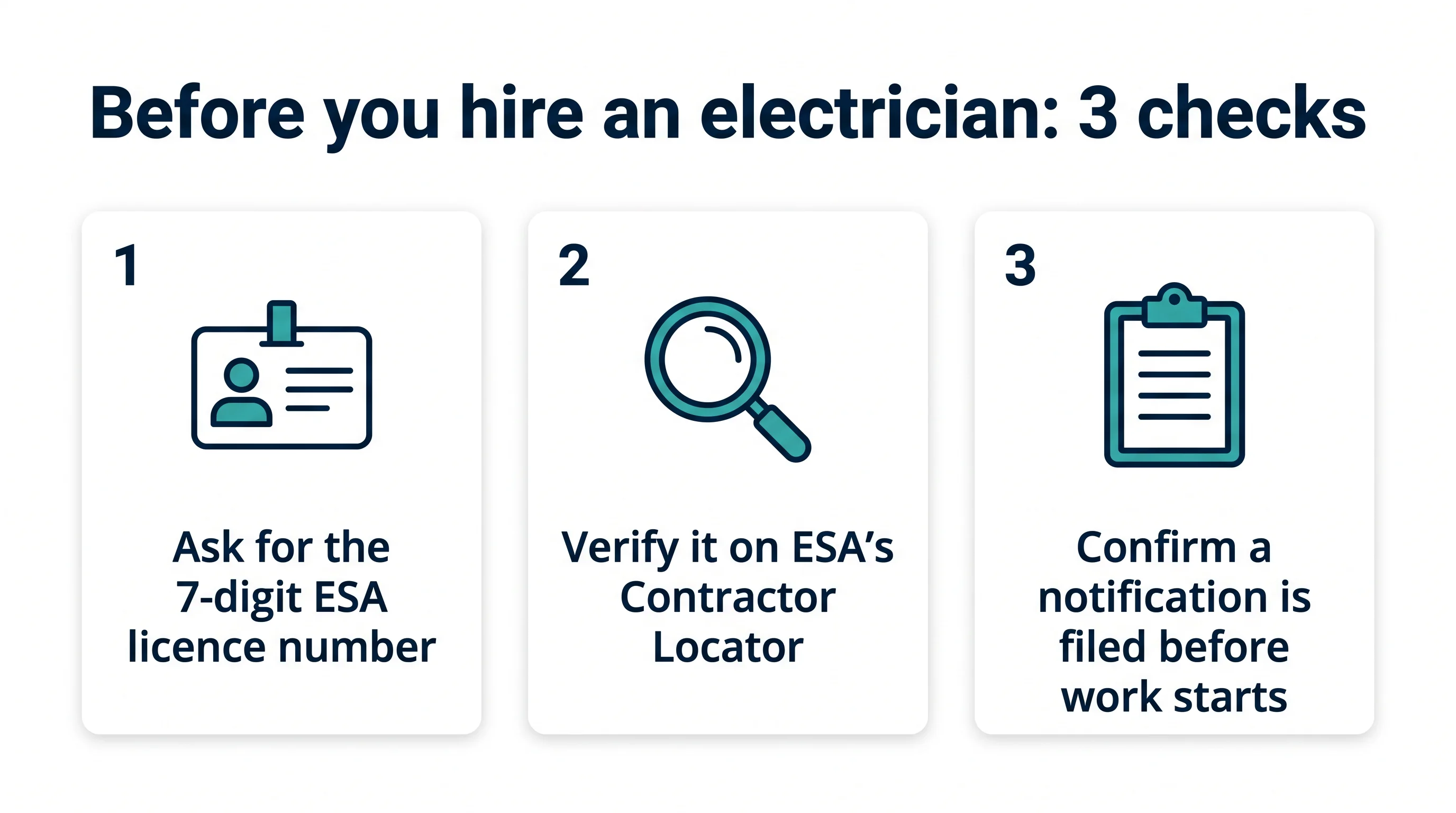
- Ask for the licence number. ESA says to ask for the seven-digit ECRA/ESA electrical contractor licence number before hiring.
- Verify it. Check the number in ESA's Contractor Locator.
- Confirm the notification. ESA's notifications page says almost all electrical work must be reported to ESA by a notification of work (a "permit") filed before work starts, by the person doing the work. ESA calls it a red flag if a contractor asks you to file it in your name.
- Keep the Certificate of Acceptance. Once the work passes, ask the contractor for a copy for your property records.
- Report concerns. Suspected unlicensed work can be reported to ESA at ESAsafe.com/ReportAContractor, anonymously if you prefer.
For more Ontario rental guidance, see the Ontario Landlord Resource Center.
Keep your Ontario rental paperwork in order
Free Ontario landlord and tenant forms, including the Standard Lease and the N-forms.
Free • No signup required