To dispute a notice to vacate in Saskatchewan, give your landlord written notice that you dispute it within 15 days after you receive it (Residential Tenancies Act, 2006, ss.58(5), 59(5), 60(9)). If you do, you are not deemed to accept the end date, and if the landlord applies to the Office of Residential Tenancies (ORT), the landlord has to prove it is entitled to end the tenancy (s.67(2)).
Miss the 15 days and you are deemed to accept that the tenancy ends on the notice date and must move out by then (s.58(6)). This guide is for Saskatchewan tenants holding a notice for cause, for the end of a caretaker's job, or for the landlord's own use, a sale, renovation or a housing program. For the bigger picture, see Saskatchewan Tenant Rights: A Complete Guide.
Which Saskatchewan notices can a tenant dispute within 15 days?
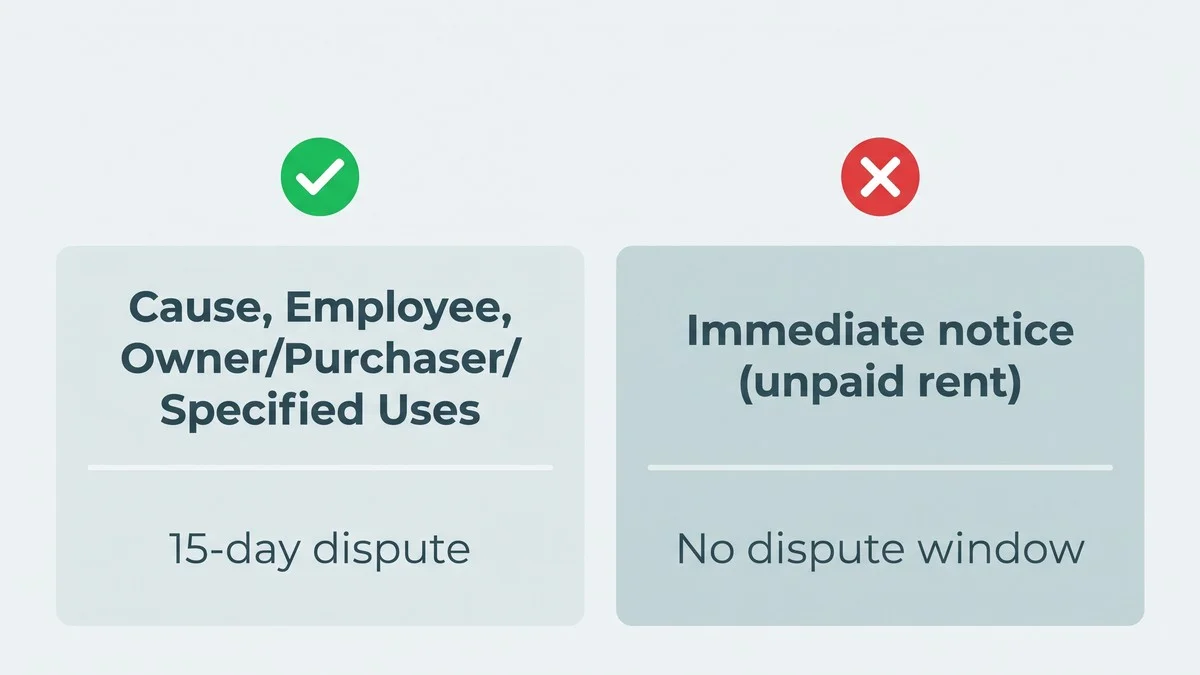
The 15-day written dispute applies to every Saskatchewan landlord notice under ss.58, 59 and 60 of the Act. It does not apply to the Immediate Notice to Vacate and Notice of Arrears for unpaid rent (s.57), which has no dispute window.
| Notice (ORT portal name) | Section | 15-day dispute? |
|---|---|---|
| Notice to Vacate: Cause | s.58 | Yes |
| Notice to Vacate: Employee | s.59 | Yes |
| Owner Occupy, Purchaser Occupy, Specified Uses, Housing Program Purposes | s.60 | Yes |
| Immediate Notice to Vacate and Notice of Arrears | s.57 | No; raise your case at the hearing |
If you have the immediate notice, read what tenants can do after an immediate notice instead.
What do you need before you start?

You need the notice itself, the date you received it, and a way to deliver your reply that leaves a record.
- The notice and the envelope, email or text it came in.
- Your landlord's address for service from your tenancy agreement, or their email.
- Any evidence you want to rely on later, such as receipts, photos and messages.
How do you dispute the notice, step by step?
- Work out your deadline. Count 15 days from the day you received the notice. A mailed notice is deemed received on the third business day after mailing, an emailed one on the next business day (s.82(4)–(5)).
- Write the dispute. The Act requires it to be in writing but sets no form. Include your name, the unit address, the date of the landlord's notice, and a clear sentence: "I dispute this notice."
- Deliver it to the landlord. Serve it personally on the landlord or their agent, by ordinary mail to the landlord's address in the tenancy agreement, or electronically (s.82(2)(c)). Mail is deemed served three business days later, so do not mail it near the deadline.
- Keep proof. Keep a copy, the sent email, or a note of who you handed it to and when.
- Stay and keep paying rent. Rent is still due on time (s.42(1)). Only a sheriff enforcing an ORT writ can remove you (s.65).
What happens after you dispute?
After a Saskatchewan tenant disputes, the landlord may apply to the ORT for an order ending the tenancy, and the landlord must prove it is entitled to end it (s.67(1)–(2)). If the landlord applies, you will be served a hearing notice, and ORT hearings are held by phone unless the hearing officer decides an in-person hearing is needed (ORT Rules of Procedure, Part 3).
At the hearing you can ask for relief if the notice was given because you made a good-faith complaint about health or housing standards, tried to enforce your rights, or the landlord breached the agreement (s.70(11)). Send your evidence to the landlord directly as well as uploading it; uploading is not service (Rules of Procedure, Part 4).
Frequently asked questions
What if I missed the 15 days?
You are deemed to accept the end date (s.58(6)). The landlord still cannot remove you without an ORT order and writ (s.65), and if the landlord applies, you must be served notice of the hearing (s.70(2)(b)).
Does the notice date have to be exact?
No. A date that is too early is treated as the earliest date that complies (s.64(2)), so a wrong date alone does not cancel the notice.
The landlord said they were moving in but re-rented the unit. What can I do?
You can apply for compensation if the stated purpose is not carried out within a reasonable time or the unit is not used that way for at least six months (s.62). Re-renting on other grounds is also an offence (s.79(4)).
Can I leave before the date instead?
After an s.60 notice, yes: give at least 10 days' written notice of an earlier date and pay rent up to it (s.61(1)).
Fifteen days in writing is all it takes to make the landlord prove the case. More is in the Canadian Tenant Resource Center.
Protect your tenancy
Compare the notice you were given with the free Saskatchewan notice forms: cause, owner occupy, purchaser occupy and specified uses.
Free • No signup required