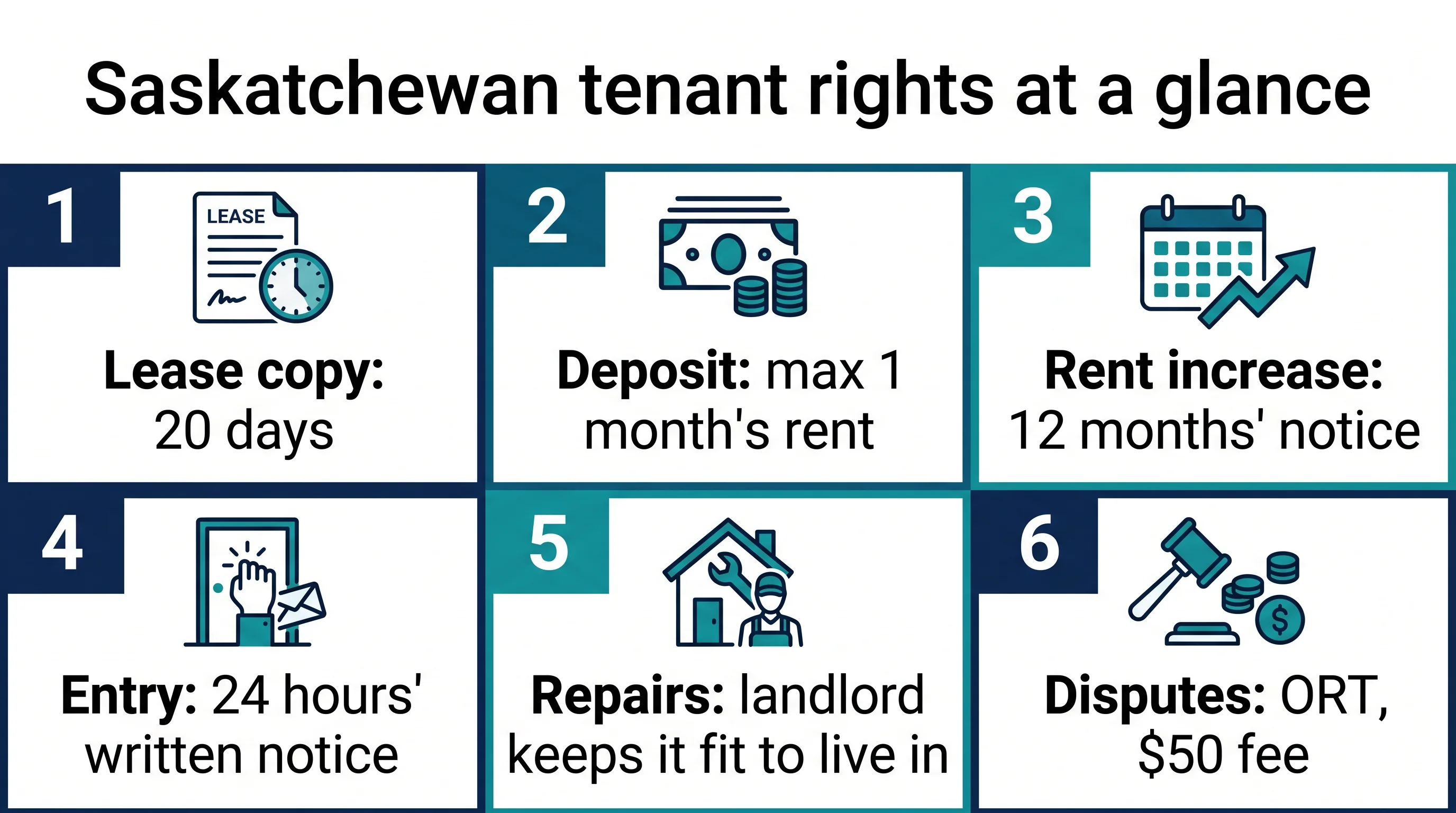
Saskatchewan tenant rights come from The Residential Tenancies Act, 2006 and its Regulations: a lease copy within 20 days, a security deposit capped at one month's rent, 12 months' notice of a rent increase, 24 hours' written notice before most entries, a home kept in good repair, and eviction only through the Office of Residential Tenancies (ORT).
This guide maps every main right a Saskatchewan renter has, with the section of the Act behind it, so you can check what your landlord is asking against the law. The ORT is the provincial body that decides landlord and tenant disputes; older guides and many people still call it the Rentalsman, its former name.
At a glance
- Lease: copy within 20 days (s.19(2)); no application fees (s.23).
- Deposit: at most one month's rent, half at signing, the rest within two months (s.25(1), s.26(4)); back or claimed within seven business days (s.32(1)).
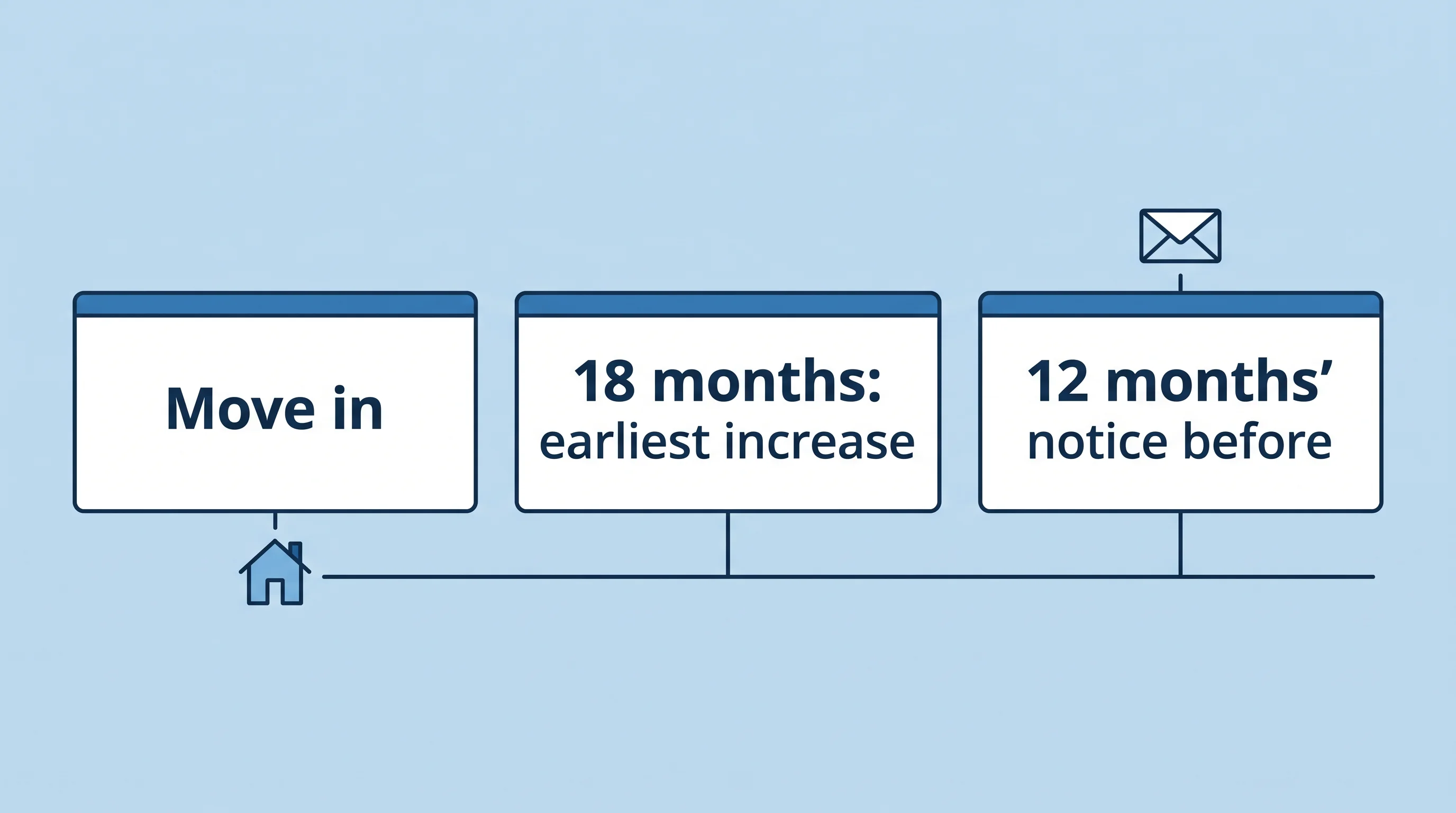
- Rent increase: no cap on the amount; 12 months' written notice for most landlords, and not within the first 18 months (s.54).
- Entry: 24 hours' to seven days' written notice with a four-hour window between 8 a.m. and 8 p.m. (s.45(1)(b), (2)).
- Eviction: only on a valid notice, and removal only with an ORT order and a sheriff's writ (s.65).
- Disputes: ORT, $50 fee, within one year, claims up to $30,000 (Regs s.13(1)(a), s.11; s.71.1).
Saskatchewan Tenant Rights Checklist
Get Free PDF →What law protects tenants in Saskatchewan?
Saskatchewan tenants are protected by The Residential Tenancies Act, 2006 and The Residential Tenancies Regulations, 2007, whose Schedule 1 lists the Standard Conditions that are part of every tenancy agreement (Regs s.4; Schedule 1, s.1(1)). A landlord and tenant cannot contract out of the Act (s.6), and a lease term that is inconsistent with it, unconscionable or unclear is not enforceable (s.7(2)).
The Act covers most homes you rent, including a room in someone else's house unless an exclusion applies. It does not cover some accommodation listed in s.5 and Regs s.3, such as a hotel, motel or bed and breakfast where you stay less than six consecutive months, crisis shelters, licensed personal care homes, and student housing owned by an educational institution. Commercial leases fall under a different law, The Landlord and Tenant Act, which is why searching that name gives the wrong rules for a home.
What must your lease include, and what can't a landlord charge?

A written Saskatchewan tenancy agreement must include the Standard Conditions, both parties' legal names, the address, the landlord's address for service and phone number, an emergency repairs number if different, the rent and due day, who pays which utilities, the services included and the deposit (s.19(1)). The landlord must give you a copy of the signed agreement within 20 days (s.19(2)).
A lease can be oral, but a fixed term of three months or longer must be in writing (s.20). If a landlord does not provide the copy or, for an oral agreement, the written contact details, s.19(5) suspends the obligation to pay rent, and the landlord can ask the ORT to lift that suspension (s.19(6)). Read both subsections and contact the ORT before relying on them.
Some charges are not allowed at all. A landlord must not charge to accept or process a rental application, investigate an applicant or accept a tenant (s.23), must not demand money now for rent due in the future (s.40), and must not include a clause making the rest of the term's rent due if you breach the lease (s.41). The Act and Regulations say nothing about late-payment or NSF fees; any fee has to be in the agreement and can be challenged at the ORT if it is unreasonable.
How much can a Saskatchewan landlord take as a security deposit?
In Saskatchewan the security deposit (often called a damage deposit) cannot be more than one month's rent (s.25(1)), and a landlord can require only one deposit, at the start of the tenancy (s.26(1)(a)–(b)). You pay no more than 50% when the agreement is made and the rest within two months after you take possession (s.26(4); Schedule 1, s.3(1)).
- Held in trust: the deposit is held in trust and invested or kept in a trust account (s.28–29).
- Interest: none is payable if the tenancy ends within five years (Regs s.5(1.1)); for longer tenancies the ORT publishes the rate.
- Return: within seven business days after the landlord knows you have moved out, the landlord returns the deposit, or returns the undisputed part and serves an approved notice of claim (s.32(1)).
- Dispute: you can apply to the ORT within 60 days after the tenancy ends (s.33(2)).
- Missed deadline: if the landlord did not follow s.32(1)(b), the hearing officer must order the deposit returned (s.34(1)), unless the narrow exception in s.34(3) applies.
The deposit cannot be kept automatically under a lease clause (s.26(1)(c)), and the ORT's page says a landlord cannot automatically charge for cleaning. For a comparison, Alberta's landlords have 10 days (see Alberta security deposits) and BC landlords can owe double the deposit.
How much and how often can rent go up in Saskatchewan?
Saskatchewan's Act sets no limit on the amount of a rent increase; it controls notice and timing. For a periodic tenancy the landlord must give 12 months' written notice, and the increase cannot take effect earlier than 18 months after the tenancy began or 12 months after the last increase, whichever is later (s.54(1)(a), (2)(a)).
Landlords who are members in good standing of a prescribed association, the Saskatchewan Landlord Association Inc. or the Network of Non-Profit Housing Providers of Saskatchewan, give six months' notice, with the increase no earlier than 12 months after the start or six months after the last increase (s.54(1)(b), (2)(b); Regs s.8.1). A notice that breaks these rules takes effect on the earliest date that would comply (s.54(4)). In a fixed-term lease, rent cannot rise during the term unless the amount and timing were agreed when you signed (s.53.1).
Bill 608, The Rent Control Act, 2025, is a private member's bill that has not passed; it is not law. A landlord also cannot start charging for a service or facility that was free, or remove one, such as parking or laundry, without your agreement or an ORT order (s.43). Compare Alberta's rent increase rules, which also have no cap.
When can a Saskatchewan landlord enter your home?
A Saskatchewan landlord may enter only with your permission, or with written notice given at least 24 hours and not more than seven days ahead that states a reasonable purpose, the date and a window of no more than four hours between 8 a.m. and 8 p.m. (s.45(1)(a)–(b), (2)). Entry without notice is allowed in an emergency to protect life or property, or if the unit appears abandoned (s.45(1)(e)–(f)).
Showings to new tenants after you give notice, or in the last two months of a fixed term, need two hours' notice, and showings to buyers need 24 hours'; neither can happen on a Sunday or your day of religious worship (s.45(3)–(6)). You are entitled to quiet enjoyment: reasonable privacy, freedom from unreasonable disturbance and exclusive possession (s.44). A landlord cannot change the locks to your unit without your agreement and new keys (s.48(2)).
Who fixes things in a Saskatchewan rental?
The landlord must keep the property in good repair and fit for habitation, use and enjoyment, and keep supplied services such as heating, plumbing and appliances in repair, including wear and tear (s.49(1), (4)). You keep the unit reasonably clean and repair damage you or your guests cause (s.49(5)–(6)).
Keep paying rent while you wait: rent is due "whether or not the landlord complies" (s.42(1)), and the ORT can order rent paid to the director and used for the repair (s.70(6)(b), (7)).
How can a tenancy end in Saskatchewan?
A Saskatchewan tenancy ends only in the ways listed in Schedule 1, s.15: a written notice that follows the Act, a written agreement, the tenant leaving, circumstances outside both sides' control such as a fire, or an ORT order. Every notice must be in writing, dated, identify who is giving it, give the address and effective date, and a landlord's must state the grounds and use the approved form (s.63).
| Situation | Notice | Section |
|---|---|---|
| You end a monthly tenancy | At least one month after the landlord receives it, effective the day before a rent day | s.56(1) |
| Rent unpaid 15 days or more | Immediate Notice to Vacate and Notice of Arrears (formerly Form 7) | s.57(1) |
| Cause (for example repeated late rent, damage, disturbance) | One month; you can dispute in writing within 15 days | s.58(3), (5) |
| Landlord or family will move in; demolition or renovation with permits | Two months, periodic tenancies only | s.60(3), (4), (7) |
| Buyer will move in after a sale | One month, periodic tenancies only | s.60(3.1), (6) |
| Fixed term ending | Landlord's notice of intention at least two months before the end; reply in writing within one month | Regs s.8.2; Sch.1 s.13 |
| Interpersonal or sexual violence (fixed term) | 28 days' notice with a certificate | s.64.2 |
A few points matter most. If you get a cause notice and do not dispute it in writing within 15 days, you are deemed to accept it (s.58(6)). After a landlord's s.60 notice you can leave earlier on 10 days' written notice, paying rent only to that date (s.61), and you can claim your losses if the landlord does not use the unit for the stated purpose for at least six months (s.62). For a fixed-term notice of intention, the Regulations say one month, but the ORT's page says 30 days: reply within 30 days to be safe. If you receive an immediate notice for unpaid rent, the Act does not say that paying afterwards cancels it; the hearing officer decides, so get any agreement to stay in writing (s.60.1).
Your landlord cannot remove you, change the locks or take your belongings to force you out. Possession is regained only if you leave or with an ORT order and a writ directed to a sheriff (s.65), and seizing a tenant's property is prohibited (s.12). The ORT's page says that if anyone else tries to remove a tenant, the tenant should call the police.
How must notices be served on a Saskatchewan tenant?
A notice to a current Saskatchewan tenant must be handed to you personally, or posted on your front door and also sent by ordinary mail or electronically (s.82(2)(a)). An email on its own does not serve a current tenant. Mail is deemed received on the third business day after mailing, and electronic delivery on the next business day, unless you show you did not get it through no fault of your own (s.82(4)–(5)).
How do you take a dispute to the ORT?
You apply to the ORT through its online portal using a Saskatchewan Account. The fee is $50 for every application (Regs s.13(1)(a)) and is non-refundable (s.70(2.01)), with a fee waiver available under The Fee Waiver Act. Most applications must be made within one year (s.71.1), and the ORT can decide monetary claims up to $30,000 (Regs s.11). According to the ORT's hearings page, hearings take place by phone, so keep your phone free of blocked 1-800 numbers. An order can be appealed to the Court of King's Bench on a question of law or jurisdiction within 30 days (s.72(1)).
For how other provinces compare, see the Alberta tenant guide and tenant rights in BC, or browse the Canadian Tenant Resource Center.
Frequently asked questions
What is the Rentalsman in Saskatchewan?
The Rentalsman is the former name of the Office of Residential Tenancies, the body that runs The Residential Tenancies Act, 2006 and decides disputes between landlords and tenants. If an older document tells you to apply to the Rentalsman, apply to the ORT.
Is there rent control in Saskatchewan?
No. The Act limits how often rent can rise and how much notice you get, but not the amount. Bill 608, The Rent Control Act, 2025, is a private member's bill and is not law.
Can a Saskatchewan landlord charge an application fee?
No. Section 23 forbids charging to accept or process an application, investigate an applicant or accept a tenant.
Can my landlord evict me without going to the ORT?
A landlord can serve a notice without the ORT, but cannot remove you. If you stay after the notice date, the landlord must apply to the ORT for an order of possession, and only a sheriff enforces the writ (s.65; s.70(13)).
Do I get interest on my security deposit?
Not if the tenancy ends within five years of the agreement (Regs s.5(1.1)). For longer tenancies interest is paid at the rate set under Regs s.5, which the ORT publishes in its interest table.
Can my landlord keep part of my deposit for cleaning?
Only by claiming it. The landlord must serve the approved notice of claim within seven business days of your move-out (s.32(1)), and you can dispute it at the ORT within 60 days (s.33(2)).
Most Saskatchewan tenancy problems come down to a few rules: get it in writing, keep paying rent, use the approved forms, and take what you cannot settle to the ORT within its deadlines.
Saskatchewan Tenant Rights Checklist
Get Free PDF →Know your rights before you sign
Browse free landlord and tenant resources
Free • No signup required