In Saskatchewan, a landlord must give at least one month's written notice to end a tenancy for cause or employment, one or two months for the landlord's own use, and no notice period at all once rent is 15 days or more overdue. Every notice must use the approved form and, except for unpaid rent, end the day before a rent day (Residential Tenancies Act, 2006, ss.57–60).
If you are asking how much notice does a landlord have to give in Saskatchewan, the answer depends on the ground. This guide sets out every landlord notice to vacate in one table, with the section of The Residential Tenancies Act, 2006 (the Act), the notice period and the tenant's 15-day dispute window. Notice names are the ones used in the Office of Residential Tenancies (ORT) online portal, formerly the Rentalsman, with the old form numbers in brackets, as listed on the ORT's Ending a Tenancy page.
- Unpaid rent: immediate notice once rent is 15 days or more overdue (s.57(1)).
- Cause or end of employment: at least one month (ss.58(3), 59(3)).
- Owner or family moving in, demolition, renovation: at least two months, periodic tenancies only (s.60(3)).
- Purchaser moving in, housing program: at least one month, periodic only (s.60(3.1)).
- Fixed term ending: a Two Month Notice of Intention at least two months before the end date (Regs s.8.2).
- Tenant's dispute: 15 days in writing for every s.58, 59 and 60 notice (ss.58(5), 59(5), 60(9)).
Saskatchewan Landlord Notice to Vacate Checklist
Get Free PDF →How much notice does a Saskatchewan landlord have to give for each ground?
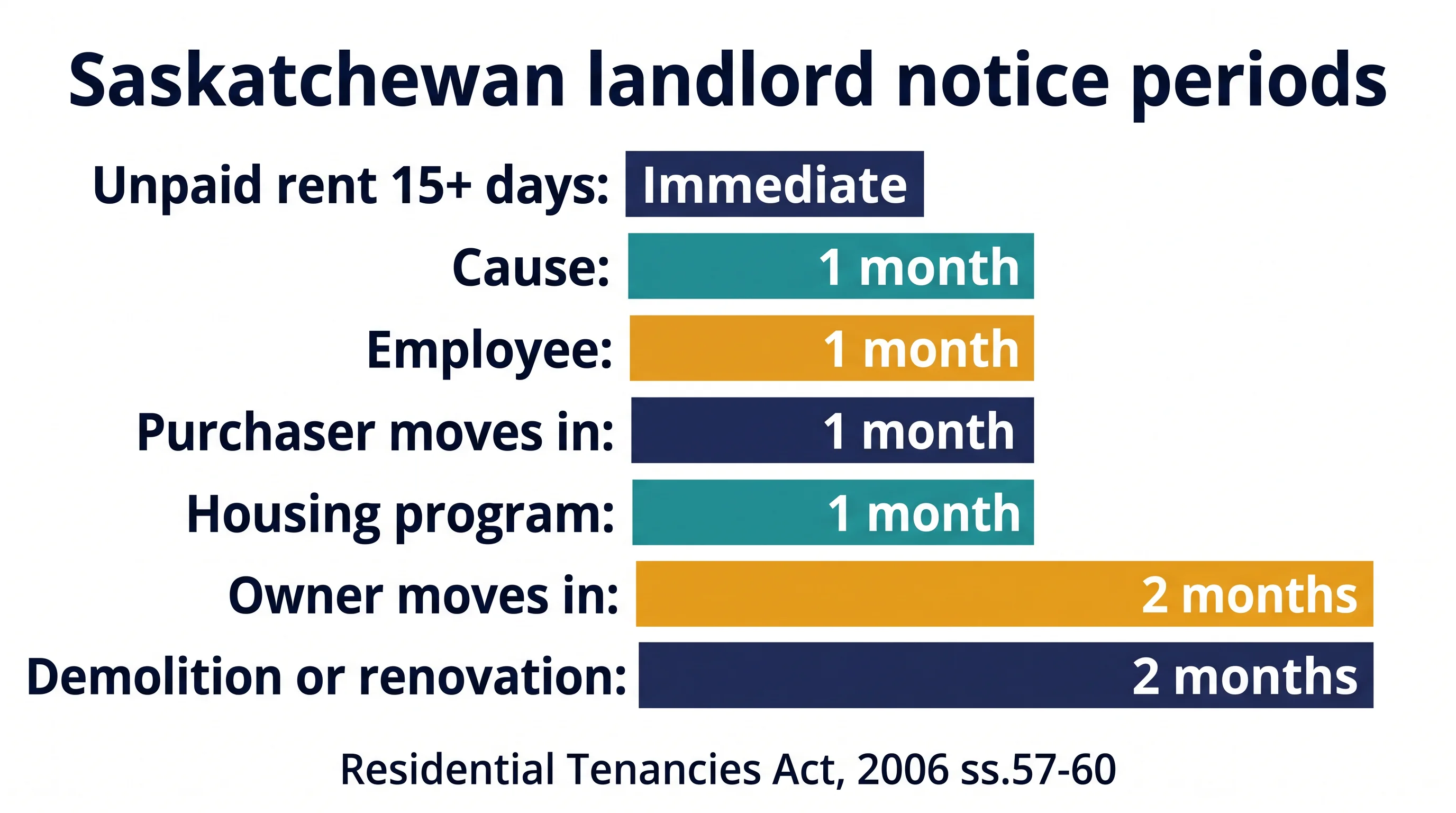
A Saskatchewan landlord's notice period runs from one month to two months, depending on the ground, except for unpaid rent, where the notice takes effect immediately. The ORT's portal lists these landlord notices:
| Ground | Portal notice (old number) | Section | Minimum notice | Tenancy type | Tenant's dispute |
|---|---|---|---|---|---|
| Rent unpaid 15 days or more | Immediate Notice to Vacate and Notice of Arrears (Form 7) | s.57 | Immediate | Either | No window stated; relief can be asked at the hearing (s.70(11)) |
| Utilities unpaid 15 days after a written demand | Notice of Utility Arrears (Form 7a) | s.57(5) | 15 days, then treated as rent | Either | — |
| Cause (s.58 grounds) | Evictions Requiring Notice of One Calendar Month (Form 8) | s.58 | One month | Either | 15 days |
| Employment as caretaker, manager or superintendent ends | Notice to Vacate – Employee (Form 8a) | s.59 | One month | Either | 15 days |
| Landlord or close family member or friend will move in | Notice to Vacate so Owner can Occupy (Form 8b) | s.60(4)–(5) | Two months | Periodic | 15 days |
| Buyer, or buyer's family, will move in | Notice to Vacate so Purchaser can Occupy (Form 8c) | s.60(6) | One month | Periodic | 15 days |
| Demolition, renovation, conversion (permits in hand) | Notice to Vacate for Specified Uses (Form 8d) | s.60(7) | Two months | Periodic | 15 days |
| Housing program purposes | Notice to Vacate for Housing Program Purposes (Form 8e) | s.60(7.1) | One month | Periodic | 15 days |
| Fixed term ending: renewal offer or non-renewal | Term Lease – Two Month Notice of Intention (Form 15) | Regs s.8.2 | Two months before the end date | Fixed term | Tenant replies in writing within one month |
Each period is counted from the day the tenant receives the notice, not the day you sign it (ss.58(3), 59(3), 60(3)). If a date is too early, the Act moves it to the earliest date that complies instead of cancelling the notice (s.64(2)). Alberta's periods are set out in ending a tenancy in Alberta.
When can a Saskatchewan landlord give an immediate notice for unpaid rent?

A Saskatchewan landlord may give the Immediate Notice to Vacate and Notice of Arrears once rent has been unpaid for 15 days or more (s.57(1)). To be safe, serve it on day 16 or later, counting from the day after rent was due.
The notice has no effect if the tenant withheld the money under a lawful right to deduct it (s.57(3)). Taking a payment afterwards does not by itself cancel the notice unless you agree in writing (s.60.1); if the tenant stays, a hearing officer decides whether to grant possession. Unpaid utilities the tenancy agreement makes the tenant pay can be treated as rent once they are 15 days unpaid after a written demand (s.57(5)). For comparison, Alberta uses a 14-day notice for unpaid rent.
What grounds count as cause for a one-month notice in Saskatchewan?
In Saskatchewan, a one-month notice for cause is available on the grounds listed in section 58(1) of the Act, including repeated late rent, a deposit not paid within two months, serious disturbance, risk to the property, illegal activity and extraordinary damage. The full list:
- Security deposit not paid within two months of the start date (s.58(1)(a)).
- Repeated late rent, or an unreasonable number of occupants (s.58(1)(b)–(c)).
- Significant disturbance, serious risk to health or safety, or significant risk to the property, by the tenant or a guest (s.58(1)(d)).
- Noxious, offensive or illegal activity with the harms the Act describes (s.58(1)(e)).
- Extraordinary damage, or damage not repaired within a reasonable time (s.58(1)(f)–(g)).
- A material breach not fixed within a reasonable time after written notice, or repeated breaches of the landlord's rules (s.58(1)(h)–(h.1)).
- Assigning or subletting without the landlord's written consent (s.58(1)(i)).
- Knowingly giving false information to a prospective tenant or buyer (s.58(1)(j)).
- An authority's order to vacate, a housing-program breach, or an ORT order not complied with within 30 days (s.58(1)(k)–(m)).
- Smoking in a detached house the landlord lives in, after a written warning (s.58(1)(o)).
- Improperly denying the landlord lawful entry (s.58(1)(p)).
- A bylaw breach or unpaid municipal charge that may be added to the landlord's property taxes (s.58(1.1)).
- Any other reason a hearing officer finds reasonable (s.58(1)(n)).
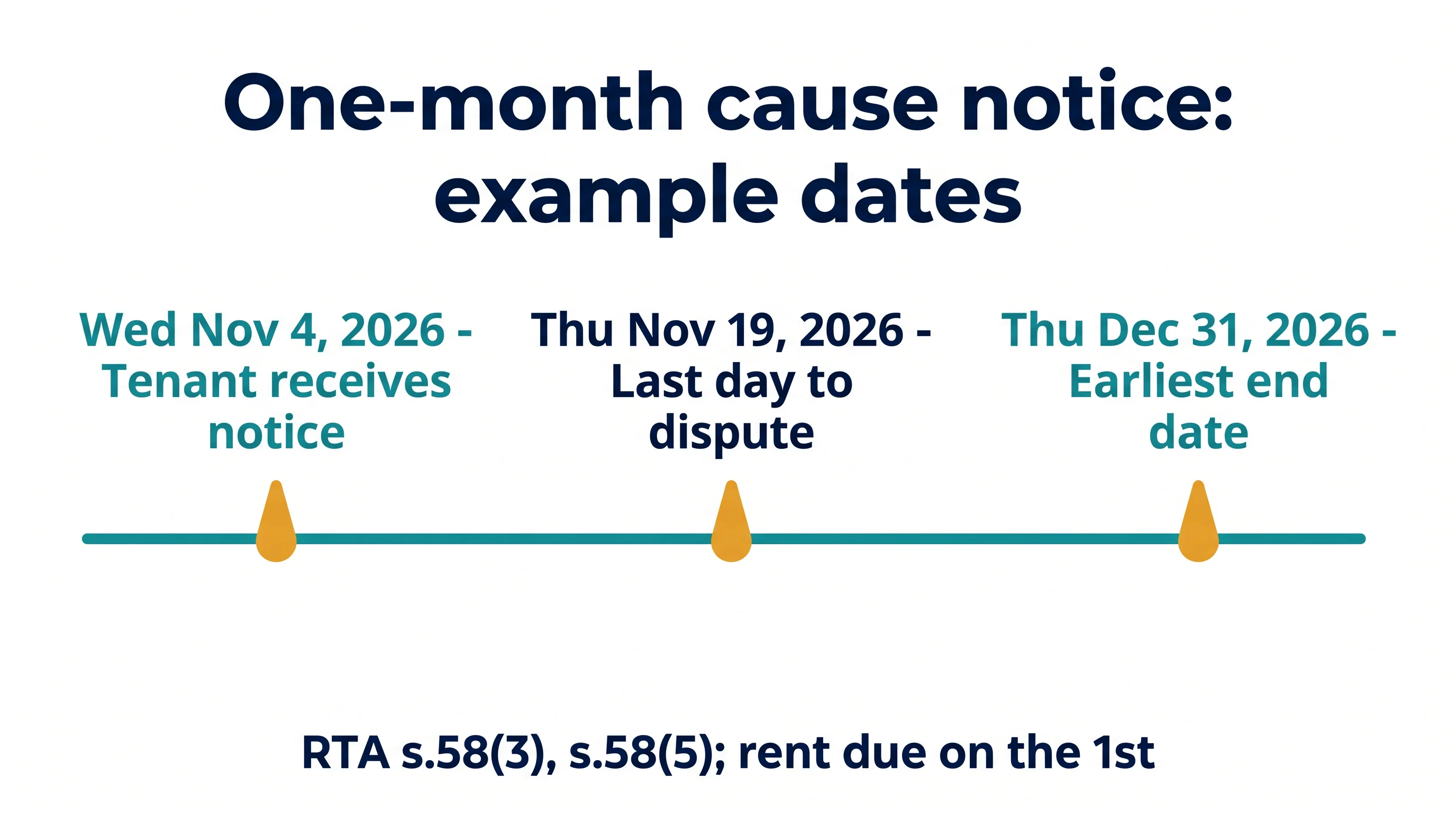
Where the problem can be fixed, you must first give the tenant a reasonable period to remedy it; the smoking ground is the only exception (s.58(2)). The notice must end on a date at least one month after the tenant receives it and the day before a rent day (s.58(3)). Example: rent is due on the 1st and the tenant receives the notice on Wednesday, November 4, 2026. The earliest end date is Thursday, December 31, 2026, and the last day to dispute is Thursday, November 19, 2026.
How much notice is needed for a landlord's own use in Saskatchewan?
A Saskatchewan landlord who wants the unit for their own use must give two months' notice for an owner or family move-in or for demolition, renovation or conversion, and one month for a purchaser move-in or a housing-program purpose (s.60(3), (3.1)). These notices end periodic tenancies only, never a fixed term (s.60(2)).
- Owner occupies: an individual landlord holding at least a one-half interest, or a family corporation, whose owner or "close family member or friend" intends in good faith to live there (s.60(1), (4)–(5)). The term covers a spouse, children, parents, siblings, grandparents, aunts, uncles, nieces and nephews of the landlord or their spouse.
- Purchaser occupies: only after every condition of the sale is satisfied and the buyer asks in writing (s.60(6)).
- Specified uses: only once you have every permit and approval the work needs (s.60(7)).
After receiving a s.60 notice, the tenant may leave earlier on at least 10 days' written notice, paying rent only to their own end date (s.61). If the stated purpose is not carried out within a reasonable period, or the unit is not used for it for at least six months, the tenant can claim compensation for their losses (s.62). Re-renting the unit on other grounds is an offence, with a fine of up to $300 for an individual (s.79(4)–(5)).
What must a Saskatchewan notice to vacate include, and how is it served?
A Saskatchewan landlord's notice to vacate must be in writing, dated, identify the landlord, give the rental address, state the end date and the grounds, and be on the approved form (s.63). The ORT asks for legal names on every notice.
Serve a current tenant personally, or post the notice on the front door and also send it by ordinary mail or electronically (s.82(2)(a)). Email on its own does not serve a current tenant. Mail is deemed received on the third business day after mailing, and an electronic copy on the next business day, which moves your end date (s.82(4)–(5)). Compare how BC treats service.
What happens if the tenant disputes or ignores the notice?
A Saskatchewan tenant has 15 days after receiving a s.58, 59 or 60 notice to dispute it by written notice to the landlord; if they do not, they are deemed to accept the end date and must move out by then (ss.58(5)–(6), 59(5)–(6), 60(9)–(10)). If they dispute it, you may apply to the ORT for an order ending the tenancy, and you carry the burden of proof (s.67(1)–(2)).
If the tenant stays past the end date, apply for an order of possession through the ORT online portal; a copy of the notice and your evidence form part of the application. For serious misconduct, s.68 lets you apply for possession without any notice, but it needs strong evidence that waiting a month would be unreasonable. More guides are in the Canadian Landlord Resource Center.
Frequently asked questions
Can a Saskatchewan landlord end a fixed-term lease early with notice?
Not for the landlord's own use: s.60 notices apply only to periodic tenancies. Cause, employment and unpaid-rent notices can end either type. A fixed term otherwise ends on its date unless a new agreement is made (s.55(2)).
Is "Form 8" still the right notice?
Form 8 is the old number. In the ORT portal it is "Evictions Requiring Notice of One Calendar Month". The old numbers 7, 8 and 8a to 8e still appear on the ORT's own table beside the portal names.
What if I put the wrong end date on the notice?
The notice is not void. An end date that is too early, or not the day before a rent day, is deemed changed to the earliest date that complies (s.64). Count again from the day the tenant actually received it.
Does a Saskatchewan landlord have to pay a tenant to move for their own use?
No set payment is required. The tenant may leave early on 10 days' written notice and pay prorated rent (s.61), and can claim losses if you do not use the unit for the stated purpose (s.62).
Before you serve
Pick the notice that matches your ground, count the period from the day the tenant will receive it, end it on the day before a rent day and keep proof of service. Most disputes over notices to vacate in Saskatchewan come down to those four steps.
Saskatchewan Landlord Notice to Vacate Checklist
Get Free PDF →Get your rental paperwork right
Browse free landlord and tenant resources.
Free • No signup required