In Saskatchewan, a landlord must give a periodic tenant at least 12 months' written notice of a rent increase, and the new rent cannot start until 18 months after the tenancy began and 12 months after the last increase (The Residential Tenancies Act, 2006, s.54). Members of two prescribed landlord associations use 6 months' notice instead. There is no cap on the amount.
At a glance
- Notice: at least 12 months, in writing, for a periodic (month-to-month or week-to-week) tenancy (s.54(1)(a)).
- First increase: not earlier than 18 months after the tenancy started (s.54(2)(a)(i)).
- Later increases: at least 12 months after the previous increase took effect (s.54(2)(a)(ii)).
- Association members: 6 months' notice, 12 months from the start, 6 months between increases (s.54(1)(b), (2)(b); Regs s.8.1).
- Fixed-term leases: no increase during the term unless the amount and timing were agreed when it was signed (s.53.1).
- Amount: the Act sets no limit.
This guide is for Saskatchewan landlords planning an increase and for tenants checking a notice they have received. It covers how much notice is needed, when the first increase can start, the shorter rule for association members, fixed-term leases and what happens when a notice gets the dates wrong. Every rule below comes from The Residential Tenancies Act, 2006 (the Act), The Residential Tenancies Regulations, 2007 (the Regs) and the Office of Residential Tenancies (ORT, formerly the Rentalsman) page on rent increases.
Saskatchewan Rent Increase Checklist
Get Free PDF →How much notice does a Saskatchewan landlord need to raise the rent?
A Saskatchewan landlord needs to give at least 12 months' written notice before a rent increase takes effect in a periodic tenancy (s.54(1)(a)). It applies to month-to-month and week-to-week tenancies alike.
The notice is made on the ORT's approved Notice of Rent Increase (formerly Form 5), which the ORT says is available through its online portal. The Standard Conditions that form part of every Saskatchewan tenancy agreement repeat the rule in plain words: a landlord who is not a member of a prescribed association must give one year's advance written notice and may not raise the rent more than once each year (Regs, Schedule 1, s.5(1)).
Notice is counted from when the tenant is served. A current tenant is served in person, or by posting the notice on the front door of the unit and sending it by ordinary mail or electronically (s.82(2)(a)). Mail is deemed served on the third business day after mailing, and an electronic copy on the next business day (s.82(4)-(5)). Email on its own does not serve a current tenant.
When can rent go up for the first time in Saskatchewan?
In Saskatchewan, the first rent increase in a periodic tenancy cannot take effect until at least 18 months after the date the tenancy began (s.54(2)(a)(i)). After that, each increase must take effect at least 12 months after the previous one (s.54(2)(a)(ii)). The effective date must satisfy whichever of the two is later.
The ORT's rent increase page puts it the same way: the increase "may not begin within the first 18 months of the tenancy start date, and the rent may only be increased once every 12 months."
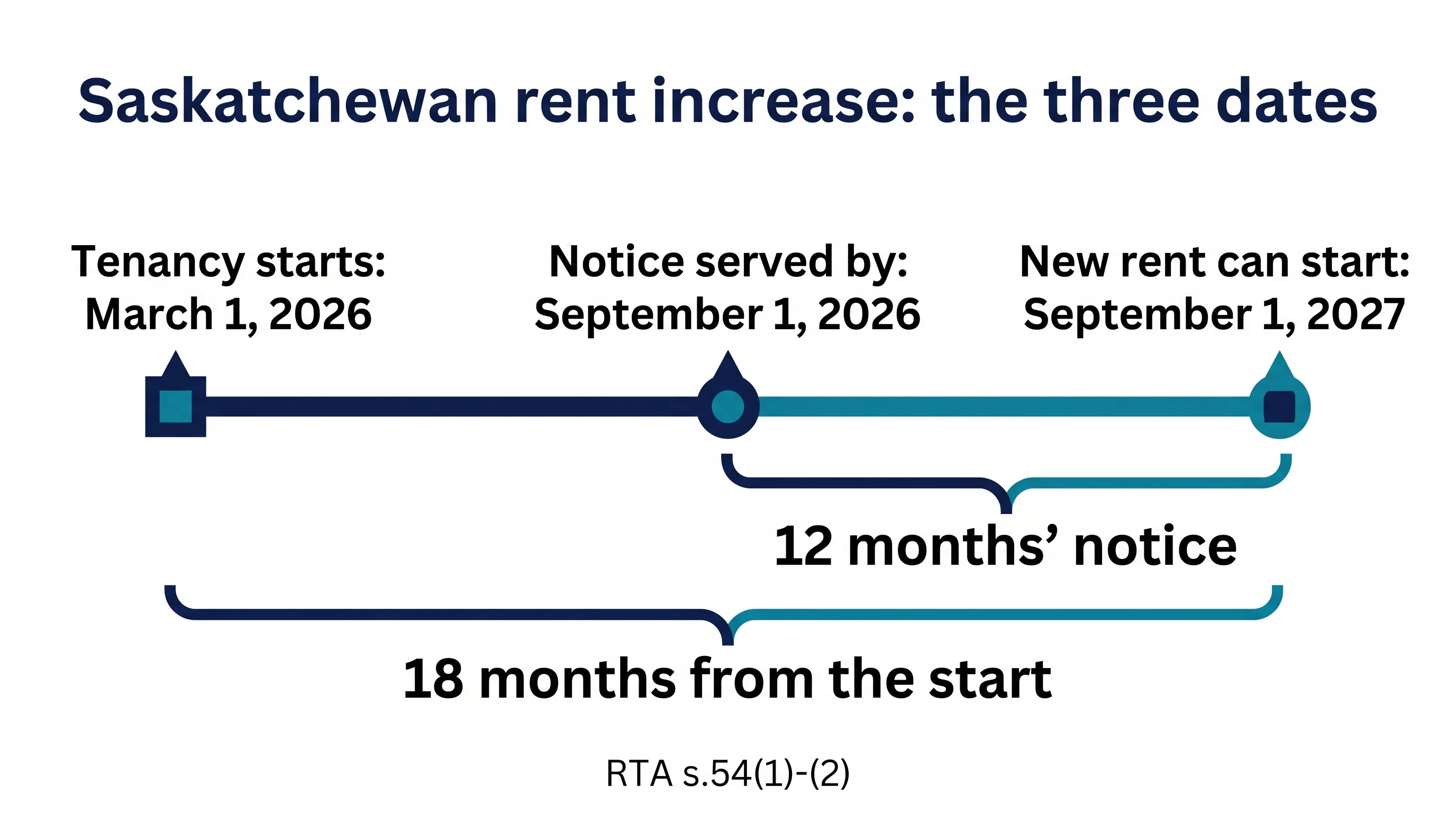
The 18-month wait and the 12-month notice run together, not one after the other. A landlord can serve the notice six months into the tenancy, as long as the effective date it names is at least 18 months after the start and at least 12 months after the notice is served.
A worked example
- The tenancy: a month-to-month tenancy in Regina began on March 1, 2026, with rent due on the 1st. There has been no increase yet.
- The 18-month floor: 18 months after March 1, 2026 is September 1, 2027.
- The 12-month notice: for a September 1, 2027 increase, the tenant must be served by September 1, 2026. If the landlord misses that and serves on October 15, 2026, the earliest valid date becomes October 15, 2027.
- The next increase: if the new rent starts on September 1, 2027, the following one cannot start before September 1, 2028, again with 12 months' notice.
What is the 6-month rule for landlord association members?
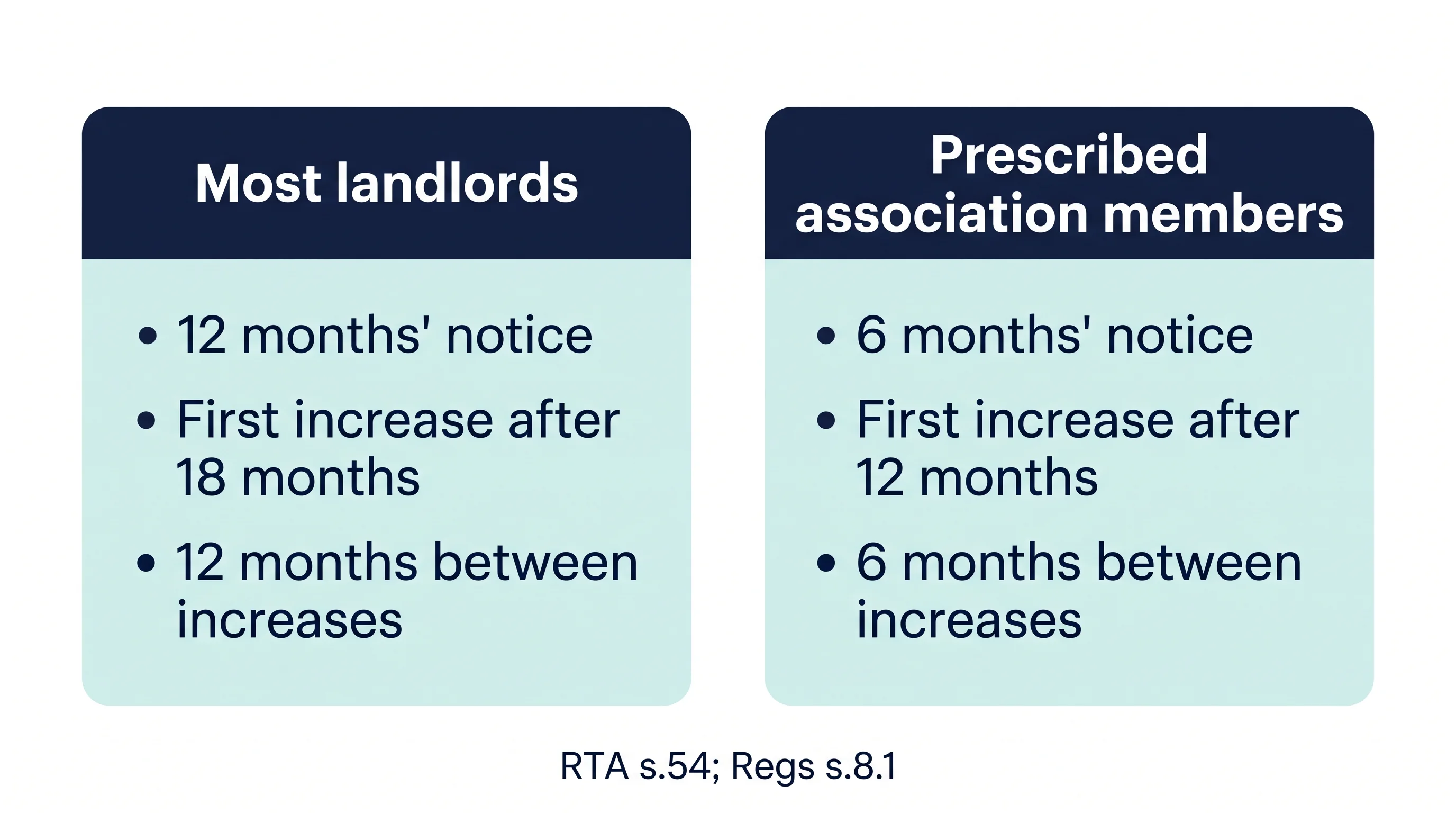
A Saskatchewan landlord who is a member in good standing of a prescribed landlord association can give 6 months' written notice instead of 12 (s.54(1)(b)). For these landlords the first increase can take effect 12 months after the tenancy began, and later increases 6 months after the previous one (s.54(2)(b)).
Only two associations are prescribed: the Saskatchewan Landlord Association Inc. and the Network of Non-Profit Housing Providers of Saskatchewan Incorporated (Regs s.8.1(1)). They use a separate approved form, the Notice of Rent Increase for Prescribed Landlord Association Members. The Standard Conditions describe the result as no more than two increases each year (Schedule 1, s.5(2)).
Membership has to last. If a member gives a 6-month notice and stops being a member in good standing during those six months, the 12-month rule applies, the notice takes effect 12 months after its date, and the landlord must tell the tenant the new effective date in writing (Regs s.8.1(2)).
| Rule | Most landlords | Prescribed association members | Source |
|---|---|---|---|
| Written notice before the increase | At least 12 months | At least 6 months | s.54(1) |
| Earliest first increase | 18 months after the start | 12 months after the start | s.54(2) |
| Gap between increases | 12 months | 6 months | s.54(2) |
| Approved form | Notice of Rent Increase | Notice of Rent Increase for Prescribed Landlord Association Members | ORT forms |
Is there a limit on how much rent can increase in Saskatchewan?
No. Saskatchewan's Act sets no percentage or dollar limit on a rent increase; Part IV controls only the notice and the timing (ss.52-54). A landlord who follows the notice and timing rules can set the new rent at any amount, and a tenant who does not accept it can end a periodic tenancy with their own notice (s.56).
That is a different system from Ontario and British Columbia, which set a yearly limit for most units. Alberta, like Saskatchewan, has no cap but shorter notice. A bill proposing rent control, Bill 608, The Rent Control Act, 2025, was introduced in the Legislative Assembly as a private member's bill and read a first time on November 24, 2025. The Assembly's Progress of Bills (October 5, 2026) records no later stage. It is not law.
| Province | Limit on the amount | Notice, monthly tenancy |
|---|---|---|
| Saskatchewan | None | 12 months (6 for association members) |
| Alberta | None | 3 tenancy months |
| Ontario | Yearly guideline for most units | At least 90 days |
| British Columbia | Yearly limit | At least 3 months |
For the details elsewhere, see Alberta's rent increase rules, the Ontario N1 guide and BC's 2027 rent increase limit.
Can rent go up during a fixed-term lease in Saskatchewan?
Only if the lease already said so. A Saskatchewan landlord cannot raise the rent during a fixed term unless the amount of the increase and when it starts were agreed at the time the fixed-term tenancy was entered into (s.53.1(1)). The amount can be written as dollars or as a percentage (s.53.1(2)).
A new rent for the next term is handled differently. At least two months before a fixed term ends, the landlord serves the approved Term Lease - Two Month Notice of Intention, saying whether a new agreement is offered and on what terms (Regs s.8.2(1)-(2)). The tenant accepts in writing within one month of being served (Regs s.8.2(3)); the ORT page says 30 days, so answer within 30 days to be safe. A tenant who does not answer is treated as rejecting the offer (Regs s.8.2(1)(d)).
What happens if a rent increase notice has the wrong date?
A Saskatchewan rent increase notice that does not comply with s.54 is not thrown out; it takes effect on the earliest date that does comply (s.54(4)). If a landlord names a date too early, the increase simply starts later.
A landlord who collects the higher rent before that date has increased rent contrary to the Act. On a tenant's application, an ORT hearing officer can make any order and award any compensation that is just and equitable (s.54(5)). Applications cost $50 and are made through the ORT portal.
What does not count as a rent increase?
Three things sit outside the 12-month rule in Saskatchewan:
- Extra occupants: a higher rent for additional occupants is not a "rent increase" if the tenancy agreement authorizes it under s.19(1)(g)(iv) (s.52).
- Income-based housing programs: rent geared to a tenant's income in a housing program can rise as income rises (s.54(6)).
- Mobile home sites: the same 12-month and 18-month rules apply through Regs s.9.
Services are protected separately. A landlord cannot start charging for a service or facility that was free, raise its charge, or end or restrict it, unless the tenant agrees or the ORT orders it (s.43). Parking, laundry or utilities included in rent cannot be turned into a back-door increase.
Frequently asked questions
How often can a landlord raise the rent in Saskatchewan?
Once every 12 months for most landlords, with the first increase no earlier than 18 months after the tenancy began (s.54(2)(a)). Members of the two prescribed landlord associations can raise it every 6 months, starting 12 months after the tenancy began (s.54(2)(b)).
Can my landlord give me 3 months' notice of a rent increase?
Not in Saskatchewan. The minimum is 12 months, or 6 months for a member in good standing of a prescribed association (s.54(1)). A notice with too short a period takes effect on the earliest date that complies (s.54(4)).
Does a rent increase notice have to be in writing?
Yes. Section 54(1) requires written notice, and the ORT provides approved forms for it. It must be served by a method the Act allows, such as personal service or door posting plus ordinary mail or an electronic copy (s.82(2)(a)).
Can I refuse a rent increase in Saskatchewan?
A tenant cannot block a properly served increase, because the Act sets no limit on the amount. A periodic tenant who does not want to pay it can end the tenancy with at least one month's written notice, effective the day before a rent day (s.56(1)).
Is Bill 608 rent control in force?
No. Bill 608, The Rent Control Act, 2025, is a private member's bill. Until a bill passes and comes into force, the Act's notice and timing rules are the only limits on rent increases.
Saskatchewan gives landlords freedom on the amount and asks for patience on the timing. Plan the date first, serve the approved notice by a method the Act allows, and keep proof of when it was served. Tenants can check any notice against the three dates above. Landlord and tenant guides for other provinces are in the Canadian Landlord Resource Center and the Canadian Tenant Resource Center.
Saskatchewan Rent Increase Checklist
Get Free PDF →Get your rental paperwork right
Browse free landlord and tenant resources.
Free • No signup required