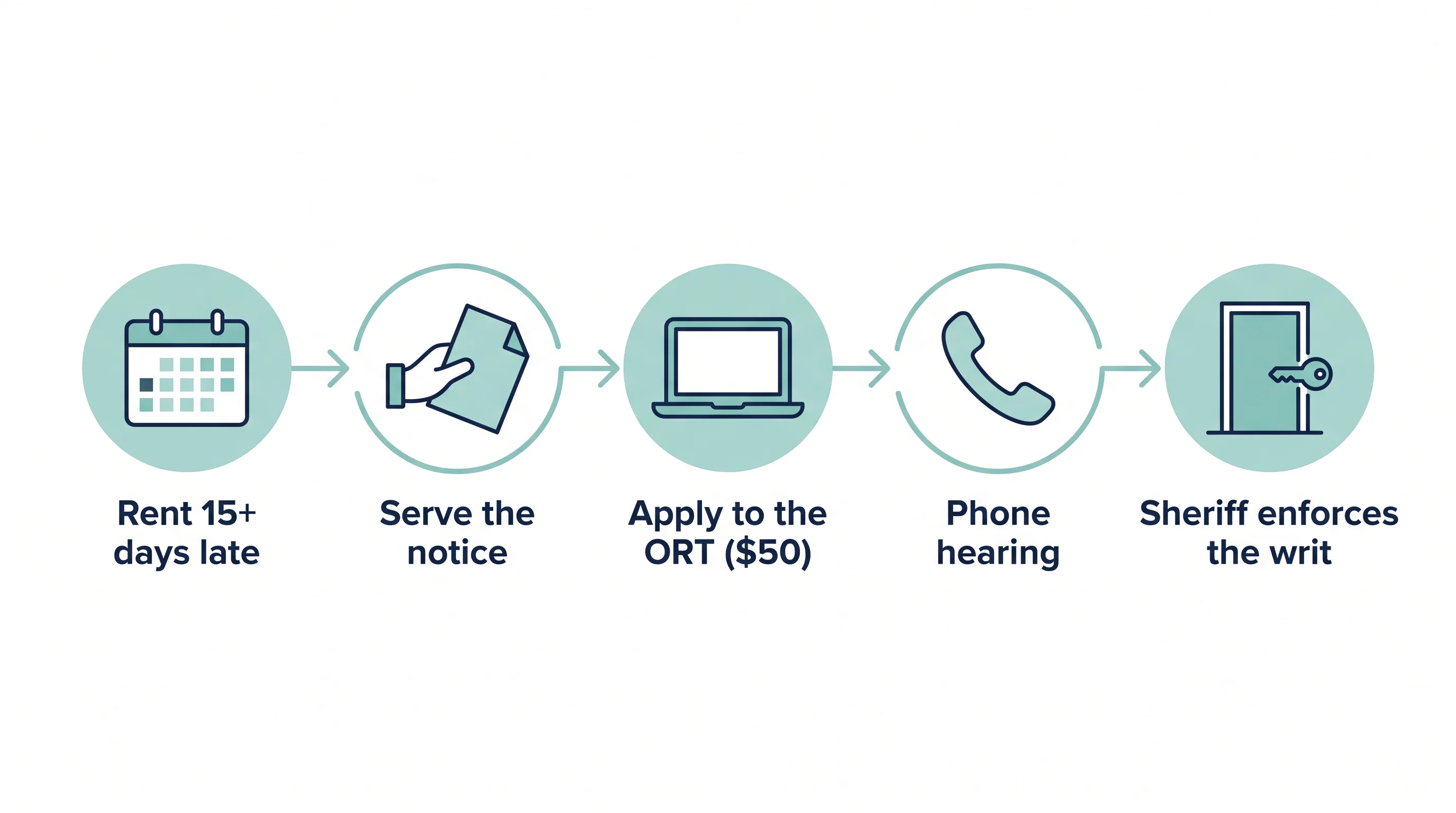
Here is how to evict a tenant in Saskatchewan for unpaid rent: wait until rent has been unpaid for more than 15 days, serve the Immediate Notice to Vacate and Notice of Arrears (s.57(1)), and, if the tenant stays, apply to the Office of Residential Tenancies (ORT) for an order of possession. Only a sheriff enforcing a writ of possession can remove the tenant (s.65).
At a glance: a Saskatchewan unpaid-rent eviction
- When: rent unpaid 15 days or more after the due date (s.57(1)); serve on the 16th day after the due date or later to be safe.
- Notice: the approved Immediate Notice to Vacate and Notice of Arrears (formerly Form 7), served on every tenant (s.63, s.82(2)(a)).
- Application: an ORT possession application in the online portal, with a $50 non-refundable fee (Regs s.13(1)(a); s.70(2.01)).
- Hearing: by phone; the decision is written and sent afterwards.
- Removal: only by a sheriff under a writ of possession, which expires 30 days after it is ordered unless the hearing officer sets another date (Regs s.10(2)).
This step-by-step guide is for Saskatchewan landlords whose tenant has stopped paying. It follows The Residential Tenancies Act, 2006, The Residential Tenancies Regulations, 2007 and the ORT's Rules of Procedure, as read on October 26, 2026. The ORT is the office many people still call the Rentalsman. Every eviction runs through it: a landlord cannot change the locks, remove belongings or cut off services to force a tenant out.
Saskatchewan Unpaid-Rent Eviction: Landlord Checklist
Get Free PDF →When can a Saskatchewan landlord give notice for unpaid rent?
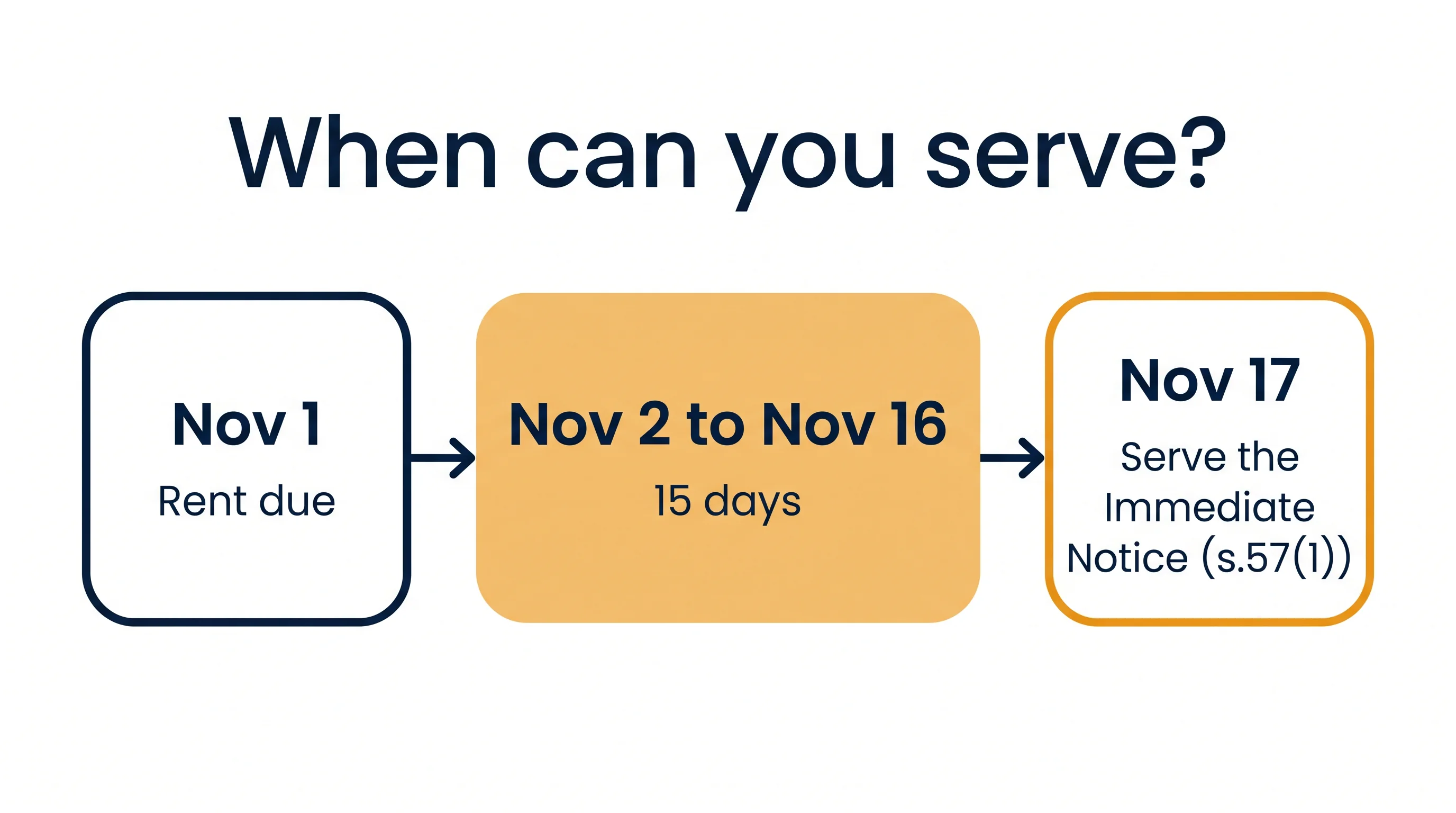
A Saskatchewan landlord can end a tenancy immediately once rent has been unpaid for a period of 15 days or more after the day it is due (s.57(1)). The Standard Conditions in Schedule 1 of the Regulations word it as "more than 15 days" (Sch.1 s.17(1)), so the safe practice is to serve on the 16th day after the due date or later.
| Rent due | 15 days after the due date end | Serve the notice on or after |
|---|---|---|
| November 1 | November 16 | November 17 |
| December 1 | December 16 | December 17 |
| January 15 | January 30 | January 31 |
Two exceptions are worth checking first. The notice has no effect if the unpaid amount is one the Act allows the tenant to deduct from rent (s.57(3)), for example a deposit overpayment (s.25(2)). And if the tenancy agreement makes the tenant pay utilities, unpaid utility charges can be treated as rent once they are unpaid 15 days or more after you give the tenant a written demand (s.57(5)); the ORT portal's Notice of Utility Arrears (formerly Form 7a) is that demand.
How do you fill in and serve the Immediate Notice to Vacate?
In Saskatchewan the notice must be in writing, dated, identify you as the landlord, give the rental address, state the grounds and be on the approved form (s.63). The approved form is the Immediate Notice to Vacate and Notice of Arrears, created in the ORT online portal or downloaded from Publications Saskatchewan. It asks for:
- the rental unit address and every tenant's legal name;
- the day of the month rent is due;
- the rent more than 15 days in arrears on the date you send the notice;
- the monthly rent under the agreement; and
- your legal name, mailing address, email and signature.
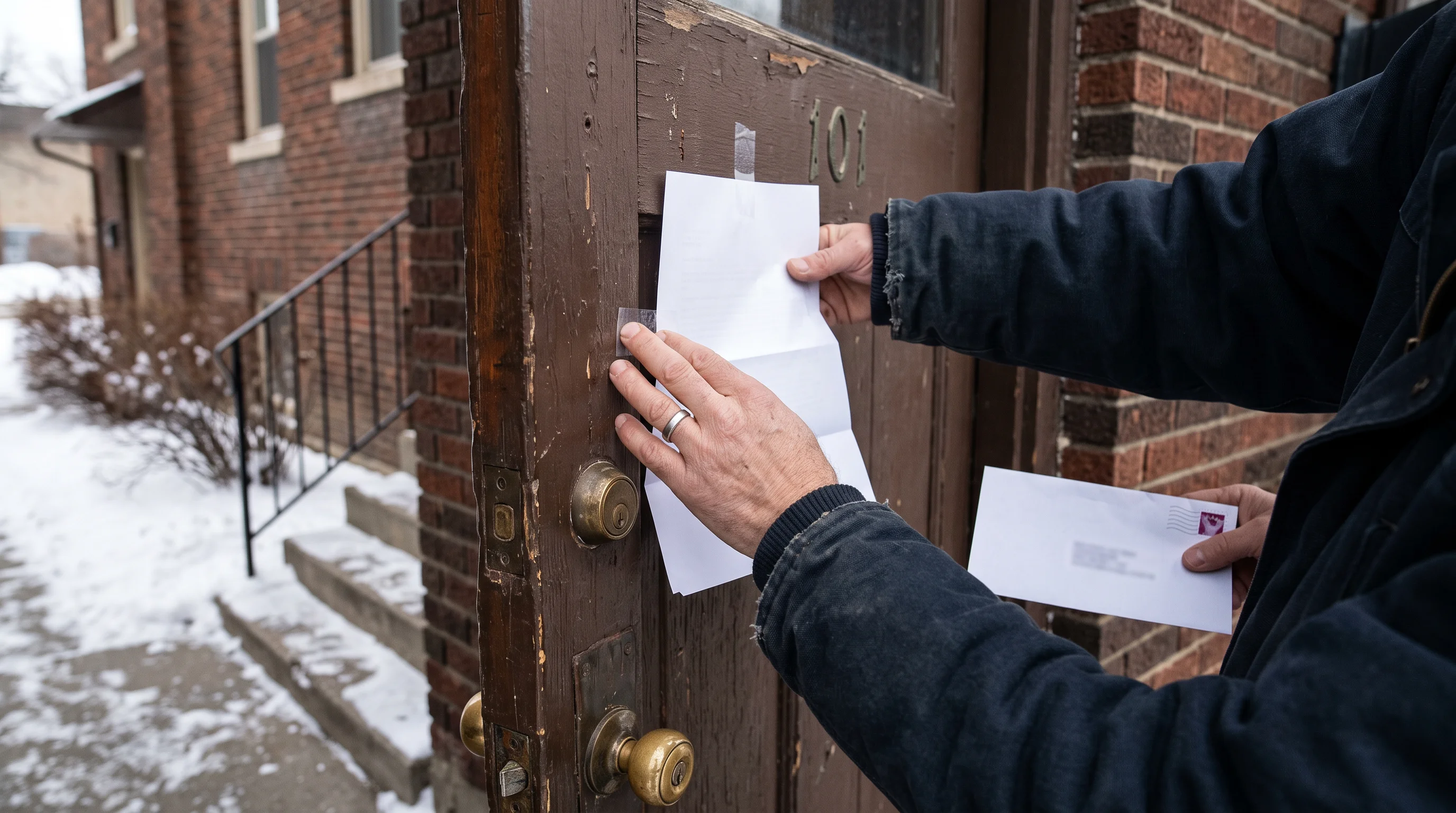
Serve it the way s.82(2)(a) requires for a current tenant: hand it to the tenant personally, or post it on the front door of the unit and send it by ordinary mail or electronically. Email on its own does not serve a current tenant. A mailed copy is deemed served on the third business day after mailing and an electronic copy on the next business day (s.82(4)-(5)). Serve each tenant named on the agreement.
What happens if the tenant does not move out?
If the tenant stays after a valid immediate notice, the landlord applies to the ORT for an order of possession (s.57(4)). The ORT's Rules of Procedure (Part 2) list what the application must include:
- the landlord application completed in the online portal, signed in with a Saskatchewan Account;
- a true copy of the Immediate Notice to Vacate and Notice of Arrears, exactly as it was served;
- a Certificate of Service explaining how the notice was served, one for each tenant served personally or electronically;
- the $50 filing fee, or an approved fee waiver certificate;
- a copy of the written tenancy agreement, if there is one; and
- a copy of the rent ledger.
The arrears stated on the notice, and the filing fee, can be claimed at the possession hearing without a separate monetary claim (ROP Part 2). Rent that falls due after the notice, or damage, is claimed with a Landlord Monetary Claim, up to the $30,000 limit (Regs s.11) and within one year (s.71.1).
How does the ORT possession hearing work?
A possession application is an urgent application, and ORT hearings are held by phone unless a hearing officer grants an in-person hearing (ROP Parts 3 and 5). Once the ORT schedules it, it sends you a hearing notice, usually by email, which you must serve on the tenant in the same way as the notice, at least two days before an urgent hearing (ROP Part 4). Then:
- complete a Certificate of Service for the hearing notice and upload the served notice;
- upload your evidence and serve it on the tenant as well, because uploading is not service;
- give the ORT the phone number to call at least two business days before the hearing; and
- expect the decision in writing afterwards; it is never given at the hearing (ROP Part 6).
The tenant can ask for relief at the hearing, for example if the notice followed a good-faith complaint to a health or housing authority, or if the rent owing comes from an increase made to end the tenancy (s.70(11)). Accepting arrears after the notice does not cancel it unless you agree in writing (s.60.1), so put any payment arrangement in writing.
Who removes the tenant in Saskatchewan?
Only a sheriff can remove a tenant in Saskatchewan, by enforcing a writ of possession ordered by the hearing officer (s.65; s.70(13)). The writ is directed to the sheriff at the judicial centre nearest the rental unit and expires 30 days after it is ordered, unless the hearing officer sets another date (Regs s.10). The writ form tells landlords to deliver it to the sheriff at least 5 business days before it expires (Regs, Form A).
A tenant can appeal to the Court of King's Bench within 30 days on a question of law or jurisdiction (s.72(1)), and filing the notice of appeal stays the writ (s.78(1)). To appeal a writ based on unpaid rent, the tenant must first pay one month's rent to the ORT and file the Certificate of Payment of Rent (s.72(1.3); Regs s.10.1).
How does Saskatchewan compare with Alberta, BC and Ontario?
Saskatchewan's notice ends the tenancy immediately and contains no pay-to-stay period, which is the main difference from neighbouring provinces.
| Province | Notice for unpaid rent | Does paying cancel it? |
|---|---|---|
| Saskatchewan | Immediate Notice to Vacate, after 15 days unpaid | The Act does not say so; the hearing officer decides |
| Alberta | 14-day notice | Yes, if all rent due is paid before the termination date |
| British Columbia | 10 Day Notice (RTB-30) | Yes, if paid within 5 days of receiving it |
| Ontario | N4 | Yes, if the arrears are paid before the termination date |
For the details, see Alberta's 14-day notice for unpaid rent, BC's 10 Day Notice for unpaid rent and the Ontario N4 notice. More landlord topics are in the Canadian Landlord Resource Center.
Frequently asked questions
How long does an eviction for unpaid rent take in Saskatchewan?
The Act sets no total time. The notice can be served once rent is more than 15 days late, possession applications are scheduled as urgent, and the hearing notice must reach the tenant at least two days before the hearing. After the order, the writ is usually valid for 30 days.
Can I change the locks after serving the immediate notice?
No. A landlord regains possession only if the tenant leaves or abandons the unit, or through an order of possession and a writ directed to a sheriff (s.65). A hearing officer can award punitive damages to a tenant locked out without justification (s.66(4)).
Do I need a separate application to recover the rent?
Not for the arrears shown on the notice: they and the filing fee can be claimed at the possession hearing (ROP Part 2). Rent that came due later, and damage, need a Landlord Monetary Claim.
Can I email the notice to the tenant?
Only as the second half of door posting. A current tenant is served personally, or by posting on the front door plus ordinary mail or an electronic copy (s.82(2)(a)).
Can I charge a late fee before evicting?
The Act and Regulations do not mention late-payment or NSF fees, and they set no dollar amount. Any fee would have to be in the written agreement, and a term that is inconsistent with the Act, unconscionable or unclear is not enforceable (s.7(2)). Disputes about it go to the ORT.
An unpaid-rent eviction in Saskatchewan is short on paper: wait out the 15 days, serve the approved notice correctly, apply with the right documents and let the sheriff enforce the writ. Most delays come from a notice served too early or served the wrong way, so check the date and the method before you start.
Saskatchewan Unpaid-Rent Eviction: Landlord Checklist
Get Free PDF →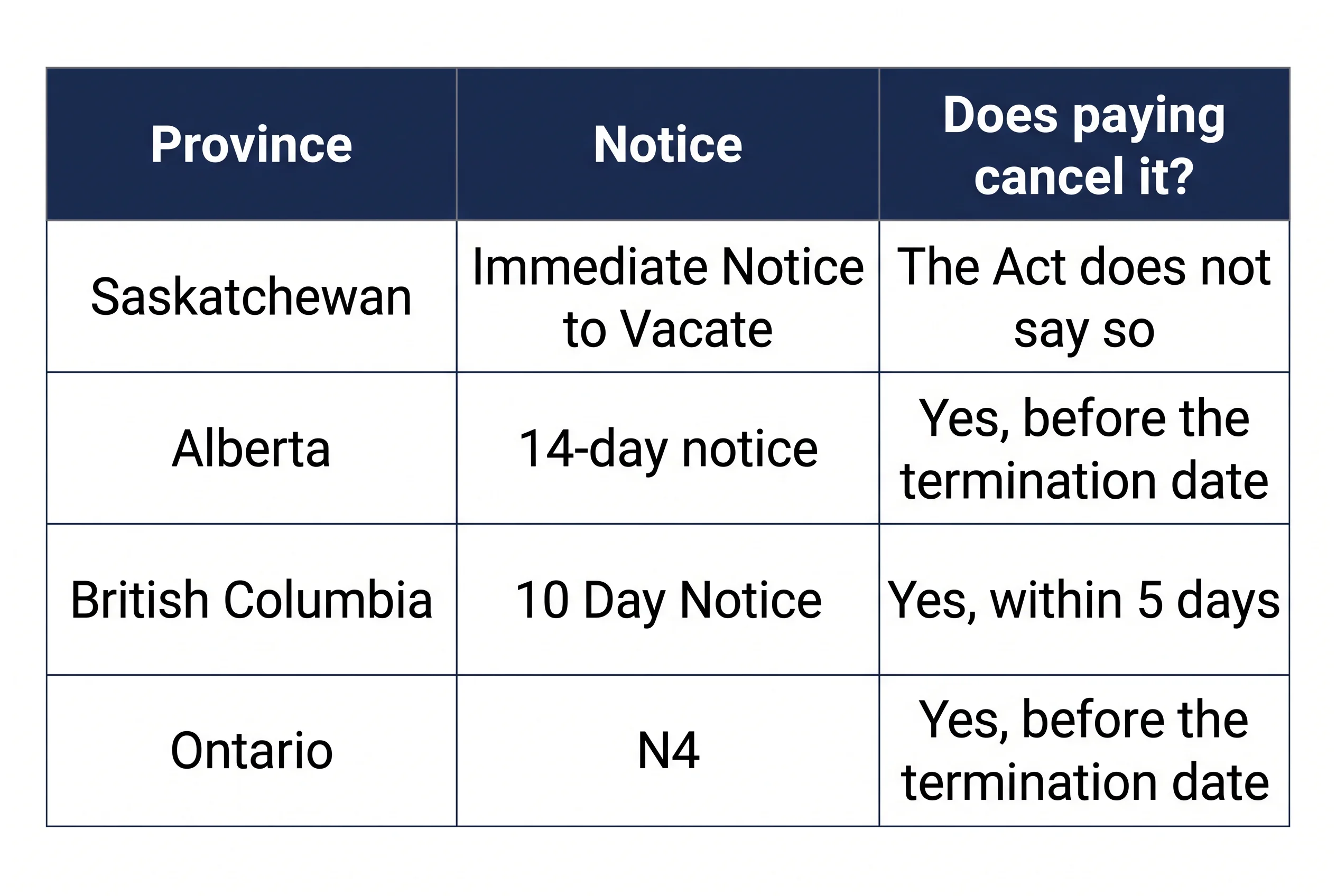
Get your rental paperwork right
Browse free landlord and tenant resources.
Free • No signup required