If you got an Immediate Notice to Vacate, Saskatchewan tenant law still protects you from being put out on the spot. Your landlord must apply to the Office of Residential Tenancies (ORT), win a hearing and have a sheriff enforce a writ of possession before you can be removed (s.65). Use that time to check the notice, talk to your landlord in writing and prepare for the hearing.
At a glance: what Saskatchewan tenants can do after an immediate notice
- You cannot be locked out: only a sheriff with a writ of possession can remove you (s.65). Anyone else trying it: the ORT says call the police.
- Check the notice: rent unpaid 15 days or more, the approved form, your legal name, the arrears, and how it was served (ss.57, 63, 82).
- Paying: the Act does not say paying cancels the notice; get any deal with your landlord in writing (s.60.1).
- The hearing: by phone; you can ask for relief, for example if the notice followed a complaint (s.70(11)).
- Appeal: to the Court of King's Bench within 30 days, with a Certificate of Payment of Rent (s.72).
This FAQ is for Saskatchewan renters who have received an Immediate Notice to Vacate and Notice of Arrears (the old Form 7) for unpaid rent. It explains what the notice does, what happens next and the choices you have at each step. It was checked against The Residential Tenancies Act, 2006, its Regulations, the ORT Rules of Procedure and the ORT's web pages on October 26, 2026. The ORT is the office many people still call the Rentalsman.
Immediate Notice to Vacate: Saskatchewan Renter Checklist
Get Free PDF →Do I have to leave right away after an immediate notice in Saskatchewan?
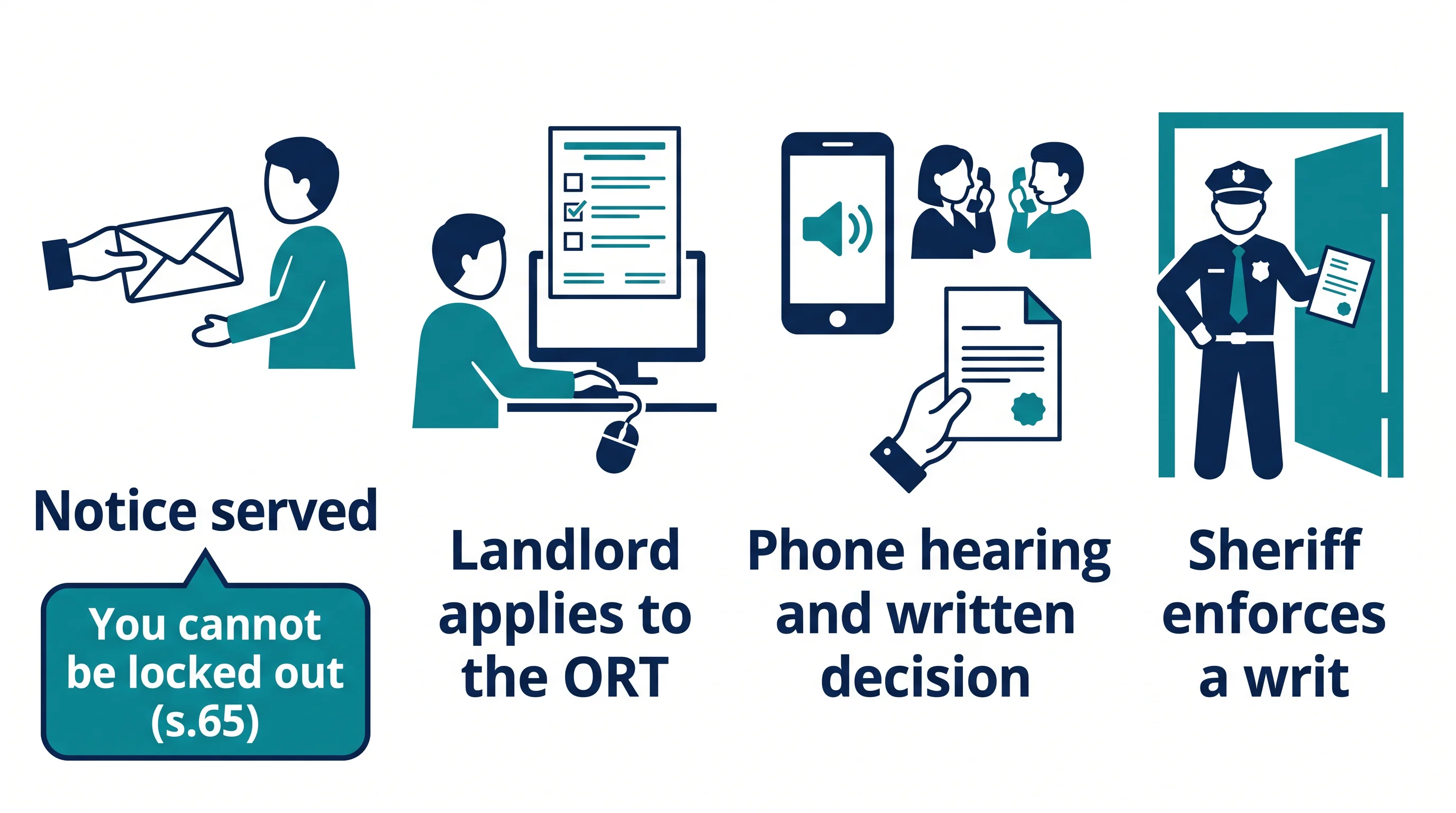
No one can make you leave a Saskatchewan rental on the strength of the notice alone. The notice tells you to give up possession immediately, but if you stay, the landlord's next step is to apply to the ORT for an order of possession (s.57(4)). A landlord can regain possession only if you move out or abandon the unit, or with an order of possession and a writ of possession directed to a sheriff (s.65).
- Your landlord must not seize your belongings or stop you reaching them (s.12).
- If a landlord locks you out without justification, you can apply to the ORT for possession, and a hearing officer may award punitive damages (s.66).
- The ORT's own guidance is that if any person other than a sheriff tries to remove a tenant, the tenant should call the police.
How do I check whether the notice is valid?

A Saskatchewan immediate notice is valid only if rent was unpaid for 15 days or more after its due date, it is on the approved form, and it was served the way the Act requires. Check these points:
| Check | What the law says |
|---|---|
| Timing | Rent unpaid 15 days or more after the day it was due (s.57(1)); the Standard Conditions say more than 15 days (Sch.1 s.17(1)). |
| Form and contents | In writing, dated, from the landlord, with the address and grounds, on the approved form (s.63). |
| The amount | The notice has no effect if the unpaid amount is one the Act lets you deduct from rent (s.57(3)). |
| Service | Handed to you, or posted on your front door plus ordinary mail or an electronic copy (s.82(2)(a)). Email alone is not enough. |
If something looks wrong, say so in writing to the landlord and raise it at the hearing. A hearing officer can still accept service if the notice came to your attention (s.82.1), so do not ignore a notice because of a technical point.
Will paying the rent stop the eviction in Saskatchewan?
Not automatically. Unlike Alberta's 14-day notice, BC's 10 Day Notice or Ontario's N4, Saskatchewan's Act contains no rule that paying after an immediate notice cancels it. If your landlord accepts money after the notice, that does not waive the notice or reinstate the tenancy unless you both agree otherwise in writing (s.60.1).
Paying still matters. It reduces what you owe, and a hearing officer can make any order they consider just and equitable in the circumstances (s.70(6)). If your landlord agrees to let you stay, ask for that in writing, signed and dated, before or when you pay. A tenant who is owed money by the landlord should not simply hold back rent: the Act requires rent to be paid when due unless the Act allows a deduction (s.42(1)).
For comparison, see what tenants should do after a BC 10 Day Notice and what to do with an N4 in Ontario.
What happens at the ORT hearing?
A possession hearing in Saskatchewan is usually held by phone, and you are entitled to take part and give your side. The landlord must serve you with the hearing notice, at least two days before an urgent hearing such as possession (ROP Part 4). Then:
- Use the link code served with the hearing notice to join the application in the ORT online portal and upload your evidence.
- Send your evidence to the landlord as well; uploading it is not service (ROP Part 4).
- Give the ORT the phone number to call at least two business days before the hearing, and do not block 1-800 numbers.
- Be ready for the call for most of the hearing day; hearings can start late (ROP Part 5).
If you do not take part, the hearing officer may proceed without you (s.73(4)). The decision is written and sent afterwards; it is never given at the hearing (ROP Part 6).
When can I ask for relief?
At a landlord's possession hearing you may ask the hearing officer for relief (s.70(11)) if:
- the notice was given because you made a good-faith complaint to the ORT or a government or municipal agency about health or safety, including housing standards;
- it was given because you tried to enforce your rights under the Act;
- the landlord has breached the tenancy agreement or a standard condition; or
- the unpaid rent comes from an increase the landlord made in order to end the tenancy, and relief is just and equitable.
Relief can include terms about paying the rent and an order to stop the landlord's breach (s.70(12)).
What can I do after the decision?
In Saskatchewan you have three routes after a possession order, each with its own deadline.
| Route | When | What it does |
|---|---|---|
| Request to correct or clarify | Within 15 days, $50 fee | Fixes obvious errors or unclear wording (s.76; ROP Part 7). |
| Rehearing | Ask the ORT in writing | Available if the order was made without hearing you or you did not get notice of the hearing (s.73(5)); it does not stop the landlord enforcing a writ (ROP Part 7). |
| Appeal | Within 30 days of the signed order | To the Court of King's Bench on a question of law or jurisdiction (s.72(1)); filing the notice of appeal stays the writ (s.78(1)). |
To appeal an order with a writ based on unpaid rent, you must file a Certificate of Payment of Rent with the court, which the ORT issues after you pay one month's rent, in the amount set out in the order, into the ORT (s.72(1.3); Regs s.10.1). A writ expires 30 days after it is ordered unless the hearing officer sets another date (Regs s.10(2)).
Frequently asked questions
Can my landlord change the locks after an immediate notice?
No. Possession is recovered only if you leave or abandon the unit, or through an ORT order and a sheriff enforcing a writ (s.65). A tenant locked out without justification can apply for possession, and punitive damages are possible (s.66).
Can I get the $50 fee waived?
ORT applications, including a request to correct or clarify, cost $50 unless a fee waiver certificate is approved under The Fee Waiver Act (s.70(2); ROP Part 2). The fee is for making an application (Regs s.13(1)); the Act sets no fee for responding to your landlord's.
What if I never received the hearing notice?
Contact the ORT straight away and ask in writing for a rehearing. A hearing officer may rehear an application where the order was made without hearing you or you did not receive notice (s.73(5)).
Is the Rentalsman the same as the ORT?
Yes. The Office of Residential Tenancies was formerly called the Rentalsman. It is reached at 1-888-215-2222 or through saskatchewan.ca/ort.
Do I still owe the rent if I move out?
Yes. The landlord can claim the arrears on the notice at the possession hearing, and other amounts through a monetary claim (ROP Part 2), up to $30,000 (Regs s.11).
An immediate notice is the start of a process, not the end of your tenancy. Check the notice, keep paying what you can with receipts, put any deal in writing and take part in the hearing. More renter resources are in the Canadian Tenant Resource Center, and the Alberta tenant guide shows how a neighbouring province handles the same questions.
Immediate Notice to Vacate: Saskatchewan Renter Checklist
Get Free PDF →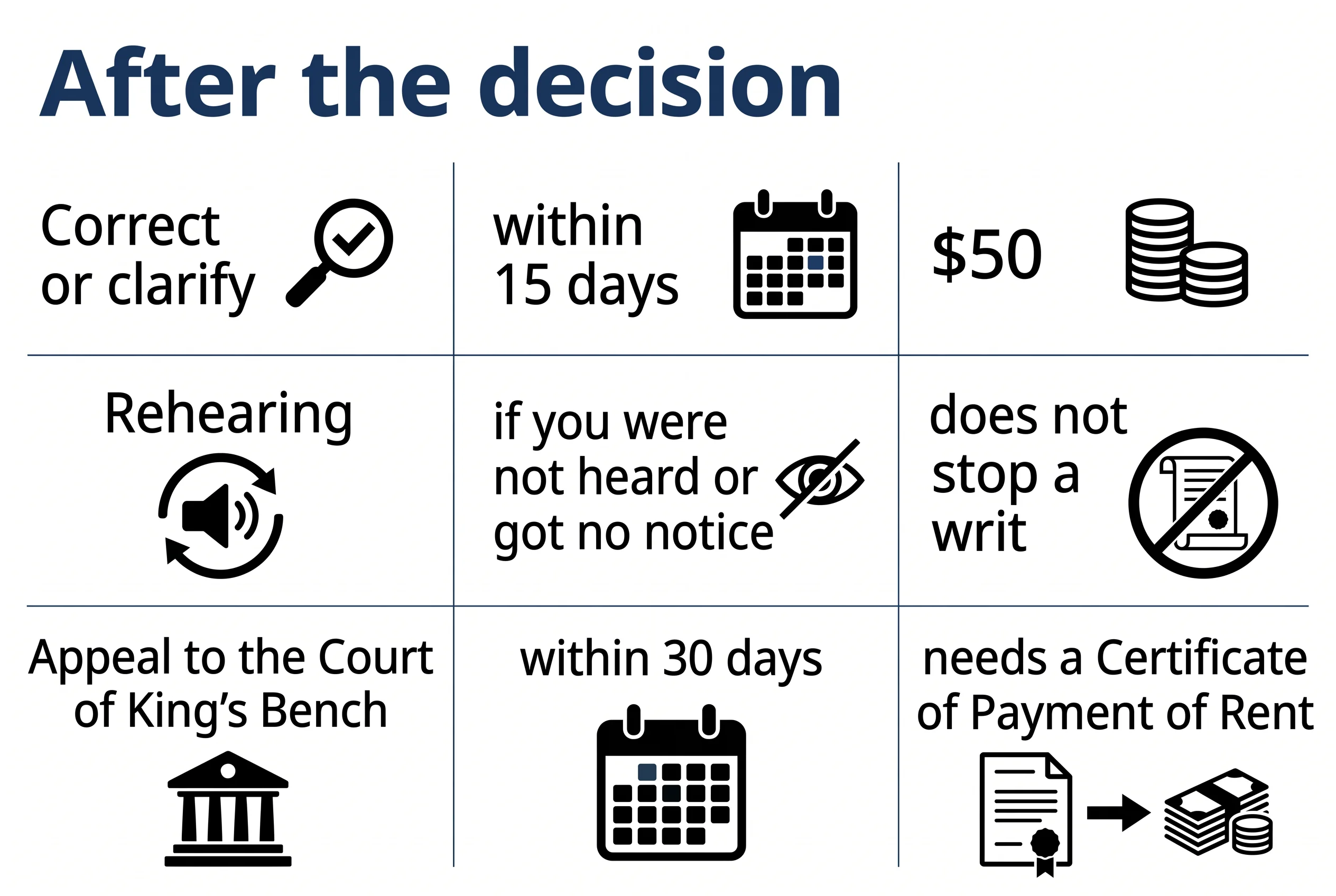
Know your next step
Browse free landlord and tenant resources.
Free • No signup required