

Renting in Alberta from Ontario or BC means trading a capped rent increase for no cap at all: Alberta sets no limit on how much rent can rise, though it limits how often and needs 3 tenancy months' notice. Deposits can be up to one month's rent, inspection reports are mandatory, and disputes go to the RTDRS or the court.
At a glance: what changes when you move to Alberta
- Rent increases: no limit on the amount; once every 365 days; none during a fixed term of a year or more.
- Deposit: up to one month's rent, held in trust, back within 10 days of move-out.
- Inspections: a written report at move-in and move-out, both required.
- Fixed-term leases: end on the end date with no notice from either side.
- Disputes: the Residential Tenancy Dispute Resolution Service (RTDRS) or the court, not a board or branch.
This guide is for renters who are moving to Calgary, Edmonton or anywhere else in Alberta after renting in Ontario or British Columbia. It compares the rules you know with the ones that will apply, section by section, so you can spot the differences before you sign. Every rule was checked against Alberta's Residential Tenancies Act (RTA) and the Ontario and BC statutes on October 24, 2026.
Moving to Alberta: Renter's Checklist
What changes when you rent in Alberta after Ontario or BC (rules as of October 24, 2026).
Get Free PDF →What is the biggest change for renters moving to Alberta?
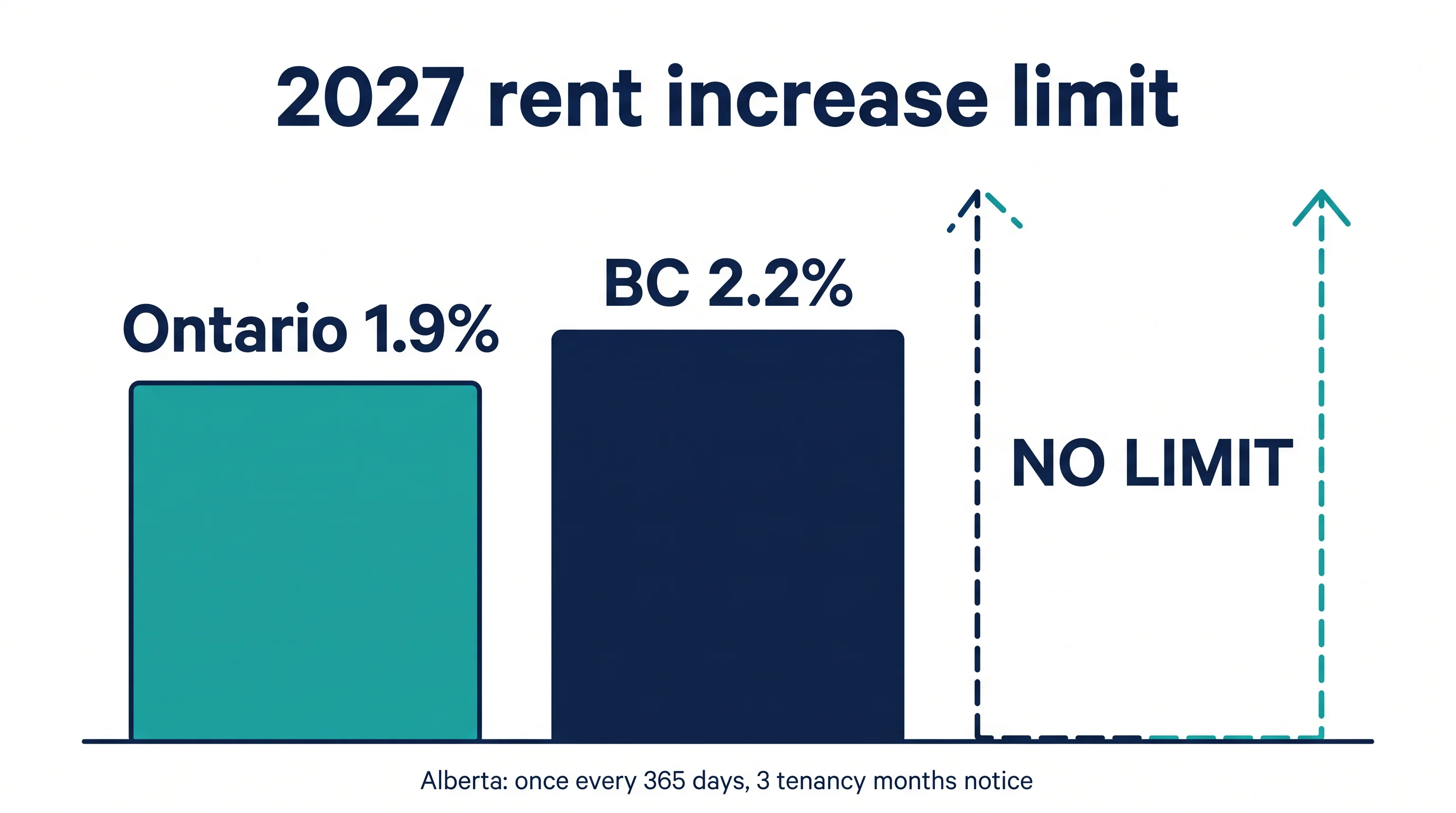
The biggest change is rent: Alberta has no rent increase limit, while Ontario's 2027 guideline is 1.9% and BC's 2027 limit is 2.2%. An Alberta landlord can raise rent by any amount, as long as the timing and notice rules are followed.
Those timing rules are strict. In a monthly tenancy, the landlord must give you written notice at least 3 tenancy months before the increase takes effect (RTA s.14(1)(b)), and rent can rise only once every 365 days from the start of the tenancy or the last increase (Residential Tenancies Ministerial Regulation, AR 211/2004 s.3(1)). During a fixed-term lease of one year or more, rent cannot go up at all (AR 211/2004 s.3(3)). A notice that does not meet these rules is void (RTA s.14(6)), and if you paid an increase that was not properly made, you can recover it (s.14(7)).
In practice, the price you agree to at signing is the number to negotiate, because nothing caps the next one. The Alberta rent increase rules guide works through the dates.
How are security deposits different in Alberta?
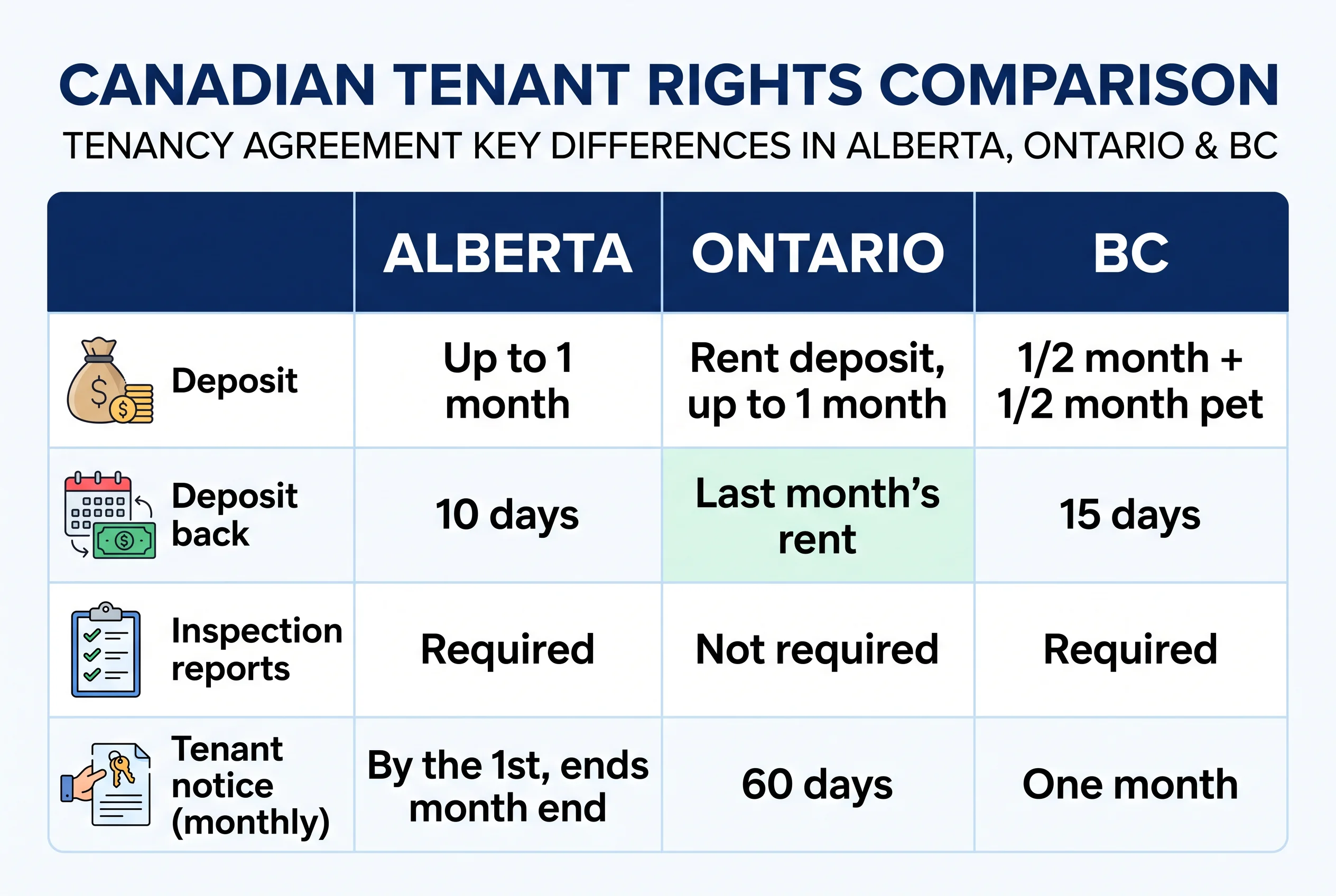
An Alberta landlord can ask for a security deposit of up to one month's rent (RTA s.43(1)), which is more than BC allows and different from Ontario's last-month's-rent deposit. The landlord cannot raise the deposit when rent goes up (s.43(2)).
| Deposit rule | Alberta | Ontario | British Columbia |
|---|---|---|---|
| What can be taken | A security deposit of up to one month's rent (s.43(1)) | A rent deposit only, up to one month, used for the last month (ss.105-106) | A security deposit and a pet damage deposit of up to half a month's rent each (s.19) |
| Where it is held | An interest-bearing trust account in Alberta within 2 banking days (s.44(1)) | Held by the landlord; interest paid yearly (s.106(6)) | Held by the landlord; interest under the regulation |
| When it comes back | Within 10 days after you give up possession (s.46(2)) | Applied to your last month's rent (s.106(10)) | Within 15 days, or double (s.38(1), (6)) |
Alberta deposits earn interest (s.45), and within 10 days after you move out the landlord must return the full deposit with interest, return the balance with a statement of account, or send an estimate and then a final statement within 30 days (s.46(2)). Nothing can be kept for normal wear and tear (s.46(5)). The Alberta security deposit guide covers the trust account and the return in detail.
Why do Alberta inspection reports matter so much?
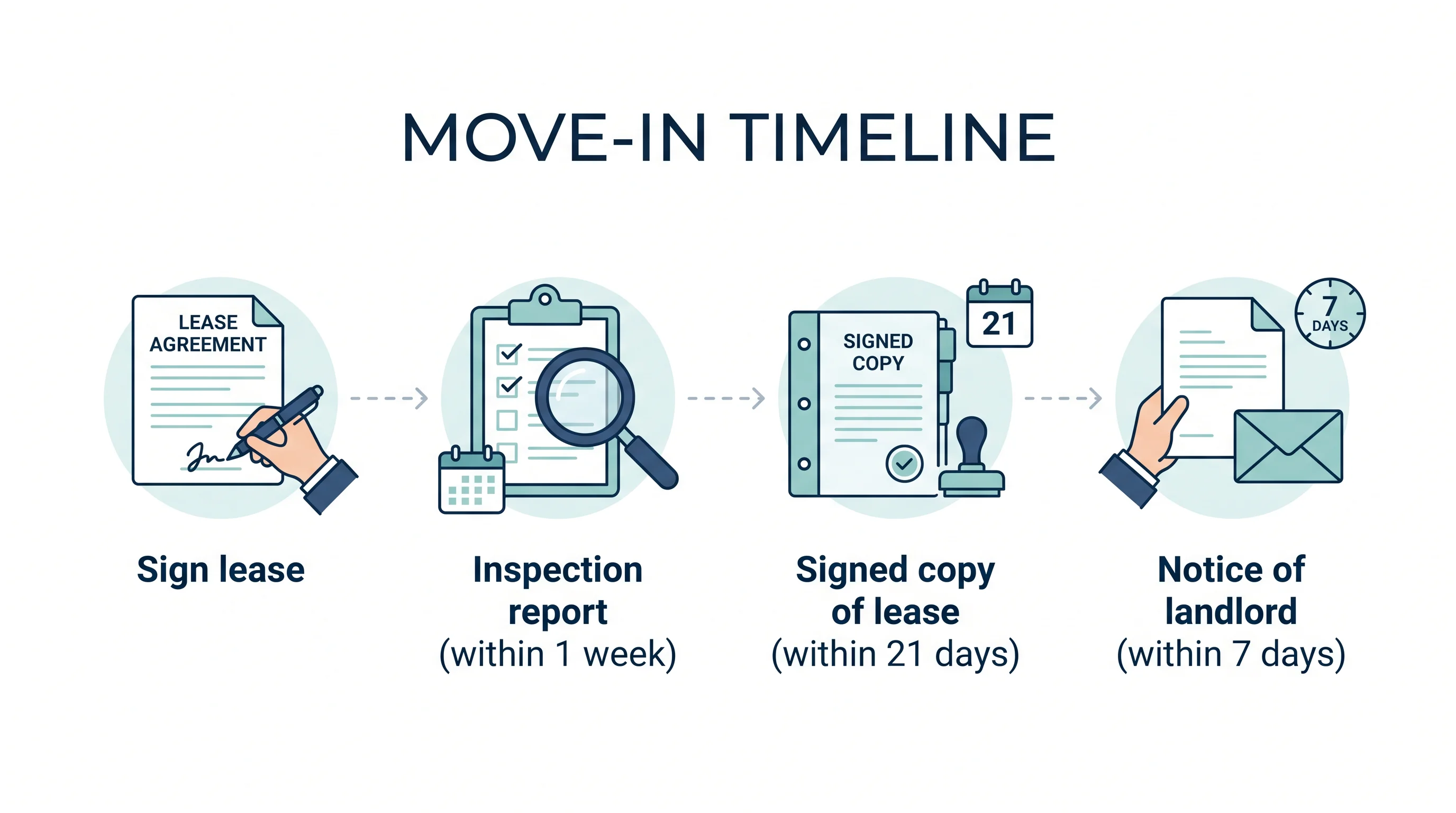
Alberta requires a written inspection report within one week before or after you move in and again within one week before or after you move out (RTA s.19(1)), and a landlord cannot deduct anything for damage unless both were done (s.46(6)). Ontario's Act does not require them, so this may be new to you if you are coming from Ontario.
The landlord may inspect without you if it proposes two inspection times on different days that are not holidays, between 8 a.m. and 8 p.m., and no adult tenant agrees to take part (s.19(3)). Go to both inspections, read the report before you sign it, note anything you disagree with, and take dated photos of every room. The landlord must give you a report of each inspection (s.19(1)-(2)). Our guide to move-in and move-out inspection reports in Alberta explains what the report must contain.
What paperwork should an Alberta landlord give you?
If you sign a written lease, the Alberta landlord must give you a copy signed by the landlord within 21 days after you return it (RTA s.17(1)), and you may withhold rent until you receive it (s.17(2)). Alberta publishes no standard lease, unlike Ontario's standard lease form, so read every clause.
Within 7 days after you take possession, the landlord must also give you a written, dated and signed "notice of landlord" naming a landlord and a postal address and physical location in Canada, or post it in a common area of the building (s.18(2)-(3)). Keep both documents: they tell you where to serve a notice later. See what must be in writing in an Alberta lease.
How do you end a tenancy in Alberta compared with Ontario or BC?
In an Alberta monthly tenancy, your written notice must be served on or before the first day of a tenancy month and ends the tenancy on the last day of that month (RTA s.8(1)(a)). Ontario needs at least 60 days (s.44(2)) and BC at least one month, ending the day before rent is due (s.45(1)).
Fixed-term leases work differently too. In Alberta, a fixed-term tenancy ends on its end date and no notice is needed from either side (s.15). In Ontario and BC, a fixed term that ends without a new agreement generally continues month to month (Ontario s.38(1); BC s.44(3)). If you stay on in Alberta after the term ends, a periodic tenancy may be implied, and it is monthly if the term was a month or more (Alberta s.13). Any notice must be in writing, signed, and identify the premises and the date it ends (s.10). Read ending a tenancy in Alberta for every notice period.
What else is different day to day?
An Alberta landlord who needs to enter must give at least 24 hours' written, signed notice with the reason and the date and time, and entry must be between 8 a.m. and 8 p.m. and not on a holiday or on your day of religious worship once you have told the landlord in writing which day that is (RTA s.23(4)-(5)). Ontario's window is also 8 a.m. to 8 p.m. (s.27(3)); BC's is 8 a.m. to 9 p.m. (s.29(1)(b)).
- Unpaid rent: an Alberta landlord can serve a 14-day notice, which has no effect if you pay all rent due before the termination date (s.29(1), (4)). See how Alberta's 14-day notice works.
- Disputes: you or the landlord can apply to the RTDRS instead of the court, and once one forum has the application the other cannot be used for the same dispute unless it is withdrawn (ss.54.2-54.3). Read RTDRS explained.
- Heat: the provincial Minimum Housing and Health Standards (M.O. 57/2012, s.8) require heating that can keep habitable rooms and bathrooms at 22 °C or more.
- Landlord's own use: Alberta's RTA has no compensation when a landlord ends a tenancy to move in, unlike Ontario (s.48.1) and BC (s.51(1)).
Frequently asked questions
Is there rent control in Alberta?
No. Alberta sets no limit on the amount of a rent increase. It limits increases to once every 365 days, needs 3 tenancy months' written notice in a monthly tenancy, and bars increases during a fixed term of one year or more.
Can an Alberta landlord ask for first and last month's rent?
Alberta's Act allows a security deposit of up to one month's rent, and the landlord holds it in trust and returns it after you move out. It is not prepaid rent the way Ontario's rent deposit is.
Do I have to give notice at the end of a one-year lease in Alberta?
No. A fixed-term tenancy in Alberta ends on its end date without notice from either side (RTA s.15). If you want to stay, agree on a new lease or a monthly tenancy with the landlord before the end date.
What happens if I miss the move-in inspection?
If the landlord proposed two times on different days and no adult tenant agreed to take part, the landlord may complete the report alone (RTA s.19(3)). You lose the chance to note existing damage, so attend or ask for a time that suits you.
Where do Alberta renters go with a dispute?
To the Residential Tenancy Dispute Resolution Service (RTDRS) or the court, meaning the Court of Justice or the Court of King's Bench (RTA s.1(1)(c), s.54.2). These replace Ontario's Landlord and Tenant Board and BC's Residential Tenancy Branch for Alberta tenancies.
Moving provinces means learning a new rulebook. Before you sign in Alberta, compare the rent, the deposit and the lease term, and plan to attend both inspections. Our Alberta tenant guide follows a tenancy from move-in to move-out, and if you are leaving BC, giving notice as a BC tenant covers ending the lease you have now.
Moving to Alberta: Renter's Checklist
What changes when you rent in Alberta after Ontario or BC (rules as of October 24, 2026).
Get Free PDF →Starting a new tenancy in Alberta?
Tenon10 runs move-in and move-out inspection reports, tracks your deposit and its return date, and sends rent reminders.
Free • No signup required


