You found a new place. The move is set for the end of December, and you want to tell your landlord properly so you are not stuck paying rent on two homes. A text saying "I'm out on the 31st" feels like enough. In British Columbia it is not.
A tenant's notice has to be in writing, contain specific details, and reach your landlord at least one full rental month before you leave. Get the timing wrong by a single day and your tenancy, and your rent, can run a month longer than you planned.
This guide explains the one-clear-month rule, how to count it from the day your landlord receives the notice, and what to do between giving notice and handing back the keys.
BC Tenant's Notice to Move Out Checklist
A renter checklist for giving notice in BC: what the notice must say, the latest day to give it by each method, and what to do before you hand back the keys.
Get Free PDF →The rule: one full rental month, received in time
Section 45(1) of the Residential Tenancy Act (RTA) lets you end a month-to-month tenancy with a notice whose effective date is:
- not earlier than one month after the date your landlord receives it, and
- the day before the day rent is due under your tenancy agreement.
The RTB's tenant options page puts it plainly: this is not simply 30 days' notice but a complete rental month. The standard terms in every BC tenancy agreement give the example: to move out at the end of May, your landlord must receive your written notice on or before April 30.
What the notice must contain
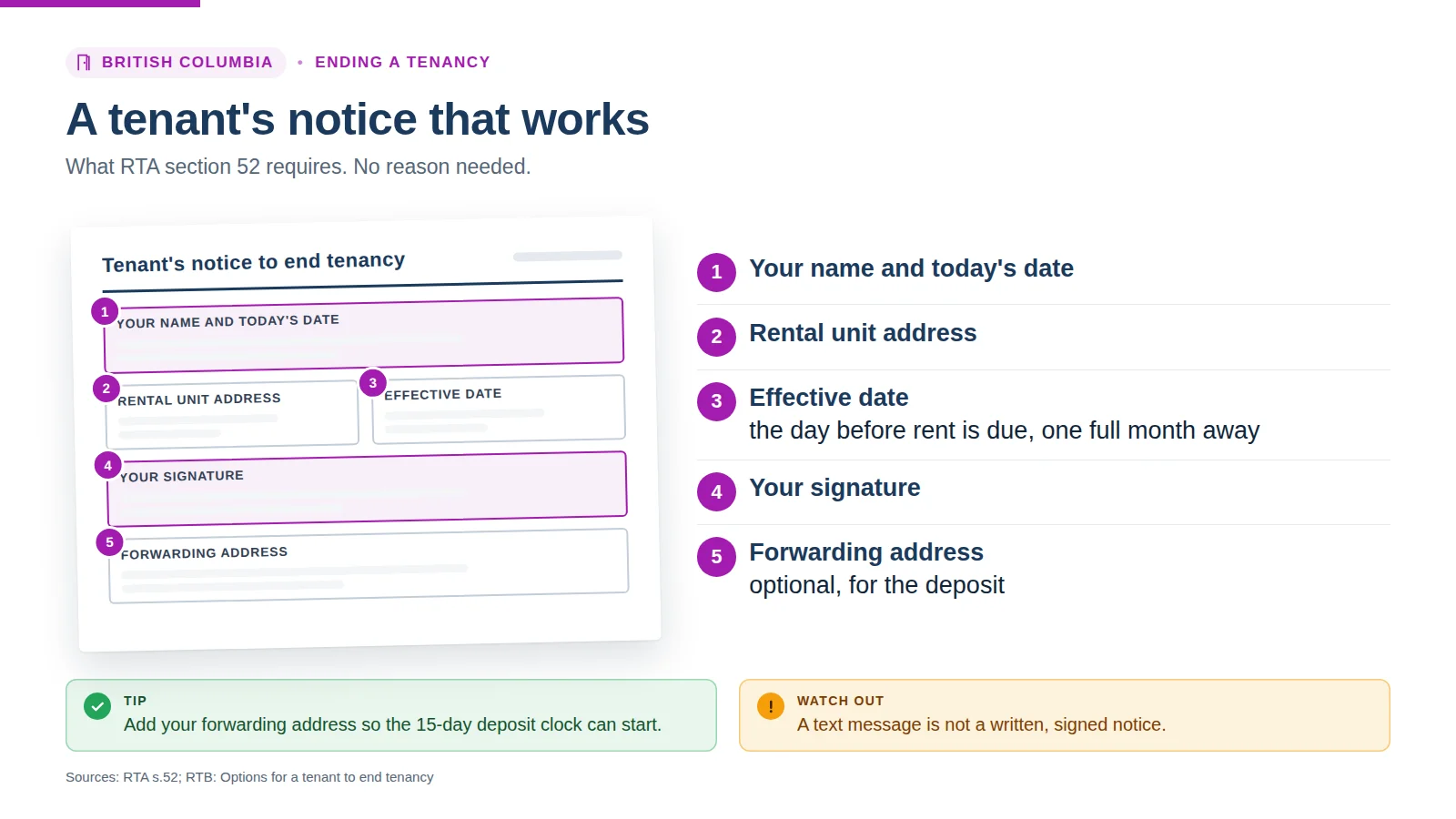
Section 52 says a notice to end a tenancy must be in writing and must:
- be signed and dated by you,
- give the address of the rental unit, and
- state the effective date (your last day).
You do not have to give a reason. The RTB says you can write your own letter, including your name, the date, the address, the date you plan to leave and your signature. Keep a copy.
"Received" is the key word
The month counts from when your landlord receives the notice, and the RTA deems some delivery methods to arrive later than the day you send them:
| How you give it | When it counts as received |
|---|---|
| Handed to your landlord or their agent | That day |
| Left in the landlord's mailbox or mail slot | The third day after you leave it (s.90) |
| Attached to the door where the landlord lives or does business as a landlord | The third day after you attach it (s.90) |
| Ordinary or registered mail | The fifth day after mailing (s.90) |
| Email, only to an address the landlord gave for service | The third day after sending (Regulation s.44) |
These are deemed dates. If your landlord actually gets the notice sooner, it counts from then, but you cannot prove that unless they confirm it.
Worked example: moving out on December 31, 2026
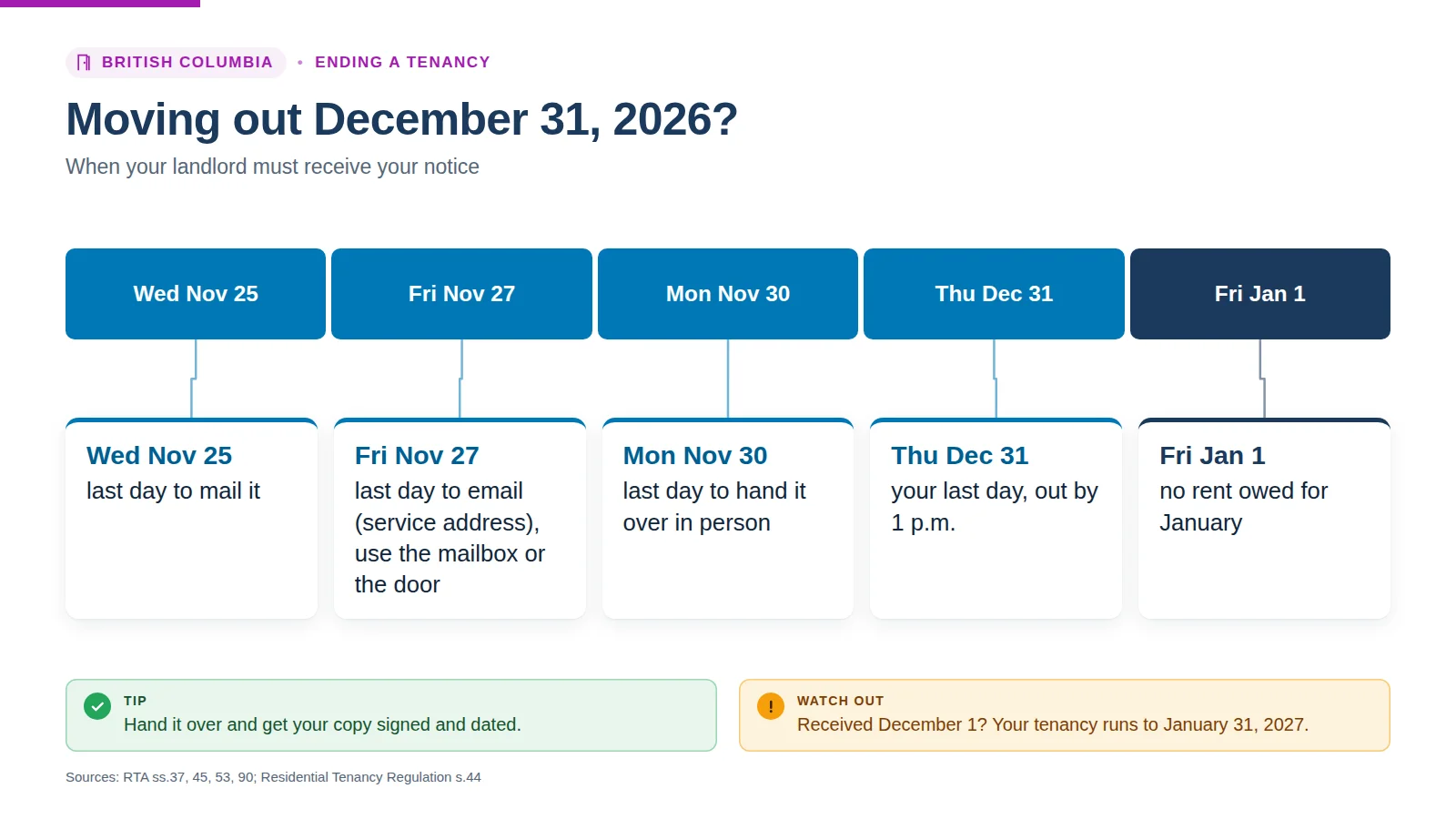
Your rent is due on the 1st, so your last day must be the last day of a month. For a move-out on Thursday, December 31, 2026, your landlord must receive the notice by Monday, November 30, 2026.
| Method | Latest safe day to give it |
|---|---|
| In person | Monday, November 30 |
| Email to the landlord's service address, door or mailbox | Friday, November 27 (deemed received November 30) |
| Wednesday, November 25 (deemed received November 30) |
If rent is due on another day
The effective date is the day before rent is due. If your rent is due on the 15th, your last day is the 14th. To leave on Thursday, January 14, 2027, your landlord must receive the notice by Monday, December 14, 2026.
If you are on a fixed-term lease
Section 45(2) adds one more condition: the effective date cannot be earlier than the end date in your agreement. If your lease ends on June 30, 2027 and you want to leave then, your landlord must receive your notice by May 31, 2027. Leaving before the end date is breaking the lease, which is a different situation with different costs.
Common mistakes
- Counting 30 days. Notice received on December 1 for a December 31 move is one day late.
- Texting. A notice must be in writing and signed. Email works only if your landlord gave an email address for service.
- Forgetting deemed receipt. A notice taped to the door on November 30 is not received until December 3.
- Picking a mid-month date. The effective date must be the day before rent is due.
- Leaving out the address or signature. Section 52 lists these for a reason.
What happens if you are late? Your notice is not thrown out. Section 53 moves the effective date to the earliest date that complies. If your landlord receives your notice on Tuesday, December 1, 2026, for a December 31 move-out, the date becomes Sunday, January 31, 2027, and you owe January's rent. The RTB warns that a tenant who does not give proper notice may have to compensate the landlord for losses.
What to do next

- Keep paying rent until the effective date.
- Book the move-out inspection. Your landlord should offer times. If you do not take part when given the opportunities, you may lose your right to have your deposit returned.
- Give your forwarding address in writing. The 15-day deposit clock starts on the later of the tenancy ending and the landlord receiving it.
- Clean and repair. Under section 37, leave the unit reasonably clean and undamaged except for reasonable wear and tear. The RTB lists patching nail holes, cleaning wall marks and, after a tenancy of a year or more, steam cleaning carpets.
- Be out by 1 p.m. on your last day and return all keys and fobs, unless you and your landlord agree otherwise in writing.
- Track the deposit. Within 15 days the landlord must return it with any interest or apply to the RTB to claim against it.
How Tenon10 helps
Tenon10 generates a BC tenant's notice to end tenancy with the details section 52 requires: your signature and date, the unit's address and the effective date.
If your landlord uses Tenon10, your lease, notices and payment records sit together, which helps if anything about the move-out is disputed later.
Frequently asked questions
Do I have to tell my landlord why I am leaving?
No. Section 52 excuses a tenant's ordinary notice from stating grounds.
Can I give notice by text message?
No. The notice must be in writing and signed. You can email it only if your landlord provided an email address for service.
My landlord found a new tenant early. Do I still owe the full month?
You can ask your landlord to agree to an earlier end date. Any change should be in writing, signed by both of you.
Is there an official form?
The RTB says you can write your own letter as long as it has the required details. A mutual agreement to end early is a different document, Form RTB-8.
BC Tenant's Notice to Move Out Checklist
A renter checklist for giving notice in BC: what the notice must say, the latest day to give it by each method, and what to do before you hand back the keys.
Get Free PDF →Give notice that counts
Create a BC tenant's notice to end tenancy in Tenon10 with every detail the Act requires.
Built for Canadian landlords and property managers.
Related BC guides
- Getting Your Deposit Back in BC: A Tenant's Step-by-Step Guide
- Fixed-Term vs Month-to-Month in BC: What Happens When the Term Ends
- Serving Documents in BC: Every Method the RTA Allows
Sources: Residential Tenancy Act; Residential Tenancy Regulation; RTB: Options for a tenant to end tenancy; RTB: Breaking a lease as a tenant; RTB: Moving out of rental units. This article is a summary of British Columbia rules as of October 2026, not legal advice. Check the Residential Tenancy Branch for your situation.