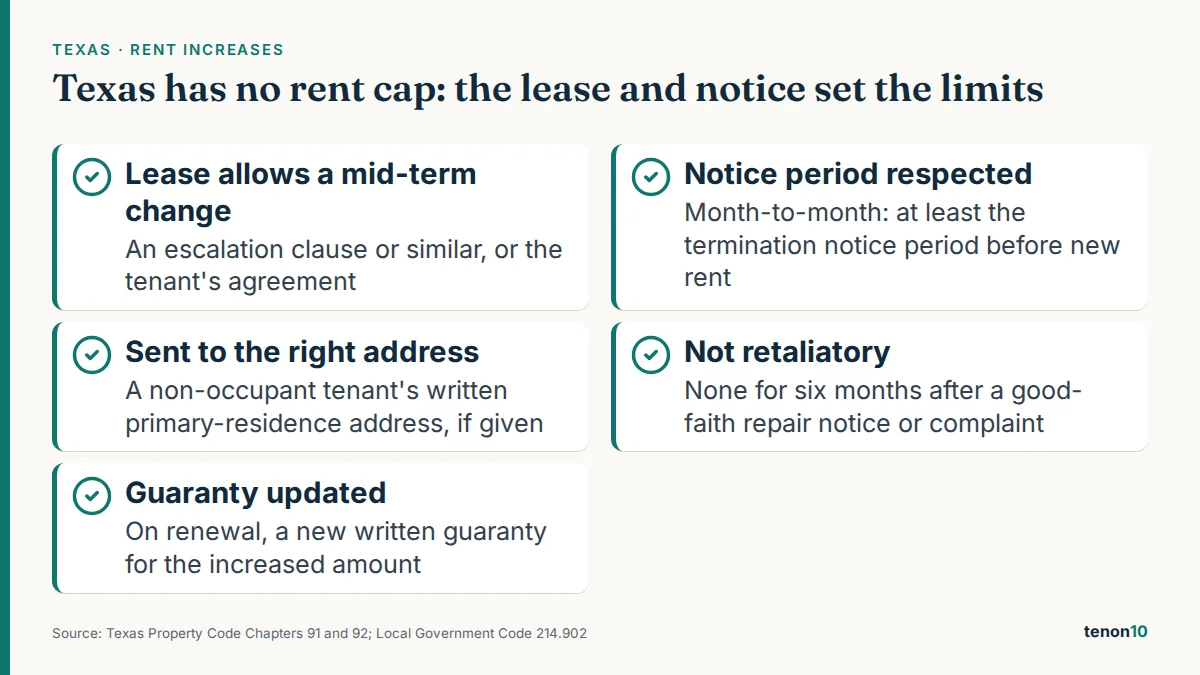
Texas rent increase rules start with one fact: Texas has no statewide limit on how much or how often a landlord can raise the rent. A city may adopt rent control only during a declared disaster and with the governor's approval (Local Government Code 214.902). The real limits are the lease, the notice needed to end a month-to-month tenancy, and the ban on retaliatory increases.
Texas landlords set rent by agreement. Section 214.902 of the Local Government Code lets a city establish rent control only if it finds "a housing emergency exists due to a disaster" and "the governor approves the ordinance." That leaves three limits: your lease, how the tenancy ends under Property Code Chapter 91, and the retaliation rules in Chapter 92. Amounts are in US dollars.
Texas Rent Increase: Landlord Checklist
A one-page checklist for Texas landlords raising rent: check the lease, time it to the notice period, send it to the right address and avoid retaliation.
Get Free PDF →What will a Texas landlord need before raising the rent?
- The signed lease, including its term, any renewal clause and any rent escalation clause.
- The tenancy type: fixed term, or month to month.
- The tenant's written notice address, if the tenant gave one under Property Code 92.012.
- A record of any repair requests, code complaints or other tenant actions in the last six months.
How does a Texas landlord raise the rent step by step?

Step 1: Check whether the lease lets you change rent mid-term
In Texas, rent during a fixed-term lease is the rent the lease sets. A lease is "any written or oral agreement between a landlord and tenant that establishes or modifies the terms" of occupancy (Property Code 92.001(3)), so a change during the term needs the lease's own mechanism, such as an escalation clause, or the tenant's agreement. Without one, plan the increase for the renewal date.
Step 2: Time the increase to the end of the term or the notice period
For a Texas month-to-month tenancy, either side can end it by notice. Where the rent-paying period is at least one month, the tenancy ends on the later of the date in the notice or one month after the notice is given (Property Code 91.001(a), (b)), unless both parties signed an agreement setting a different notice period (91.001(e)). The Property Code does not set a separate rent-increase notice, so give at least the termination notice period before new rent starts, letting a tenant who rejects the terms leave. For a fixed term, put the new rent in the renewal offer.
Step 3: Send the notice to the right address
If a tenant who does not live in the unit gave written notice at signing asking for notices at a primary residence, the landlord must mail "all notices of rental increases at the end of the lease term" there (Property Code 92.012(a)(3)). Regular US mail is enough and the notice counts as given on the postmark date (92.012(c)), unless notice is hand delivered to someone occupying the unit (92.012(e)).
Step 4: Screen the timing for retaliation
A Texas landlord may not raise rent in retaliation within six months after a tenant in good faith exercises a lease or legal remedy, gives a repair notice, complains to a code or utility authority, or joins a tenant organization (Property Code 92.331(a), (b)(4)). Section 92.332(a) protects escalation-clause increases for utilities, taxes or insurance, and project-wide patterns of increases, unless they violate a prior court order. See our Texas retaliation guide.
Step 5: Deal with any guarantor
A guarantor who signed the original Texas lease is liable only for the original term unless the lease says otherwise, and a renewal guaranty covers only a renewal that does not increase the guarantor's potential obligation for rent (Property Code 92.021(a), (b)). If you raise rent on renewal and want the guaranty to cover it, get a new written guaranty for the increased amount (92.021(c)). Our Texas lease provisions guide covers the other clauses Chapter 92 regulates.
Step 6: Collect the new rent the lawful way
Late fees on the new amount still follow Property Code 92.019; see our Texas late fees guide.
What goes wrong most often with Texas rent increases?
| Problem | Why it matters | Rule |
|---|---|---|
| Raising rent mid-lease with no clause | The lease sets the rent for the term | Property Code 92.001(3) |
| Increase within six months of a repair request or code complaint | A retaliation claim and tenant remedies | Property Code 92.331 |
| Assuming a guarantor covers the higher rent | Renewal guaranty cannot increase the rent obligation | Property Code 92.021 |
If the tenant stays past the end of a tenancy without agreeing to the new terms, the remedy is a notice to vacate and an eviction suit in justice court, never a lockout; see our Texas notice to vacate guide. Canadians who own a Texas rental can read our tax guide for Canadians who own a US rental for the income side.
Frequently asked questions
Is there rent control in Texas?
Not in ordinary times. A Texas city may establish rent control only for a housing emergency due to a disaster, with the governor's approval, and it ends the way the governor's disaster declaration does (Local Government Code 214.902).
How much can a Texas landlord raise the rent?
No Texas statute caps the amount. The increase must fit the lease and must not be retaliatory (Property Code 92.331).
How much notice does a Texas landlord need to give for a rent increase?
The Property Code sets no separate rent-increase notice. A month-to-month tenancy ends on the later of the notice date or one month after notice unless a signed agreement says otherwise (Property Code 91.001), so that is the usual timing.
Can a Texas landlord raise rent after a tenant asks for repairs?
Not in retaliation. For six months after a good-faith repair notice or code complaint, a retaliatory rent increase is prohibited (Property Code 92.331), subject to the exceptions in 92.332.
Texas Rent Increase: Landlord Checklist
A one-page checklist for Texas landlords raising rent: check the lease, time it to the notice period, send it to the right address and avoid retaliation.
Get Free PDF →Raise Texas rent on solid ground
Read Tenon10's free guides for US landlords on leases, notices and deposits.
Free • No signup required