
A Canadian resident who owns a US rental is taxed in both countries: the US taxes the rent as US-source income, either at a flat 30% of gross rent or, by election, on net income through a Form 1040-NR, and Canada taxes the same rent on your T776 as part of your worldwide income, with a foreign tax credit for the US tax.
This guide walks through the whole picture for a Canadian who rents out a condo in Florida, a house in Arizona or a cabin in Washington State: the US side, the Canadian side, the forms that connect them, what happens when you sell, and the deadlines for each. It covers US federal and Canadian federal rules as the IRS and the Canada Revenue Agency (CRA) state them for the 2025 tax year. The state where your property sits may have its own income tax rules, which are outside this guide. Each section points to the official page it relies on, and the sources are listed at the end.
Who taxes the rent from a US property owned by a Canadian?
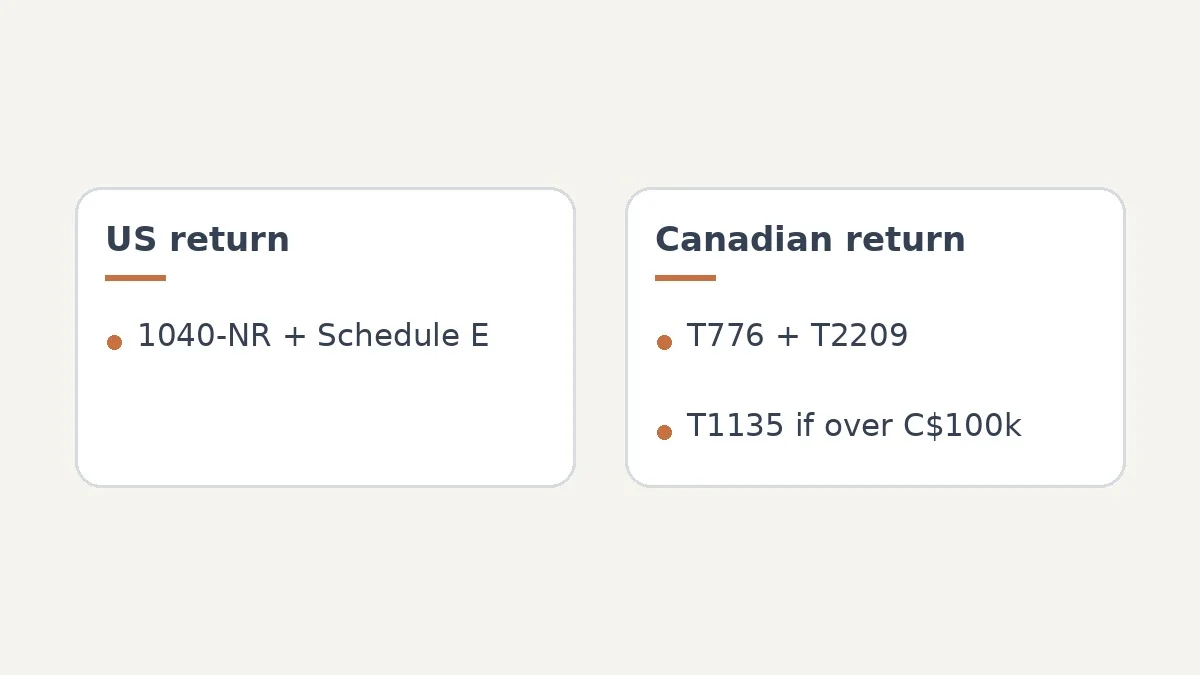
Both countries can tax it, and the treaty decides who goes first. Article VI of the Canada–United States Tax Convention says income a resident of one country earns from real property in the other "may be taxed in that other State", and paragraph 3 applies that to income from "letting" the property. So the US, where the property sits, has the first right to tax the rent.
Canada does not give up its own right. The CRA's page for Canadian residents going down south says a factual resident continues to "pay tax on your world income (income from all sources both inside and outside Canada)". The treaty's Article XXIV(2)(a) then has Canada allow a deduction from Canadian tax for income tax paid to the US on US-source income. In practice that is the federal foreign tax credit.
Everything below assumes you are a resident of Canada and a nonresident alien for US tax purposes. If you spend long stretches in the US, your US status depends on the residency tests in IRS Publication 519, and the answers can change.
How does the US tax rent paid to a Canadian owner?

By default, the US taxes rent paid to a nonresident alien at 30% of the gross amount, with no deductions. Publication 519 (2025) lists rents among the "fixed or determinable" income items taxed at "30% (or lower treaty) rate" on the gross amount when the income is not effectively connected with a US trade or business. The tenant or property manager who pays you is the withholding agent: Publication 515 tells them to withhold on rents "unless the foreign payee elects to treat this income as effectively connected".
The alternative is the net-basis election under Internal Revenue Code section 871(d). If you make it, Publication 519 says "you can claim deductions attributable to the real property income and only your net income from real property is taxed", at the graduated rates. You report the rent and expenses on Schedule E, carry the net figure to Schedule 1 (Form 1040), line 5, and attach both to Form 1040-NR.
| Question | 30% on gross rent (default) | Net-basis election (s.871(d)) |
|---|---|---|
| What is taxed | Gross rent, no deductions | Net rental income after expenses and depreciation |
| Rate | 30% (Pub. 519) | Graduated rates (Pub. 519) |
| US return | Not needed if withholding covered the tax (Pub. 519 example) | Form 1040-NR with Schedule E, every year |
| Form you give the payer | None (or Form W-8BEN) | Form W-8ECI, which needs a US taxpayer identification number |
| How long it lasts | Year by year | All later years until revoked (Pub. 519) |
A worked example (illustrative figures only)
Suppose a Canadian owns a US condo bought for US$250,000, of which US$200,000 is the building and US$50,000 is land. It rents for US$2,000 a month, US$24,000 for the year. Cash expenses are US$9,000: property tax, insurance, the condo fee, management and repairs.
- Default: 30% × US$24,000 = US$7,200 withheld. That is the US tax.
- Election: Publication 527 depreciates residential rental buildings over 27.5 years and land not at all, so a full year's depreciation is about US$200,000 ÷ 27.5 = US$7,273. Net rental income is US$24,000 − US$9,000 − US$7,273 = US$7,727, taxed at graduated rates.
The election shrinks the taxable amount from US$24,000 to about US$7,727 in this example. The actual US tax depends on your rates for the year, and the first year's depreciation is less because of the mid-month convention in Publication 527.
What US forms does a Canadian landlord need?

An owner using the election usually needs four things: a US taxpayer identification number, Form W-8ECI for whoever pays the rent, an annual Form 1040-NR with Schedule E, and, in the first year, the election statement.
- An ITIN. A nonresident alien who cannot get a Social Security number applies for an Individual Taxpayer Identification Number on Form W-7, generally attached to the front of the first tax return. The instructions say to allow 7 weeks, or 9 to 11 weeks between January 15 and April 30 or when filing from overseas.
- Form W-8ECI. The W-8ECI instructions say you must enter a US TIN "for this form to be valid", give the form to the withholding agent (not the IRS), and that without it the agent "must withhold at the 30% rate". A form generally stays valid until the end of the third calendar year after the year you sign it.
- Form 1040-NR with Schedule E. Rental income or loss goes on Schedule 1 (Form 1040), line 5, figured on Schedule E, per the 2025 Instructions for Form 1040-NR. Publication 519 also says nonresident aliens "cannot claim the standard deduction".
- The election statement, attached in the first year. It must say you are making the choice and whether it is under section 871(d) or a treaty, and list your US real property, your ownership share, its location, major improvements, the dates you owned it, your income from it and any earlier elections or revocations.
How is US rent reported on a Canadian return?
You report the US rental on Form T776 in Canadian dollars, under Canadian rules, and carry the net figure to line 12600 of your return. The CRA's Rental Income guide (T4036) says to enter the amount from line 9946 of the T776 on line 12600. If you have filed for a Canadian rental before, our guide to the T776 form walks through it line by line.
Three differences matter for a US property:
- Depreciation does not carry over. The US 27.5-year depreciation is a US figure. On the T776 you use capital cost allowance (CCA) under the CRA's rules, and T4036 explains the limits on using CCA to create a rental loss. Our article on how CCA works for rental property explains the trade-offs.
- Currency. Every amount is converted to Canadian dollars. The CRA's foreign tax credit page says to use the Bank of Canada rate in effect on the day an amount arose, or the average annual rate for amounts received at different times in the year.
- The expense list is Canada's. A cost that is deductible on Schedule E is not automatically deductible on the T776, and the reverse. Apply the CRA's expense rules, covered in our T776 expense deep-dive.
Continuing the example with the Bank of Canada's 2025 annual average of 1.3978 Canadian dollars per US dollar: rent of US$24,000 becomes C$33,547 and cash expenses of US$9,000 become C$12,580, before any CCA you choose to claim.
How does the foreign tax credit stop double tax?
Canada gives you a credit for US income tax on the rent, limited to the Canadian tax on that same income. The CRA's line 40500 page says you calculate the federal credit on Form T2209 and the provincial or territorial credit on Form T2036, and that the usual limit for each country is the lesser of the foreign tax you paid and the Canadian tax payable on that country's income.
The CRA's Income Tax Folio S5-F2-C1 adds the rules that trip people up:
- Tax on income from the rental or disposition of real property is not caught by the 15% cap that applies to an individual's other foreign property income (¶1.22).
- Tax that is refunded, or will be, is not "foreign tax paid" (¶1.33), and tax paid voluntarily is not either (¶1.34).
- Unused non-business foreign tax credits "cannot be carried over" to another year (¶1.24), although subsection 20(12) can give a deduction instead in some cases.
- US tax is converted "at the same rate at which the income itself was converted" (¶1.42).
That second point is why the US return matters for the Canadian credit: if 30% was withheld on gross rent but your actual US tax on a filed 1040-NR is lower, the refundable part is not creditable in Canada.
Do you have to file Form T1135 for a US rental?
Yes, if the total cost of all your specified foreign property was more than C$100,000 at any time in the year. The CRA's T1135 questions and answers say personal-use property is excluded, that "primarily" means more than 50% personal use, and give the example of a condo rented for eight months and used personally for four, which must be reported. The form's instructions say rental property outside Canada is reported in the "Real property outside Canada" category, and the simplified Part A is available only when the total cost stayed under C$250,000 throughout the year. T1135 is due on the same day as your income tax return.
The penalty for filing late is C$25 a day for up to 100 days, with a minimum of C$100 and a maximum of C$2,500, under the CRA's table of penalties for information returns. The CRA can also reassess the related return for three extra years when T1135 is late or wrong.
What happens when a Canadian sells the US property?
The buyer usually withholds 15% of the sale price under the Foreign Investment in Real Property Tax Act (FIRPTA), and you then file a 1040-NR to report the actual gain. IRC section 1445(a) sets the 15% rate on the "amount realized", and Publication 519 says gain on a US real property interest is treated as effectively connected income.
Publication 515 (2026) sets out the exceptions that depend on the buyer: no withholding if the buyer is an individual who acquires the property as a residence for a price of US$300,000 or less, and 10% instead of 15% for a residence buyer when the price is over US$300,000 and not over US$1,000,000. The buyer files Form 8288 within 20 days of the transfer, and the IRS returns a stamped Copy B of Form 8288-A to you, which you need to claim the withholding as a payment on your 1040-NR.
If 15% of the price is more than your actual US tax on the gain, you or the buyer can apply on Form 8288-B for a withholding certificate before the closing. The IRS says it normally acts within 90 days of receiving a complete application.
On the Canadian side the sale is reported on your return in Canadian dollars, and Folio S5-F2-C1 includes US tax on gains from disposing of real property in the foreign tax credit without the 15% cap. Article XIII(1) of the treaty gives the US the right to tax the gain first.
Which deadlines apply to a Canadian with a US rental?
| Filing | Deadline for the 2025 tax year | Source |
|---|---|---|
| Form 1040-NR (no US wages) | June 15, 2026; Form 4868 extends to December 15, 2026 | IRS Pub. 519 |
| Form 1040-NR to keep deductions | Within 16 months of the due date | IRS Pub. 519 |
| Canadian T1 return and payment | April 30, 2026 (June 15, 2026 to file if you or your spouse are self-employed) | CRA important dates |
| Form T1135 | Same day as your T1 return | CRA T1135 Q&A |
| Form W-8ECI renewal | End of the third calendar year after signing | W-8ECI instructions |
| Form 8288 (buyer, on a sale) | 20 days after the transfer | IRS Pub. 515 |
Note the order: the Canadian return is due before the 1040-NR. If the US tax figure is not final by April 30, the foreign tax credit you claim may need to be adjusted later once the US return is filed.
What mistakes do Canadian owners of US rentals make most often?
- Giving a W-8ECI with no ITIN. The form is not valid without a US TIN, so the payer keeps withholding 30%.
- Making the election and then not filing. Deductions need a timely, true and accurate 1040-NR.
- Copying US depreciation onto the T776. Canada uses CCA, with its own classes and limits.
- Claiming the foreign tax credit for the full 30% withheld when part of it is refundable by filing a US return.
- Forgetting T1135 because the property "is just a condo". A rental is specified foreign property.
- Using a different exchange rate for the rent and for the US tax. Folio S5-F2-C1 asks for the same rate, used consistently.
Good records make every one of these easier. Our year-end tax prep checklist for landlords and bookkeeping guide apply to a US rental too: keep US-dollar receipts, the date each amount was paid, and the rate you used.
Frequently asked questions
Do I have to file a US tax return if 30% was withheld from my rent?
Not necessarily. Publication 519 gives the example of a nonresident whose only US income is rent with 30% properly withheld and reported on Form 1042-S, and says that person does not have to file Form 1040-NR. You file if you want the net-basis election, a refund, or deductions.
Can I make the net-basis election for just one property?
No. Publication 519 says the choice applies to all income from real property located in the United States that is held for the production of income, not property by property.
Is US state income tax creditable in Canada?
Folio S5-F2-C1 treats tax paid to the government of a state or other political subdivision of a foreign country as foreign tax that can qualify, subject to the folio's conditions. Whether a particular state tax qualifies depends on that tax, so check it against the folio.
Does the T1135 threshold use market value or cost?
Cost. The CRA's T1135 questions and answers say cost amount generally means adjusted cost base, not fair market value, and the test is whether the total exceeded C$100,000 at any time in the year.
What if my ITIN expires?
The Form W-7 instructions say an ITIN not used on a US federal tax return for 3 consecutive tax years expires on December 31 of the third year and must be renewed before you use it on a return again. An owner who files a 1040-NR every year keeps it active.
The bottom line for a Canadian with a US rental
Expect two returns every year if you make the net-basis election: a 1040-NR with Schedule E in the US and a T776 with a foreign tax credit in Canada, plus a T1135 once your foreign property cost passes C$100,000. Get the ITIN early, give the payer a valid W-8ECI, convert every amount at a rate you can show the CRA, and plan for FIRPTA withholding well before you list the property. The rules in this guide were checked against the IRS and CRA pages listed below on November 6, 2026.
Keep your rental books ready for both returns
Guides, tools and checklists for Canadian landlords in one place
Free • No signup required
Sources
- IRS Publication 519 (2025), U.S. Tax Guide for Aliens
- IRS Publication 515 (2026), Withholding of Tax on Nonresident Aliens and Foreign Entities
- IRS Publication 527 (2025), Residential Rental Property
- Instructions for Form 1040-NR (2025), Form W-8ECI, Form W-7, Form 8288-B
- CRA: Canadian residents going down south
- CRA Income Tax Folio S5-F2-C1, Foreign Tax Credit
- CRA: Questions and answers about Form T1135
- Bank of Canada: Annual exchange rates