The Vancouver empty homes tax requires one declaration a year for every residential property in the City of Vancouver, including rentals and homes the owner lives in. A property declared, deemed or found empty for the 2025 reference year is taxed at 3% of its 2025 assessed taxable value, but a unit rented to a qualifying tenant for at least six months is not.
At a glance
- Who declares: one owner per property, every year, even if you live there.
- Rate: 3% of assessed taxable value for the 2025 reference year.
- 2025 dates: declaration due February 3, 2026; tax due April 16, 2026.
- Rental rule: rented at least six months of the year, in periods of 30 or more consecutive days, to an arm's-length tenant.
- Miss it: deemed vacant, taxed at 3%, plus a $250 by-law ticket.
Vancouver Empty Homes Tax Checklist
The yearly steps for a Vancouver rental owner: keep the unit occupied, declare once a year and keep the evidence.
Get Free PDF →What is Vancouver's Empty Homes Tax?
It is a City of Vancouver tax on residential property that is empty for more than six months of a year, imposed under the Vacancy Tax By-law No. 11674 and also called the Vacancy Tax. The City started it in 2017 to address housing affordability and availability, according to its Empty Homes Tax page.
It is separate from the Province's speculation and vacancy tax. The City says you may have to pay both, and each has its own declaration; our guide to renting out a strata unit in BC covers the other rules a Vancouver condo owner faces.
Who has to declare, and when?
Every Vancouver homeowner declares each year, and the City says that even if you live in your home, you must make a declaration. Only one declaration is needed per property: if you co-own, one owner declares, according to the City's declaring your property status page.
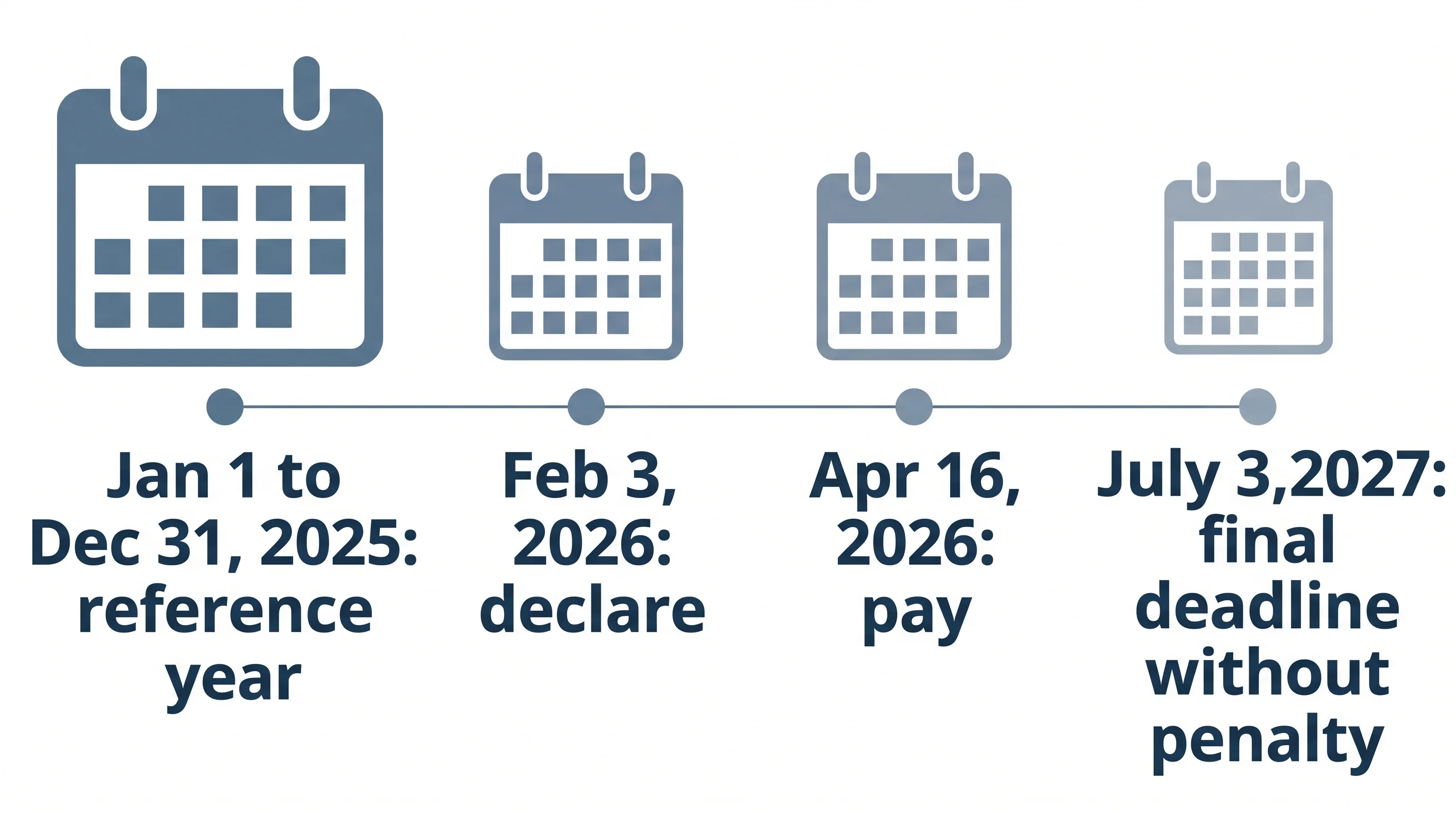
| Date the City has posted | What it is |
|---|---|
| January 1 to December 31, 2025 | Vacancy reference period |
| February 3, 2026 | Declaration deadline for the 2025 year |
| April 16, 2026 | Empty Homes Tax payment for 2025 |
| July 3, 2027 | Final deadline without penalty |
| July 3, 2030 | Late declaration deadline, following submission of acceptable evidence |
As of October 24, 2026, the City had not posted the declaration deadline for the 2026 reference year. Do not assume a date: check the City's page early in the new year.
To declare you need your folio number and access code from your property tax notice, and, depending on your status, details such as tenant names. The City estimates it takes about five minutes.
How does a rental stay exempt?
A rental is treated as occupied when it is rented to an arm's-length tenant for residential purposes, for at least six months of the year, in periods of at least 30 consecutive days. The City's evidence and exemptions page says a property unoccupied for more than six months of the year is taxed unless an exemption applies.
| Counts toward the six months | Does not count |
|---|---|
| A one-year lease | Months the unit was listed for rent but empty |
| Several shorter tenancies of 30+ consecutive days each, adding up to six months | Stays shorter than 30 consecutive days |
| A tenant who uses the unit as a second home, if the other conditions are met | Months the unit was listed for sale but empty |
The provincial tax has a similar rule with different details: it asks for a written agreement under the Residential Tenancy Act and periods of at least one month. Use a written BC tenancy agreement and you have the record both taxes look for.
What other exemptions are there?
The City lists ten: death of a registered owner, redevelopment or major renovations, an owner in care, occupancy for full-time employment, transfer of property, a court order, limited-use residential property, vacant new inventory, hazardous or damaged residential property, and a secondary residence for medical reasons. Each has its own conditions and evidence.
What happens if you get it wrong?
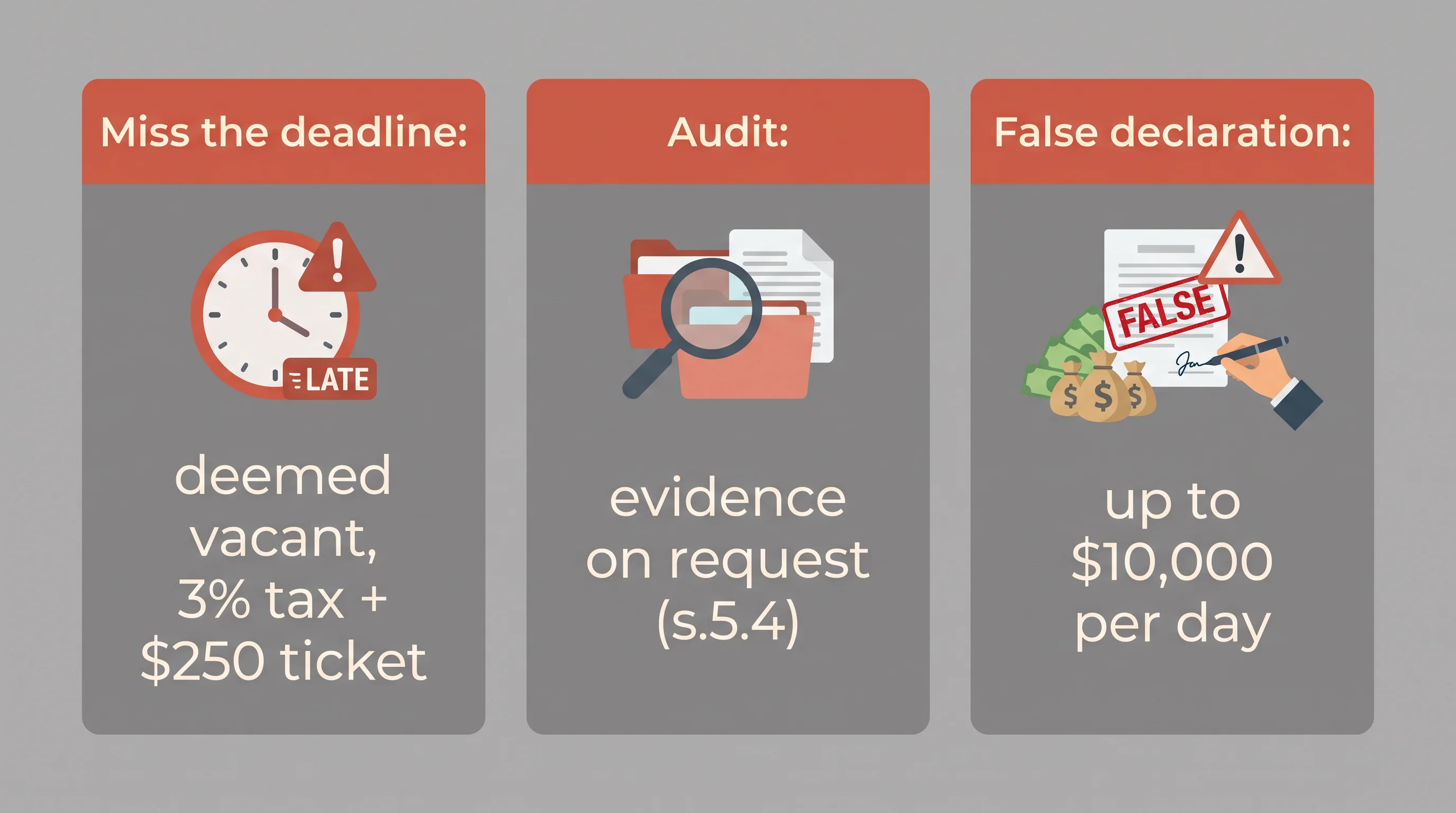
If you fail to declare by the deadline, the City deems the property vacant, taxes it at 3% of its assessed taxable value for the 2025 year and issues a $250 by-law ticket. Any declaration can be audited: section 5.4 of the Vacancy Tax By-law requires owners to provide evidence when asked, and the City says evidence is requested only if the property is selected for audit. A false declaration can bring fines of up to $10,000 per day of the continuing offence, in addition to the tax.
If you missed a year, the City allows late declarations after you submit acceptable evidence; for the 2024 year, it accepted late declarations until July 3, 2026 through a Notice of Complaint.
Common mistakes Vancouver landlords make
- Not declaring a rented unit. A tenanted home still needs the yearly declaration.
- Short-stay rentals. Periods under 30 consecutive days do not count as occupied.
- Counting a vacancy as rented. Being listed for rent is not an exemption.
- Two co-owners, no declaration. Only one is needed, so agree who files.
- Forgetting the provincial tax. The speculation and vacancy tax needs its own declaration by March 31.
How Tenon10 helps
Tenon10 creates the BC tenancy agreement and keeps each tenancy's start and end dates, which are the facts the declaration asks about. It also runs move-in and move-out inspection reports, tracks deposits and their return dates, and sends rent reminders. For the move-in report, see BC condition inspections.
Frequently asked questions
Do I declare if I live in my Vancouver home?
Yes. The City says every homeowner must declare every year, even if they live in the home.
My tenant moved out in May and I re-rented in December. Am I taxed?
Possibly. Count the months rented in periods of at least 30 consecutive days. If the total is under six and no exemption applies, the property is taxed.
Does the City need my lease when I declare?
Not at the time of declaring; you give details such as tenant names. Evidence is requested only if the property is selected for audit, so keep the agreement and rent records.
Does a short-term rental count as occupied?
Only stays of at least 30 consecutive days count toward the six months. Short-term rentals also need a City licence and must be the host's home; see BC's principal residence requirement.
What is the 2026 rate and deadline?
As of October 24, 2026, the City's posted figures are for the 2025 reference year (3%). Check its page for the 2026 reference year's rate and deadline before you declare.
For a Vancouver landlord, the Empty Homes Tax comes down to one habit: keep the unit rented in 30-day-plus periods and declare every year, whatever the property's status.
Vancouver Empty Homes Tax Checklist
The yearly steps for a Vancouver rental owner: keep the unit occupied, declare once a year and keep the evidence.
Get Free PDF →Keep every tenancy on paper
A written BC tenancy agreement shows who rented, and when.
Free • No signup required