You rent out a Vancouver condo, house or laneway home on a normal lease. Then a tenant asks if they can list a bedroom while they travel, or a neighbour tells you short-term rentals earn more than rent. Before you answer either, you need to know how the rules stack up: the City of Vancouver licenses short-term rentals and limits them to principal residences, and the Province adds its own requirement and registry on top.
This guide covers who can host in Vancouver, how the provincial rules fit, and what it means for a long-term landlord. The City's own short-term rental licence page is where to confirm the City's current fees and conditions before anyone applies.
Vancouver Short-Term Rental Landlord Checklist
A checklist for Vancouver landlords: only a host who lives in the unit may list, the City licence and provincial registration both apply, and a tenant's hosting needs a written answer.
Get Free PDF →Vancouver's rules for hosts
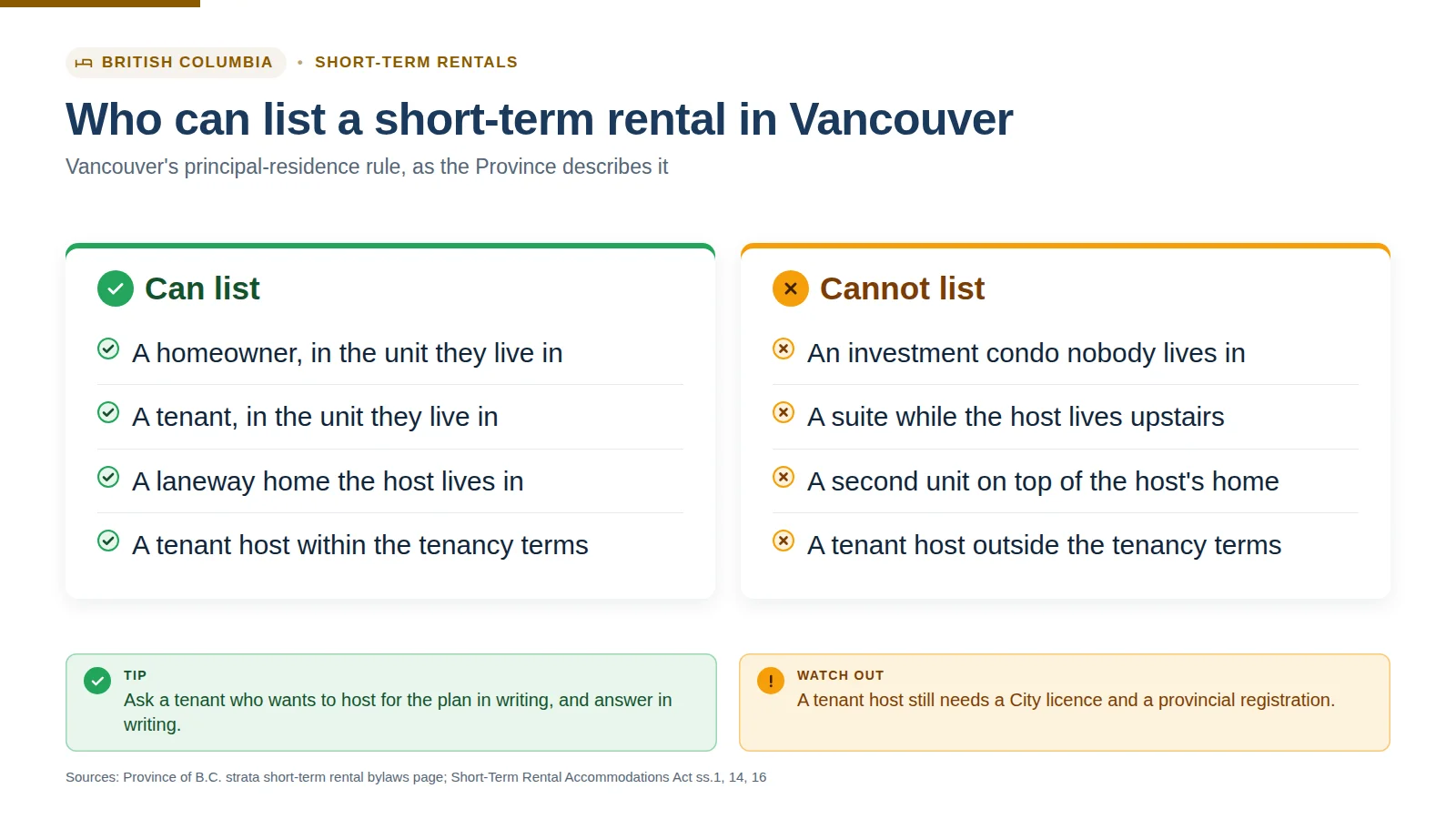
Under the Province's Short-Term Rental Accommodations Act, a short-term rental is accommodation offered to the public for a fee for less than 90 consecutive days. Vancouver is on the Province's list of communities where the provincial principal residence requirement applies, and the City adds its own rules through a short-term rental business licence.
The Province's strata short-term rental page names Vancouver as one of the local governments that generally limit short-term rentals to principal residences only. In the Province's words, only the homeowner who lives in the unit, or the tenant who lives in the unit, may list it, and investors who do not live in the residence may not. For a landlord, that means:
- a condo or house you own but do not live in cannot be a short-term rental;
- a tenant who lives in the unit can be the host, but only within the tenancy agreement and with your written consent where the Residential Tenancy Act requires it; and
- a laneway home or suite qualifies only if the person listing it lives in that unit.
How this compares with the provincial rule
The provincial rule allows a host's principal residence plus not more than one secondary suite or accessory unit on the same parcel. Vancouver's rule, as the Province describes it, is narrower: the unit listed must be the one the host lives in. Hosts must meet both. The Act says a provision of a Vancouver short-term rental bylaw has no effect if it is inconsistent with the provincial requirement, but a stricter City rule is not inconsistent as long as following it does not break the provincial rule (s.16).
Licence, registration and listings
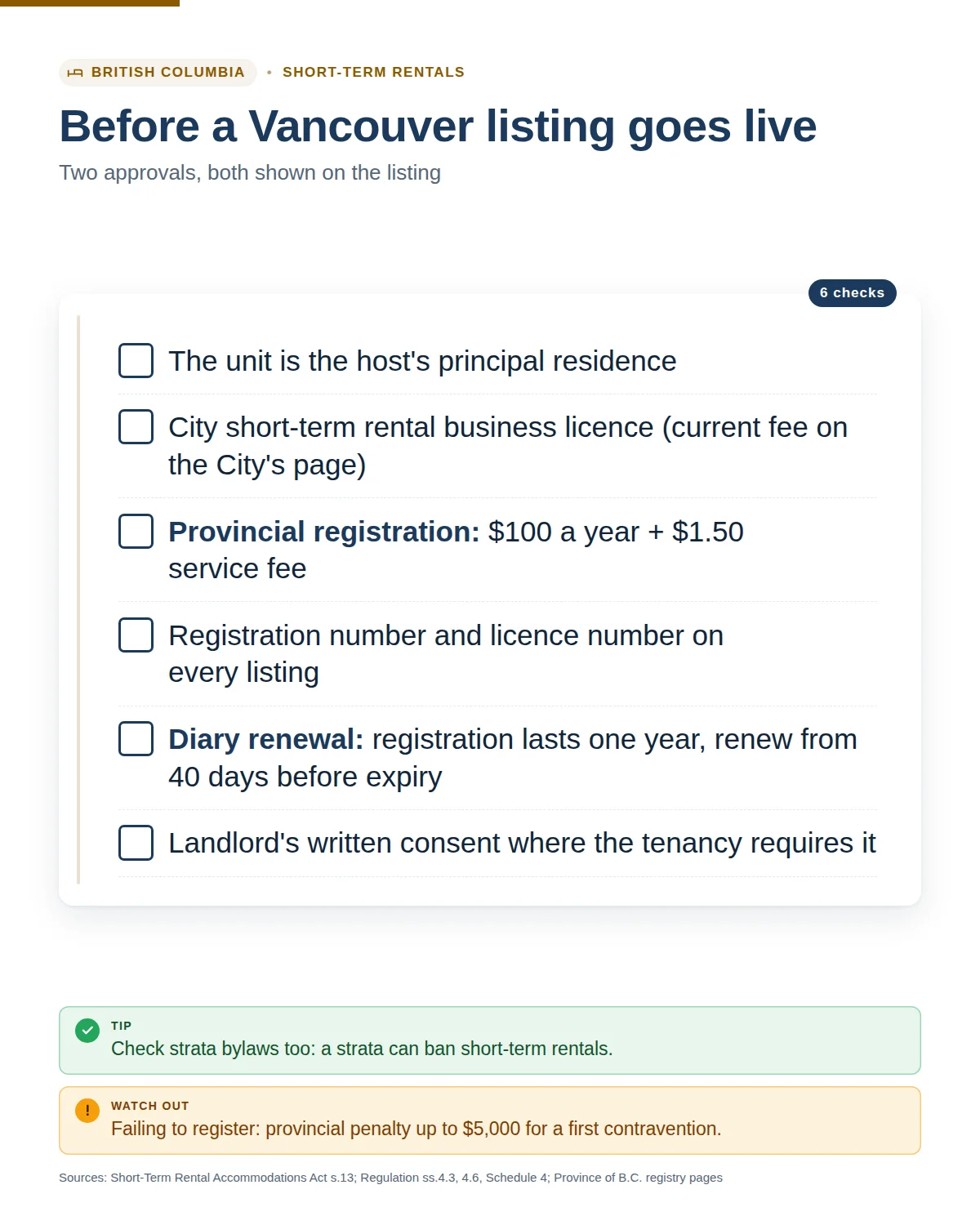
A Vancouver host needs two separate approvals, and each listing has to show them.
| Item | What applies |
|---|---|
| City short-term rental business licence | Issued by the City of Vancouver; its licence page sets the current fee, conditions and renewal rules |
| Provincial registration | Required since May 1, 2025; $100 a year for a unit that is the host's principal residence, plus a $1.50 service fee |
| Listings | Must show the provincial registration number and, where a business licence is required, the licence number (Act s.13) |
| Platforms | Must not keep providing services for a listing without a valid registration number |
| Registration period | One year; renewal opens 40 days before expiry |
Short-term rentals in Vancouver must be in the host's principal residence, so the $100 provincial fee is the one that normally applies. The City's licence fee is separate and is set by the City.
Common mistakes
- Thinking an investment condo qualifies. It does not. In Vancouver only a unit the host lives in can be listed.
- Listing the laneway home while living in the main house. Under Vancouver's rule as the Province describes it, the laneway can only be a short-term rental if the host lives in it.
- Giving a tenant a casual "sure." Put any approval in writing, with its scope. A text message reply leaves both sides unclear on terms.
- Forgetting the provincial registration. A City licence alone is not enough; platforms must not keep providing services for a listing without a valid provincial registration number.
- Letting either approval lapse. The provincial registration lasts one year and can be renewed from 40 days before expiry; the City licence has its own renewal rules, set by the City.
If you own several Vancouver rentals

For a landlord with more than one Vancouver unit, Vancouver's principal-residence rule settles the strategy: you have one principal residence at a time, so at most one of them can be a short-term rental, and only if you live in it. Every other unit belongs in the long-term market under the Residential Tenancy Act.
- Write a standard tenant-hosting policy so every request gets the same answer, and attach it to any approval you sign.
- Track approvals by unit: who asked, what you approved, and the date.
- Keep long-term paperwork tight: a written tenancy agreement, a move-in inspection, and rent increases on the approved form.
Under the Residential Tenancy Act, a tenant needs your written consent to sublet or assign (s.34). If you agree to short-term hosting, put the scope in writing so it is clear what you approved.
How Tenon10 helps
Tenon10 generates a BC tenancy agreement with every detail the Act requires and the standard terms copied word for word from the current Regulation, the Notice of Rent Increase (RTB-7) and the fillable RTB-27 Condition Inspection Report for your long-term units.
FAQ
Can my tenant run an Airbnb in my Vancouver rental?
Only in the home that is their principal residence, within the tenancy agreement, and with a City licence and provincial registration. If the arrangement amounts to a sublet or assignment, it needs your written consent (RTA s.34), and a strata may ban short-term rentals by bylaw.
Can I short-term rent my basement suite while living upstairs?
Not under Vancouver's rule as the Province describes it: only the person who lives in a unit may list it.
How much does it cost to register?
The provincial registration for a principal residence is $100 a year plus a $1.50 service fee. The City's licence fee is separate; check the current amount on the City's licence page.
Is a 3-month stay a short-term rental in Vancouver?
Short-term means under 90 consecutive days, so a stay of 90 days or more is not one. Count the days: some three-month periods are shorter than 90.
Vancouver Short-Term Rental Landlord Checklist
A checklist for Vancouver landlords: only a host who lives in the unit may list, the City licence and provincial registration both apply, and a tenant's hosting needs a written answer.
Get Free PDF →Keep your Vancouver long-term rentals in order
Tenon10 generates a BC tenancy agreement with the current standard terms, plus the RTB-7 and a fillable RTB-27, for every long-term unit.
Built for Canadian landlords and property managers.
Related BC guides
- The BC Residential Tenancy Agreement (RTB-1): The Complete Landlord Guide
- What You Can and Can't Add to a BC Tenancy Agreement
Sources: City of Vancouver: Short-term rental business licence; Short-Term Rental Accommodations Act; Short-Term Rental Accommodations Regulation; Province of B.C.: Principal residence requirement; Province of B.C.: Strata short-term rental bylaws; Province of B.C.: Short-term rental legislation; Province of B.C.: Renew your registration; Province of B.C.: Register as a host; Residential Tenancy Act. This article is a summary of British Columbia rules as of October 2026, not legal advice. Check the Residential Tenancy Branch for your situation.