If you own a condo, a house with a suite, or a cabin in BC, you have probably wondered whether short-term rentals pay better than a long-term tenant. Since 2024 and 2025, the answer depends first on a legal question: is the place you want to list your principal residence, and does the provincial principal residence requirement apply where it is?
BC now regulates short-term rentals at three levels: the Province, your local government, and, if you live in one, your strata. Getting one level right and missing another can mean fines, a removed listing, and cancelled bookings.
This guide explains the provincial rule, where it applies, the registration and penalty system behind it, and what it means if you own rentals and are deciding between short-term and long-term use.
BC Short-Term Rental Owner Checklist
A checklist for BC owners weighing short-term rentals: the principal residence rule, the community list, registration fees and penalties, local and strata rules, and moving units to long-term.
Get Free PDF →The principal residence requirement in plain terms
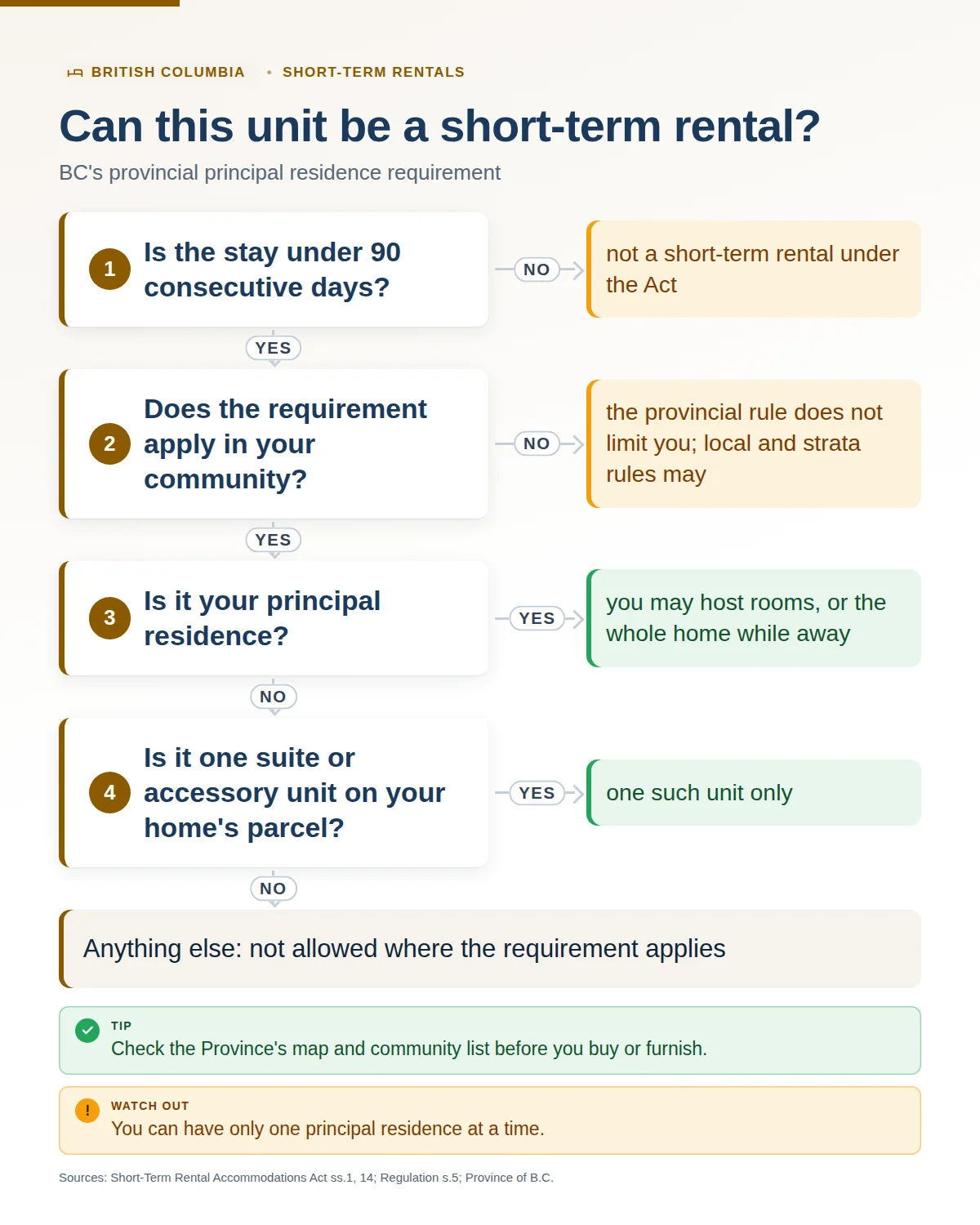
The Short-Term Rental Accommodations Act defines a short-term rental as accommodation in a host's property, offered to the public for a fee, for less than 90 consecutive days. Hotels and motels are outside the Act.
Where the principal residence requirement applies, section 14 of the Act allows short-term rentals only:
- in the host's principal residence; and
- in not more than one secondary suite or other accessory dwelling unit, which the Regulation says must be on the same parcel as the host's principal residence.
The Act defines principal residence as "the usual place where an individual makes the individual's home." The Province's registry page describes it the same way: the place where the host usually lives.
How the Province illustrates it
The provincial host registration page gives examples. Paraphrased:
- An owner living on the main floor of a house with a basement suite and a laneway home can rent her own floor while away, rooms at any time, and either the suite or the laneway home, but not both.
- A renter whose basement suite is his home can rent it while on vacation, or rent bedrooms at any time.
- An owner who lives in his house and owns five condos in the same city can host only in his house, not in any of the condos.
Where the requirement does not apply, an owner can host in other properties, such as a second apartment or a part-time cabin.
Where the requirement applies
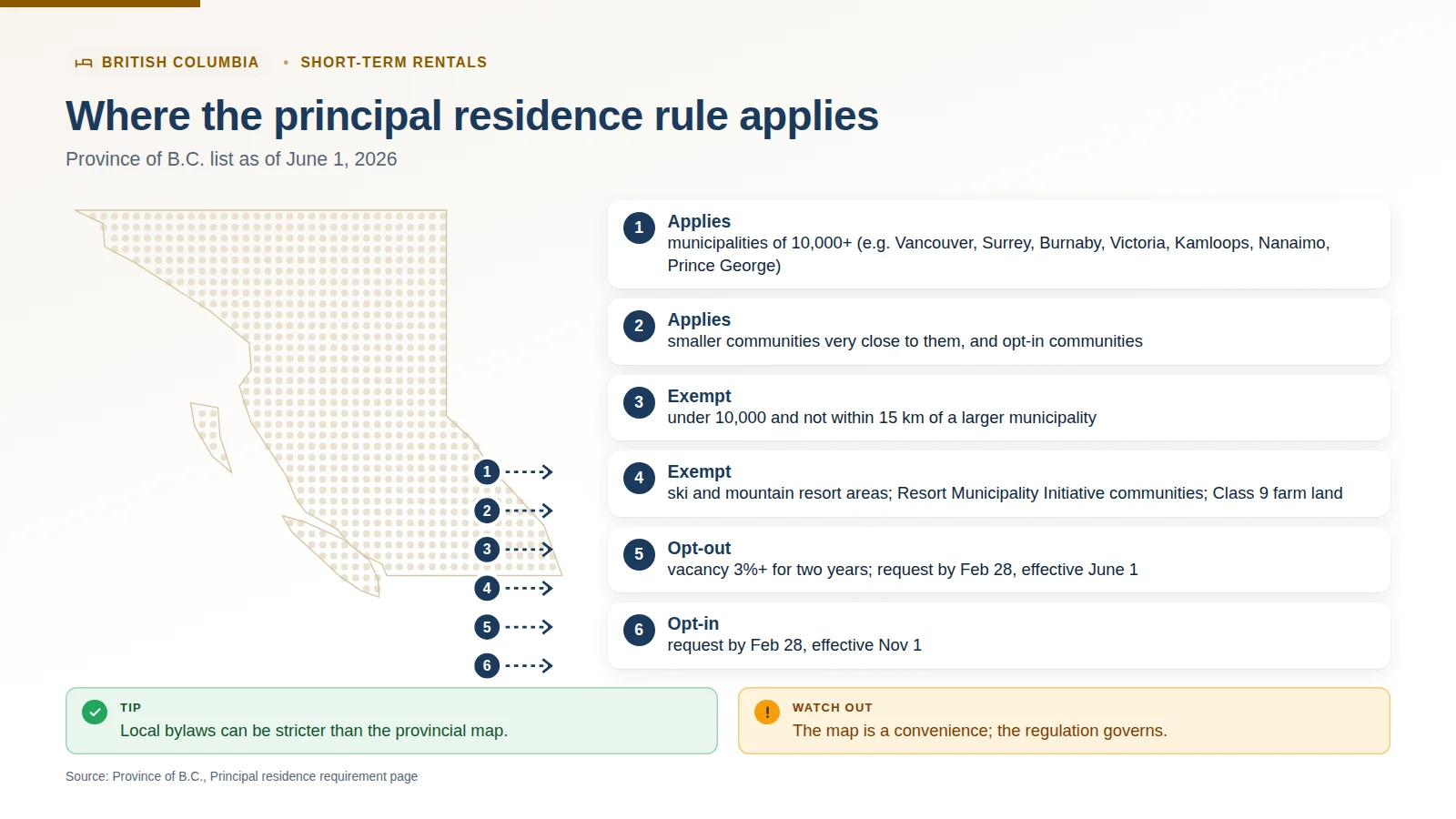
According to the Province's principal residence requirement page, the rule applies in municipalities with a population of 10,000 and over, in smaller communities very close to them, and in communities that opt in. The list, as of June 1, 2026, includes Vancouver, Burnaby, Surrey, Richmond, Victoria, Saanich, Kamloops, Nanaimo, Prince George, Abbotsford, Chilliwack, Squamish and many more.
The requirement does not apply in:
- municipalities under 10,000 people that are not within 15 km of a larger municipality;
- listed mountain resort and ski resort areas, and Resort Municipality Initiative communities;
- most regional district electoral areas and most Islands Trust areas (Salt Spring and Gabriola Islands are covered); and
- farm land assessed as Class 9 (Agricultural Land Reserve designation alone is not enough).
The map changes every year
Eligible local governments can ask to opt out if their rental vacancy rate has been 3% or more for two consecutive years; the resolution is due by February 28 and an approved change takes effect June 1. Local governments can ask to opt in by the same February 28 date, effective November 1 of that year. Check the list each spring if you own in a borderline community.
Local rules can be stricter
The provincial rule is a minimum. The Province's strata page names Kelowna, Powell River, Victoria and Vancouver as local governments that generally limit short-term rentals to principal residences through their own bylaws. Kelowna shows why you check both: it appears on the Province's list of municipalities exempt from the provincial requirement, yet its local bylaws are described as limiting rentals to principal residences.
Registration, penalties and the other layers
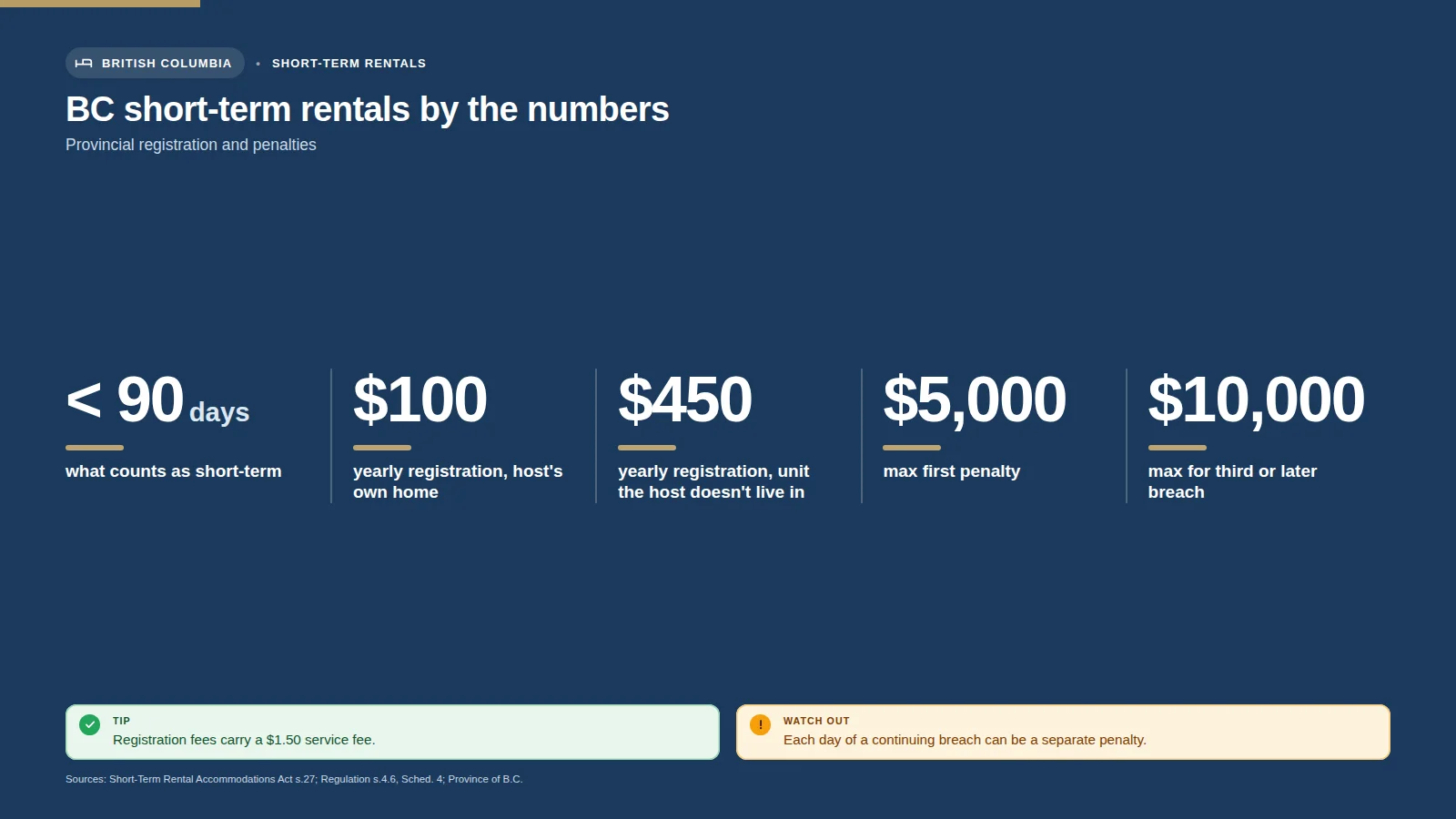
Since May 1, 2025, short-term rental hosts and platforms operating in BC must be registered with the provincial registry. Hosts must show the registration number on every listing, and platforms must validate it.
| Item | Amount or rule | Source |
|---|---|---|
| Registration, unit in the host's principal residence | $100 a year (plus a $1.50 service fee) | Regulation s.4.6; registry page |
| Registration, unit the host does not live in (including a suite or laneway home) | $450 a year (plus a $1.50 service fee) | Regulation s.4.6; registry page |
| Registration period | One year | Regulation s.4.3 |
| Penalty, breaching the principal residence requirement | Up to $5,000 first, $7,500 second, $10,000 third or later | Regulation Schedule 4 |
| Penalty, failing to register | Up to $5,000 / $7,500 / $10,000 | Regulation Schedule 4 |
| Continuing contraventions | A separate penalty may be imposed for each day | Act s.27(2) |
On top of the provincial rules, local governments may require a business licence, and the Province raised the maximum municipal ticket fine to $3,000 per infraction, per day. Stratas may limit or ban short-term rentals by bylaw, with fines of up to $1,000 a day. The Province also ended legal non-conforming use protection for short-term rentals.
Common mistakes
- Counting an investment condo as a "second home." Your principal residence is the place you usually live. In a covered community, a condo you do not live in cannot be a short-term rental.
- Listing both the suite and the laneway home. The rule allows not more than one secondary unit with your home.
- Relying on an old exemption. Non-conforming use protection no longer covers short-term rentals.
- Checking only the provincial map. City bylaws and strata bylaws can be stricter.
- Treating 90 days as a loophole for guests. Bookings of 90 days or more fall outside the short-term rental rules, but the Province warns a tenancy may be established in some circumstances, bringing the Residential Tenancy Act into play.
If you own several rentals

For an owner with units across BC, the practical question is which units can lawfully be short-term rentals, and which belong in long-term tenancy. A simple sort:
- Map each unit against the Province's community list, and note opt-in or opt-out changes each spring.
- Check local bylaws for a business licence or a stricter principal residence rule.
- Check strata bylaws for a short-term rental ban.
- Identify your principal residence. Only that home, plus one suite or accessory unit on the same parcel, can host where the rule applies.
- Move the rest to long-term tenancies under the Residential Tenancy Act, with a written tenancy agreement and a move-in inspection.
How Tenon10 helps
Tenon10 is built for long-term tenancies. When you move a unit from short-term to long-term use, it generates a BC tenancy agreement with every detail the Act requires and the standard terms copied word for word from the current Regulation, and the fillable RTB-27 Condition Inspection Report, and tracks the security deposit against the 15-day return clock.
FAQ
Does the principal residence requirement apply to renters?
The Province's examples show a renter hosting in the home they rent, such as a basement suite. Other rules, including the terms of the tenancy agreement and local bylaws, still apply.
Is a 30-day furnished rental a short-term rental?
Yes, under the Act's definition: anything under 90 consecutive days. Some local business licence rules use shorter periods, but provincial registration still applies under 90 days.
Can my city change whether the rule applies?
Yes. Eligible local governments can request to opt in or opt out each year by February 28.
What does a breach cost?
The maximum administrative penalty for breaching the principal residence requirement is $5,000 for a first contravention, $7,500 for a second repeat contravention and $10,000 for a third or later one, and a continuing breach can attract a penalty for each day.
BC Short-Term Rental Owner Checklist
A checklist for BC owners weighing short-term rentals: the principal residence rule, the community list, registration fees and penalties, local and strata rules, and moving units to long-term.
Get Free PDF →Turning a short-term unit into a long-term rental?
Tenon10 generates a BC tenancy agreement with the current standard terms and the RTB-27 inspection report and tracks the deposit return clock.
Built for Canadian landlords and property managers.
Related BC guides
- The BC Residential Tenancy Agreement (RTB-1): The Complete Landlord Guide
- The Half-Month Cap: How Much Deposit a BC Landlord Can Collect
- Fixed-Term vs Month-to-Month in BC: What Happens When the Term Ends
Sources: Short-Term Rental Accommodations Act; Short-Term Rental Accommodations Regulation; Province of B.C.: Principal residence requirement; Province of B.C.: Register as a host; Province of B.C.: Short-term rental legislation; Province of B.C.: Registration terms and conditions; Province of B.C.: Strata short-term rental bylaws; Province of B.C.: Renew your registration. This article is a summary of British Columbia rules as of October 2026, not legal advice. Check the Residential Tenancy Branch for your situation.