Since May 1, 2025, a short-term rental in BC needs a provincial registration number on every listing. Without one, platforms are not allowed to keep providing their services for the listing, and the Province can impose penalties. Registering is mostly paperwork, but it is paperwork with ID checks, proof of residence and dated deadlines.
This guide walks through who registers, what you need, what it costs, and the deadlines that follow. It also covers what a long-term landlord should know when a tenant or a property manager wants to host.
BC Short-Term Rental Registration Checklist
A step-by-step checklist for registering a BC short-term rental: per-unit registration, proof of principal residence, fees, the 8-day and 14-day deadlines and renewal 40 days before expiry.
Get Free PDF →Who must register, and how
Under section 6 of the Short-Term Rental Accommodations Act, a short-term rental offer must be registered by the supplier host responsible for it. In practice, according to the Province's host registration page, that is either:
- the property host: the person legally entitled to possession of the property who arranges the short-term rental; or
- a property manager (a "supplier host" in the Act) acting for the property host, who must supply the property host's name, contact details, date of birth and Social Insurance Number.
Registration is per unit. One registration covers a unit even if it has several listings, including separate bedrooms. A suite or accessory dwelling unit on the same property needs its own registration, and units without a kitchen, such as a guest suite, still need to register.
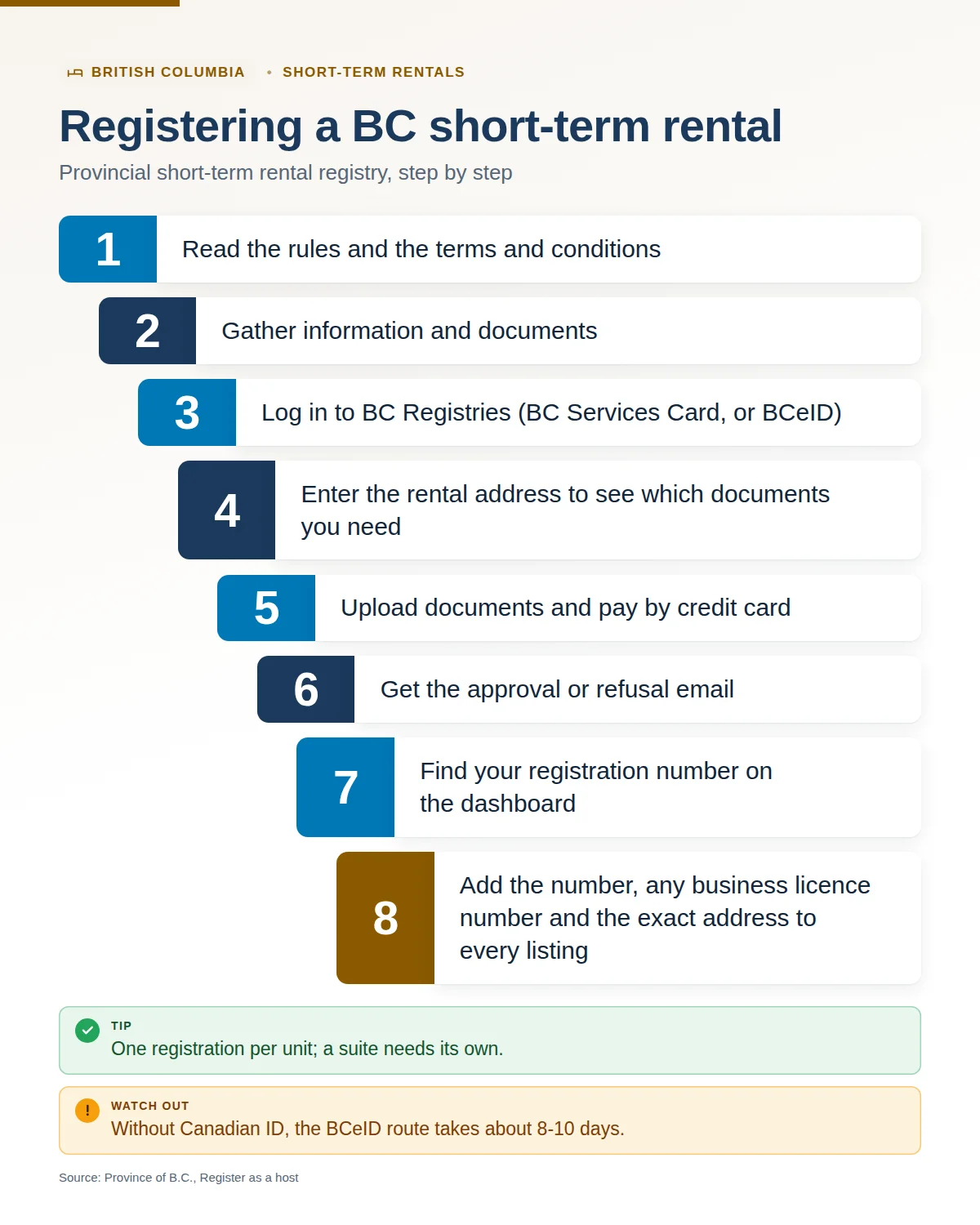
The steps
- Read the registration information and the terms and conditions.
- Gather your information and documents (below).
- Log in to a BC Registries account. With Canadian ID, you use a BC Services Card account; without it, you set up a BCeID account, which the Province says takes about 8 to 10 days and needs a notarized identity affidavit.
- Enter the rental's address, which tells you which supporting documents you need.
- Complete the form, upload documents and pay the fee by credit card.
- Wait for the approval or refusal email.
- Find your registration number on your dashboard.
- Add the registration number, any local business licence number, and the registered address to every listing.
Fees, documents and deadlines
Fees
| Type of unit | Annual fee | With $1.50 service fee |
|---|---|---|
| Your principal residence (rooms, or the whole home while you are away) | $100 | $101.50 |
| A unit you do not live in, including a suite or laneway home on your property, or a second property where the principal residence requirement does not apply | $450 | $451.50 |
The fees are set by section 4.6 of the Regulation. The Province says fees are not refunded if an application is denied, and that discounts are no longer available.
Information and documents
You will need the property's address, parcel identifier (PID), number of bedrooms and ownership type, and the property host's name, contact details, SIN and date of birth. Depending on the address, you may also need:
- Proof of principal residence where the requirement applies: one BC photo ID (driver's licence, BC Services Card, combined card or BC ID card) plus at least two supporting documents, such as a property assessment notice, property tax notice, home insurance summary, bank statement or a government letter. The name and address must match the host and the rental.
- Proof of an exemption from the principal residence requirement, such as for Class 9 farm land or a qualifying strata hotel.
- A local business licence, where your local government requires one.
A host who is a tenant must include either the residential tenancy agreement or a notice of rent increase from the landlord dated within the last year, as one of the two supporting documents.
Deadlines after you apply
| Event | Deadline | Source |
|---|---|---|
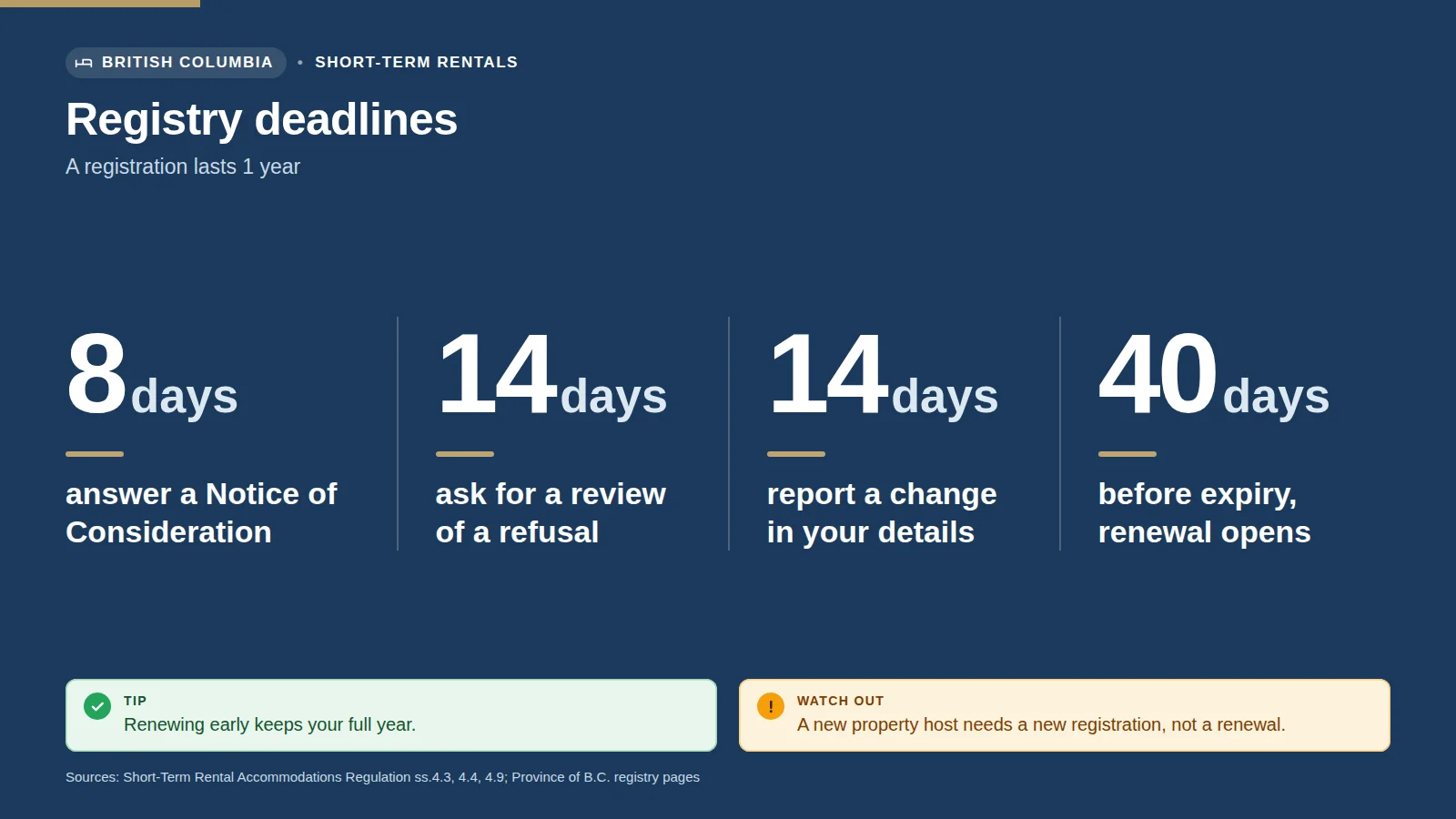
| Notice of Consideration (missing information) | 8 days from the email to respond | Registry page |
| Review of a refusal, suspension or cancellation | Within 14 days of receiving the decision | Regulation s.4.9 |
| Report a change in registration details | Within 14 days | Regulation s.4.4 |
| Registration period | One year | Regulation s.4.3 |
| Renewal window for hosts | Opens 40 days before expiry | Renewal page |
The registry sends renewal reminders 40 days, 14 days and 1 day before expiry. If the property or host details have changed, you may need a new application and a new number rather than a renewal.
Common mistakes
- One registration for a house with a suite. Each unit you rent short term needs its own number.
- A property manager registering as the property host. The Province says a manager who applies as the host must submit a new application.
- Screenshots as proof. The Province will not accept screenshots or online look-ups from BC Assessment; it wants the official mailed notice.
- Missing the 14-day change window after a change in your registration information or your principal residence status.
- Assuming registration settles everything. The registration terms require you to follow the principal residence requirement and local bylaws, and a registration can be suspended or cancelled.
For landlords and managers with several units

If you manage short-term units for owners, you are likely registering as the supplier host for each. Keep one record per unit: registration number, expiry date, business licence number and expiry, and the owner's details used on the application. Review it monthly for expiries in the next 40 days.
If you are a long-term landlord, the registry touches you in a different way. A tenant who wants to host in the home they rent can use their tenancy agreement or your notice of rent increase as proof of residence. The Province's examples note that short-term rentals may also have to follow the terms of tenancy agreements, and if the arrangement amounts to assigning the tenancy or subletting the unit, the Residential Tenancy Act requires your written consent (s.34). Talk to your tenant before an issue arises, and put any agreement in writing.
How Tenon10 helps
Tenon10 is built for long-term tenancies. It generates a BC tenancy agreement with every detail the Act requires and the standard terms copied word for word from the current Regulation, and the Notice of Rent Increase (RTB-7), the two documents a renting host may use as proof of residence.
If you decide a unit belongs in the long-term market instead, it also offers the fillable RTB-27 Condition Inspection Report for a clean move-in.
FAQ
Do I need to register a four-month furnished rental?
Not under the short-term rules. The Province says bookings over 90 days per booking do not need registration. Such a stay may be a tenancy under the Residential Tenancy Act instead.
Is the registration number the same as a city business licence?
No. They are separate. Where your local government requires a business licence, your listing must show both numbers.
How long is a registration valid?
One year. You can renew from 40 days before expiry and keep the same number if nothing has changed.
What happens if I operate without registering?
The maximum administrative penalty for a supplier host failing to register is $5,000 for a first contravention, rising to $10,000 for a third or later one, and platforms must not keep providing services for a listing without a valid number.
BC Short-Term Rental Registration Checklist
A step-by-step checklist for registering a BC short-term rental: per-unit registration, proof of principal residence, fees, the 8-day and 14-day deadlines and renewal 40 days before expiry.
Get Free PDF →Long-term rentals, done properly
Tenon10 generates a BC tenancy agreement with the current standard terms, the RTB-7 rent increase notice and the fillable RTB-27 inspection report.
Built for Canadian landlords and property managers.
Related BC guides
- The BC Residential Tenancy Agreement (RTB-1): The Complete Landlord Guide
- The BC Notice of Rent Increase (RTB-7): How to Fill It In
Sources: Short-Term Rental Accommodations Act; Short-Term Rental Accommodations Regulation; Province of B.C.: Register as a host; Province of B.C.: Renew your registration; Province of B.C.: Registration terms and conditions; Province of B.C.: Short-term rental legislation; Residential Tenancy Act. This article is a summary of British Columbia rules as of October 2026, not legal advice. Check the Residential Tenancy Branch for your situation.