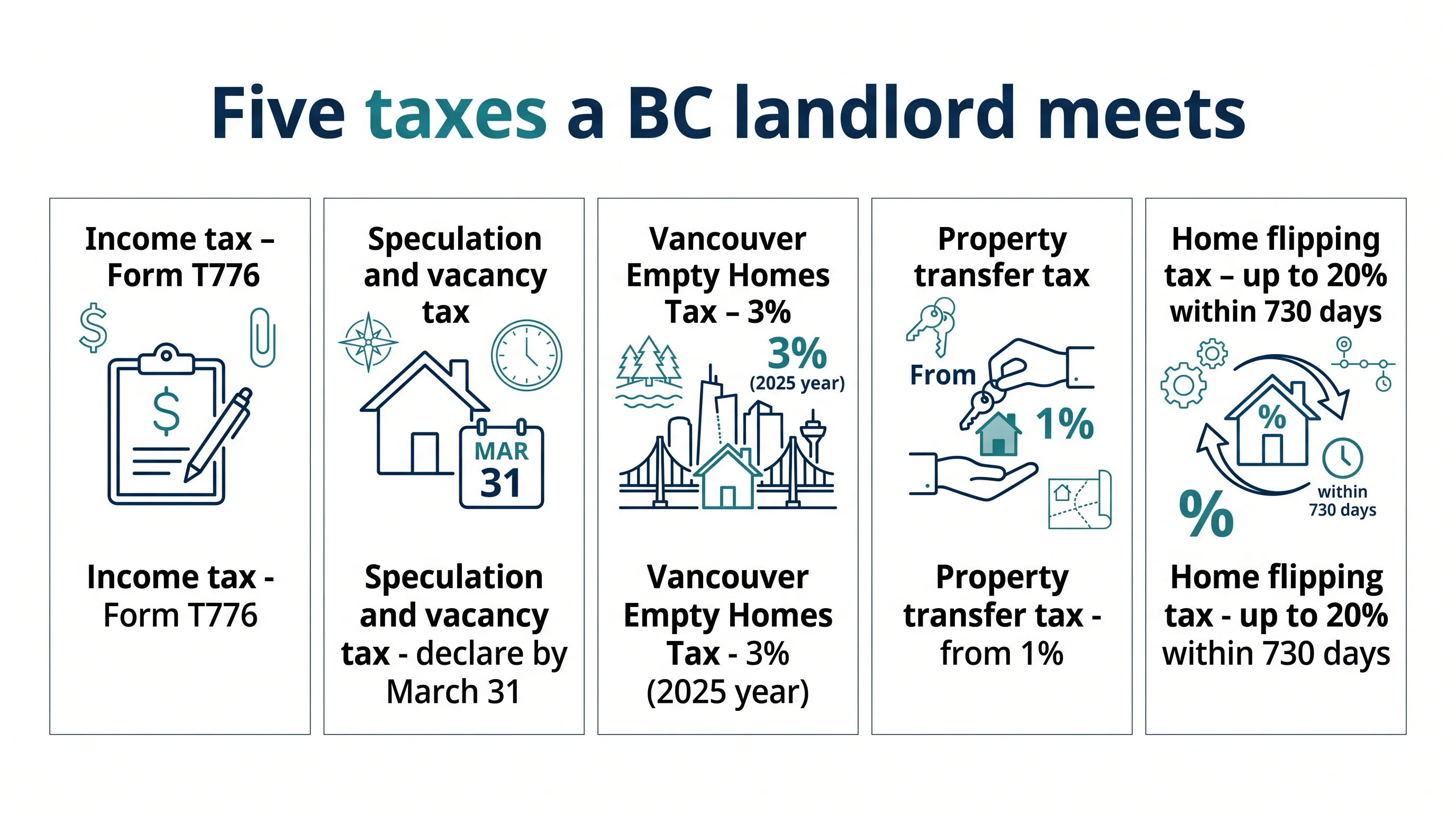
BC landlord taxes start with income tax: a landlord pays federal and provincial income tax on net rental profit, reported to the Canada Revenue Agency on Form T776. On top of that, a home in a designated area must be declared every year for the provincial speculation and vacancy tax, a Vancouver home must also be declared for the City's Empty Homes Tax, and buying or quickly reselling a rental brings property transfer tax and the BC home flipping tax.
At a glance
- Income tax: rent minus allowable expenses, reported on CRA Form T776.
- Speculation and vacancy tax (SVT): declare by March 31 every year; 2026 rates are 1% (Canadian citizens and permanent residents) and 3% (foreign owners and untaxed worldwide earners).
- Vancouver Empty Homes Tax: 3% of assessed taxable value for the 2025 reference year; a separate declaration to the City.
- Renting it out helps with both: each exempts a home rented to an arm's-length tenant for at least six months of the year, on its own conditions.
- Buying and selling: property transfer tax from 1% when you buy; the home flipping tax of up to 20% if you sell within 730 days.
This guide is the starting point for the BC Landlord Tax Series. Each section links to the deeper guide where one exists.
BC Landlord Tax Checklist
The yearly tax and declaration steps for a BC rental: income tax, the speculation and vacancy tax, Vancouver's Empty Homes Tax, and the taxes on buying and selling.
Get Free PDF →How is rental income taxed in BC?
Rental income in BC is taxed as part of your ordinary income: you report gross rents and deduct allowable expenses on Form T776, Statement of Real Estate Rentals, which you file with your personal return. The CRA's Rental Income guide (T4036, Rev. 25) sets out the rules. Our national guide to the T776 form walks through it line by line.
Four T4036 rules matter most to a BC landlord:
- Current versus capital expenses. A current expense recurs and gives a short-term benefit, so you deduct it in the year. A capital expense lasts several years, so you generally cannot deduct the full cost at once.
- Capital cost allowance (CCA). You recover capital costs over time through CCA. Rental buildings in Class 1 are depreciated at 4%.
- The half-year rule. In the year you acquire a property, you can usually claim CCA on only half of your net additions to a class.
- No CCA losses. You cannot use CCA to create or increase a rental loss.
The guide also covers co-owners, who generally report their own share, and says to keep records for six years after the end of the tax year they relate to.
Who must declare the speculation and vacancy tax?
In BC, every owner of residential property in a designated taxable area who receives a declaration letter must declare for the speculation and vacancy tax by March 31, every year, even when no tax is owed. The Province's SVT page says you cannot declare until your letter arrives, and that the tax is due on the first business day in July (July 2 in 2026).
The taxable areas include the City of Vancouver and most of Metro Vancouver, the City of Victoria and most of the Capital Regional District, and cities such as Kelowna, Nanaimo, Kamloops, Abbotsford and Chilliwack. Check your address on the Province's taxable areas page.
What are the SVT rates for 2026?
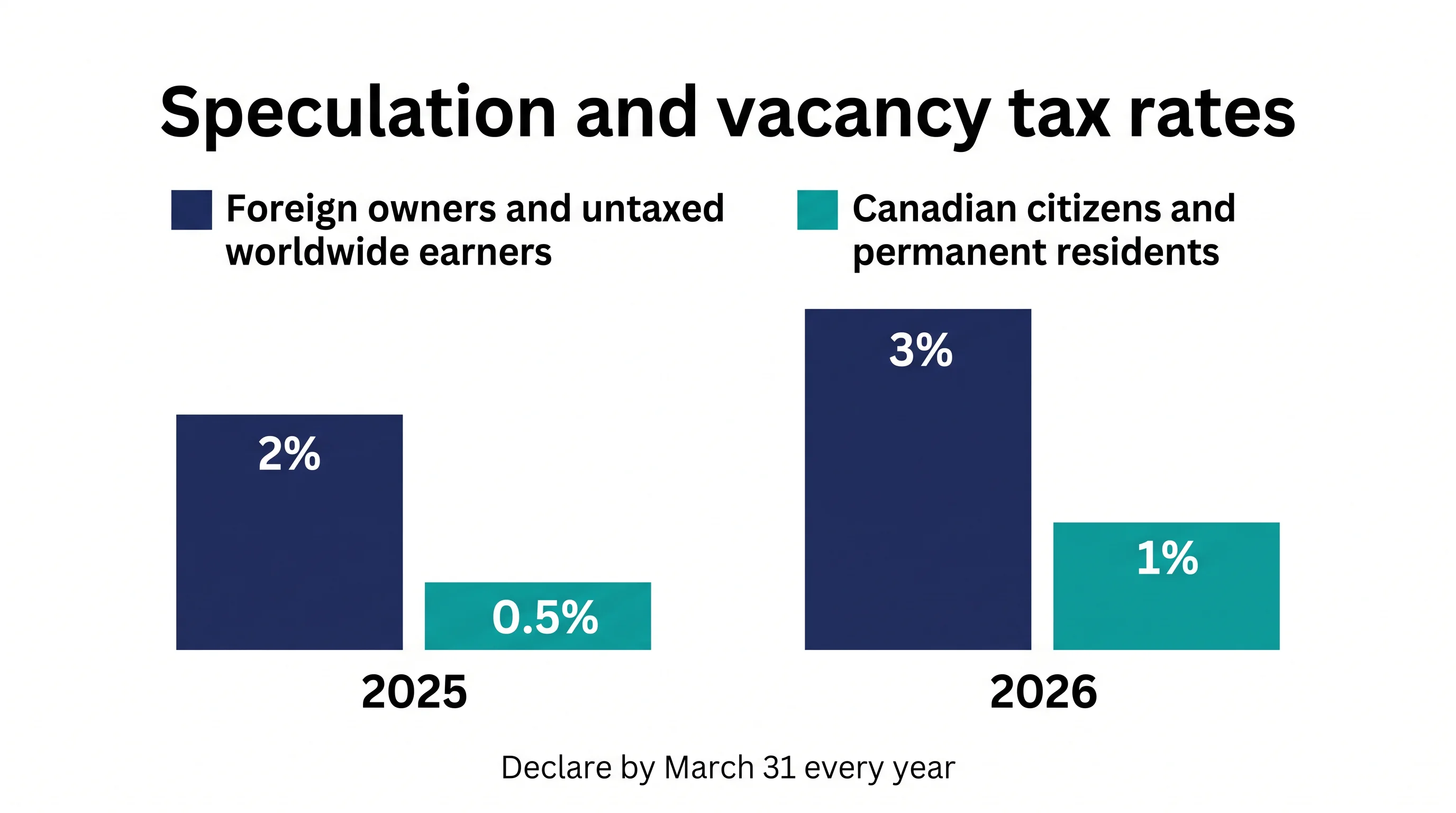
The rates rose for the 2026 tax year, according to the Province's rates page:
| Tax year | Foreign owners and untaxed worldwide earners | Canadian citizens and permanent residents |
|---|---|---|
| 2025 | 2% | 0.5% |
| 2026 | 3% | 1% |
For the 2027 tax year, the Province has already set 4% for foreign owners and untaxed worldwide earners, with 1% unchanged for Canadian citizens and permanent residents. The rate is applied to the property's assessed value, based on who owned it on December 31. Co-owners each pay on their share, and a corporation or trust pays at the highest rate that applies to any of its interest holders.
Does renting the home out exempt it?
Usually, yes. A home is exempt when a tenant occupies it for at least six months of the calendar year and each tenancy meets the Province's tenancy requirements. For an arm's-length tenant, that means a written tenancy agreement under the Residential Tenancy Act, rentals in at least one-month increments, and a tenant who makes the home their home. Our spoke guide covers the declaration in detail.
Does Vancouver charge its own empty homes tax?
Yes. A home in the City of Vancouver needs a separate Empty Homes Tax declaration to the City every year, in addition to the provincial SVT. For the 2025 reference year, the City charged 3% of the property's 2025 assessed taxable value on homes deemed, determined or declared empty, with declarations due February 3, 2026 and payment due April 16, 2026, according to the City's Empty Homes Tax page.
The City says a property is not taxed if it was rented to an arm's-length tenant for residential purposes for at least six months of the year, in periods of 30 or more consecutive days. As of October 24, 2026, the City had not yet posted the declaration deadline for the 2026 reference year, so check its page early in the new year.
What taxes apply when you buy or sell a rental in BC?
When you buy a BC rental, you pay property transfer tax (PTT) when the transfer is registered at the Land Title Office. The general rates on the Province's PTT page are:
| Part of the fair market value | PTT rate |
|---|---|
| Up to and including $200,000 | 1% |
| Over $200,000 up to and including $2,000,000 | 2% |
| Over $2,000,000 | 3% |
| Residential value over $3,000,000 | A further 2% |
Foreign nationals, foreign corporations and taxable trustees pay an additional PTT on the residential portion of property in specified areas of BC.
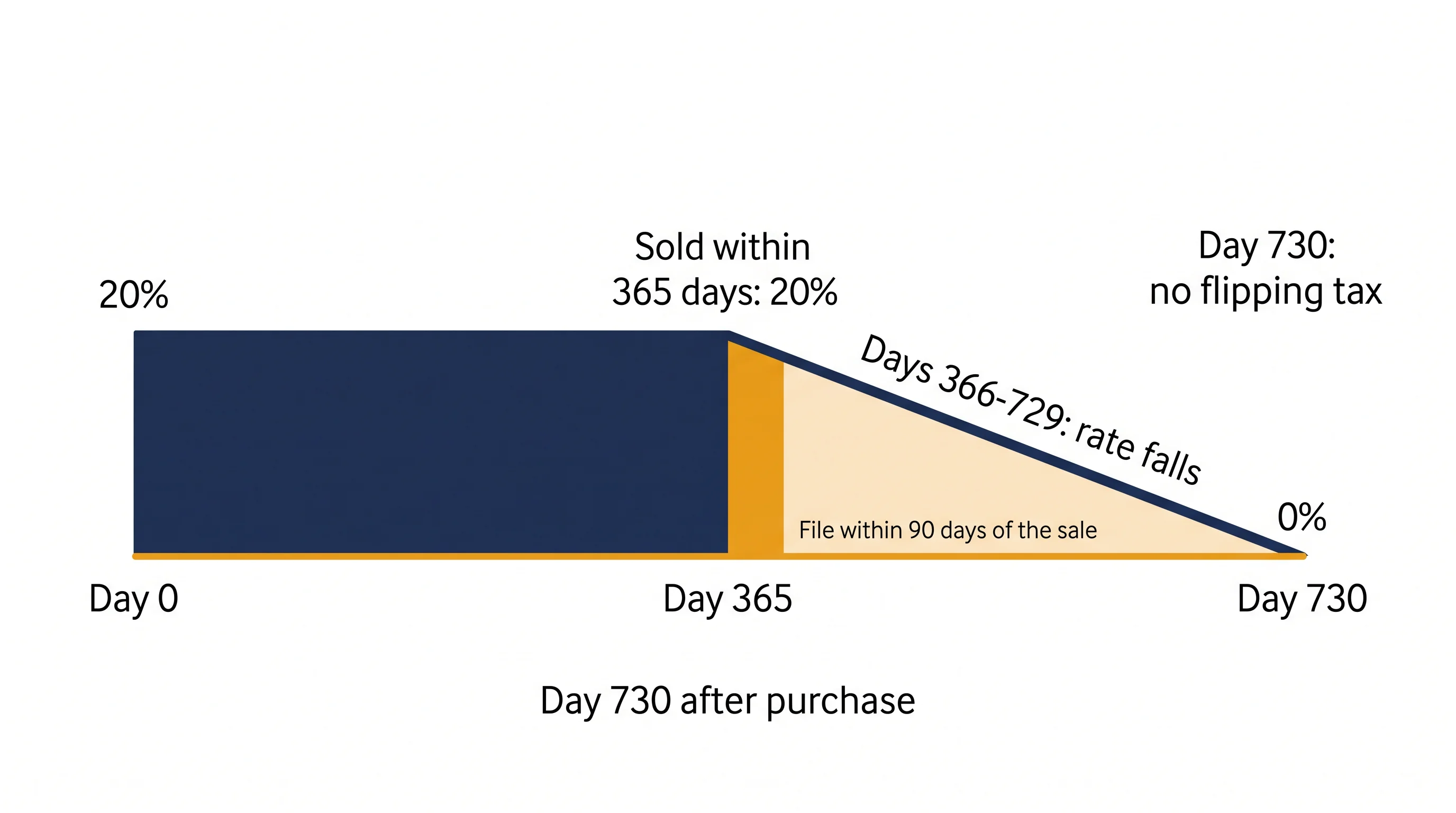
When you sell quickly, the BC home flipping tax may apply. Since January 1, 2025 it taxes the profit from selling residential property owned for less than 730 days: 20% of net taxable income for a property sold within 365 days, falling gradually to zero at 730 days. If you are subject to it, you file a return within 90 days of the sale. It applies on top of income tax.
Common tax mistakes BC landlords make
- Skipping the declaration because the home is rented. An exemption still has to be claimed. Missing the City of Vancouver deadline means the home is deemed vacant and taxed at 3%, plus a $250 by-law ticket.
- Counting a vacancy as rented. Neither tax exempts a home that sat empty while listed for rent; the six months must actually be tenanted.
- Using a short licence instead of a tenancy. The SVT exemption needs a written agreement under the Residential Tenancy Act; Vancouver needs periods of 30 or more consecutive days.
- Deducting a renovation in one year. A capital improvement is added to the CCA class, not written off as a repair.
- Forgetting the flipping tax on a short hold. Selling a rental within two years of buying can trigger it, even if you never lived there.
How Tenon10 helps
Tenon10 creates the BC tenancy agreement, so every rental starts with the written agreement the SVT tenancy exemption asks for. It runs move-in and move-out inspection reports, tracks deposits and their return dates, sends rent reminders, and keeps trust ledgers for BC property managers. If you manage for owners, see our guide to trust accounting for BC property managers. Short-term hosts should also read BC's principal residence requirement.
Frequently asked questions
Do I pay both the SVT and the Vancouver Empty Homes Tax?
You may. The City of Vancouver says the provincial speculation and vacancy tax is in addition to its Empty Homes Tax. A Vancouver home needs both declarations each year, and a home that is exempt from one is not automatically exempt from the other.
What SVT rate will I pay for 2026?
For the 2026 tax year, the Province lists 1% for Canadian citizens and permanent residents and 3% for foreign owners and untaxed worldwide earners. The rate applies to the assessed value of your share, and many owners are fully exempt.
Does a family member living in my condo count as a tenant?
For the SVT, a non-arm's-length tenant can count toward the six months, with separate conditions, but your spouse, or your minor child living with their parent or guardian, can never be a tenant. Read the Province's tenancy requirements before you declare.
Can I claim CCA to reduce other income?
No. The CRA's T4036 says you cannot use capital cost allowance to create or increase a rental loss. CCA can only reduce rental income to zero.
Does the flipping tax apply to a rental I hold for three years?
No. The BC home flipping tax applies only to residential property held for less than 730 days. A sale after that is taxed under the ordinary income tax rules.
Every BC landlord's tax year has the same skeleton: report the rent on T776, declare for the SVT by March 31, declare to the City of Vancouver if the home is there, and plan any sale around the flipping-tax window. If you are setting up a new rental, start with the BC tenancy agreement guide, and if you own a condo, renting out a strata unit.
BC Landlord Tax Checklist
The yearly tax and declaration steps for a BC rental: income tax, the speculation and vacancy tax, Vancouver's Empty Homes Tax, and the taxes on buying and selling.
Get Free PDF →Start every BC rental with the right paperwork
A written tenancy agreement and a move-in inspection report are the records tax exemptions and the RTB both rely on.
Free • No signup required