VICTORIA, Oct. 25, 2026: Preliminary results from BC's October 24 provincial election show the Conservative Party of BC leading in 64 of 93 electoral districts, more than the 47 seats needed for a majority. The results are not final: Elections BC's final count is planned for November 6 to 10. Nothing in BC's rental law changes on election night, and the Conservative platform makes no commitment on the Residential Tenancy Act.
What are the preliminary BC election results?
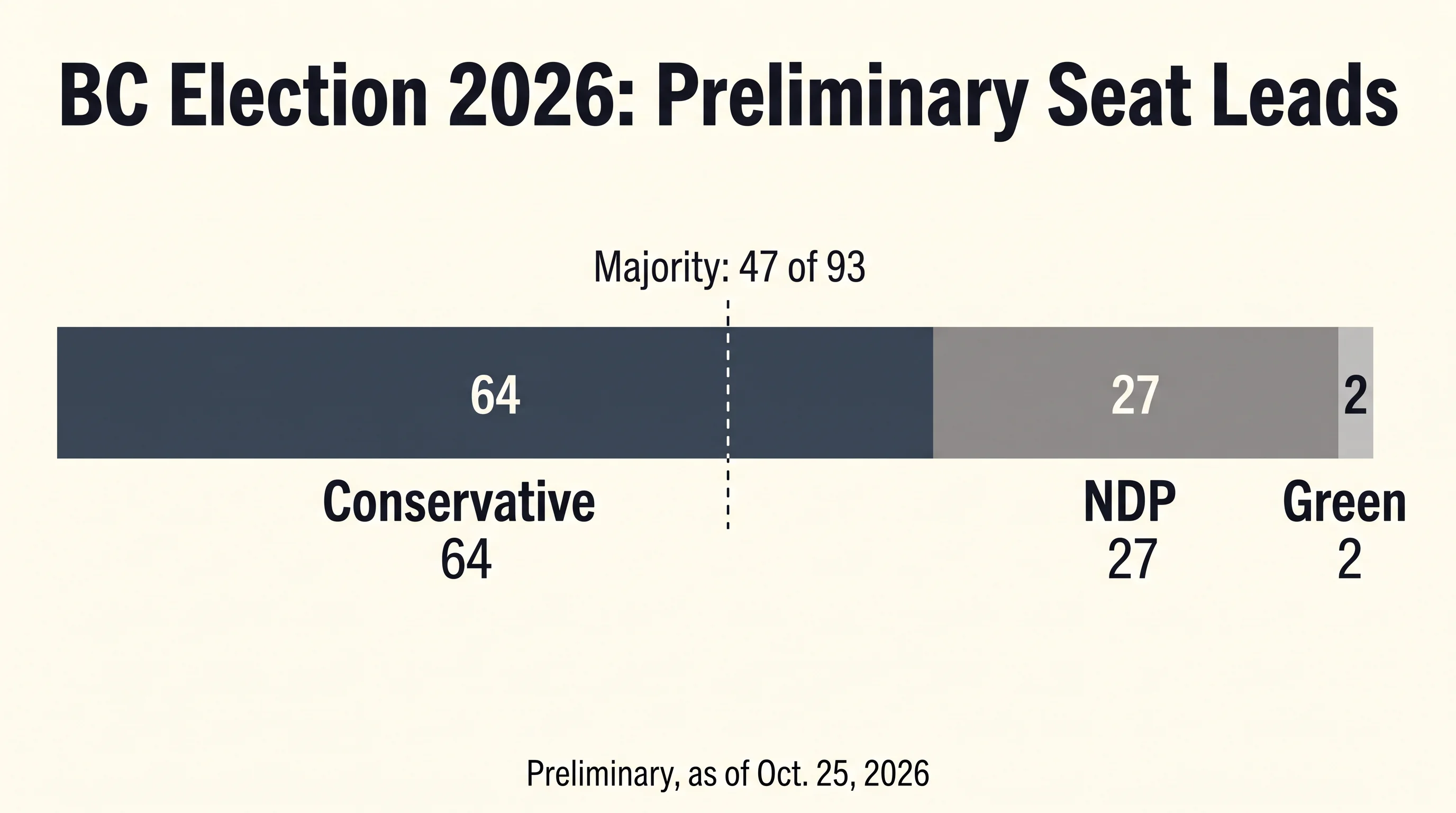
As of 01:49 PST on October 25, with 99.57% of ballot boxes reporting, Elections BC's event-night results show these leads:
| Party | Districts leading | Share of vote |
|---|---|---|
| Conservative Party of BC | 64 | 48.05% |
| BC NDP | 27 | 37.38% |
| BC Green Party | 2 | 10.97% |
| All other parties and candidates | 0 | 3.60% |
CentreBC took 1.62% and OneBC 1.51%. Elections BC reports 1,796,615 votes considered and a preliminary turnout of 48.06%.
When will the BC election results be final?
BC's results become final only after the final count, which the Elections BC 2026 election page lists as November 6 to 10, 2026 (planned), with Return Day on November 18. Vote-by-mail, assisted telephone and absentee ballots are not counted on election night; Elections BC counts them about two weeks later, after extra integrity checks.
Six districts had not finished their initial count at 01:49 PST: Fraser-Nicola, Langford-Highlands, North Island, Prince George-North Cariboo, Salmon Arm-Shuswap and Vancouver-South Granville. Their counts continue this morning.
Two districts are close enough to be recounted automatically. Under the Elections BC Guide to Voting and Counting, all ballots in a district are recounted when the top two candidates are 100 votes or fewer apart at the end of initial count:
- Burnaby South-Metrotown: BC NDP 5,811, Conservative 5,745, a gap of 66 votes.
- Ladysmith-Oceanside: Conservative 13,418, BC NDP 13,329, a gap of 89 votes.
What has the Conservative Party of BC promised on rental housing?
The party's 2026 platform, Lorne Doerkson's Plan for a Stronger BC, makes housing-supply commitments but none on tenancy rules. Its housing items are:
- Construction costs (p. 5): "Cut construction taxes and charges" and "scrap unnecessary charges that add to construction costs."
- Approvals (p. 6): "Approve homes in months, not years," and work with municipalities "so zoning bylaws match official community plans."
- Density (p. 6): "Give local governments a say in deciding where density goes," holding municipalities to locally developed Official Community Plans.
- Building code (p. 6): overhaul the step code and "simplify and harmonize the building code."
- Multigenerational homes (p. 7): a provincial tax credit matching the federal one for families creating self-contained living space for senior relatives.
- Farms (p. 18): allow "limited short-term rentals supporting agri-tourism."
The platform does not mention the Residential Tenancy Act, the Residential Tenancy Branch (RTB), the annual rent increase limit, deposits, evictions, the Speculation and Vacancy Tax or the short-term rental principal residence requirement.
Separately, the BC SPCA has asked parties and candidates to commit to updating housing legislation so families with pets have equal access to housing (BC SPCA, October 14, 2026). That is an advocacy request, not a party position. Today, a BC tenancy agreement may still prohibit or restrict pets (RTA s.18(1)), a pet damage deposit is capped at half a month's rent (s.19(1)), and both rules are subject to the Guide Dog and Service Dog Act (s.18(3)). Our guide to pets in BC rentals covers the detail.
What does not change for BC landlords and tenants now?
BC's rental laws stay in force until the Legislature or cabinet changes them:
- The 2027 rent increase limit is 2.2%, effective January 1, 2027 (news release, August 27, 2026). It comes from the standing formula in the Residential Tenancy Regulation, s.22 (percentage amount = inflation rate). A future cabinet could change that regulation, but only from the date of the change. See the 2027 limit for landlords and the renter's guide.
- Notice rules: rent can rise only once every 12 months, with at least three months' notice on the approved form (RTA s.42).
- The RTB process and forms are unchanged; disputes still go through the RTB's dispute resolution process.
- Bill 11 (Residential Tenancy Amendment Act, 2026): its supportive-housing provisions, RTA ss.4.4 to 4.9, still come into force December 1, 2026 under B.C. Reg. 144/2026, as shown in the RTA table of legislative changes.
- Speculation and Vacancy Tax: the 2027 rates, set from January 1, 2027, are 4% for foreign owners and untaxed worldwide earners and 1% for Canadian citizens and permanent residents (SVT tax rates).
- Short-term rentals: the principal residence requirement still applies in municipalities of 10,000 people and over and some smaller neighbouring communities (principal residence requirement). Our short-term rental guide explains it.
What it means for landlords
For BC landlords, the preliminary result changes no current obligation. Rent increases for 2027 remain capped at 2.2%, served on the approved form with at least three months' notice. The platform's supply measures would matter mainly to owners planning to build, once acted on.
What it means for tenants
For BC tenants, every Residential Tenancy Act protection still applies. A tenant who receives a 2027 rent increase above 2.2%, or one given with less than three months' notice, can still contact the RTB or apply for dispute resolution.
What to do now
- Treat every seat count as preliminary until the final count (November 6 to 10, planned) and Return Day (November 18).
- Keep serving notices and handling disputes under the current RTA and RTB forms.
- Watch for three dates that have not yet been announced: the swearing-in of a new cabinet, the throne speech and the start of the next legislative session. Election-night counts do not by themselves change the government: in the 2017 precedent recorded by the Legislative Assembly, the incumbent government stayed in office until the Premier resigned. The timing of any transition has not been announced.
The rules haven't changed, so keep your paperwork current
Create a BC tenancy agreement, run move-in and move-out inspection reports, and track deposits and their return dates in Tenon10.
Free • No signup required