In British Columbia, a landlord can ban pets or limit their size, kind and number through the tenancy agreement, and can take one pet damage deposit of up to half a month's rent when pets are allowed. Guide and service dogs are not pets: a landlord cannot refuse a guide or service dog team or charge a pet deposit for the dog.
The rules come from section 18 of the Residential Tenancy Act (RTA), the Guide Dog and Service Dog Act and the Human Rights Code. This guide covers what a pet clause can say, how it is enforced, the pet damage deposit, and where assistance animals fit, for landlords and tenants alike. Pet terms go in the BC tenancy agreement.
At a glance
- No-pet clauses are allowed, as are limits on size, kind and number (RTA s.18(1)).
- One pet damage deposit per tenancy, however many pets, capped at half a month's rent (ss.19(1), 20(d)).
- Guide and service dogs cannot be refused or restricted (Guide Dog and Service Dog Act s.3(2)), and need no pet deposit (RTB).
- Certification is voluntary; the RTB says a landlord can't reject a tenant because the dog isn't certified.
- A pet clause is enforced by a breach letter, then a One Month Notice if it is a material term (RTB Policy Guideline 28).
BC Pet Clause Checklist
Write, approve and enforce pet terms in a BC tenancy without tripping the Guide Dog and Service Dog Act.
Get Free PDF →Can a BC landlord ban pets?
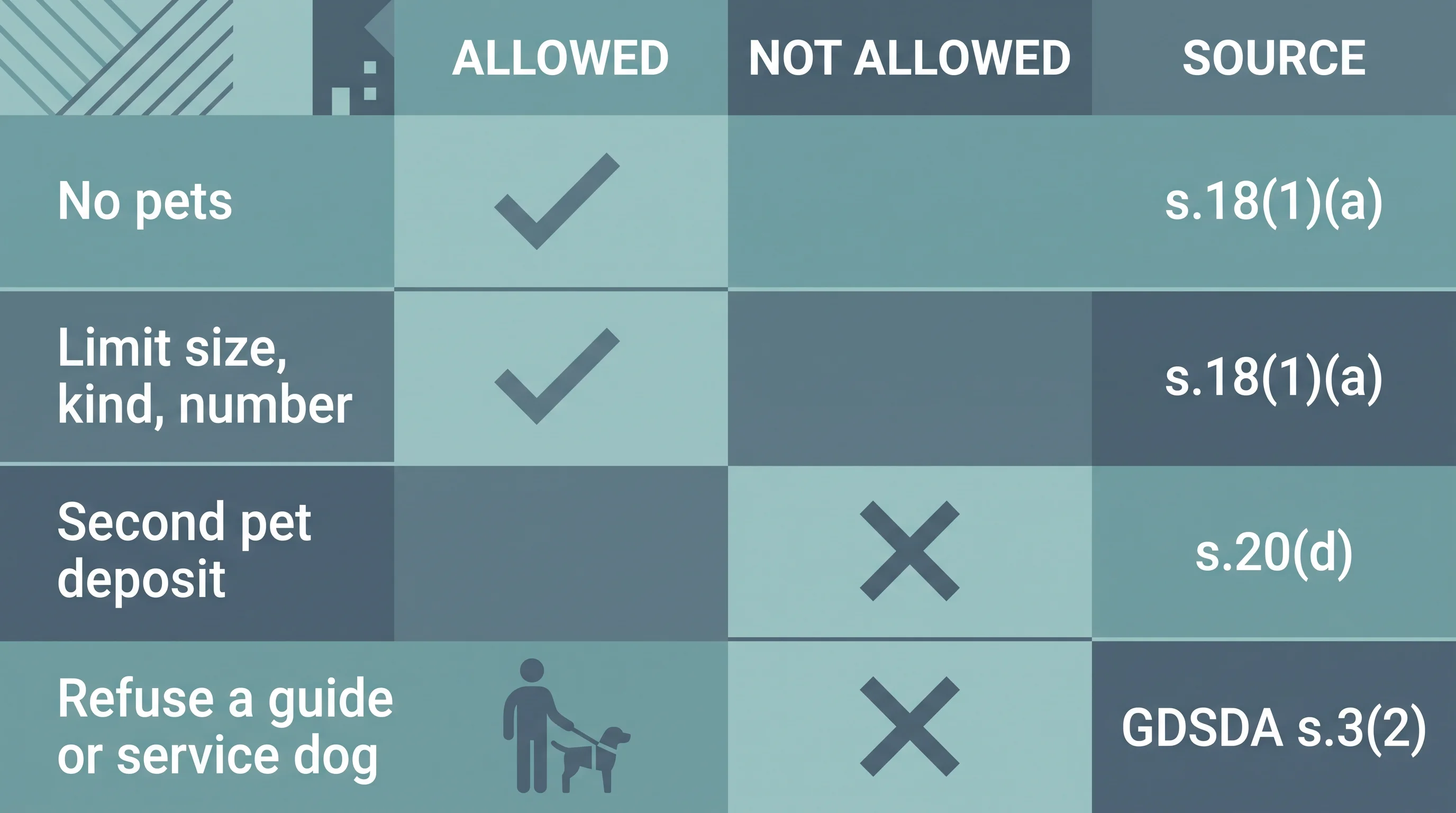
Yes. In BC, section 18(1) of the RTA lets a tenancy agreement prohibit pets, restrict the size, kind or number of pets, and set the tenant's obligations for keeping a pet. The RTB's pets page adds that landlords are not required to change a no-pets clause because a tenant later wants a pet.
That power has two limits written into the law. Section 18(3) makes it subject to the Guide Dog and Service Dog Act, and standard term 3 in every BC tenancy agreement repeats it. The Human Rights Code also applies to tenancy (Code s.10). A pet clause, like any term, must be clear and not unconscionable to be enforceable (RTA s.6(3)).
| Pet term | Allowed in BC? | Source |
|---|---|---|
| No pets at all | Yes | RTA s.18(1)(a) |
| Limit on size, kind or number | Yes | RTA s.18(1)(a) |
| Rules for keeping a pet (waste, noise, leashes) | Yes | RTA s.18(1)(b) |
| Asking for pet documents such as vaccination records | Yes, the RTB says landlords can ask | RTB pets page |
| A second pet damage deposit for a second pet | No | RTA s.20(d) |
| Refusing or restricting a guide or service dog | No | Guide Dog and Service Dog Act s.3(2) |
Allowing a pet after the tenancy starts
A landlord can agree to a pet partway through a tenancy. The RTB says the change should be in writing, either as a separate agreement or as a note on the original agreement initialled by both. It also warns that if a tenant can prove the landlord agreed out loud, the landlord may not be able to enforce the restriction. Guideline 28 calls it "always acceptable and advisable" to write down and sign an agreement that a particular pet is acceptable.
How does a BC landlord enforce a no-pet clause?
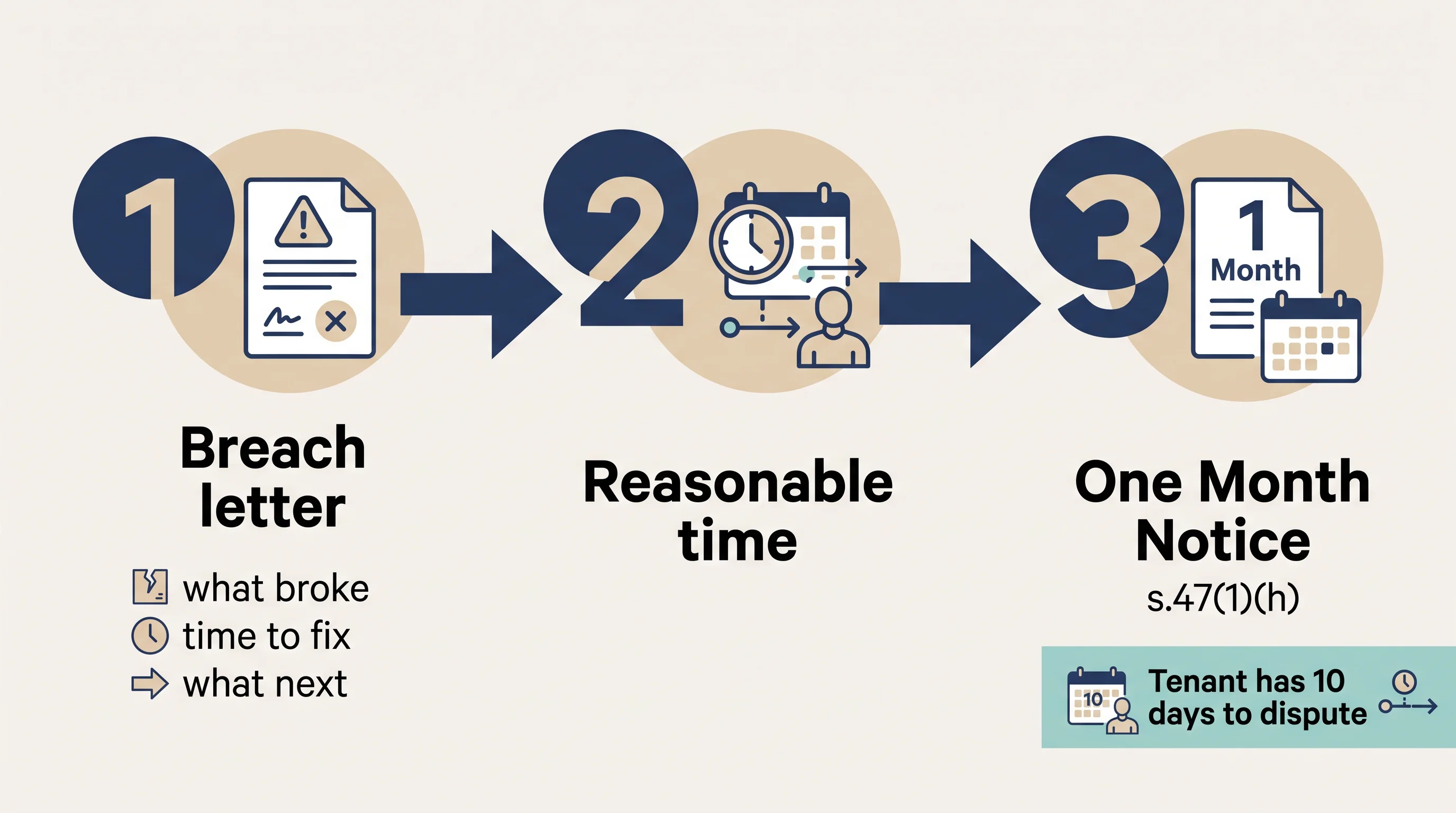
In BC, a landlord who finds a pet in breach of the clause usually gives the tenant written notice to remove it, then may serve a One Month Notice for breach of a material term if the tenant does not fix it within a reasonable time (RTA s.47(1)(h); Guideline 28). For a term that is not material, the landlord can instead apply for an order that the tenant comply.
The RTB calls the written notice a breach letter, and says it must explain how the agreement has been broken, how much time the tenant has to remove the pet, and what will happen if they don't. If the tenant disputes the notice, an arbitrator decides whether the clause is material. Guideline 28 says the agreement can label the pet clause a material term, which is important but not always conclusive, and that a clause catching trivial breaches may not be found material.
Waiting can cost you the breach
Guideline 28 says a landlord's mere delay does not stop them insisting on the clause later, but a delay may suggest the clause is not material. A landlord who knows about the pet and does something that clearly shows it is acceptable may waive the right to end the tenancy for that breach.
Problem pets, with or without a clause
Even where pets are allowed, a pet can lead to a One Month Notice if it causes extraordinary damage, unreasonably disturbs others or threatens safety (s.47(1)(d) to (f)), or causes damage the tenant does not repair within a reasonable time after written notice (s.47(1)(g)). See The One Month Notice to End Tenancy for Cause in BC (RTB-33) for how that notice works and the tenant's 10 days to dispute it.
How do pet damage deposits work in BC?
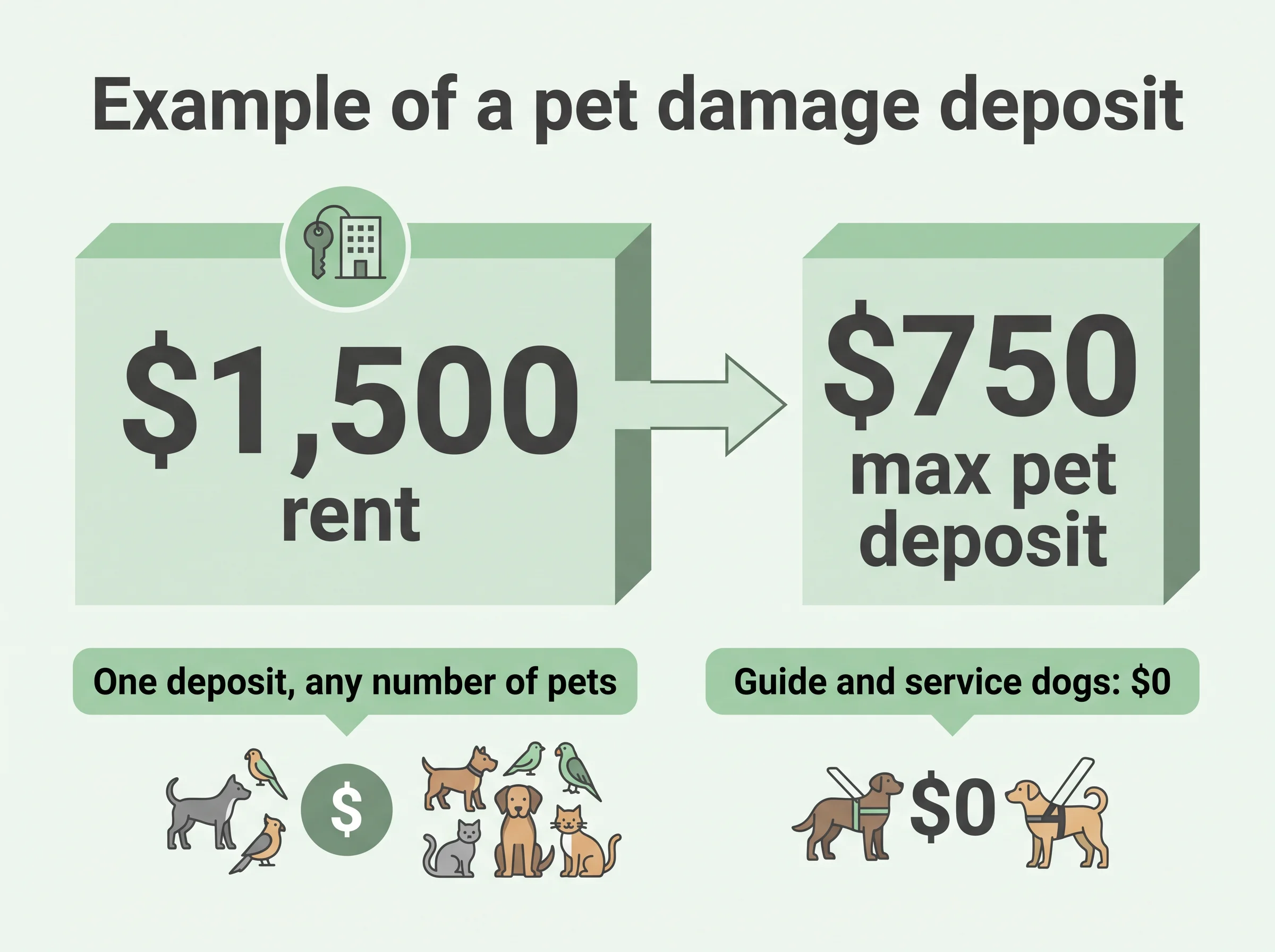
In BC, a landlord who allows a pet may require one pet damage deposit of no more than half of one month's rent, no matter how many pets are allowed (RTA ss.18(2), 19(1), 20(d)). It can be required only when the agreement is signed or when the landlord agrees to a pet later (s.20(c)).
Three points that catch people out:
- It is separate from the security deposit. Each can be up to half a month's rent, so together they can reach one month's rent. The details are in The Half-Month Cap: How Much Deposit a BC Landlord Can Collect.
- It covers pet damage only. When a landlord keeps part of it, the pet damage deposit may be used only for damage caused by a pet, unless the tenant agrees otherwise (s.38(7)).
- It is not returned early. The RTB says a landlord does not have to return it before the tenancy ends if the pet dies or leaves. It is returned, with any interest, under the usual 15-day rule; see BC Security and Pet Damage Deposits: The Complete Landlord Guide.
Can a BC landlord refuse a guide dog, service dog or other assistance animal?
No, not a guide or service dog. In BC, the Guide Dog and Service Dog Act s.3(2) says a person must not deny a rental unit to a guide dog team, service dog team or retired team, or impose a tenancy term that discriminates because the person intends to keep the dog in the unit. Breaking that rule is an offence with a fine of up to $3,000 (s.8).
The RTB's pets page sets out what this means in practice:
- Guide and service dogs are not pets, so no pet damage deposit can be required for them.
- Restrictions on guide or service dogs aren't allowed, so a no-pets clause does not apply to them.
- Certification is voluntary in BC, and a landlord can't reject someone as a tenant just because the dog isn't certified.
- Landlords also have a duty under the Human Rights Code to accommodate tenants who rely on a guide or service dog because of a disability.
There is one narrow exception. Section 3(3) says the refusal rule does not apply where the advertisement says the unit may involve sharing sleeping, bathroom or cooking facilities with someone from another family. Falsely representing a dog as a guide or service dog is itself prohibited (s.4).
Other assistance animals
BC's tenancy law has no separate category for emotional support or other assistance animals. A request linked to a disability falls under the Human Rights Code, which bars discrimination in tenancy because of physical or mental disability (s.10(1)), and the Guide Dog and Service Dog Act says nothing in it reduces the Code (s.1.1). The conservative course for a landlord is to treat such a request as a possible accommodation request, consider it individually, and keep a written record of the discussion rather than relying on the pet clause alone.
Frequently asked questions
Can my BC landlord make me get rid of my pet?
Only if your agreement prohibits or restricts it, or the pet causes damage, disturbance or safety problems. The landlord usually sends a written breach letter first and may then serve a One Month Notice, which you can dispute within 10 days (RTA s.47(4)).
How much is a pet deposit in BC?
No more than half of one month's rent, and only one pet damage deposit per tenancy regardless of the number of pets (RTA ss.19(1), 20(d)). On $1,500 rent, the RTB's example cap is $750.
Does a no-pets clause apply to a service dog in BC?
No. The Guide Dog and Service Dog Act bars refusing a rental unit to a guide or service dog team or imposing a discriminatory term, and the RTB says no pet deposit may be required for these dogs.
Does a service dog have to be certified in BC?
No. The RTB says certification is voluntary, and a landlord can't reject a tenant just because their guide or service dog isn't certified.
My landlord said yes to a cat on the phone. Is that enough?
It may be, if you can prove it: the RTB says a proven verbal agreement may stop the landlord enforcing the restriction. A written note initialled by both of you is far safer.
BC Pet Clause Checklist
Write, approve and enforce pet terms in a BC tenancy without tripping the Guide Dog and Service Dog Act.
Get Free PDF →Conclusion
BC gives landlords real control over pets through the tenancy agreement, but it stops at guide and service dogs and at the Human Rights Code. Write the pet terms clearly, put every approval in writing, inspect when a pet arrives, and treat disability-related requests as accommodation questions rather than pet questions.
Put your pet terms in a BC tenancy agreement
Tenon10 creates the BC tenancy agreement, tracks deposits and their return dates, and runs move-in and move-out inspection reports.
Free BC form • Built for Canadian landlords