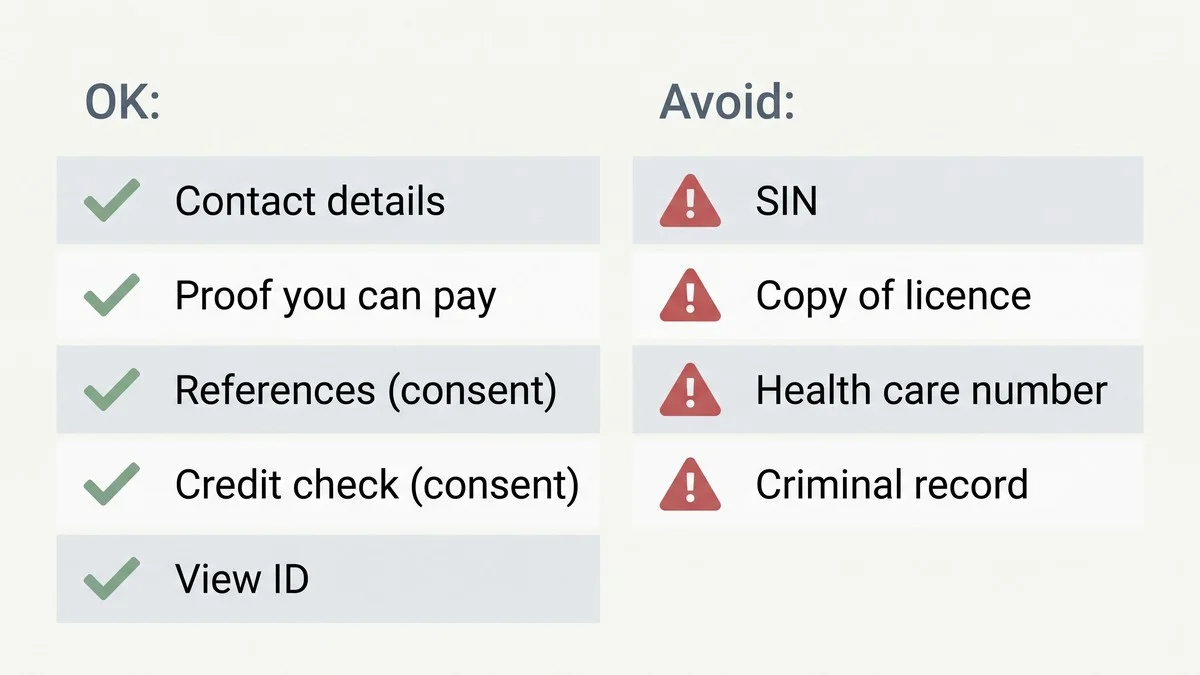
Under PIPA, an Alberta landlord may ask on a rental application only for the personal information reasonably needed to decide whether to rent, such as proof of ability to pay, references and contact details, and must say why. The privacy commissioner advises against collecting a SIN, copying a driver's licence or asking for a health care number.
The Personal Information Protection Act applies to anyone renting out all or part of a property for profit, including individual landlords (OIPC Landlords and Tenants: Guidance on PIPA).
What can an Alberta landlord ask on a rental application?
| Question | OIPC position |
|---|---|
| Name, contact details | Yes, needed to reply |
| Income or proof you can pay | Yes, reasonable |
| Landlord references | Yes, with consent |
| Credit report | Yes, with consent (also required by the Consumer Protection Act) |
| See photo ID | Yes; view it and hand it back |
| Photocopy of driver's licence | Likely over-collection |
| SIN | Avoid: name and date of birth produce a credit report in nearly all cases (Order P2012-11) |
| Criminal record | May not be reasonable; be ready to justify it |
| Health care number | Not reasonably required |
| Educational background | Not needed to rent (the OIPC's own example under s.7(2)) |
| Names of other occupants | Yes, even if they are not on the lease |
The test behind every row is the same. PIPA defines "reasonable" as what a reasonable person would consider appropriate in the circumstances (s.2), and a landlord may collect only the amount and type of information reasonably required for the purpose (s.11). If you would not use an answer to decide on the application, leave the question off the form; you can ask for it later if it becomes necessary.
What does PIPA require after you collect it?

- No forced consent: renting cannot be conditional on consent to collect more than is necessary (s.7(2)).
- Protect it with reasonable security (s.34).
- Destroy it when no longer reasonably required (s.35). The OIPC says credit reports and applications need not be kept after move-out.
- Give access: tenants may ask to see their information and request corrections.
Two more duties catch landlords out. Information collected for one purpose may be used and disclosed only for that purpose (s.16, s.19); the OIPC's example is a landlord who collected tenants' emails for building newsletters and then sent them marketing for another business, which PIPA does not allow. And if information is lost or accessed without authority in a way that a reasonable person would see as a real risk of significant harm, the landlord must notify the people affected and report the breach to the OIPC (s.34.1). An email of a tenant's file sent to the wrong contractor is the kind of incident the OIPC has treated as a reportable breach.
Is a question also a human rights issue?

Yes. The Alberta Human Rights Act bars refusing a self-contained unit because of grounds including source of income, family status, age and marital status. Lease basics: Alberta residential leases; the full rulebook: Alberta landlord guide.
The OIPC adds that collecting information about a protected ground is usually not a purpose a reasonable person would consider appropriate, so it is not authorized under PIPA either. Section 5 of the Human Rights Act lists race, religious beliefs, colour, gender, gender identity, gender expression, physical disability, mental disability, age (with exceptions), ancestry, place of origin, marital status, source of income, family status and sexual orientation. A question such as "Are you planning to have children?" or "Is your income from assistance?" fails both laws at once. Ask whether the applicant can pay the rent, not where the money comes from.
How should you get consent on an Alberta rental application?
Ask for it in writing on the form, at the point of collection. PIPA generally requires consent to collect, use or disclose personal information (s.7), and the landlord must tell the applicant the purpose and give a contact for questions before or when collecting it (s.13(1)). The OIPC recommends written or verbal consent, with written consent giving both sides a record, and says express consent is needed when the information is sensitive or the use is outside what the person would expect.
A workable form has three short blocks:
- Notice of collection: "We collect this information to decide whether to offer you a tenancy and to contact you about our decision. Questions: [name, email, phone]."
- Specific consents, each with its own box: to contact the references you list, and to obtain a credit report. The OIPC notes that a landlord and applicant can instead agree that the applicant gets their own credit report and hands over a copy.
- What happens to the file: how long you keep applications and how you destroy them.
An applicant can withdraw or vary consent at any time on notice. The landlord must then explain the consequences unless they are obvious, and one consequence can be that the application cannot proceed (s.9).
Can you use a screening company, a web search or a "bad tenant" list?
Use these with care, and avoid the last one. The OIPC says a landlord cannot use a third-party screening service to collect anything the landlord could not collect itself, and the landlord is responsible for the provider's compliance with PIPA, including its consent. General internet searches are discouraged because you cannot control how much you collect, you may pick up other people's information, and accuracy is hard to judge. Social media is not "publicly available" information under the PIPA Regulation (s.7), so viewing an applicant's profiles is a collection that needs consent. The OIPC advises landlords neither to report tenants to "bad tenant" lists nor to consult them.
References are the traditional route and the OIPC treats them as the better one: what landlords tell each other must be limited to suitability as a tenant, such as complaints during the tenancy, damage and rent payment history, and never personal characteristics or appearance.
What can you collect once you approve the applicant?
More detail can be reasonable once there is a tenancy, as long as it connects to the tenancy and you explain why (s.11, s.13). The OIPC's examples:
- Vehicle plate numbers, to keep unauthorized cars out of tenants' stalls.
- Emergency contacts, with consent, used only for emergencies.
- Banking details, only what the payment method needs; offer another way to pay if a tenant objects.
- Proof of tenant insurance, if, for example, your own insurer requires tenants to carry it.
Move-in is also when the deposit and inspection paperwork starts; see Alberta security deposits and Alberta inspection reports.
How fast must a landlord answer a tenant's access request?
Within 45 days. The request must be in writing (a disability can be accommodated another way), and the tenant can ask for copies of their records, how their information was used, and who it was disclosed to (s.24, s.25). A landlord may charge a reasonable fee for an access request, but must give a written estimate first, and the tenant can ask the OIPC to review it (s.32). If a complaint letter about the tenant is in the file, the landlord must remove the complainant's name and anything else that identifies them (s.24(3)(c)).
The OIPC suggests keeping a disclosure log in each tenant file (what was shared, with whom, when and why), which makes an access request quick to answer.
Common mistakes on Alberta rental applications
- Asking for a SIN "for the credit check". The OIPC says name and date of birth almost always work, and a tenant cannot be refused for declining to give a SIN unless the law requires it.
- Photocopying a driver's licence and keeping it for the whole tenancy, when viewing it would have done.
- A blanket "I consent to any checks the landlord chooses" line, which does not tell the applicant the purpose.
- Keeping every application from every vacancy "in case".
- Telling a neighbour who complained about them. The OIPC says a landlord can deal with a noise complaint without naming the complainant.
Frequently asked questions
Can I check an applicant's social media?
Generally only with consent. Social media is not publicly available information under PIPA, so looking at it is a collection of personal information.
Can I ask who else will live there?
Yes, names of occupants. The tenant should tell those occupants their names are being passed on.
Can I refuse someone who will not give references?
The OIPC says declining may be reasonable if you cannot decide without them.
Can I refuse an applicant who will not give a SIN?
No, unless you can show a law requires it. The OIPC says a SIN does not show whether a person can pay rent.
Where do tenants complain?
To the Office of the Information and Privacy Commissioner, after first trying to resolve it with the landlord. See also Alberta tenant guide.
Approved an applicant?
Put the tenancy in writing with the free Alberta Residential Tenancy Agreement. Fill it out online and download the PDF.
Free • No signup required