A plumber can come Thursday morning. A buyer wants to see the suite this weekend. The smoke alarms are due for their annual check. Each of these means someone entering a home that, for the length of the tenancy, belongs to the tenant.
British Columbia's rules on entry are short, strict and easy to break by accident. Most disputes come down to a notice that was verbal, too short, sent the wrong way, or set for 9:30 at night. A landlord who gets it wrong can face an order limiting future entry or a fine. A tenant who refuses a valid entry can face an order too.
This guide is for landlords, property managers and tenants. It covers when a landlord may enter, what a written notice must say, how to time it so it is actually received in time, and what each side can do when the rules are not followed.
BC Landlord Entry Notice Checklist
A checklist for BC landlords and tenants on entry: when a landlord may enter, what the written notice must say, how to time it, and rights at the door.
Get Free PDF →When a landlord may enter
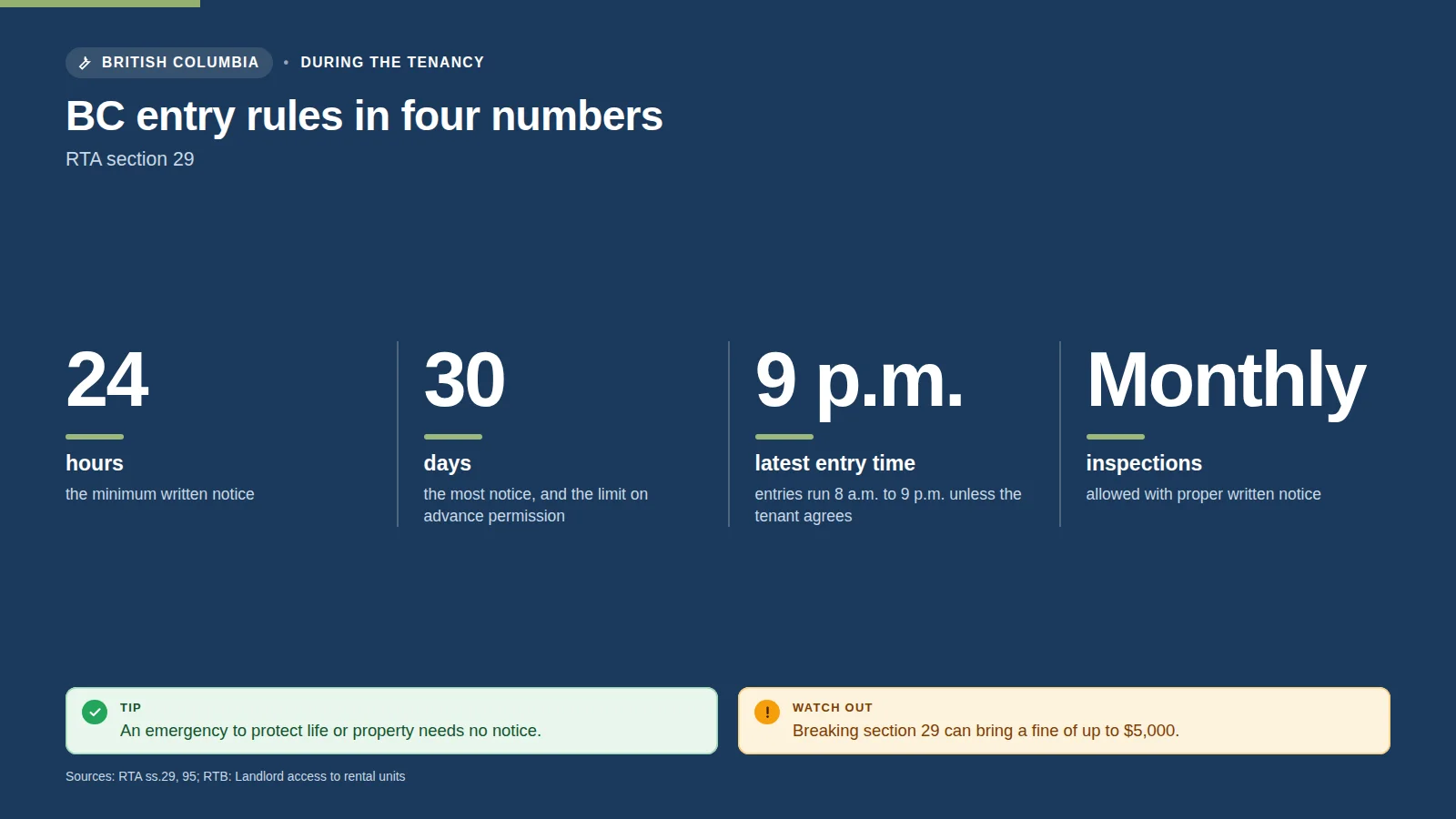
Section 29 of the Residential Tenancy Act (RTA) says a landlord must not enter a rental unit for any purpose unless one of these applies:
- Permission. The tenant gives permission at the time of entry, or not more than 30 days before it.
- Written notice. At least 24 hours and not more than 30 days before the entry, the landlord gives the tenant written notice stating a reasonable purpose and the date and time of entry, between 8 a.m. and 9 p.m. unless the tenant agrees otherwise.
- Housekeeping. The landlord provides housekeeping or related services under a written tenancy agreement, and the entry is for that purpose and follows those terms.
- An RTB order authorizing the entry.
- Abandonment. The tenant has abandoned the unit.
- Emergency. An emergency exists and entry is necessary to protect life or property.
The standard terms printed in every BC tenancy agreement repeat these rules, and add that during the tenancy the unit is the tenant's home, with a right to quiet enjoyment, reasonable privacy and exclusive use. Section 28 of the Act makes quiet enjoyment a legal right.
Monthly inspections
Section 29(2) lets a landlord inspect the unit monthly, with written notice that meets the same rules.
Common areas
The RTB's landlord access page says landlords may enter shared common areas, such as hallways or courtyards, without notice.
The written notice, step by step
What it must say
The notice must be in writing and state:
- The purpose, which must be reasonable.
- The date of entry.
- The time of entry, between 8 a.m. and 9 p.m. unless the tenant agrees otherwise.
The RTB adds that a landlord must also give notice before an authorized third party, such as the landlord's agent, enters on the landlord's behalf.
What counts as a reasonable purpose
RTB Policy Guideline 7 gives examples: inspecting for damage, carrying out repairs, and showing the unit to prospective tenants or buyers. It also warns that a reasonable purpose may lose its reasonableness if it is carried out too often. If a tenant refuses entry for an unreasonable purpose, the guideline says they may deny access, even if the notice was on time.
Timing: count from when the tenant receives it
Guideline 7 says the notice must be served in a way the Act allows, and that the time it takes for a notice to be deemed received must be taken into account when you choose the date and time of entry. In practice, count the 24 hours from when the tenant receives the notice:
| How the notice is given | When it is deemed received |
|---|---|
| Handed to the tenant | Immediately |
| Left in the mailbox or mail slot | The third day after it is left (RTA s.90) |
| Attached to the door | The third day after it is attached (RTA s.90) |
| Mailed | The fifth day after mailing (RTA s.90) |
| Emailed to an address the tenant gave for service | The third day after it is sent (Regulation s.44) |
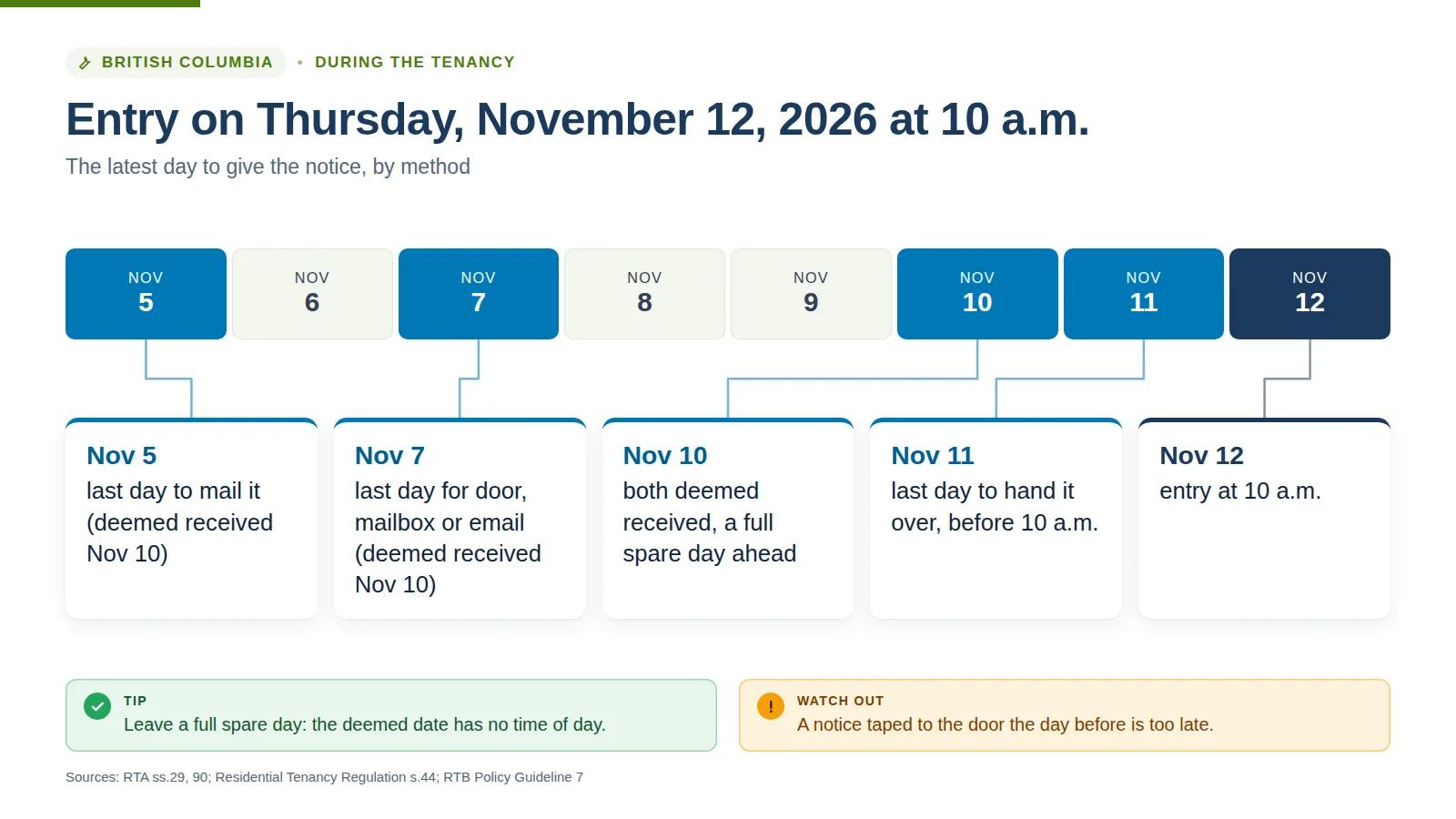
Worked example: entry on Thursday, November 12, 2026 at 10 a.m.
| Method | Give it no later than | Why |
|---|---|---|
| In person | Wednesday, November 11, before 10 a.m. | Received on the spot; 24 hours before entry |
| Door, mailbox or email | Saturday, November 7 | Deemed received Tuesday, November 10, safely more than 24 hours ahead |
| Thursday, November 5 | Deemed received Tuesday, November 10 |
The deemed date does not state a time of day, so this example leaves a full spare day rather than cutting it to the hour. Equally, do not give the notice more than 30 days ahead.
Rights and duties at the door
For tenants
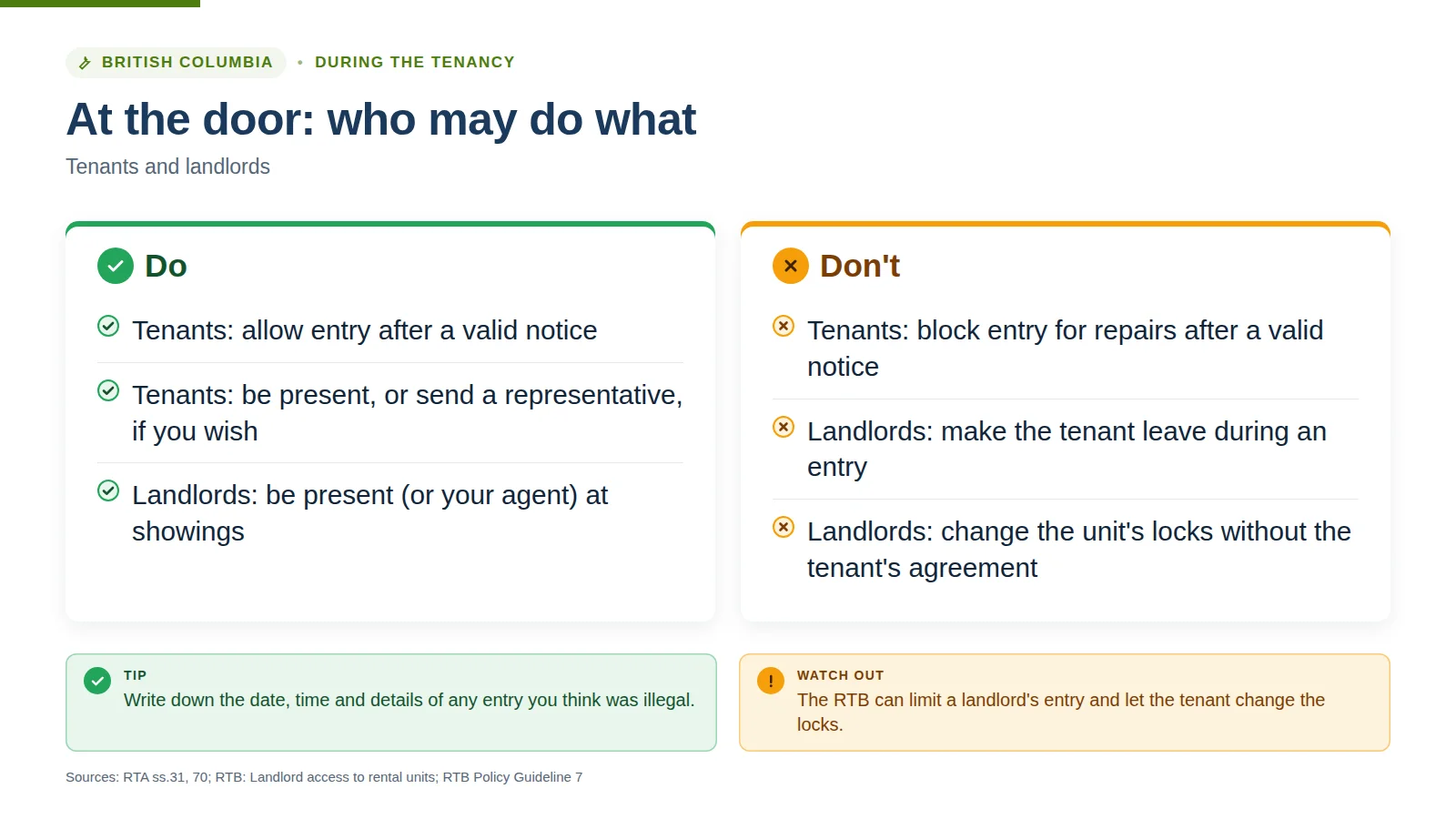
- When a landlord has given proper notice, the RTB says access must be allowed, and you do not have to be home.
- Guideline 7 says you cannot block entry for repairs after a valid notice, even if you are able and willing to do the repair yourself.
- You have the right to be present, or to have a representative present, and the RTB says a landlord cannot make you leave.
- If a landlord enters illegally, the RTB suggests asking them to leave, reminding them of the rules, and writing down the date, time and details. If it continues, apply for dispute resolution.
For landlords
- When showing the unit to buyers or tenants, the RTB says the landlord or their agent must be present.
- You cannot lock a tenant out, even during an eviction. Section 31 says you must not change the locks to a rental unit unless the tenant agrees and gets new keys.
- If a tenant blocks a valid entry, Guideline 7 says you may apply for an order allowing entry at a set time for a set purpose.
Common mistakes
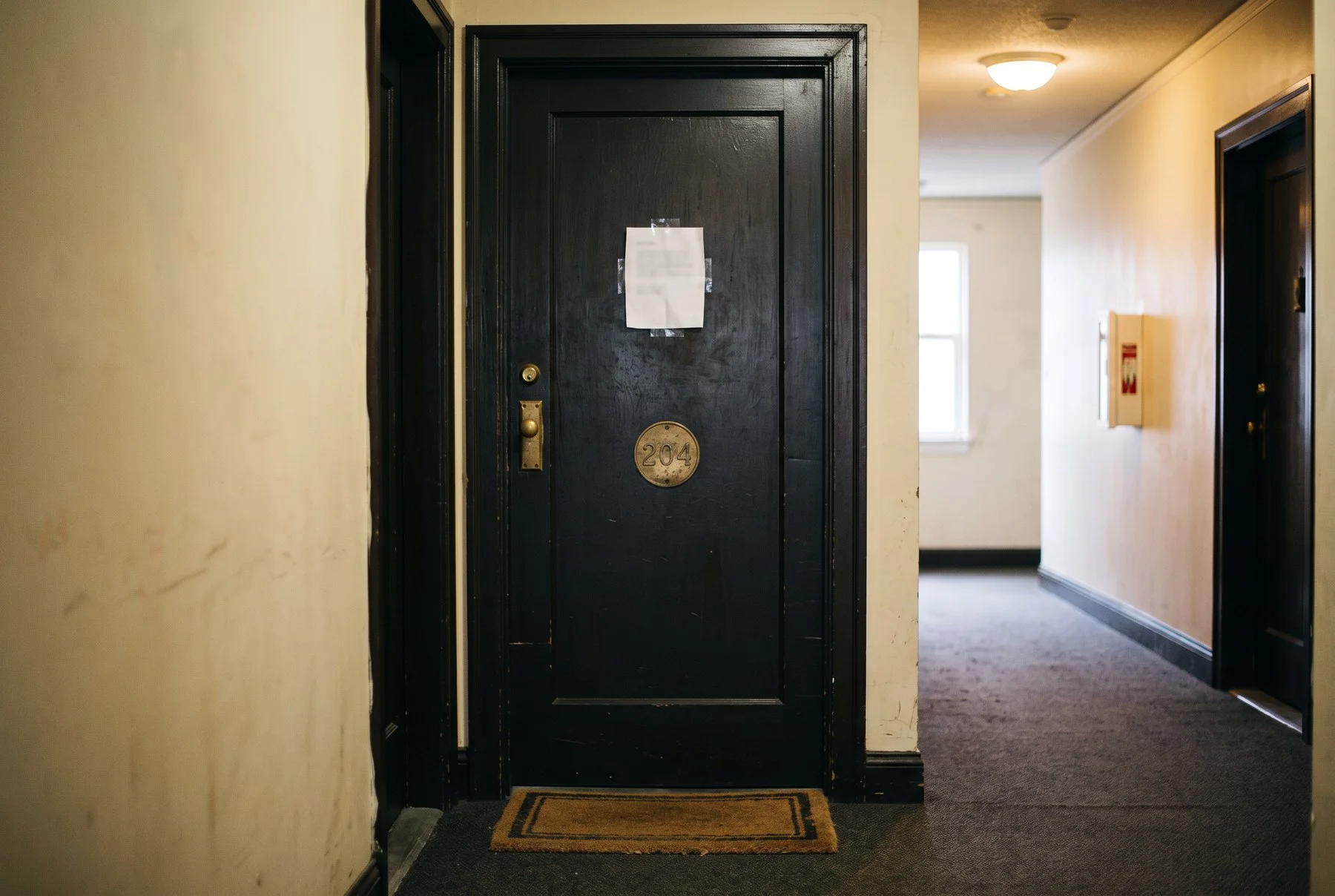
- A verbal or text "heads-up" in place of written notice. Section 29 requires written notice unless the tenant gives permission.
- Taping the notice to the door the day before. A door notice is not deemed received until the third day.
- A time window like "sometime Tuesday." The notice must give the date and time.
- Evening appointments after 9 p.m. Not allowed unless the tenant agrees.
- Back-to-back showings for weeks. Guideline 7 says frequent entries can stop being reasonable, and a tenant can ask the RTB to set conditions.
- Sending a contractor alone without notice. Notice is needed for an agent or third party too.
Doing it at scale
For a manager running inspections or repairs across many units, entry notices are a scheduling job:
- Collect service details up front. Record each tenant's email address for service, if given in writing.
- Batch by building. Plan inspection days at least a week out, so notices can go by email or door with time to spare.
- Use one template. Purpose, date, time (between 8 a.m. and 9 p.m.), unit address and who will attend.
- Log service. For each unit, record the method, the date given and the deemed-receipt date.
- Record the visit. Note who entered, when, and what was done, with photos where relevant.
How Tenon10 helps
For inspections, Tenon10 provides a fillable RTB-27 Condition Inspection Report with a room-by-room grid. Lease, notice and payment records stay together for each tenancy, which gives you an evidence record if access is ever disputed at the RTB. Tenants can submit repair requests with photos and an emergency priority, and you can track every request from the web or the mobile app.
Whatever tools you use, keep a copy of every entry notice and each tenant's service details with the tenancy file, so you can show exactly what was given, how and when.
Frequently asked questions
Can my landlord enter without notice to fix something urgent?
Only in an emergency where entry is necessary to protect life or property, or with your permission at the time. A routine repair needs 24 hours' written notice.
Do I have to be home when the landlord enters?
No. If proper notice was given, you do not have to be present. You have the right to be there if you want.
How often can my landlord inspect?
Section 29(2) allows a monthly inspection with proper written notice. Entries for other reasons must each have a reasonable purpose.
Can a landlord enter for an open house?
Guideline 7 says an arbitrator may find an open house is not a reasonable purpose if the landlord cannot ensure the safety of the tenant's belongings. Showings to individual buyers with notice are a recognized purpose.
BC Landlord Entry Notice Checklist
A checklist for BC landlords and tenants on entry: when a landlord may enter, what the written notice must say, how to time it, and rights at the door.
Get Free PDF →Inspect with a record you can rely on
Use Tenon10's fillable RTB-27 with a room-by-room grid, and keep lease, notice and payment records together.
Built for Canadian landlords and property managers.
Related BC guides
- Serving Documents in BC: Every Method the RTA Allows
- The BC Residential Tenancy Agreement (RTB-1): The Complete Landlord Guide
Sources: Residential Tenancy Act; Residential Tenancy Regulation; RTB: Landlord access to rental units; RTB Policy Guideline 7: Locks and Access. This article is a summary of British Columbia rules as of October 2026, not legal advice. Check the Residential Tenancy Branch for your situation.