To convert US rent to Canadian dollars for your Canadian return, the CRA accepts the Bank of Canada exchange rate for the day each amount was received or paid, or the Bank of Canada annual average rate for amounts like rent that come in throughout the year; whichever rate you choose, use it consistently.
Every figure on your Canadian return has to be in Canadian dollars. Income Tax Folio S5-F4-C1 (¶1.8) explains that subsection 261(2) of the Income Tax Act requires amounts to be determined in Canadian currency. This how-to covers which rate to use for US rent, US expenses, the US tax you paid and the property's cost. The full cross-border picture is in the series pillar, Canadians Who Own a US Rental: The Complete Tax Guide.
Which exchange rates does the CRA accept?
The CRA's starting point is the Bank of Canada rate for the day of the transaction. The folio's guidance, paragraph by paragraph:
| Rate | What the CRA says | Best used for |
|---|---|---|
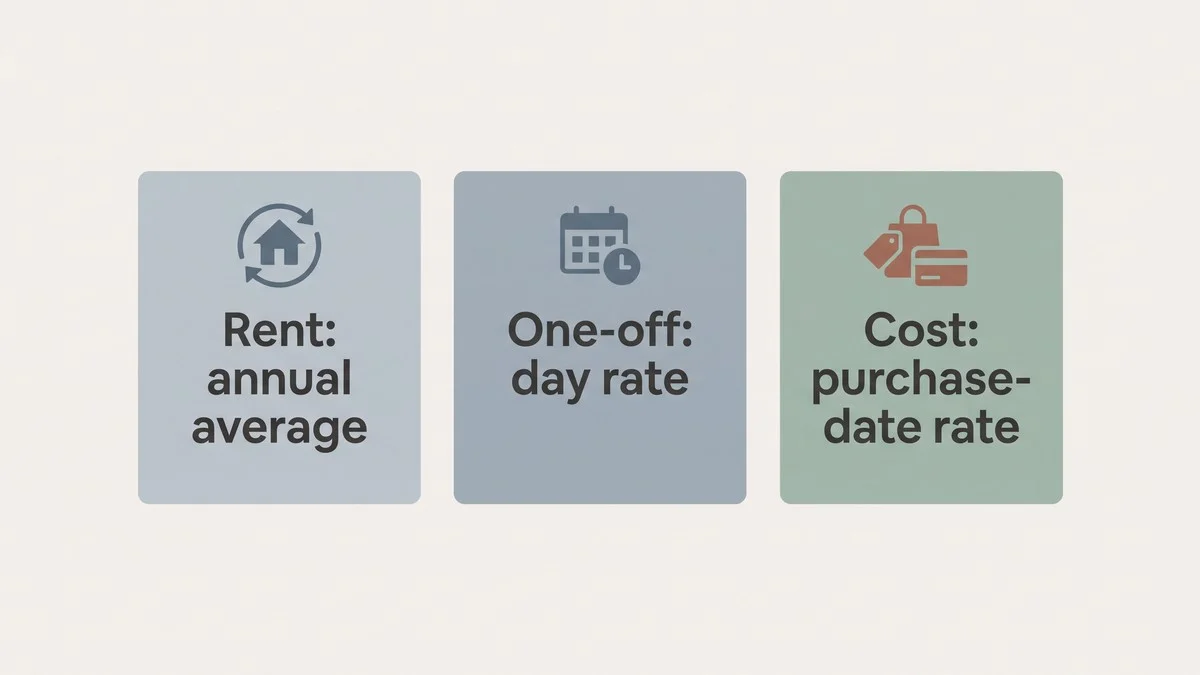
| Bank of Canada rate for the day | The spot rate is generally the Bank of Canada exchange rate for that day (S5-F4-C1 ¶1.4) | One-off amounts: a repair, an annual property tax bill, a purchase or a sale |
| Bank of Canada annual average | An average rate may be accepted for certain income items, but generally not when rates fluctuate significantly (¶1.6.1); the CRA's line 40500 page also allows the average annual rate for income paid throughout the year | Monthly rent and other recurring amounts |
| Another recognised source | Rates from sources such as Bloomberg, Thomson Reuters or OANDA may be accepted if the folio's conditions are met and the source is used consistently (¶1.6) | Owners whose records already use one of these sources |
For reference, the Bank of Canada annual average exchange rates for the US dollar were 1.3698 for 2024 and 1.3978 for 2025.
What do you need before you convert?

- A list of every US-dollar receipt and payment for the year, with its date. Your property manager's statements or your US bank statements are the usual source.
- The Bank of Canada annual average for the tax year, and the daily rate for each one-off amount.
- The purchase date and US-dollar cost of the property, for its cost and for capital cost allowance.
- Your US return or withholding statements, for the US tax figure.
How do you convert a year of US rent and expenses, step by step?
- Sort the year into recurring and one-off amounts. Rent and monthly mortgage interest recur; a roof repair or an annual tax bill does not.
- Convert recurring amounts at the annual average. Total them in US dollars and multiply by the year's Bank of Canada average.
- Convert one-off amounts at the rate for the day. Look up the Bank of Canada rate for the date you paid.
- Convert the property's cost at the purchase-date rate. The CRA's T1135 guidance uses the rate in effect when the property was purchased, and that historical cost does not move with later exchange rates.
- Convert the US tax on the same footing as the income. The CRA's foreign tax credit folio, S5-F2-C1 (¶1.42), deals with converting foreign tax, and the line 40500 page allows the day rate or the annual average.
- Enter the Canadian-dollar totals on your T776 and keep the working with your records.
Worked example (illustrative figures only)
A Canadian owner's 2025 US rental, using the 2025 Bank of Canada average of 1.3978 for recurring amounts and assumed day rates for the one-off ones:
| Item | US$ | Rate | C$ |
|---|---|---|---|
| Rent, US$2,000 a month | 24,000 | 1.3978 (annual average) | 33,547 |
| Mortgage interest, US$600 a month | (7,200) | 1.3978 (annual average) | (10,064) |
| Property tax, paid once | (4,200) | suppose 1.40 on the day | (5,880) |
| Repair, paid once | (1,500) | suppose 1.36 on the day | (2,040) |
| Net rental income | 11,100 | 15,563 |
Notice the net figure is not simply US$11,100 at one rate: each line carries its own rate, which is the point of converting item by item.
When are the figures due?
| What | Date | Source |
|---|---|---|
| Canadian return for 2025 (most individuals) | April 30, 2026 | CRA important dates |
| Canadian return if you or your spouse are self-employed | June 15, 2026 (any balance owing still due April 30) | CRA important dates |
| US Form 1040-NR with no US wages | June 15, 2026 | IRS Publication 519 |
| Form T1135, if required | With your Canadian return | CRA T1135 guidance |
What are the common conversion mistakes?
- Using today's rate for an old purchase. The property's cost stays at the purchase-date rate.
- Averaging a one-off payment. The average is for amounts spread over the year, and ¶1.6.1 warns it is generally not appropriate when rates swing sharply.
- Switching sources year to year to pick the friendlier number.
- Using your bank's card rate. What the bank charged you to convert is not the rate the folio describes.
- No working papers. Our landlord bookkeeping guide and year-end tax checklist cover what to keep.
Frequently asked questions
Can I use the annual average for everything?
Not safely. The CRA's line 40500 page allows the average for income paid throughout the year, and the folio says an average may be accepted for certain income items. A single large payment is better converted at the rate for its day.
Which rate do I use for the US tax I paid?
The CRA's line 40500 page allows the Bank of Canada rate on the day the tax was paid, or the annual average when it was paid throughout the year. Using the same basis as the related rent keeps the foreign tax credit working consistent.
Do I convert my US return the same way?
No. Your US return stays in US dollars. Conversion applies only to the figures you put on your Canadian return.
What rate do I use when I sell?
The proceeds at the rate for the sale date, and the cost at the rate for the purchase date, each on its own day per ¶1.4.
Get your rental numbers ready to file
Free guides and checklists for Canadian landlords
Free • No signup required