A civil enforcement agency eviction is the only lawful eviction in Alberta: only an agency can remove an occupant, and only under an order for recovery of possession that has been served on the tenant and proven by an affidavit of service filed in the Court of King's Bench. The landlord hires the agency; the landlord never removes the tenant personally.
This article picks up where the order starts. How a landlord gets one, from the RTDRS or the court, is in RTDRS explained and RTDRS or court.
Who carries out an eviction in Alberta?
A civil enforcement agency, acting through its bailiffs, is the only body the Residential Tenancies Act authorizes to evict an occupant from residential premises (RTA s.34.1). Every order for recovery of possession must include a statement that a civil enforcement agency has authority, once the order has been served, to evict any occupant (s.34(b)).
The RTDRS says the same from its side: if a tenant refuses to vacate after an RTDRS order, the applicant must contact a civil enforcement agency to enforce possession (RTDRS hearings and orders).
What has to happen before the agency will act?

An Alberta civil enforcement agency can evict only after it is satisfied of two things, unless the court orders otherwise (RTA s.34.1(b)):
- the order has been served on the tenant (or, where a non-tenant occupant is involved under s.33, on that person and the tenant); and
- the person holding the order has filed an affidavit of service in the Court of King's Bench.
For an RTDRS order there is a step before that. The order must be filed at the Court of King's Bench so it can be enforced as a judgment of that court, either by the RTDRS or by the applicant, and the applicant must then serve a filed copy on the respondent (RTDRS hearings and orders).
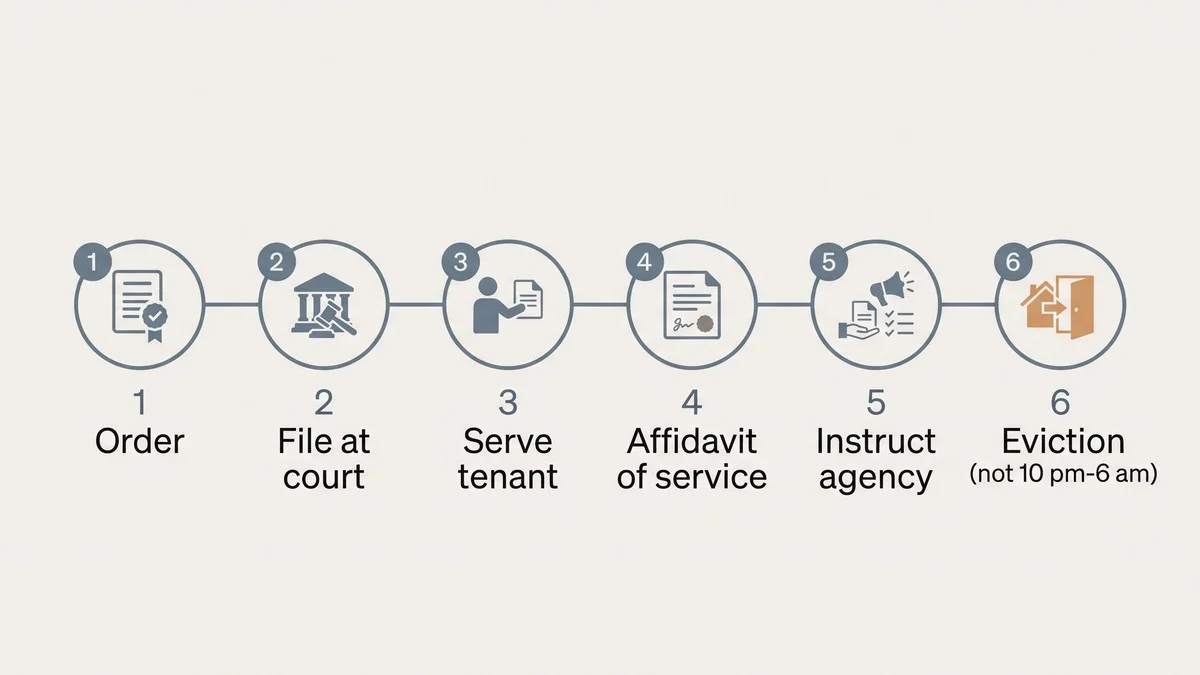
| Step | Who does it | Source |
|---|---|---|
| Get the order for recovery of possession | Landlord applies to RTDRS or court | RTA s.26 |
| File an RTDRS order at the Court of King's Bench | RTDRS or the applicant | RTDRS orders page |
| Serve the (filed) order on the tenant | Landlord | RTA s.34(c), s.57 |
| File the affidavit of service | Landlord | RTA s.34.1(b)(ii) |
| Instruct a civil enforcement agency | Landlord | RTDRS orders page |
| Eviction by the agency | Agency's bailiff | RTA s.34.1 |
How does the order set the move-out date?
An order for recovery of possession must direct the tenant to give up possession by a specified date, or within a specified time after the order is served (RTA s.34(a)). It may be served by any method in section 57 (personally or by registered mail, and in limited cases on an adult who lives there or by posting) or in another way the court directs (s.34(c)). Our guide to ending a tenancy in Alberta covers the notices that come before the order.
What if the order lets the tenant stay while paying?
Some orders are conditional: they set dates and amounts of payment, and the tenant keeps possession while paying. If a stayed order is not followed, it cannot be enforced, unless the court orders otherwise, until a notice of default has been served on the tenant (RTA s.35). The RTDRS links its Notice of Default form from the orders page; after that, the landlord can enforce at the Court of King's Bench and contact an agency for possession.
What happens on eviction day?
A bailiff from the agency attends and removes the occupants, and the landlord takes back possession. Three rules in the Civil Enforcement Regulation shape the day (AR 276/95):
- Hours. Unless the court orders otherwise, an agency may not carry out an eviction at a residence between 10 p.m. and 6 a.m. (s.8(1)).
- Fees. An agency may charge only the fees in the tariff it has filed with the sheriff (s.6). The landlord, as the instructing creditor, deals with the agency and receives its statement of account.
- Report. After an eviction or attempt, the bailiff completes a Bailiff's Report and gives the instructing creditor a copy (s.7).
What happens to belongings left behind?
Goods left by a tenant who has vacated after the tenancy ended are "abandoned goods" under RTA s.31, and the landlord must deal with them by the rules for value, storage and sale in that section. Our guide to belongings left behind and the $2,000 rule walks through them.
Frequently asked questions
Can the police evict a tenant in Alberta?
The Residential Tenancies Act gives eviction authority to a civil enforcement agency acting on an order for recovery of possession (s.34.1). The landlord should instruct an agency rather than expect police to remove a tenant.
Can a landlord evict on the day after an RTDRS hearing?
Not by themselves. The order must be filed at the Court of King's Bench, served on the tenant, and the affidavit of service filed before an agency can act, and the order's own date for giving up possession must have passed.
Can an eviction happen at night?
No. Unless the court orders otherwise, an agency cannot carry out an eviction at a residence between 10 p.m. and 6 a.m. (Civil Enforcement Regulation s.8(1)).
Who pays the civil enforcement agency?
The landlord instructs the agency and receives its statement of account. The agency may charge only the fees in the tariff it filed with the sheriff, and an enforcement debtor can ask a review officer to review the account within 6 months of receiving it (s.6.1).
What if the tenant was on a payment plan in the order?
If the order was stayed while payments were made, the landlord must first serve a notice of default after a missed payment, unless the court orders otherwise (RTA s.35).
Preparing the notice that comes before an order?
Browse Alberta's tenancy notices, fill them out online and download the PDF.
Free • No signup required