Smoke alarm rules for Alberta rentals come from the province's Minimum Housing and Health Standards: smoke alarms must be installed between each sleeping area and the rest of the suite, in the hallway where a hallway serves the bedrooms, and must be operational and in good repair at all times (M.O. 57/2012, s.12). Landlords must meet those standards under the Residential Tenancies Act (s.16(c)).
At a glance
- Where: between each sleeping area and the rest of the suite; in the hallway that serves the bedrooms (MHHS s.12).
- Condition: operational and in good repair at all times (MHHS s.12(a)).
- What counts: a combined smoke detector and audible alarm (MHHS Definitions).
- Who enforces: public health inspectors, on inspection or complaint (MHHS Introduction).
- Access: 24 hours' written notice to enter for repairs or inspection (RTA s.23).
With the heating season starting, it is a good week to test every alarm. For the rest of the standards a rental must meet, see Repairs and Minimum Housing Standards for Alberta Rentals.
Alberta Rental Smoke Alarm Checklist
Placement, testing and access under the Minimum Housing and Health Standards s.12 and the RTA.
Get Free PDF →Where must smoke alarms go in an Alberta rental?
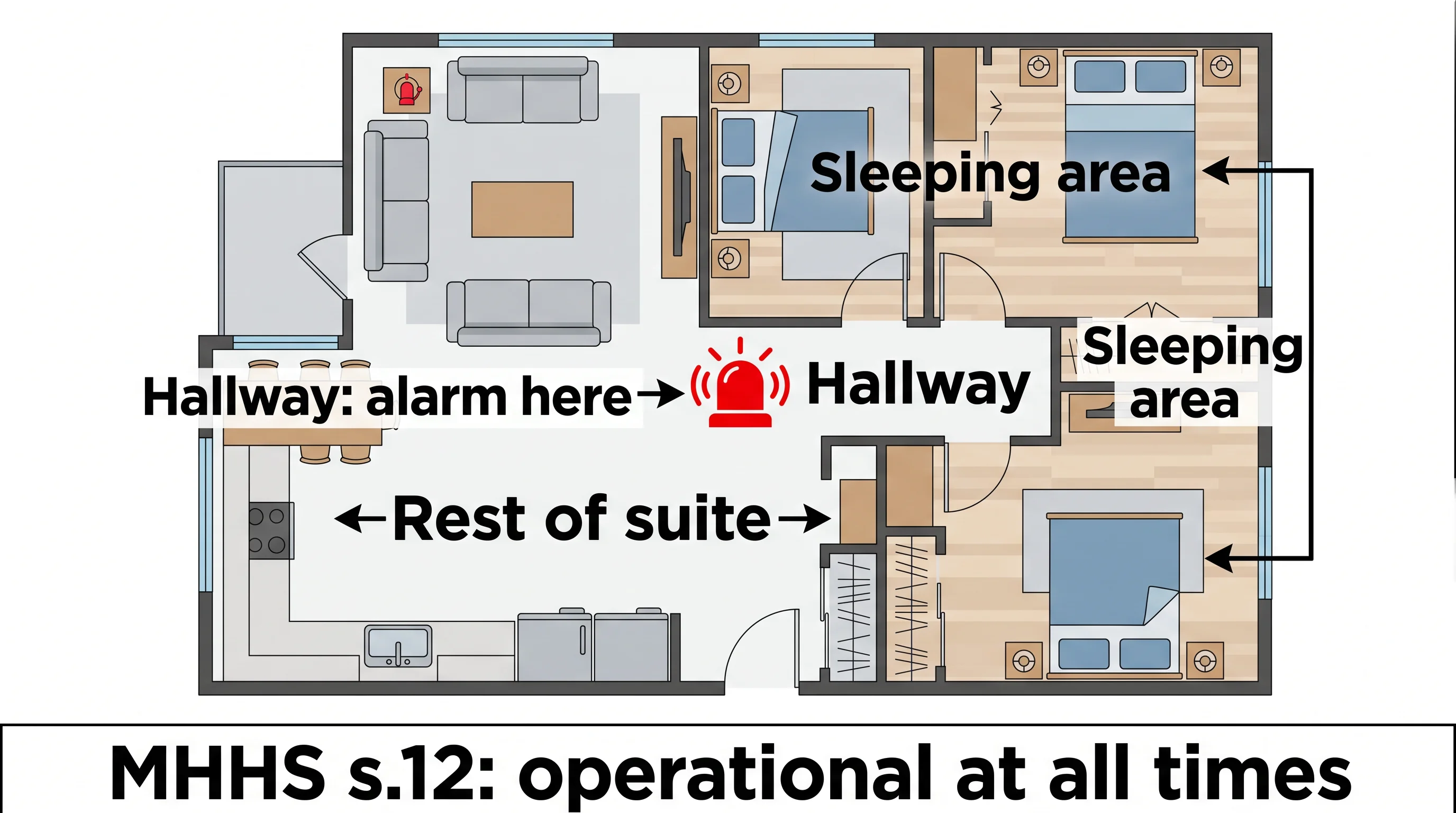
In an Alberta rental, a smoke alarm must sit between each sleeping area and the remainder of the suite, and where a hallway serves the sleeping areas, the alarm goes in that hallway (MHHS s.12). A suite with bedrooms at both ends of the unit may need more than one alarm to meet that wording. A basement suite with its own bedrooms needs its own alarm placement too.
The standard defines a smoke alarm as a combined smoke detector and audible alarm designed to sound within the room or suite where it is located when it detects smoke. A heat detector or a disconnected unit does not meet that definition.
Who has to keep the alarms working?
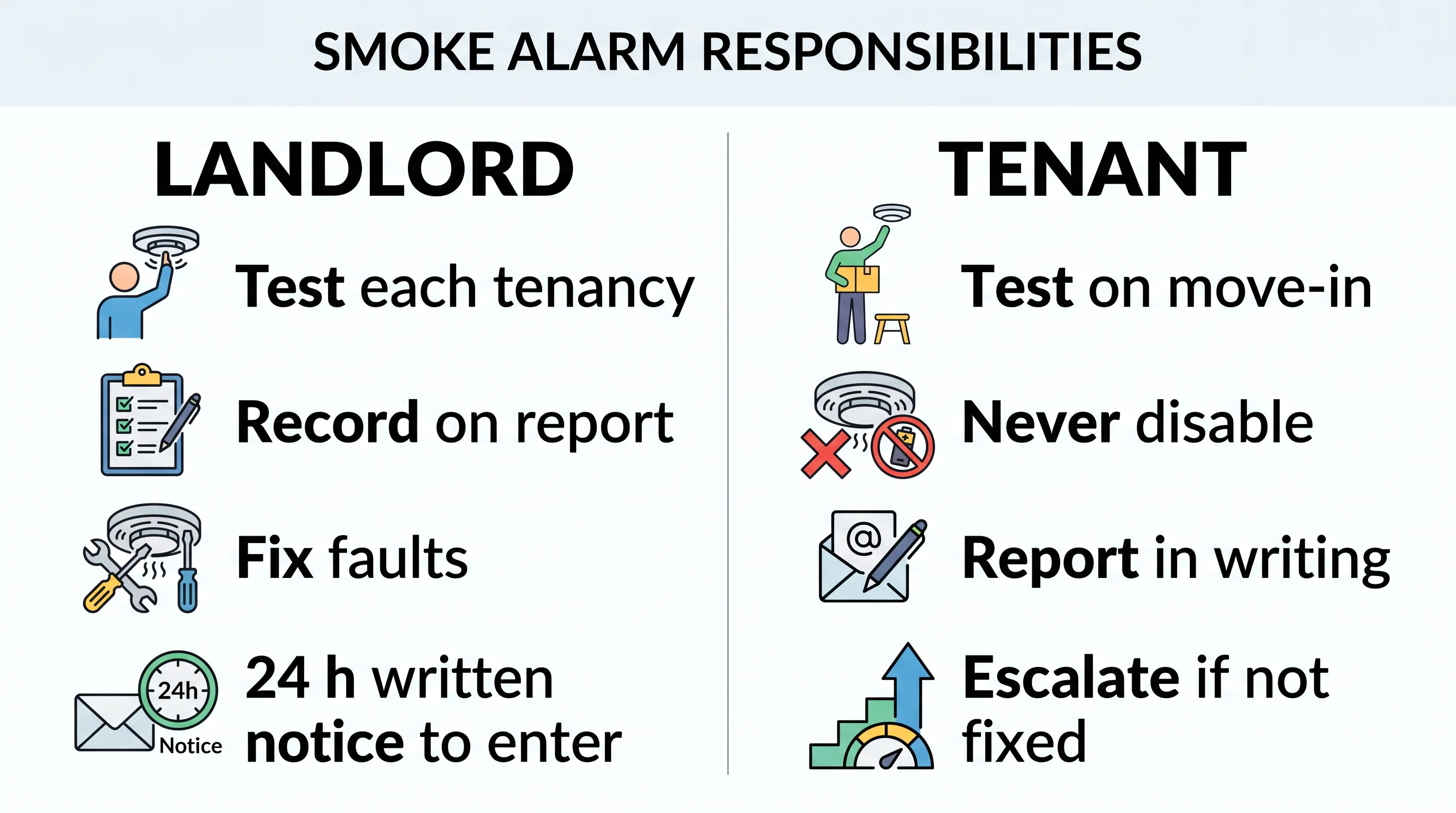
The owner. The standards are the owner's obligation, and the Residential Tenancies Act makes meeting them a landlord covenant in every tenancy (s.16(c)). The rule is "operational and in good repair at all times", so a dead battery or a missing alarm is a breach of the standard until it is fixed.
Tenants play a part. A tenant must not endanger people or property in the premises (RTA s.21(d)), which is a reason never to remove a battery or cover an alarm. Tell the landlord in writing as soon as an alarm chirps, fails a test or is missing.
Landlord smoke alarm checklist
- Map the suite. Mark every sleeping area and the hallway serving it; confirm an alarm sits between each one and the rest of the suite.
- Test every alarm before each tenancy and at each inspection, following the manufacturer's instructions.
- Check the date on each unit and replace any alarm the manufacturer says has reached the end of its life.
- Record it. Note "smoke alarm tested: working" on the move-in inspection report, which you keep for 3 years (RTA s.19(6)).
- Fix reports fast. A tenant's message that an alarm is not working is a repair under s.16(c).
- Give notice to enter. For a routine check or repair, serve written, signed notice at least 24 hours ahead, stating the reason and a time between 8 a.m. and 8 p.m., not on a holiday (s.23(3)-(5)).
Tenant smoke alarm checklist
- Find each alarm on move-in day and press the test button with the landlord present.
- Write it on the inspection report if an alarm is missing or fails.
- Never disable an alarm, even when cooking sets it off.
- Report a chirp or failure in writing and keep a copy.
- Escalate if nothing happens. Contact public health, which enforces the standards, or apply to RTDRS or a court for a remedy such as abatement or the cost of doing the landlord's obligation (s.37). A landlord may not retaliate for a complaint (s.25).
Frequently asked questions
Does every bedroom in an Alberta rental need its own smoke alarm?
The housing standard does not say every bedroom. It requires an alarm between each sleeping area and the rest of the suite, in the hallway where one serves the bedrooms (MHHS s.12). Other codes may apply to construction and renovations; ask your municipality.
Who pays for a replacement alarm?
The owner, because keeping the alarm operational is the owner's duty under the standard. If a tenant damaged it, the landlord can claim the cost from the tenant.
Can my landlord enter to test the alarms?
Yes, with 24 hours' written notice for an inspection or repair (RTA s.23(3)-(4)). In an emergency, such as an alarm sounding with no one home, the landlord may enter without notice (s.23(2)).
Are hard-wired alarms required?
The housing standard does not say. It requires a working combined detector and alarm. Wiring rules come from the building code that applied when the home was built or renovated.
Next steps
Test the alarms this week, note the result, and fix any gap before winter. Related reading: Winterizing an Alberta rental, the 22 °C heat rule and the Alberta inspection report rules. Tenon10 runs move-in and move-out inspection reports, so each test is on the record.
Alberta Rental Smoke Alarm Checklist
Placement, testing and access under the Minimum Housing and Health Standards s.12 and the RTA.
Get Free PDF →Put every alarm test on the record
Run Alberta move-in and move-out inspection reports and keep them with the lease.
Free • No signup required